Author: Stephanie Suh

  • ‘Bitter Orange’, by Claire Fuller – review

    Bitter OrangeBitter Orange by Claire Fuller

    My rating: 5 of 5 stars

    Bitter Orange by Claire Fuller is a curious case study of a woman named Frances Jellico, masquerading as a fictitious memoir laced with escapism, voyeurism, narcissism, and eroticism, all glowing in the radiant color orange smothered by the shadow of forced guilt, self-loathing, and disorientation. Frances’s narrative is, however, far from being namby-pamby, importuning the reader with her litany of her woeful life. Rather, it is her remonstration of her failed dreams, rejected desires, and unfulfilled purposes with the world she believes has always turned its back against her in the most callous way. Her only revenge for the betraying world is her death, which bestows upon her the kind of liberty she wanted to purchase in one hot summer in an idyllic English suburb twenty years ago. It’s a mad, bad, and sad drama of Frances through which Fuller plays the last swan song of a deeply troubled woman in emotional distress with her masterful storytelling skills.

    Written in the first person narrative, the reader will directly glimpse into the inner world of Frances whose days are numbered without superabundance of mawkish sentiments. In fact, it echoes Edgar Allen Poe’s “The Tell-tale Heart” in a way that  exudes a momentum of gushing stream of consciousness of a narrator that feels a combination of anger and dismay, sorrow and loneliness, and illusion and paranoia. That feeling of abstract emotions becomes physical by the witchcraft of Fuller’s atmospheric descriptions of scenes and rich dialogues. Fuller does a beautifully nuanced job of capturing all the conflicting emotions that put you in trance, carrying you over to the psych of the other.

    In comparison with Dora, the subject of Sigmund Freud’s case study of hysteria, Frances’s dilemma is more existential, more corporeal, and more noogenic in terms of the cause and the nature of her Uber-Angst. To diagnose Frances’s symptoms as a typical case of female hysteria commonly associated with a timid, introverted middle-aged virginal woman does a disservice to the woman who struggled to right the ship of her drifting life all alone. IT goes against the grain to dismiss France’s story as a mere dalliance with a hedonistic couple named Cara and Peter during her brief sojourn or a pitiful attempt to break free from her socially gawky, ill-fitted rotund virginal self at the expense of her naivety. France’s narrative attests a sense of disorientation of her life without a clear vista of purpose in her life due to the lingering influence of her dead gloomy, domineering, sordid mother who bound her entire being under the rigidity of religion and morality.

    Subsequently, Frances suffers from noogenic neuroses, neither pathological not pathogenic of origin, but of existential distress. In other words, Frances is not a basket case, but a human derelict adrift on a sea of life, brutally defenestrated from the comforting mooring of loving relationship and social connections by her also neurotic mother who blamed her daughter for almost anything. No wonder Frances associates her rotund appearance with her weight of guilt that is in fact nothing but her delusional imago forced upon her. In this regard, France’s narrative outstrips Freud’s Dora case with far more in-depth interior monologue of the narrator endowed with high intellect, impressible curiosities for life, and unyielding desire of being connected with the world outside herself.

    Fuller is a riveting writer of dialogue and scenes, all the artistry in the marks upon the page after page, wielding a pen across the pages in an expense of her boundless imagination that seems wholly realistic and ingeniously creative, producing aesthetically sensuous ambiance of the story, as if she were painting a Renaissance triptych featuring three naked adults making furiously and frantically passionate love with one another in an Arcadian English garden tinged with citrus scents of oranges, which likewise symbolize lust, desire, and passion, all flatly denied to Frances in Bitter Reality. And it is in this subtle respect of Frances’s smoldering indignation at such cruel denial of her yearnings only natural to any woman – young and old, pretty and not-so-pretty, smart and not-so-smart – that Fuller’s vivid imaginativeness and keen observation of psyche of characters manifest to the fullest extent and hold the reader’s undivided attention throughout the book with gusto and pleasure that will make you become titillatingly insatiable as you go deeper into this arresting story.

  • Coffee with Bach and Thoreau

    la-patisserie-jean-beraud
    La Patisserie by Jean Beraud

    It was still early when she got to downtown. And it was still an hour early before her day at the office was to start. That feeling of earliness needed to be indulged by the leisure of solitary coffee time at her regular coffeehouse that had lovely outside seating where you could enjoy a capricious respite with a cup of coffee and watch the swing of things, the world in motion, and the parade of the human race. That time was precious time for Julie, and it was to be observed religiously  in a way the Vestal Virgins guarded the sacred fire in the temple lest it should die out, as that would mean the peril of the Eternal City. The aroma of freshly brewed hazelnut coffee could do so many wonders, and one of them is vitalizing your listless, half-awaken stupor under which you would find yourself an unconscious somnambulist or a peevish whiner. This rhapsody of morning coffee is also testified by a testimonial of Johann Sebastian Bach, the father of Baroque music, who described himself as a “roast goat” without having a cup of sensuously aromatic coffee in the morning.

    Julie, as a faithful myrmidon of the power of wonder beverage, got her first morning hazelnut coffee and placed herself in the corner of her regular coffeeshop to set her cognitive functionality for a work day in motion by reading her subscription on Kindle Fire and writing down some notes from the reading. In fact, there was a set of rules of reading Julie adhered to: reading hardcopies on her commuter train and Kindle in coffee-shops because she found such modus operandi of reading quite congenital to her mental exercise. So there she was, doing what she always did, unless otherwise there was anything else that called for her urgent attention to attend before her work hours began. Then when her silver pocket watch indicated twenty minutes to nine, Julie headed for the office. That was how Julie began her normal work days. That was how she began to live another existential everyday.

    That particular morning, which was Friday, was a lucky one, for no exigency was awaiting for her to execute first thing in the morning. Julie was a legal assistant at a litigation firm, where a myriad of pleadings, discoveries, settlements, and confrontations were norms of the trade. And it had been only a week since a happy chance placed her into the position offered by goddess Fortuna, who had finally countenanced her new future on the frontier. Yes, it was a frontier, a new land of unyielding dreams, high hopes, and exciting desires that Julie had felt deprived of in that grey, grim land by the Atlantic Ocean. Even Henry David Thoreau attested such tenebrous somberness of the ocean as a Sea of the Old Habits and Constraints that bound people in the Memory of their aborted wishes and crushed ambitions and encouraged them to migrate to the Elysian Fields by the Pacific Ocean, which he romantically compared to the River of Lethe in his poetic pathos. Reader, you might think it as a humbug or even a jest in your most postmodern mode of thinking in the ethos of textual parallax thriving on non-platform media. But when you become known that our life is still woven by the Fates under the supervision of Fortuna and that you are made of spirit, fire, and dew, you will swivel your head in wonderment in recognition of Thoreau’s poetic perspective on the Exodus to a New Land where nature is all the more conspicuous by the relative absence of the Gothic skyline that rudely dominates the vault of heaven on the Other Side of the Continent. Julie knew it all, and that was why she wanted to start anew in the West, where the Lethe of the Pacific flew, where the rugged hills and primitive mountains setting against the deep blue ocean still maintained the rustic charm of a village maiden.

    저장

  • Colony of Time

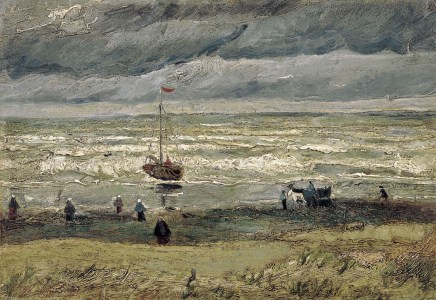
    160930092313-vincent-van-gogh-stolen-painting-sea-at-scheveningen
    View of the Sea at Scheveningen by Vincent Van Gogh

    Rapacious Time feasts on all things
    Commandeers it all within his reign,
    Ousts everything from its primeval place.
    Nothing is granted for long to remain.

  • Morning Train

    15624886771_c2ecc92688_b

    She should have caught the first-morning train to the city instead of debauching her first cigarette of the day upon her arrival on the platform. She knew smoking as the first thing in the morning wasn’t the most salubrious thing to do, but she had to. It was her way of relieving her mind of its cares, anesthetizing her strains of everyday life for the moment of her sybaritic indulgence, which was the only hedonistic practice Julie insisted on keeping because no other things were permitted to her, literally, apart from all the virtuous and sensuous delights of all human creatures that denied her access. That’s probably a pathetically lame excuse for smoking, and the militantly health-conscious, priggish, and principled public would love to lambast her and her smoking habit not because they really care about her health but because they just do it since anti-smoking is now the ethos of this ostensibly egalitarian era, the zeitgeist of New Social Totalitarianism that dictates Social Science Model Behaviors. And although Julie was never a forceful character, she was a free spirit with proud individuality, declaiming against the mob psychology that was grounded on suitably fashionable stance for demotic mores. She defied it in her own way, in her own solipsistic way.

    The act of smoking could be conceived as one of the most highly advanced forms of humankind ever since the dawn of civilization when Prometheus, an ingenious and recalcitrant Titan, a fashioned man out of clay and water, and then stole sacred fire for mankind to kindle civilization. In this regard, manipulating fire in the ritualistic process of lighting a cigarette and emitting smoke from it can be regarded as a sacred ritualistic performance to pay homage to the benefactor of civilization. Also, Ahura Mazda, a lord of heaven and light and the only true god of the prototype of Judaism, Christianity, and Islam – Zarathustra, aka Zoroaster by the Greeks, was manifested in the form of Sacred Fire, symbolizing Purity, Illumination, Warmth, Enlightenment, and the Zeal. And there were also the Vestal Virgins, the ancient Roman priestesses who kept the celestial fire of Hestia, the virgin goddess of the hearth, home, and domesticity.

    Like the tortured thinker Kierkegaard anguishing over his existential conflicts caught between actions and religion, Julie was wretched in this world of collapsed grand narratives, fake news, volatile subjective opinions, hypocritical truths, and inflated egos, all fallen apart and adrift on a sea of the postmodernist detritus. What are am I in now? Is humankind really progressing for betterment or gearing up for its own destruction?

    According to the ancient Greek peasant/poet Hesiod, known for didactic elements in his poems, there are Five Ages of Mankind: the first one is a “Golden Age,” governed by the Titans, the first generation of Greek mythology, where no words for sickness, war, and discord existed. You see, the Titans were alright for humans although their own children raised war against their parents, even castrating Uranos, the first ruler of the universe, the sky, Titan of Titans; the second one is a “Silver Age,” a reign of Zeus and the Olympians who were very much like us in temperament and characters with the exception of supernatural endowments of immortality, talents, and beauty (but not in the case of Hephaestus, the lame and ugly god of fire and blacksmith, and the husband of Aphrodite). Humans lived only 100 years, most of which was suspended in childhood, consequently making them sophomoric, childish, and disputatious; then came a “Bronze Age,” chockablock with warriors and more warriors spending their time in the office of war and conflict; the next “Heroic Age” was a modified version of Bronze Age in the sense that the characters of war were tinctured with noble and epic elements as in the case of Homer’s “Trojan War” in which Hector, a Trojan prince and the greatest warrior and Achilles, the Greek version of Hector, Odyssey, the timeless voyager, and Aeneas, a Trojan refuge who later founded Rome, the ancestor of the feral brothers Romulus and Remus; and the last and the lasting one is the “Iron Age,” in which we all live now. Hesiod might have foreseen where we are now in his poet’s eye; it’s a world of vehement contenders vying for the sponsorship and the possession of the beautiful, the powerful, the fortunate,… THE FITTEST. It’s a world of social Spencerism that yoked Darwinian evolutionism into philosophy to champion eugenics. And what will be the next age be like? Julie was curious, but then she was soon past caring because she wouldn’t live to tell anyway.

    All of the aforesaid musing triggered by her smoking kept her occupied while waiting for the next train to the city. Julie looked around her at the station that began to be full of another batch of commuters, more men than women at a glance. Funny, Julie thought. Are there more men working in the city than women in this town? Or is it because there are just more men than women in this town? Anyway, the men looked just average without distinguishing outward appearances. Julie knew that beauty was only skin deep, but being a highly aesthetically person, she could not help but observe physiognomies of whoever she saw in view. As a matter of fact, even the intellectual like Francis Bacon also took a person’s physiognomy into consideration that he even rationalized phrenology, a divinity by shapes of skulls. And then there was Karl Lagerfeld who realized that the look was what others made interested in your soul.

    Woe betides anyone who would disagree with this dictum of our time, for she or he would be a downright hypocrite! The human faculty is instinctive, sentient, and physical. Beauty is an essential objective of intelligence that calls a beholder’s attention to the other elements of its possessor in the sense that the poster of a movie gathers spectators to the doors of the movie theater.

    Moreover, Julie could see what others could not see or decided to ignore because it’s regarded as a trifle. Her sense, sensitivity, and sensibility were extraordinary to the point of exquisite uncanniness. Then, she jeered at the thought and dismissed it as hocus-pocus, all jumbled up with meaningless bits of harebrained abracadabra in a shambolic array of grim masks that languished with faint tweaking in the left corners of their lips. That was another way of visceral escapism she sometimes took to bring herself to a different place from the rabble that seemed to belittle her nondescript exotic existence that didn’t fit their circle, their legion of the beauty. That’s the existential issues Julie had to face every day – an acute sense of isolation, an unquenchable feeling of rejection, and a sentient awareness of her aloneness… To escape from the excessively dour, namby-pamby sentimentality, Julie looked at the magnificently rustic beauty of mountains and hills outside the moving windows of the train and fell into a reverie of the 19th century Wild West where she as a Pony Express Rider was riding on a rapid mustang across the land to deliver a Letter of Hope to a final station in the city.

    저장

  • Pirate, Writer, and Traitor- on Walter Raleigh

    1_123125_122961_2240504_2273278_101115_poem_sirwalterraleigh.jpg.CROP.original-original
    Sir Walter Raleigh

    The first time I got to know this interesting English notable was through a small paperback compiling vignettes of historical figures in the western civilizations I found from my father’s library. No man stood more gallantly and impressively than this daring figure in the Elizabethan England; it was no less a courtier, writer, and adventurer than Sir Walter Raleigh (1554-1618) himself. The vista of his gentlemanly manner of soaking his cloak for the queen to tread upon in the messy muddy road lingered in my mind. (He was the only man in the queen’s entourage who did not hesitate to do so.) This would generate a possible peal of jeering laughter from many contemporary men and women in the age of insouciant conventions and lax mores. But such gesture of civility, a sign of respect, orderliness, and thoughtfulness, tells a lot about one’s character in the absence of the proliferation of the civic virtue as a result of ignorance, lassitude, and degradation. And based upon this gentlemanly aspect of Raleigh, I have formulated and kept my favorable opinions on him.

    With this as a background of my knowledge of and interest in Raleigh, to come upon the article written by Anna Beer, visiting fellow at University of Oxford, about Raleigh’s years in the Tower of London from the latest edition of BBC History was a kind of nostalgic pleasure, rekindling my first impression on this enigmatic man. In fact, Ms. Beer seems to have viewpoints on Raleigh similar to mine: an explorer (or more precisely, a privateer), a writer, a poet, a courtier, and a gentleman are nominal titles bestowing upon Raleigh. Besides, unlike many other political and historical figures of his time, Raleigh was a dashing, handsome man who would make a fitting character actor for romantic adventure movies or drams, if he were alive. And perhaps it was this physical attractiveness of Raleigh that contributed to his endearment to Queen Elizabeth I, who was offended upon learning that her favorite subject had married discreetly without letting her know in advance. But above all, Raleigh’s prodigious feats of intellect in a spirit of Odyssey were laurels for his distinguishing merits. At the behest of the queen, Raleigh ventured to South America in search of El dorado, directed a settlement of the lost colony of Roanoke in Virginia (even though he himself did not go), ruled the seas by confiscating valuable cargoes carried by Spanish ships (he was also a pirate), and engaged in international trades like a very successful modern businessman. He was in fact flying high under the aegis of Queen Elizabeth I.

    However, after the death of the vestal guardian and benefactor, Raleigh fell out of favor with King James I, who seemed to be hell bent on removing him from the court because of his unyielding individuality, which only the queen knew how to harness to her advantage. So Raleigh was found guilty of treason and incarcerated in the Tower of London on the ground that he and his ilk conspired to dethrone the king. It was groundless, of course, but the king could not wait longer to get rid of him and did not even allow him to retain a lawyer to defend himself. But no such royal counter-intuitive animosity deterred him from expressing his ever unbridled spirit; during his imprisonment in the tower, Raleigh built up a personal library of 500 books, a personal conservatory for drawing on the knowledge of a universal history for his writings, one of which included The History of the World that criticized King James I and his abuse of autocratic power and institutionalized faith. It was a radical kind of thought in his time of England. The recalcitrant subject was surely anathema to the king. Raleigh was beheaded in public in 1618, but even during his execution, he was all man by adhering to his principles without an apology nor a customary reverence toward the king.

    The legacy of this adventurous Elizabethan gentleman continues in his writings that strike the political, religious, and literary chords in our hearts as well as those of the revolutionaries subsequent to his death. For example, Oliver Cromwell was an ardent myrmidon of Raleigh’s writings and even recommended them to his son in earnest. Not only Cromewell championed Raleigh’s political stance but also he reconstructed Raleigh’s dismally pessimistic providentialism, aka Calvin Predestination, based on the futility of all human actions as a result of unavoidable death to an optimism about the potentials of human endeavor under the proper guidance of providence. In addition, Raleigh’s critiques of monarchy and his support of parliament ignited the fuse of insurgencies calling for radical political changes. Surely, Raleigh was not a perfect man with immaculate morality, but he was a man of intellect, courage, confidence, and civility laced with irrepressible individuality whom posterity can look up to, especially in this multifariously convoluted era when so many politicians are just grandstanding from the vantage points of popularity.