Author: Stephanie Suh

  • Existentialism in a nutshell

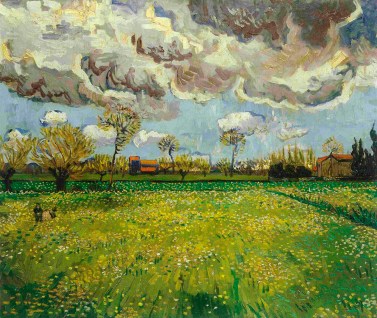
    landscape-under-a-stormy-sky
    Landscape under a stormy sky by Vincent Van Gogh

    Existence precedes
    the secondhand identity;
    Essence follows
    the primary reality.
    Where a fact finds a being,
    Man defines a meaning.


    P.S. The tenet of Sarte’s Existentialism is “Existence precedes Essence.” People love to criticize it because it lays bare to the starkest truth of life, even though they are all aware of it. Man defines himself where he stands in his life vis-a-vis his contemporaries, measuring himself against the burgeoning careers and just moderately settled lifestyles of his peers. I find this school of philosophy applicable to Charles Horton Cooley’s sociological theory of “Looking Glassed Self,” stating that you become what others think you are. Although I do not want to wholly subscribe to either of the thoughts, I can see where these thoughts come from: Human sentience, that is. Our faculty is rather instinctive than reasoning, physical than metaphysical because it reacts to an external stimuli much more than to internal principles of judgment. And I guess the age we are living in now is the apotheosis of sentient modus vivendi in many aspects…

  • Ditto to ‘On Writing’, by Stephen King

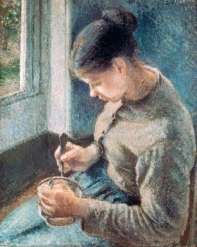
    Camille_Pissarro_-_Flowering_Plum_Tree,_Eragny
    Flowering Plum Tree by Camille Pissarro –

    I have been writing profusely and religiously almost on a daily basis since I created the blog a month ago. I love the process of writing my thoughts and feelings publicly in hope of communicating with the people who can share them and appreciate my writing. Although I don’t have a huge fan base, nor do many people leave comments on my posts, I am not dispirited because even David Hume, the author of Human Understanding received a total lack of recognition upon publication, nor did Athony Trollope’s The Macdermots of Bally Cloran gain any readership. Nary a one bit. What a comfort.

    While reading Stephen King’s On Writing: A Memoir of the Craft, I have been getting many invaluable tips on how to write a story, what to write, and what to possess to write. King’s advice is down to earth, straightforward, honest, and friendly. Also, he is very humble to share his own craftsmanship in reference to his own personal experience which I am greatly appreciative of. Before I read the book, I felt a great distance from the contemporary American writers and their works because they seemed to belong to another world where I could not find myself comfortable with and connected to. However, King with his book On Writing has kindly and warmly invited me to the world of modern American literature and his personal/professional world in a very American way.

    His writing style is precise, perspicuous, scintillating, and personal. There are no belle lettres, no plum words, no grandiloquence, no priggishness, and no platitudes therein. Just a straight story-telling as truthfully as possible. It’s both intellectual and entertaining. Besides, the facts that (1) he went to a state university; (2) he’s not from an affluent or a typical middle class family; (3) his writer wife, who also went to the same university as he did, worked at a Dunkin’ Donuts’ to support their family; and that (4) he plays the rhythm guitar in an amateur rock band consisting of his fellow writers have drawn me closer to appreciate his world of literature, his brilliant creations.

    Furthermore, King seems to have read my mind in regards to my arrested development of writing stories I want the world to read. To write good, I have to read a lot consistently. Also, setting up a writing routine on a daily basis is highly recommendable. He suggests any aspiring writer write at least 500 words per day. So here I am writing this long-forgotten online journal. And the most important thing to keep in mind is that I should not lower my level to expose my writing to any external feedback by publicizing it in expectation of receiving praise or even the smallest comment, unless my writing is complete and reader-friendly after satisfactory re-draft of the original. Besides,  I will not canvass for readership because I don’t want my blog to be tainted by internet marketers of dubious origins and their ilks. In fact, the satisfaction results from writing a story that is honest to myself, that is easy to write about, and that is vivid in telling a story abstracted in my brain. Thus, I have decided to publish my blog post upon thoroughly circumspect review thereof. And I will keep this journal diligently and write a short story per week.

    I will let go of myself in the world of armature writing and see how far I will get to. And if this is not my thing to pursue, then I will toss it to find another avenue in my life. But for now, I will stick to this writing plan.

    *Having done this entry, I have realized 699 words were written! There I go! I have already written a short story of mine!

    P.S. Sir Francis Bacon once said, “Reading makes a full man, conference a ready man, and writing an exact man.” How rightly so.

    The rare equanimity of this Sunday evening (also in celebration of denouement of the senseless Daylight Savings Time in the States) allured me to trace back my bygone days, and hence this entry of my interior monologue I wrote on Tuesday, December 8th, 2015, several days after starting my blog on wordpress.com. I have always liked to write since I could read and write, no matter how amateurish it may be.

    Although I can’t imagine myself earning the bare necessities by means of writing, an act of writing emboldens my otherwise timid self under the aegis of anonymity. Well, I have my name Stephanie Suh manifested as the author of the writings on my blog, but other attributes of mine are protected by stealth, and it will remain so in fear of losing a magical sense of writing as a ghost writer. (Or sometimes, I feel like Artemis, a divine huntress who vehemently protected herself from the leers and jeering of mortals in terms of her fierce guarding of noble independence. ) After all, writing is an act of discovery of a self, ego qua meaningfulness, a search for sense of purpose in life. It’s also a sanctuary, an elbow room of a restive, lost soul on a life sea. It’s also a cultivation of  plants and flowers and trees in your Secret Mind Garden. 
     

  • Thanks from the Author for my review

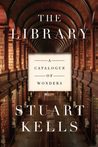
    Mr. Stuart Kells, the author of The library: A catalogue of wonders, liked my review of the book and retweeted it into the bargain! https://t.co/oPrHlE4ian https://twitter.com/pekoya1/status/1059087996761268225?s=17

    This will mark the second time the authors of the books I have read and reviewed liked my reviews and retweeted them on their tweeter accounts with compliments. The first one is from the New York Times bestselling American novelist Chris Bojalian and now Stuart Kells, an eminent Australian historian, writer, and professional book trader.

    Although my blog does not have  a legion of readers like those of many others, recognitions from the great writers remind me of the simple but truthful proverb: “A bird in the hand is worth two in the bush.” What a feeling!

  • ‘The Library: A Catalogue of Wonders’, by Stuart Kells – review

    The Library: A Catalogue of WondersThe Library: A Catalogue of Wonders by Stuart Kells

    My rating: 5 of 5 stars

    Libraries are more than boring stockpiles of books gathered, nondescript depositories of books collected frequented by socially gawky individuals we love to call “nerds” or “misfits.” They are symbolic fortresses of our human cultural progresses as collective enterprises. In fact, libraries are precious repositories of our cultural wealth and knowledge inherited from the forerunners of the Humanities with prescient intentions to preserve the intellectual and spiritual prerogatives of the mankind for the posterity. Any book lover sees this magnificence of libraries, and that is the motif of Stuart Kells’s The Library: A Catalogue of Wonders, a vivacious, jocund presentation of histories and development of libraries and an uplifting rhapsody of bibliophile – love of books. What’s more, this book is not a product of armchair thesis of a library as an anthropological institution, but of an empirically telltale account of cultural, aesthetic, literary, and social phenomena dedicated to preserving the writings of Mankind based on Kells’s actual visitations to the libraries he presents to us.

    To begin with, Stuart Kells wears many hats in this book: a teacher, a guide, a book-collector, a historian, and a confirmed book-lover. But most of all, the image of him as I follow his narrative is that of a cross between a teacher and a tour guide with erudition and bonhomie. Like peripatetic Aristotle communicating to the minds of his students in the ancient Greek Lyseum, Kells invites the reader to saunter with him in his own mental library of snippets from a variety of literature and history that merit their substratum of textual human cultural artifacts bestriding the shelves of the Humanities ranging from the classical to the contemporary, all in the loving and caring custodianship of the author whose love of books is so deep and passionate that it’s almost physical. It’s personal, historical, academical, and magical in a way that imparts a sense of flitting in the phantasmal reverie of the world of libraries, now and then, existing and extinct, and  real and imaginary, to the reader.

    We travel along with Kells playing the role of a likable and knowledgeable cicerone from the Library of Alexandria to the Italian monastery of Bobbio in the Middle Ages that was said to house 666 manuscripts, Germany’s Wuttemberg State Library possessing a 17th century portrait of Vlad Dracul, aka Dracular, and the Abbey Library of Saint Gall, aka St. Gall’s Library, in Switzerland, which is now a UNESCO world cultural heritage site holding more than 400 manuscript volumes produced before the year 1000. And before we know it, Kells also brings us to the fantastic libraries of the famous Hobbits, also known as a race of bibliophile with personal libraries at home, however small the size might be, and the medieval monastery library in Umberto Eco’s The Name of the Rose, where lightheartedness of the atmosphere contributes to the joy of knowledge and the elevation of the mind and soul. Although Kells’s Australian identity tells of the superiority of J.R.R. Tolkien’s Mathom House, a wondrous library of literary paraphernalia, over the Italian Eco’s monastery library, it’s altogether a magical sightseeing of the mystical libraries conjured up before our eyes by the imaginativeness of Kells, and we can decide which of these fantastic libraries appeal to us.

    To conclude, the book is an axiomatic compendium of world’s famous libraries throughout the western civilizations, smartly studded with tidbit information on eccentric librarians, book-collectors/booksellers, and historical figures in between the chapters serving as a kind of delightful intermissions introducing a subject of each new chapter with provocative anecdotes and vignettes, which are pleasingly digressive rests from the tour of the libraries. It’s really a bright book, not a heavy-duty one with lots of footnotes and scholastic priggishness that the reader may expect a book of this subject matter to be. Notably, Kells’s interpretations drew on his impressively eclectic knowledge of these extensive sources as a respectful book-trade historian, but he wears his learning lightly and writes with a general reader in mind. And I believe that just as the famous English poet Samuel Taylor Coleridge often kissed the books of the Dutch philosopher Desiderius Spinoza, out of Kells’s passions for books and possession of the knowledge of multidisciplinary studies comes his love child in the form of this jolly, easy-to-read book.  In the end, the reader will come to love this book for simple, pure pleasure of reading and may kiss the book.

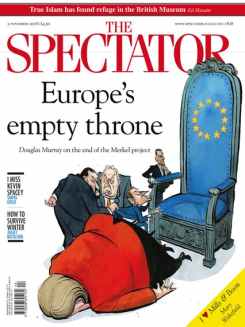
  • The Spectator – review

    cover_20181103_issueAlthough I try not to read a newspaper on a daily basis because it is always fraught with starkly existential horrors of life that rudely bestride a secret garden of my sanity like a herd of barbarians in the ancient forest, I enjoy reading a selection of magazines filled with well-written articles of interesting topics aiming to educate us, the citizens of the world, on the state of affairs around us in order that we may formulate our own views of the world based on the acquisition of the knowledge. In this regard, this historically and intelligently renowned magazine The Spectator epitomizes literary journalism in the most scintillating way that makes reading a magazine at once an enlightening and entertaining experience.
    Established in 1828 (but its actual genesis began way back in 1711 by Addison & Steele.), this magazine is packed full of current affairs, reviews of the Arts, essays, and many more that will pique your attention; they are also surprisingly easy to read without the usual journalistic lingo chockablock with gobbledygook, priggish literary expressions, and biased opinions that are common features of magazines of the similar kind.

    My Caveat emptor for The Spectator is thus: because of its political and cultural leaning toward conservatism, many of the first time readers might feel guarded to hold their due admiration of the fine quality of writing laced with the characteristic British witticism. But don’t let it deter you from enjoying this cracking compendium of our today’s world in a wonderfully intelligent kaleidoscope, which is a truly one-of-a-kind. This magazine provides to you all the knowledge with information rarely found in any other popular contemporary periodicals, especially here in the States where the majority of them are proudly anti-establishment, anti-tradition, and just about all anti-anything civility without meritorious writing styles laced with scintillating witticism that was once wielded by the pens of Mark Twain, Horace Greeley, and Roger Ebert.

    All in all, in reflection of Benjamin Franklin’s timeless sage adage “An investment in knowledge pays the best interest,” it is worth the subscribing to The Spectator. And if you have a Kindle Fire like I do, you will be looking forward to receiving and reading it every week with a kind of expectation you would rarely get from reading just another lackluster periodical.

    P.S. This overview of the magazine was written in response to an email sent by Amazon asking for my customary opinion on it. Hence this review.