Category: Film Review

  • ‘Ocean Waves’ (1993 film) by Tomomi Mochizuki – review

    ocean-waves-49Some stories are better told in animation. The characters become vividly alive in a way that your imaginary world effortlessly conjures up before your very eyes by a witchcraft of wondrous imagination. It’s a world of fantasy, but it is also a realm of parallel universe where reality is poetically translated through the avatars living in the creator’s make-believe world without the alloyed feelings and crafted emotions by way of thespian performance. It also enables the characters to perform feats of wondrous physical motions and a wealth of emotions effectually, which real persons can hardly accomplish. That said, animation as an established genre of performing art deserves of legitimate artistic appreciation and merits its own place in the canon of cinematography.

    “Ocean Waves” a 1993 Japanese anime television film directed by Tomomi Mochizuki and written by Kaori Nakamura based on the 1990 eponymous novel by Saeko Himuro is worth noting the beautiful cinematic qualities and elegant storyline that spreads through the mind and lingers there in alterations so deep that they are felt almost physical. The setting of the film is in the city of Kochi, located on the Japanese island of Shikoku. It tells of the first love developed by Taku Morisaki whose story flashes back to his high school years in Kochi as he catches the sight of a familiar woman whom he has fallen for on the platform opposite at a Tokyo subway station. It’s Rikako Muto, a bright and beautiful new girl transferred to his high school. At that time, Taku did not realize that he was besotted with her. However, as Taku narrates the events that have brought her into his life, Taku comes to know that for all these times, he has been crazy about her. It’s a moment of great awakening of love, an epiphany of adulthood, all in the calm recognition of meaning of love as to see the essence of another human being in the inner most core of who the person is. Taku and Rikako has known their own faults and frailties since they first met in school, and now they see one another’s innermost core of their personalities, which are the essential traits and features of the beloved person to actualize their potentialities in love with awareness and understanding.

    The emotions are elegantly nuanced in the narration, but we know that the feelings are all present in the ways that the characters move and talk. That is the beauty of this animated film that renders no less visual and dramatic effects than other genres of film. Director Mochizuki is a young, ambitious director whose punctilious attention to details and the authenticity of the ambiance and theme of this film speak to our lost days of innocence in this world of collapsed grand narratives, gratuitous sensual expressions and super abundance of raw, unbridled charge of emotions that are hard to be empathetic to the minds of those who are likely to find solace in quietude. Walt Disney said animation offers an effective medium of story-telling and visual entertainment which produces pleasure and story that people of all ages everywhere in the world can enjoy and relate to. For these reasons, this film is worthwhile to be noted.

  • there she goes (BBC drama 2018) – review

    WWPRhFciMS3y8S8vTLb3Tg-1200-80

    Although I am not a parent, I know that parenting is a grand task constant of every age. The ancient Greeks thought that to rear children was a hazardous undertaking and success was won though struggle. In this respect, parenting -like all other our human vicissitudes that life presents to us – can be something of an odyssey packed full of both foreseeable and unforeseeable events tinged with laughs and sighs sailing through thick fogs of uncertainty of the future but with silver-lined clouds of hope for tomorrows. A family is in the vessel of life’s voyage, and they are in for the adventure together as in the Yates of “There She Goes”.

    This drama evolves around Rosie Yates, a nine-year old learning-disabled daughter of Emily and Simon and her bright older brother Ben. Rosie is a beautiful girl in appearance, but she still wears a diaper and needs her parents’ help in all things she wants to do, ranging from going to a park to eating pastas, to wearing her clothes, and to combing her hair. Her intention of the will is expressed by raw emotions of crying, shrieking, lying down on a floor (even in public) and laughing. To be brutally honest, Rosie is unbelievably uncontrollable and patently outrageous in her unbridled behaviors as symptoms of chromosomal disorder. Looking at Rosie’s outbursts of frustration, I recollected the image of wild Helen Keller before she met Ms. Sullivan. I could not help but think throughout the whole series of the drama thus: ‘What if Rosie got a teacher like Ms. Sullivan? The Yates were of a middle-class family, and there must be a way Rosie could be like Helen Keller in order that she will be independent of her family’s twenty-four-hour vigilance. It will be beneficent  to both herself and her family.’  But then my wish would be father to the thought because the Yates would not seem to entrust the care of Rosie to any one outside her family.

    The drama is based on the real-life experiences of creator Shaun Pye to whom I applaud to the very echo for all that she has taken to raise her daughter. And I also feel for her husband brilliantly played by David Tennent who at first did not want to accept the truth of Rosie’s disability but later turned to be a loving father. In fact, Tennent’s performance excels in portraying a neurotic-looking father who has doubts about Rosie’s betterment but has no doubt about his love of her, his wife, and their son. He does it without a shred of overaction or hyperventilating emotions, which renders the drama a sense of verisimilitude. Parents or not, married or single, this drama shows the truthful and honest portrayal of family on a life’s odyssey bound by love and understanding and patience. If you like a simple drama that portrays the life of ordinary folks without perfect teeth and great hair but with a good storyline and elliptical scripts, this is worth watching.


  • ‘Bad Ben – The Way In (2019)’, by Nigel Bach – review

    I don’t know why I am drawn to this bold middle-aged curmudgeon named Tom Riley, who fashions himself to be a self-professed paranormal investigator. While I liked the Mandela Effect one about which I even wrote because of its refreshingly ingenious takes on a genre of horror film, it never occurred to me that I would be contracted with the uncanny charm of this ireful, cloddish Jersey man’s fiasco of battles with a legion of nine demons commandeering in the same beautiful house to no end. That’s the gist of this hilariously polished offbeat film about Tom Riley, the alter ego of director Nigel Bach, and that’s why he returns with his own legion of demons in this ‘Bad Ben – the Way in.’

    In this installment, Riley goes back to the haunted house of which he was a former owner to rid the demons thereof at the request of a new owner before the family moves in. He accepts the offer for none other than an existential need of money, hence the repertoire of his wrestling with the demons begins: the toy girls still wreak havoc of already edgy borderline neurotic Riley with seven other demons, introducing Clown and Voodoo dolls that look irritatingly menacing without diabolic charisma. Well, that’s the point of this new film by Bach, who seems to render the ambiance of irony fused with comedy and tragedy, which is another stance on life itself according to his view of reality. At least, that is what Bach visualizes his way of weltanschauung with go-aheaditiveness and hubris even though the motives are for lucrative rewards. But then who will pillory the man in need when we all need it to get by?

    Mad, bad and bold Riley is here again to do his job, and he does it with his trademark dour humor and grumpy face that render his continuing saga of ghost-busting all the more realistic and business-like, which is all the more refreshing and oddly attractive and highly addictive. If you do not like the person of Riley for his ill-temper at his worst, you can appreciate his resilience, optimism, and courage against the forces of evil at his best. This is Bach’s finest hour.

  • Life of the Undead: ‘In the Flesh (BBC TV Series)’ – review

    91lCcNIQVvL._SY445_“You can’t go home again,” declared Thomas Wolfe, who even wrote a book titled the selfsame slogan. That is, the place of memory however dearly held and fondly deemed exists only in the world of your reality, not in this world of existential truths and brutal subjective narratives of inflated egos and cosseted self-aggrandization. Once you’re out of it, you’re cut off from its association that binds you in the circumstances surrounding your whole being like a halo of a saint. For you’re one of them, you’re part of their culture, you’re in their clique. But what if you are sent back home after resurrection from death? Will your expectation meet with open arms or less than heartfelt welcome or even guns and knives?

    Meet Kieren Walker, who is one of the undead, a Partially Deceased Syndrome sufferer (“PDS”). To put it more blatantly lucid, he is an unlikely zombie who was treated and humanized to return to home and society. Kieren, a sensitive artistic 18-year-old boy who committed suicide, is “reanimated” thanks to the splendid medical advancement. But the blessing of a second life can be also the cursing of resurrection because Kieren the walking dead must confront the ills of social ostracization, which also include his own family’s changed sentiments toward him in their facades of niceness. It would have been better if he had not risen from death. What a rotten fate for a rotter, thinks Kieren until he meets his best dead friend Amy Dyer, a romantic bluestocking who happens to be a PDS. Despite her abundance of undying feminine sensitivity, Amy smothers her woes and disappointments with her vivaciousness and smiles which are her jewels of loveliness. She is in fact a Beatrice who guides Kieren in the course of his unfinished coming of age with encouragement and support and most importantly, friendship that seems matter even in life after death.

    In the Flesh is a well-crafted television drama without shocking suspense or spectacular visual effects associated with Zombies. It is an intelligent drama that draws on social alienation of individuals shunned away for the singularities of their individualities. It spurs the detritus of existential dilemma of anyone who feels estranged from the social mooring made up of jetsam and flotsam of failed expectations, forced conformity, and false valuations of oneself setting against the backgrounds of Social Spencerism, which basically sets forth that might is right to be the fittest. However, this drama doesn’t turn out to be a grand social commentary that vehemently calls for equal rights for all. Rather, its strength lies in the subtle expressions of human feelings and emotions with elliptical scripts rendered authentic by a cast of characters, both imaginary and ordinary. The pathos of the characters is elegantly nuanced throughout the episodes, capturing all the conflicting emotions that one can imagine. For this reason, it is a drama worth viewing among others, all mindless and senseless adrift in Sea of Ignoramus.

  • ‘A Harlot’s Progress (2006)’, directed by Justin Hardy – review

    71+BMGiROqL._RI_Throughout human civilization, prostitution has been arguably something of a necessary evil, intentional or unintentional, an institution of erotic bartering between a client and s prostitute for wants of flesh and fortune. For a client, it’s all about releasing his rapacious libido in a brothel, whereas for a prostitute offering a pleasure of the flesh can be a means to a social mobility in a period when women’s place was confined by biological determinism. But that social mobility would be possible with the intervention of Goddess Fortuna. ‘A Harlot’s Progress’ follows a life of an unfortunate prostitute named Mary through the eyes of William Hogarth, an English painter and social critic renowned for choice of his subjects crossing the strata of the social class system for inspirations.
    The painter Hogarth chooses Mary as his unofficial muse for various paintings depicting modern moral subjects as a series of picturesque statements of social criticism on the oppressed conditions of the poor whose lives are already determined by their biological and social statuses. Likewise, Mary’s downfall from a beautiful courtesan to a common, over-the-hill backstreet slut is already a foregone conclusion for the nature of the profession. Besides, she’s not exactly cut out for a fine prostitute with artful plans to forward her rank and condition; she has a pride but no courage. She yearns for a polite society, but her frailty of character prevents her from advancing in her career to a mistress of a high-birth man. In other words: Mary chose a wrong job that ruined her life.

    The film is said to be based upon a true story with references to the famous figures of William Hogarth and his friend Henry Fielding, the author of Tom Jones. It gives the veracity of the event with a charge of authority, rendering the story of lachrymose life of Mary emotionally powerful and factually unchallenged in the veneer of historicity. Yet, in terms of objectivity of the stance that the film takes, its view on prostitution in the 18th century London is clearly askew on the side Mary because she is cast as being a victim of the social evil with her purity of the soul torn apart by men’s rampant animalistic sexual desires as presented by all uniformly unattractive and perverted men on screen. In fact, the only pitiful character in the film seems to be Mother Needham, who is mercilessly abused on the pillory for three consecutive days and nights of stoning, defiling, and cursing from the public who were once or twice her clients and neighbors. The sight is sufficient to incite pathos because of her plea for life authentically delivered by the excellent performance of actress Geraldine James.

    No one can throw stones at Mary for her life of “sin and depravity” because there’s no one who is immaculately cleared of guilt and sins to judge her character as arbitrator of morals. But then she is responsible for her own life with her own free will to choose to be a harlot. For not all destitute women driven by abject economic conditions are succumbed to the trade of the flesh. Nonetheless, this film is a good period drama that resurrects the ethos of the time with the parlance, habits, and costumes of different classes peculiar to the 18th century, well executed by a cast of classically-trained fine thespians.

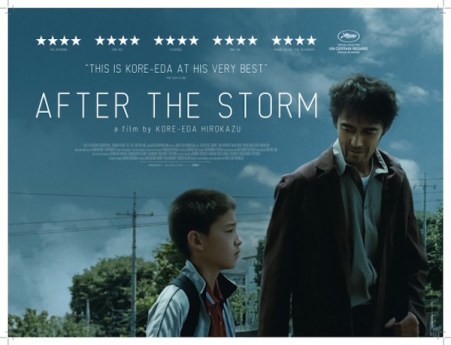
  • ‘After the Storm’, by Hirokazu Kore-eda – review

    After_the_Storm-landscape-600

    Life reminds me of a Baroque fugue; it begins with the exposition of a short melody, then develops into busy melodies and finally reaches a dramatic final entry in tonic. It is a continuous surrendering of the old and a trust in new beginnings with lots of in-between episodes, intricately interwoven by multiple strands of occasional chances called “luck,” failed expectations, and grace of hopes that creates a curiously riveting toccata. In this film by Kore-eda, Ryota’s life is a ballad of a soft troubadour, who wants to sing a happy song with his fractured but beautiful family.

    Ryota, once a promising novelist, now a divorced middle-aged struggling writer, makes a living as a part-time private detective under the pretext of enriching his writer’s imaginativeness for his next best oeuvre. He loves his ex-wife and his son dearly, so he always hangs around them surreptitiously. But he does not understand that how he feels about them is unrequited because he is not in their lives any longer. In fact, Ryota is even unsure of himself, of his reason for writing, and of what he wants to become amid his dwindling writing career and growing distance from his already fractured family. There is a sense of drift in his life, that feeling of emptiness, loneliness, and disappointments, all fragmented in the detritus of broken wishes, unpaid dues, and lost dreams. He has nonetheless a heart of gold, and his humor is his saving grace that helps him get going. Ryota’s life has been in the doldrums for so long that he forgets he has to move forward to get out of the stasis binding him in the longing for bygone days. A stream of pathos oozes out to see Ryota thinking, ‘Who would have known my life would turn out like this?’

    Director Kore-eda uses the storm, more accurately a typhoon, as a medium to free Ryota from the memories of the past, from the obsession of his past, in order to give him a new meaning of life, will to meaning. Kore-eda does a beautifully nuanced job of capturing the innermost feelings of the characters without elaborate lines or super-abudance of emotions throughout the scenes. It is a Japanese film, but the sentiments and judgments of the characters are rendered communicative to the hearts of the universal audience.