Category: Miscellany

Anything that’s on my mind.

  • Smell the Coffee and Smile

    photo (1)

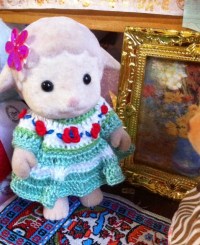
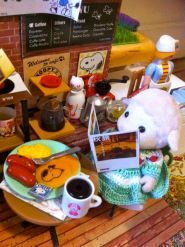
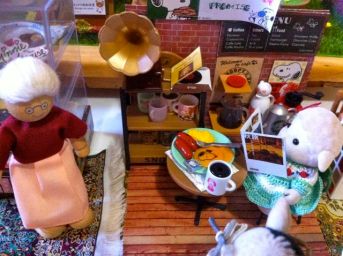
    “Holiday~ Celebrate~” with Madonna singing ebulliently in celebration of her holiday from the radio, Sally woke up to the tune and stepped into a hello brand new day. It was also a beginning of a three-day long Labor Day holiday weekend, and Sally was only glad to stay away from the city chockablock with rushing cars and the usually slightly ireful and forever impatient drivers as well as lumpish pedestrians with luggage, perambulators, shopping bags, and suitcases. So she decided to opt for a quiet leisure of her own comprising reading books she had ordered at the recommendation of the last week’s The Avonlean Book Review. But first, Sally had to have her morning coffee with a nice breakfast meal at Hush Puppy’s. Otherwise, she would be grumpy all day long, and that would certainly not be a way to make her day pleasant.

    IMG_3993

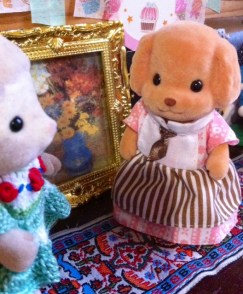
    Her favorite coffee of a day was always hot hazelnut-flavored with half-and-half because it tasted very smoothly sweet without sugar. She thought that Hush Puppy’s hazelnut coffee was the best in town. But Ms. Long, the proprietor of the establishment had recently been worried about a low sales net of her famous coffee because the city council egged on by a group of hypochondriacs was going to put soon warning labels on coffee cups that would say “Acrylamide contained in this coffee may cause a risk of cancer.” Sally knew it from the articles in the Times and thought it was always the people like Ms. Long whose honest-to-goodness way of running business consorting with her moral character and faith that suffered the waves of unfair backlash from the public. Indignant at such injustice, Sally wanted to cheer up Ms. Long in any way she could do within her ability and measure.

    IMG_3995“Ms. Long, your hazelnut coffee is one of the best in the town, and I told it to all my friends and colleagues at work and suggested them they come by here.They are not hypochondriacs or bombastic health freaks at all. I mean what can coffee possibly do harm on people? The eminent Baroque composer Bach once said without a cup of hot coffee, he would be like a grilled goat. and as far as I am concerned, I have never heard of any one who has died from drinking too much coffee.” There was a flicker of smile flitting in the gracefully aged face that shinned with her incorruptible beauty from within. Ms. Long had never felt more comforted and warm than ever in her long life as a spinster. “Thank you, Sally, for your caring words. I will continue to make the best hazelnut coffee just for you.” There was in the air something that filled the whole of Hush Puppy’s at the moment. It was wonderfully conflated with the aroma of Sally’s hazelnut coffee that Ms. Long had just finished brewing. Sally’s spirit was flitting in the loveliness of the ambience, soaking herself in the moment of happiness coming from within. It sure was a pleasant morning for Sally.


    thanks-for-reading-Rok-Hardware

  • Heart of Gold

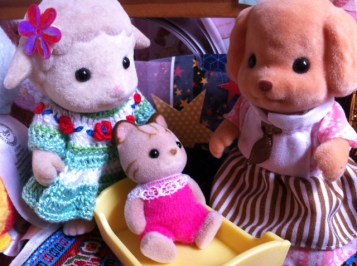
    image (2)“Anything new in today’s newspaper, Seraphina?” asked inquisitive Patricia, who arrived at Cafe Jolie, her and Seraphina’s “third” place after their homes and workplaces. “Yes, there is  very shocking news connected to our neighbors in Avonlea!” Seraphina  was excited by this one-of-kind news involving her beloved town that was seldom covered by any major newspaper unless big wigs in corporate world or bureaucrats in political arena visited the town with no other reasons than canvassing for “likes” of the good people of Avonlea, all for their dominance of popularity over the populace. So what made her flushed with rare effervesce? Patricia was by all means curious about it and wanted to dig out the whys and wherefores.
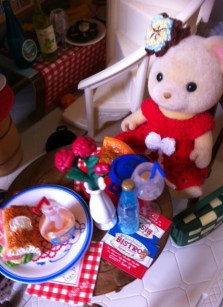
    image (2)

    “You know the Magoo family who owns the mini mart down on the Merton Bowley Road? While Mr. Priam Magoo and his two other children Tony and Tracy were on their fishing trip to Bella Vista, their bedroom ceiling completely collapsed to the ground all of sudden on Friday morning! And the thing was that Mr. Priam’s wife Helen and their infant son George were in that bedroom! But by the grace of God, she and the baby were unscathed by the falling debris because Helen, with her  innate athletic feats accelerated by her maternal instinct, covered George’s tiny body with hers and escaped the scene as swiftly as she could. Both the mother and the baby fled to the Collies, their next door neighbors to calm their nerves. Until Priam and the other children would  return home tonight (a drive to Bella Vista takes about two days.), Helen and George would stay at the Collies.”

    photoPatricia’s heart became laden with ebbs and flows of emotions, erratically setting in motion a convolution of sadness, indignation, ebullience, longing, benevolence, and then pathos with a detritus of the news about the unfortunate incident befalling Helen and George  she had just heard from Seraphina. So much so that her eating at the cafe with Seraphina made her feel indulged in some sort of sybaritic activities with a phantasmagorical display of the scenes in which both the mother and the baby were frightened, taking a flight to their neighbors until the return of other family members played stereoscopically in her metal theater. While her friend Seraphina just matter-of-factly discoursed the news as if it had been one of those articles in a provincial bill posted on a public board in a park, Patricia took it to heart and decided to visit Helen and George at the Collies after the brunch. Just as the great Roman historian Pliny the Elder aided the refugees of the catastrophic eruption of Mount Vesuvius with all his might, Patricia was willing to offer consolation however small it might be to the mother and the baby.
    thanks-for-reading-Rok-Hardware

  • Carpe Diem, Ladies and Gentlemen! Enjoy the Moment!

    image (1)

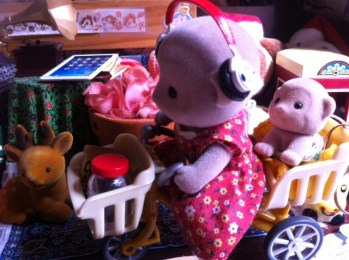
    It’s a dewy one Saturday morning after the nightly rain that cooled off the fiery flame of the sun. Thanks to the abundance of flora in Avonlea, the process of transpiration by which leaves of plants release moisture  into the air that results in rain on earth, the land of Avonlea is hardly parched, and the atmosphere always fresh and fragrant. That is why Helen induced her husband Priam to move to Avonlea a year ago from Roanoke, where humidity and mosquitoes ruled in autocracy; it was an unsavory place to live, let alone to start a family. The rumor had it that the nondescript town was later set ablaze and ravaged by a man driven to madness by such a torid ambience of the toil. In the background of all this, Helen cannot be happier than now, while listening to one of her repertoires, “Downtown” by Petula Clark on her iphone. In fact, she feels as if she and her George were flitting on her aerial bicycle in the blue sky.

    image

    Meanwhile, Sally and Bonnie are cooing Alfred, a  baby son of their neighbors Mr. and Mrs. Redfox who are on holiday  to Prince Edward Island. Their vivacious daughter Judy is at a parochial summer camp in Thousand Silvers. The Redfoxes are scheduled to return home tomorrow afternoon, so it’s not too much of onerous task the two ladies have to tackle, straining themselves over how to pacify a crying baby, what to do in case he becomes sick out of the blue, and when to change his diapers, etc. Fortunately, Alfred is so mildly-tempered and easy to take care of in the bargain that it is actually a pleasure attending to the toddler without feeling stressful. Sally ponders if such equilibrium in temperament would be a manifestation of solidification of genetic composition. In a minute, Sally and Bonnie are going to take Alfred out for their usual morning promenade.

    photo

    “Look, Bonnie. Alfred’s got a cute mole on the right cleft of his lips! So adorable! I wish I had it too!” “Let me see. Hmmm… I had not noticed it until you told me so. Don’t you know that his sister Judy’s got the same mole on the left cleft of her lips? And so does Mr. Redfox? It seems to be a genetic trait of the family. Definitely. Funny that a man like him has got it, while his wife has dimples. But then the dimples are more precious and feminine and more desirable than a mole, no?” In fact, Bonnie secretly wishes that she would have the same attractive dimples around the corners of her lips that would make her face prettier and perkier. But it is just one of those innocent, muliebral wishes of  a lady who doesn’t think that she’s pretty enough to be wooed and sought after. But then who can blame Bonnie for vanity when a gentleman likes a pretty lady? But let us put all the convoluted thoughts and tangled emotions and untamed emotions aside for this bright Saturday fragrant with fresh petrichor. Forget all the worries just for Today and Tomorrow, which is Official Holy Rest Day, and let’s just pretend to have million dollars in our bank accounts for the weekend.

    0682e26f337825b366e8e3e3e0003ad1--folk-disc-golf

  • Kill or Cure? – on Medieval Medical Practice

    RE: September 1, 2018 issue of BBC History Magazine article by Elma Brenner

    The grace of health is conspicuous only by its absence when we fall into sickness unexpectedly in the course of our earthly lives. Throughout the history of human civilizations, there have been many interesting ways of curing illnesses peculiar to different wells in sound body,” went to Temple of Aesculapius, the demigod born into Apollo and Coronis, a beautiful mortal, later raised by the wise and kindly old centaur named Chiron, in eager hope of seeing the demigod in their dreams to listen to his prescriptions for the maladies, primarily consisting of a mixture of herbs and cooling potions followed by divine incantations. In this regard, the people in the Middles Ages were not more different than their ancient pagan Mediterranean counterparts. Moreover, their medieval attitudes toward sickness and a general well-being was no less incongruent than those of ours as Brenner takes us to the time period in this scintillating article.

    Pace our prevalent perception of backwardness of its culture and science in the tenebrous reign of the Church, there was a multitude of practical treatments for maladies as well as preventive health cares that appeared to produce efficacy to certain desirable extents. Just like their 21st century progeny, medieval physicians emphasized on the importance of preventive health cares, such as “Rapid stair climbing” for 3 or 4 times a week to strengthen cardiovascular endurance, a moderate diet, good sleep, and other types of physical exercise to promote general health of the medieval folks. In fact, it seems to me that such measures may seem as a wise way of preventing an individual from falling into a serious type of sickness that might have required of a physician a diagnosis of which he would not have yet known at that time,  or even if he had known it, he would not have known the cure.

    It is also very interesting to know that during this period of time, a physician was to diagnose causes of ailments and then referred a patient deemed necessary for a surgery to a surgeon whose status was considered less than a physician’s by dint of the nature of the physical exertions that involved unpleasant sensory aspects, such as bloodletting, collecting urine, and most dreadful of all, cries and screams of the patients under the surgeries without anesthesia. All of these physical “drudgery” or “legwork” was strictly undertaken by a surgeon under the guideline of a physician who offered prevention medicinal advice based upon a patient’s case-history, observation of pulse, urine, and blood. Thenceforth, at the instruction of a physician it was an apothecary, a modern day equivalent of a pharmacist you see in Duane Reade or Rite Aide, who completed the physician’s job by supplying the prescribed medicine to the patient.

    Since the medieval times was undeniably under the aegis of the Church that functioned as the Divine Terrestrial Office with its authority imprinted in all aspects of life, a spiritual application of supernatural agency in the cure of sickness was de rigueur for a medicinal procedure. For example, the Church instructed the agnus dei to see a priest prior to visiting a physician who also often had some degree of medical knowledge. Moreover, in the practice of Couching, which was a cataract surgical procedure by which a surgeon moved the cloudy lens on the iris of the patient to the bottom of the eye with a gold/or silver needle, 4 recitations of Pater Nostra –  the Lord’s Prayer-  were administered.

    In view of the above, it seems to me that except for the absences of antibiotics, surgical methods, and anesthesia, some of the practices are still existent, such as the use of uroscopy, which is the examination of urine to determine a patient’s conditions, a general medical procedure involving the trinity of physician, surgeon, and pharmacist, and the advocate of preventive health cares are very much similar to those of the 21st century counterparts. Hence, I am in agreement with Brenner that it would be our fallacy of human ego to flatly deride or discredit the medieval medical practices as backward or ludicrously primitive or even barbarous and proclaim our modern superiority. For were we pitchforked backward in the Middle Ages, perhaps we would understand their ways of working the cure apropos the medieval epoch. But then the prospect of going through  a surgery minus anesthesia – not even a dosage of Vailum – makes me thank God for the fact that I wasn’t born in that time.


  • Broken Will, Lost Soul

    RE: 8/12/2018 article of “Broken Guy goes down with plane” from the Los Angeles Times

    However bleak and and fatalistic his views on Death of God and Nihilism might be, the one definitive thing German philosopher Friedrich Nietzsche knew was this: “Anyone who has a why to live can bear also any hows.” How reassuring it is because it means that even if life presents you anything but shattered dreams, aborted hopes, and clipped anticipations for whatever you try to work out, as long as you still hold steadfastly onto a sense of purpose – that is a why to continue this so-called “life”- your life will not end in nil, or in crash such as the man I read about in the newspaper today.

    His name was allegedly known as “Richard Russel,” according to his bantering with an airport controller during his audaciously precarious aerial heist of an passenger aircraft he had stolen from Sea-Tac Airport in WA. He was reported to be a 29-year old former ground service agent at Horizon who had also run a bakery with his wife until 2015. It is reported that he died in crash on a wooded area on Ketro Island south of Seattle, WA by saying, “I wasn’t really planning on landing it.” The plane did not hit any structures nor did it cause any collateral damages to private properties, since the island itself is underdeveloped. The whys and wherefores of Russel’s quixotic joy ride have not yet been manifested in the course of the current FBI investigation, but judging from his communication with the controller, he might have been suffering from existential vertigo in which he had lost a sense of purpose, a why for continuing his life in dealing with demands of tasks that everyday life had imposed on.

    In case of art imitating life, Russsel on the passenger aircraft reminds me of Don Quixote who, on his beloved Rocinante, gallops toward the huge windmill to vanquish it, a stereoscopic symbol of pompous hypocrisy of life that generates nothing but the ills. Foolish, yes, needless to say. But heinous or even insidious? Hardly so. Stealing is one thing, but ending his life out of emotional distress is another thing, as they are apples and oranges in the sense that he meant no fatal harm on anyone by using the stolen aircraft as a weapon of mass destruction as in the case of the terrorist carnage of 9/11. I wonder what might have gone through his mind in the cockpit of the plane as he was nearing to the end of his life: a phantasmagorical display of his memories that he had collected through life, willed or unwilled? Perhaps, being a pilot of the plane might have given him a tactile sensation of being capable of piloting his own life, that ineffable stupendousness of capability, which would have given him the equal dose of confidence at the spur of the fateful moment.

    Playing a pseudo psychiatrist is not my forte, but it is viable to think that Russel ‘s contemporary strains of life and postmortem malady that anesthetized his Reason and thus emboldened him to do such a foolhardily venturesome act at the expense of his own life are something that we can feel pathos at the least. And that is why I find it hard to criminalize him by putting him into a moral/ethical Procrustean bed, which also brings me back to an act in Macbeth:

    “Life is but a walking shadow, a poor player that struts and frets his hour upon the stage; and then is heard no more; it is a tale told by an idiot, full of sound and fury, signifying nothing”

  • Bicycle for Two

    image

    Philippa is pushing through busy Main Street on a sunny Friday afternoon with her son Fred in the backseat of her bicycle by dint of solicitation and fortitude of the valorous McGreen family.  Fred, an orphan abandoned at the age of two weeks on the step of her gingerbread lookalike house, is her de facto son, the middle one between Alfred, the eldest son of herculean feats of athleticism and the youngest, Philip, “Phil,” who, on an account of the solidification of hereditary traits of the adventurous family, goes for jocular adventure. But Fred is a different soul, he is a sensitive soul with a great mind and a tender heart. And today the foundling of Philippa is very ill that requires a doctor’s immediate attention; hence the mother is forcefully working pedals to Dr. Hobson.

    image (4)The mother and the son is also escorted by a trusty entourage of Phil, who is also concerned about his dear brother. Small as he is, Philip is all bravery and cheerfulness. He wants to make sure all’s well with Fred, who always reads him sweet bedtime stories by his nightly bedside as well as other illuminating stories about ancient Greek heros and the gods and goddesses of the Parthenon, great historical figures, and oeuvres of fine writers throughout the western civilization.  Fred to Phill is what Yoda is to Luke in the Star Wars. Philippa is pleased to see her sons bound by Charity, Hope, and Faith, the three theological virtues, not by dint of mere blood relation that is often devoid of the virtues by default.

    image (2)When the McGreen trio arrives at Dr. Hobson’s office on Kingsbridge road, they are amiably accosted by  Helen, one of the prettiest and kindest ladies in Avonlea who is married with three children to a grocery proprietor Priam, who fell in love with her at first sight by thinking, ‘She’s beautiful, and therefore to be wooed. She’s a woman; therefore to be won.’ Helen and her three-old son George are pleased to see her neighbors there and wants to know what has brought all three of them to this far. “Fred has been in agony for two weeks due to a serious case of abscess on his right shoulder,” says Philippa, “But Fred did not tell me and his brothers until this morning, enduring all to himself only the gruesome pain that stymied his everyday activities, such as eating and working. In fact, the pain even prevented him from reading a book!”

    image (3)Helen does not understand Fred’s reason of silence that was broken this morning, so she ventures to inquire about the cause. “Fred, why did you not tell your mother when it began to hurt you? Had you told her about it earlier, you would have been cured.” Fred is absorbed in all the dialogues between his mother and Helen and  forms the most honest and provident answer to the lady’s inquiry. “At first, I thought it would go away because it had happened before. But although I tried myself applying to a topical ointment and taking doses of pain suppressant and high hopes, it just became worsen… What’s more, I did not want to worry mom because she was always very busy with running the restaurant and the household all by herself. Now I am in great pain now, which has compelled me to alert mom about it.”

    image (1)

    Upon hearing such stream of heartfelt soliloquy of Fred, Philippa’s eyes are welled up in tears and with an insurmountable gushing power of pathos and charity (which actually means “Love” as its original meaning of Caritas,) she hugs her dear son Fred and tells him tender words that can only be true if carried out by the one who possesses such spirit and soul: “O, my dearie Fred! You really shouldn’t have worried about my work and myself because I am your mother. A mother is ascribed to attend to her child with unconditional love, and it is an immutably, intractably, cardinal duty of Mother, who is also endowed with magical power to endure anything. So you do not have to worry about me, ever, Love.” Feeling the heartbeat of Fred against her own, Philippa reminds herself of her mother’s advice that it is a wise mother that knows her own child. All the more, she believes that love’s reason’s without reason, especially in the family.

    thanks-for-reading-Rok-Hardware

    저장