Blog

  • over and over

    gl_wildflowers

    She kept all her love to herself alone, all alone,

    But let her concealment, like a pearl in the clam,

    Feed on her rosy cheek: she pined in thought,

    And with a blue and even bluer melancholy,

    She stood there like Dido by the River of Lethe,

    Smiling gently at the last shadow of memory.


    P.S.: A new life can mean anything, which spawns multiple kinds of rebirth in any kind: Born-again Christians believe that their newly professed baptismal promise will gain them new strength in life through conversion to God. Reformed characters want to right the ship derelict in the maelstrom of life. In this regard, I think lonely hearts hardened by the absence of love should deserve a new life filled with the pleasure of love in the same way the heartbroken Psyche descended upon the Hades and found her lost love, Eros. It’s about the soul redeeming through love. This is my kind of New Life, the Supreme One of Life, which sets a confined soul, such as the narrator of my poem, free from unjust and cruel incarceration in an existential drudgery. 

  • Thousand loves

    ofclnku1pbi65qd0ft3lgwpoc56rwcsrzkjyo0hnaasfvv6uhpcol6xx8tzkpuwz-

    Her love that has been, it is that which shall be;

    and there is no one love but a thousand loves:

    A gentleman and a foreman, a mister and a master,

    A soldier and a sailor, a wrangler and a rancher,

    A fighter and a keeper, a preacher and a paramour,

    A singer and an actor, a drifter and a deceiver –

    A Shapeshifter with a thousand faces of a lover

    changing and changing, round and round, forever

    all but his heart true blue to his mistress, dear.


    P.S.: This is my a priori adaptation of Shakespeare’s idea of the perfect better half or lover in “All’s Well That Ends Well”. She sees different aspects of her sweetness dear whose various characteristics promise her fresh delights and never bore her. 


  • they come to her at night

    Screenshot_54

    The night was a strange paradox of light and dark. It was too dark to invoke images of the bright beautiful things. It was too light to provoke imaginations of the blissful obliviousness. The night was a white heat of the sleepless senses that kept taking in all seen and heard even after the provocateurs were long gone out of sight. This was maddening and becoming madder and striking the notes of all madness. Iris couldn’t sleep as the night was getting deeper and darker, and it was consuming every part of her in a great white incandescent flame like a funeral pyre that once engulfed Dido’s forsaken body and unfortunate heart. The senses that kept her awake besieged her glass castle without mercy and started to screen the scenes of sadness and more sadness as an apparition of the past narrated the story buried in its tomb without an epitaph. She was wide awake at the bewitching hour, and she was helplessly defenseless against the force of the hour.

    Since she was a little girl, Iris has been going through the same nocturnal rituals of waking up at 3:00 AM on time, precisely, continuously, as always. Every single night was every single rite of this uncanny performance of sleeplessness – that is, exactly at 3:00 AM. When she wakes up, the electronic digits always show 3:00 AM with glows that seems to grow lighter the more she looks at it in fearful awe. Fearful because Iris has learned that it is the hour when the gates of the underworld, the netherworld, the world beyond are open, and the regions of faeries and wandering spirits roam the earth as witches fly to the devil’s banquets. Hokum it may be, but the bewitching hour also seems to include Iris as a coterie of the supernatural for what’s worth. This secret is hers and hers only in fear of being branded as a weirdo or a witch’s apprentice even. Yet, because Iris’s soft heart cannot bear a secret too long for its painfully tender fullness of emotions and feelings to keep it to herself, it now agonizes her sense and antagonizes her sensibility. And it was this night that got her to a paroxysm of inquisitiveness, inadmissibility, and ineffableness, enveloped in the mysterious veil of incredibility so enigmatically eerie that it almost felt infatuating with the unknown.

    The magical hour was now in possession of the waken Iris with wide eyes, and the effect was smeared into every part of her body without a miss like ink instantly and ferociously diffusing in a glass of clear water. She did not like it, but her opinion was useless under the power of the supernatural hour. Iris wanted to break the spell and doing so would require her of facing another unknown mysterious force. Her Catholicism would defy her magical assumption on the incredible symptom, but Iris knew that her religion itself entailed the magical qualities of belief and that it was only natural for her to connect the dots between the two belief systems as a solution to her ghostly malady. That’s it. She can’t take it anymore, she can’t have it any longer. Forget the religion, and think primal. Iris has made up her mind to start her investigation of the supernatural phenomenon that she has been going through to find whys and wherefores.

  • poesie – i dream myself alive

    cheret8

    Awake I know I dream not

    As the sense still alive

    Tells what is seen is not

    A fancy but a reality alive

    Of the wonder of the mind

    Working wonders of creation

    Of a fiction of the mind

    In a mind’s reservoir. 


    Awake I think when I dream

    As the pulses of sense weaken

    And the images seen past seem

    All but phantasmal panorama seen

    In a mind’s theater of illusion – 

    Fantastic beasts, wailing ghosts

    Enveloped in the cloud of dreams

    Lurking in the stupor of the sense. 


    Awake, awake, awake I become

    When the sense divorces fancies

    As the mind calls dreams hokum

    And claims a seat of imaginations

    Till it clears the clouds of ignorance

    Darkening the light of the mind wondrous

    Of creating the reality of its sovereign own

    With no assistance of chants and spells. 


    P.S.: Thomas Hobble (1588-1679), an English scientist and philosopher, excoriates in his essay “You and Your Dreams” the knavery of sham magicians and magical folk claiming to deal with supernatural beings to induce naive people to believe in superstitions and the power of magic for the promotion of their trades. Hobble enlightens readers that superstitions arise out of the ignorance of distinguishing imaginations, a second-hand reality, from dreams, a detritus of agitated part of the mind. The gist of his argument is that ghosts and haunted places ensue from an intractable combination of the images of the seen and the second-hand images that become distorted imaginations made look real.  In sum, Hobble’s theory of dream interpretation corresponds to the postmortem dream theories of Carl Jung. Hence this poem is my understanding of Hobble’s essay on the aforesaid subject. 

  • In the temple of Ishtar

    tumblr_inline_p7h7p1ICiL1tnzgls_500
    The Babylonian Marriage Market by Edwin Long, 1875

    There she stands like a nameless flower

    Alone, away from a heap of roses in the garden

    of the temple of Ishtar, Goddess of love in armor

    and looks not with pride seen but with pain unseen


    Days have left, Years have passed;

    But the girl still roams around the temple

    Alone, apart from the beauty selected

    And consummated to a sacred couple.


    Alas, what is it not the thing called Pity

    When the wallflower unwanted, unsought

    Alone, as always, waits a cruel eternity

    Till she meets a beholder besotted sought?


    P.S. Ishtar is the Mesopotamian goddess of love, war, and fertility. It is said that in ancient Babylonia, every young female when reaching a certain age should go to the temple of Ishta and wait for a man who will approach and take her as a wife to home. The temple was used as an open market for marriage, which was considered a sacred means of attaining divine union between mortals in the presence of the goddess. However, as the unfortunate ones in love have always been the figures of lamentation throughout human civilization, the shy, unpopular girls had to wait in the temple for years to be selected. This poem is to feel the feeling of being unwanted and ignored in the meritocracy of beauty…


  • a league of their own

    2294848759_75990646f3_b

    Reading a section featuring a small, pleasant Q&A type of interview with a writer in The New York Times Book Review on restful weekends gives me a kind of voyeuristic fillip to be privy to the life of the writer; moreover, the usual question of whom to invite for dinner is the gist of such small pleasure. I’ve found it quite stimulating to think about my own list of people to have dinner with. Therefore, I have herein drawn up my own list of invitees to confabulate with. Here’s my list of guests:

    • Eleanor Roosevelt: The paragon of the First Lady of the United States with Intelligence that ministered to her moral character, she put her philosophy into action by actively participating in social services. Besides, Mrs. Roosevelt possessed a polished but common sense of humor and wits communicative to people of all social strata with her timeless adage: “No one can make you feel inferior without your consent.”
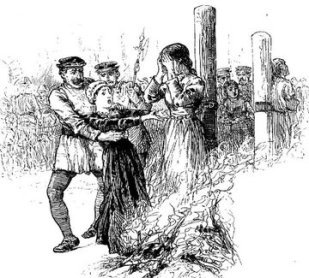
    • Joan of Arc: The Virgin of Lorraine, The Patron Saint of France… Such are the epithets of this patriotic French maiden who was burned alive on the counts of witchery and treason, which was of course conspiracy concocted by the French ecclesiastical dignitaries collaborating with the English against whom Joan of Arc fiercely and courageously fought to victory. She was neither a religious fanatic, nor a hallucinated mooncalf, nor a certifiable schizophrenic. She might be a simple peasant woman but a courageous, headstrong, and smart woman of faith who did not even protect her face during battles with the English amid the attacks of sharp arrows, axes, and lances. No wonder did Mark Twain praise the Virgin Knight forthwith: “Whatever thing men call great, look for it in Joan of Arc, and there you will find it.” Besides, her simplicity of faith excelled the pomposity of ecclesiastical knowledge by saying thus: “About Jesus Christ and the Church, I simply know they are just one thing, and we should not complicate the matter.” I can learn many things from Joan as a True Model Woman who embodied Intelligence, Femininity, Courage, and Faith.
    • Marilyn Monroe: Born as Norma Jean Baker, she was not a blonde bimbo whose physical attractiveness belied her ceaseless pursuit of knowledge concomitant with her pursuit of the meaning of life she desperately wanted to ascertain. Monroe enrolled in evening college courses in New York City when she had no schedules during the daytime. Behind her pretty persona of a movie star, there was a profound shadow of existentialist. Also, Monroe’s down-to-earth personality and kind nature would make her a lovely company striking up a convivial conversation at the table full of strangers.
    • Jane Birkin: Her bohemian look – that effortlessly sensual but charmingly delightful facade with simple French Chic style is always timeless and boundless, appealing to Womankind imbuing with a sense of emulation of the style. In fact, such qualities of Birkin had one time convinced me that she was French. She seems to wear sexuality like she’s wearing her favorite set of perfumes, which is never vulgar nor degrading. Once a shy English girl is now a sensuous cosmopolitan woman demonstrating admixture of art and individuality in the most fashionable way. She will be a delightful addition to my lunchtime table.

    In view of the above, my guests of honors are an eclectic company of women, past or present, surprisingly and strictly non-professional authors who make a living by writing only, although I did not intend it to be that way. Or maybe my preconception of professional authors – especially women – as highly volatile artists with inflated egos, dazzling intelligence, divine beauty, and impressive achievements might have played a vital role in excluding unconsciously any of them from my circle of companions. But so did Michelangelo; he was never befriended with his contemporary Leonardo Da Vinci, who in fact lambasted his untidiness as a sculptor in comparison with a baker. Nor did Michelangelo make friends with other famous artists. Instead,  he was a friend of some obscure artisan who helped around various artists by doing sorts of drudgery. It all boils down to the fact that having a good company of kindred spirits can do a favorable service to your soul, making you feel charitable and magnanimous, so much so that you can- to quote the swashbuckling Oscar Wilde- “forgive anybody, even one’s own relatives.”

    저장