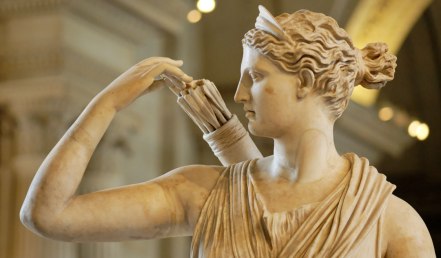
Over the relics of the marvels that belonged once
To a sacred dwelling of a Lunar Goddess, a divine
Maiden of Wild Beauty and Eternal Chastity destined
To chase the wild from dawn till dusk with her golden
Arrows missing nothing even from the top of Olympus,
A High Moon spoke with full of pathos of her immortal story.
“I once lived on the isle of Sicily with Athena and Persephone,
Gathering flowers in the Elysian Fields during the days,
Weaving our father Zeus’ robe at nights under the Moon and Stars
Enjoying our muliebrity unscathed by the lust of amorous men
Whose lascivious desire of women would forever be inordinate,
Spurning Eros, Aphrodite, Songs of Love, and Bliss of Marriages.”
“Then heard was no more; a mirth of our Persephone was heard
Nowhere, for Hades, the god of Underworld, swiftly abducted her
In his chariot and disappeared into the pit of the world down under,
Where I and Athena could not penetrate even with our divine aide,
Ending the blissful companionship of sisterhood for once for all – forever!
And thus I left the isle in quest of eternal pursuit of wild beasts alone.”
“Immune from the spells of Aphrodite and the arrows of Eros,
I am an eternal maiden who is free from marital obligations
So that I can chase down wild beasts with my ever loyal hunting
Companions of a Bear, A Wolf, and a Stag behind me all day long
And dispense my vengeful justice to all devoid of decency and civility,
Like the ones who were cruel to my mother, my brother, and me!
Such was the litany of woes told by a Goddess of the Moon
On a night when a Full High Moon filled the night alone,
Shining brightly alone above a lonely traveler listening to her
Tale of her divine destiny of solitude chasing her objects of
Pleasure for ever- forever continuing till her father Zeus takes
Away her immortality in pity and makes her a star next to Orion.
The first time I visited the New York Public Library to write a research paper on female monasticism in the High Middle Age, I was amazed by the volumes of book it possessed and its classification system of organization staffed by knowledgeable librarians, as well as the colossal architectural building in the middle of Manhattan, New York. Perhaps it might have been this kind of awe and wonder kindled in the minds of ancient travelers or scholars who had seen or visited the Library of Alexandra, one of the largest and greatest of the ancient libraries in the history of civilization, which is said to exist from the 3rd century B.C. until the Roman conquest of Egypt in 30 B.C. The Library of Alexandra: The History and Legacy of the Ancient World’s Most Famous Library by Charles River Editors presents a comprehensive history of this great ancient library from its genesis to demise on the grounds of historical accounts and logical scientific reasoning thereof.
For centuries when libraries were still few and far between as written knowledge had been exclusively held by the religious classes in private repositories, the image of this ancient library once existent in Alexandria had been evocative of mysterious ambience of esoteric mystical knowledge of the bygone eras and thus inspired imagination to create myths and legends. In fact, libraries as we know now and find ubiquitously are fairly a modern invention born of the cultural legacy of the Library of Alexandria as the apotheosis of two ancient literary and cultural traditions converging the Greek and the Egyptian.
The Egyptian Background
When Alexander the Great and his army conquered the ancient Middle East in the 4th century – one of which was Egypt -, they were encountered with cultures with long literary traditions and traditions of literary documents in repositories called, “the House of Life” and “the House of Books” that housed thousands of documents written in papyrus-made scrolls for the Egyptian and clay tablets for the Mesopotamian under the administration of the priest class. Of these two houses of documents, it is the House of Life, the ancient Egyptian equivalent of a library, from which the majority of texts have survived until the present time. Consequently, Alexander and his army were overawed with the rich literary culture of their conquered land, took the ancient Egyptian concept of a library and transformed it from a religious to a secular institution by providing a bridge of knowledge from the most ancient concepts of libraries to the modern libraries in the process of Hellenization of the Egyptian.
The Greek and Hellenization (The spreading of the Greek culture)
Alexander’s Hellenization was a two-fold political program consisting of (1) acculturation by performing and accepting certain religious and cultural traditions making him look “Egyptian” to gain acceptance by the Egyptian elite class; and (2) the promotion of the Greek culture, “Hellenism” by spreading the Greek culture throughout Egypt. The process of Hellenization in Egypt was well succeeded by his general named Ptolemy, (the founder of the Ptolemy dynasty from 304 to 330 B.C., including Cleopatra VII) who made Alexandria the capital of Egypt and the cultural center of the Hellenistic and the famed Library of Alexandria as the centerpiece. In fact, the Ptolemies’ subsidization of the Library was their way to link their dynasty, which was in a foreign land far away from their homeland Greece, to the greatness of their culture. They also banned the export of papyrus from Egypt, which resulted in increase of prices for books and creation of the industry of forgeries and plagiarism.
According to the Greek historian/geographer Strabo (64 B.C.-24 A.D.) upon visiting the Library of Alexandria, it was part of the royal palace and an annex to the museum, which was a community of academic and religious scholars gathering in the shrine of the Muses of the arts and intellect. The membership was exclusive to the men holding property in common with a priest in charge of the museum. The library housed over 500,000 papyrus book-scrolls written by the ancient notables, such as Homer, Euripeds, Sophocles, and Herodotus, all in Greeks as most of the documents stored therein had been translated from their original languages by priests under the Hellenistic influence. Besides, the Library organized all the entries into alphabetical order as a classification system of library organization that is akin to modern library information system.
Destruction of the Library of Alexandria
Since there has been no definite archeological evidence of the Library discovered, myths and legends concerning its end are still rampant in the imaginations of creative minds. It is said to be burned down by the Civil Wars in 48 or 47 B.C. by Plutarch in Life of Caesar, the theory advocated by Seneca, a famous Roman orator, and later popularized by Edward Gibbon of “The Fall and Decline of the Roman Empire.” However, the most plausible and logical theory of the destruction of the Library is that the humidity must have ensued the destruction of books in papyrus and that the process of destruction would have taken place over hundreds of years contrary to a popular dramatic version of its being burned to ashes by Caesar’s men in one night. Also, another speculation is that after Egypt was annexed to the Roman Empire in 30 B.C., the presence of the Library of Alexandria became an afterthought to the Romans, who imported Greek Scholars and books into Rome, rather than made a long trip to the foreign land. The Romans were more concerned with building their own architectural building, including libraries and schools, in their own land by sending their book agents to the Library of Alexandria to take the originals back to Rome, which contributed to a gradual demise of the Library, by making its presence obsolete and unnecessary for the upkeep of the maintenance.
The great ancient Library of Alexandria as an architectural artifact might have disappeared into history, but its cultural inheritance of civilization preserving intellectual act of learning in appreciation of arts and beauty still strongly resonates with its historiography and contribution to our modern world by continuing to inspire our minds to carry it on for posterity. The Library of Alexandria still exists in the presence of any place of learning or knowledge as long as we appreciate such cultural influence on what we take for granted, such as using our own library. Now that I have read this book, the next time I visit any library, I will think of those ancient librarians and appreciate the legacy of the Library of Alexandria and Alexander the Great for making it all possible.
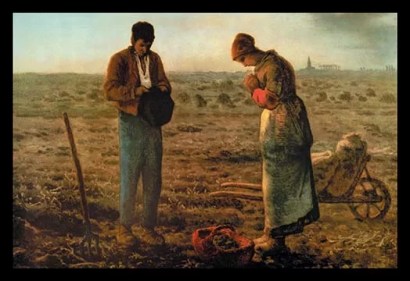
Gone with tears are the four hearts of four souls,
Weeping for the world pitiless, merciless, cheerless,
Overawing and expiring the tiny flames of four lives, and
Leaving their remains soaked with tears with no friend.
Hope? Forget about the vanity of ethereal remote longing,
Unavailable to them, unthinkable to them, for their suffering
Was theirs, theirs only, theirs alone, not ours, not yours, not mine,
Thinking “Thank God, it’s them, instead of me” with a glass of wine.
Where was Charity when the four souls- two parents, two babies-
Were forced to wander around in the vacant lot nights and days
Facing daily unkindness, hopelessness, rejections, humiliations
Gnawing every part of them till their spirits plunged to a low bottomless?
Woe is to the four souls aborting their Fates so hard, so harsh
In defiance against such Fates that even allowed no remote wish
For instant happiness and now wandering the Place of Grief where
They tell us their failed dreams and disappointments hard to bear.
P.S. : This poem was written in memory of the family of four found dead in the backseat of a van in the parking lot of a CVS store located in Garden Grove, California. It is said that the family seemed to live in the van for about six months or so. The family was composed of a father, a mother, a two-year old daughter, and a nine-month old son. Although the Police is investigating the cause of death, I can’t shake away my strong speculation that it must have been a case of suicide… Hence, this is how I feel about these souls who had no choice but ending their own – including the little ones of their own- . If the father or the mother could have gotten a job, or if anyone could provide them information on how to get public assistance, such as acquisition of housing and food stamp, they would have been with us… They should have not died… I wish they would rest in peace., especially those little ones as my heart is crying…
When Sally Lamb, a resident reporter of the town’s one and only newspaper “The Calico Times” heard the news from Mr. Randy Beaver, an able-bodied mechanic who also functions as a town’s great plumber, that his distant maternal uncle named Mr. William Rustis had arrived in the town a week ago, her journalistic instinct prompted her to meet him in person. Besides, there had been no newcomer to this small town where urbanity meets rurality, teeming with a peculiar charm of fairy-tale like atmosphere created by the affably plumb and flurry appearances of the residents.
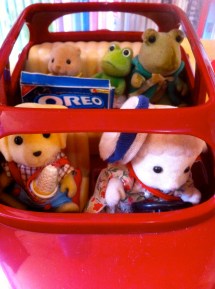
Sally gives a ride
So she drove to Dryad Park, where Mr. Rustis was reported to be seen with his camping belonging days and nights. When Sally got to the entrance of the park, she could see who Mr. Rustis was without a ray of doubt; a big sombrero, an orange-colored scarf tied in the fashion of a boy scout, a large and hefty frame, most of which was dominated by his wide waist circumference, and most of all, a striking grinning that was instantly recognizable of him even in a far distance. There he was, her Interviewee Of The Day.
Mr. William “Willie” Rustis
“H~~~~i, There ! I’m here!” was the exultant voice of Mr. Rustis with a Great Grinning. Sally, being always shy in public but bold in pen, was embarrassed by such an exuberant welcoming, when she would be the one who would welcome her interviewee to make him feel comfortable to have a good, productive interview result. ‘Thank God’, Sally thought to herself while scurrying toward the Man with Great Grinning by the fountain, the interview site. “There are just a few people in the park now. Is he a sane man as Mr. Beaver said of his uncle?… What if he dos not talk sense?… What if he bursts out a sudden fit of tantrum?… A man with such a seemingly perpetual grinning on his face will never be a sane man after all. I’d better finish this interview as quickly as possible.” So much mental ado was straining Sally’s sophisticated inner world as she was approaching closer to her subject.
Always Affable Uncle Willie
“You must be Ms. Sally Lamb! I am Willie Rustis, Randy Weaver’s old uncle. He told me many good things about you! Boy, aren’t you a lovely darling? You must have may boys and men who orbit around you. Don’t you? Ha! Ha! Ha! I’m darn glad to be interviewed by a lovely lass today! Randy didn’t tell me that you were! He just told me that you’re a good writer of a newspaper. By the way, what’s the name of your newspaper?” Sally was both stunned by his extravagant greeting, which was actually quite pleasing and flattering because she was renowned for her somewhat austere tendency toward strangers and people whom she regarded mentally benighted, especially men. Besides, she did not think herself as the “It” girl. “How do you do, Mr. Rustis. I work for “The Calico Times, the one and only newspaper of Sylvania.” Shall we begin?” “Oh, well! Sure! But please call me Willie. Being called Mr. Rustis makes me feel like I am senile! I am and always will be Willie! Ha! Ha! Ha!,” was the beginning of the day’s interview. And lo, it was a productive, intriguing interview as set forth in the following narrative of Mr. Rustis:
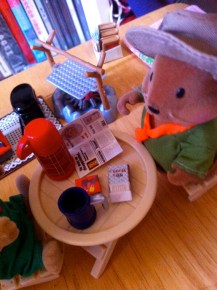
Willie reading the newspaper
Well, it’s been— I don’t know the exact numbers of days I have been spending so far in this new place, but it almost feels like a week or so. I could have gone to Randy’s as he himself and his lovely wife Brenda insisted – and they still insist! – and stay there until now, but I opted out for living here in the nature because I want to know more about this new place and feel the atmosphere myself in the most natural way, uninhibited by any superficial ways that creature comforts usually afford. Not that it’s bad, but that’s not my way of knowing a certain new thing. Maybe it’s because I’ve been a soldier too long, but I guess it’s in my nature. And in terms of the residents of this town, it’s hard for me to appraise their characters, tendencies, personalities, and so forth at this time. And people are people. As long as humanity exists, as it did thousands years ago, and it has been in existent thus far, there’s on one either extremely evil or angelically good.
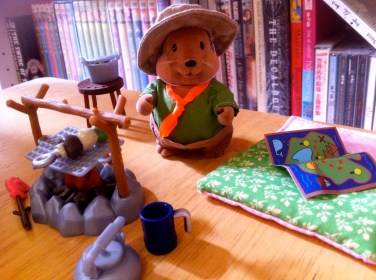
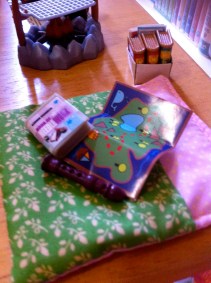
Willie’s books and map
I must say, it’s a life of pioneer in the West at this juncture. Thanks to the generosity of the park administration, I can stay here as long as I don’t cause fire and keep the place clean. Although I don’t have a tent, I have a good old army sleeping bag that I still keep from the Glory Days of The Cavalry, some food provided by good Randy and his lovely wife Brenda on a weekly basis, a radio, and books! I am a librophile, a term I coined to mean a book lover. I love reading nonfiction on the subjects of ancient history, mythology, and the Classics. Right now, I am reading Plutarch’s Lives, which is just wonderful to read! You know that Plutarch himself was Greek, but could understand the Latin language, although not to the apotheosis of lingual perfection, and could write about all those great ancient figures of the time immemorial!
Uncle Willie talking
In fact, I am talking in terms of Logotheraphy, the third Viennese School of Psychoanalysis found by Dr. Viktor E. Frankl. Yes, I read his book Man’s Search for Meaning. I know it inside and outside. Well, do I? But once in a while, you need to keep yourself detached from the crowd to ponder about what you have seen in Reality that shapes your mind in the way you perceive the swing of things in the world in your own way, all in order to establish your own Reality. Well, right now I am having the moment, a moment of laughing about my anxieties and anguish about myself and future. And this won’t last long, for in fact, next week Randy will help me set up some small business to start. And going from there, I will see if I can move onto the next big thing, another new step to climb up my Alpine Path, so steep but so worthwhile.
Sally writing at the end of the day
It was indeed a stellar Interview of The Day. What began with Sally’s uneasiness with her unknown subject ended on a high note -with a kindred spirit. Willie was an embodiment of living Logotheraphy, a human endeavor to live in quest for meaning of life. Also, Willie was something of an intellectual, a man who practiced what he preached like George Orwell, one of the favorite writers Sally admires all the time. With her Traveler’s Notebook full of wonderful accounts of the interview, Sally drove back to her home to type them, to publish urbi and orbi about a man extraordinary in thinking but ordinary in acting, that is, Willie and his Weltanschaung – the view of the world.
In the wee-hours of waking from a slumber which
left me bewitched and reluctant to slowly
return to Reality pervading me inch by inch,
My eyes saw them glowing in the twilight silently.
The faces – the faces! – those angelic faces
of the celestial choir of Cherubims and Seraphims
with the eyes of stars in the night sky, but alas!
those eyes, those starry eyes full of silent woes!
As the dawn’s breaking, and breaking ever rudely,
the faces with the fateful eyes becoming faint and fainter,
and the candlelight by the bedside flickering weakly,
My eyes saw the Lights of Life growing big and bigger.
That heartache puncturing my heart in every pieces,
filling the voids with perpetual pathos of longing
lingers in the remains of the days till my soul sees
the sorry faces to tell them I love you, and the love is never-ending.
In the passage of history, there have always been great transitions marking epochs of civilizations that have changed the structure and course of world history fundamentally, such as the fall of the Roman Empire and the Industrial Revolution. However, before these epoch-making events, before the birth of city states, such as Thebes, Athens, or Sparta, and even before the time of Alexander the Great, there was a collapse of a great ancient civilization during the late 13th and early 12th centuries of the Bronze Age that shook down the diplomatic and political systems of kingdoms of the Aegean, the eastern Mediterranean, and the Near East regions, dawning the age of the Iron Age. At the center of this momentous drama of human civilization, there were mysterious Sea Peoples. The Sea Peoples: The Mysterious Nomads Who Ushered in the Iron Age by Charles River Editors describes unsolved mystery of these invaders who wreaked havoc across the Near East during the late Bronze Period.
In 1200 BC, before the arrival of the Sea Peoples, a political and social stability was existent between the major powers of the region, which were Egypt, Hatti, the Aegean, and the eastern Mediterranean kingdoms under the modus operandi carefully crafted through a combination of diplomacy and military conquest. During this period, Egyptians, Hittites, Mesopotamians, Semites, and Mycenaeans on the Greek Mainland formed a kind of multiple interconnected societies and maintained an international hierarchy by means of trading goods and exchanging cultural artifacts. However, all of sudden, the Sea Peoples from the Mediterranean and the Near East raided the region at the end of this period by dismantling the stability of the region, as the catalyst for the collapse of the Bronze Age and thus changed the face of the ancient world forever. Then who are these Sea Peoples? What prompted them to raid the region?
It’s the Egyptian hieroglyphic texts (writing with pictures) that first and foremost depicted these mysterious people because the Egyptians fought them off three times successfully; however, it was Pyrrhic Victory eventually bringing out a butterfly effect to the region by greatly affecting the international trades one by one among the interconnected states. According to the Egyptian historiography – also known as “The Papyrus Harris” – of the nine Sea Peoples, the following are the most known of all:
• The Lydian: a tribe from a modern day Libya
• The Sherden/Shardana: a tribe from today’s Sardinia
• The Peleset: a major participant of the raid , believed to be originated from today’s Palestine
• The Tjeker: a tribe that claimed to be descendants of Troy from Sicily
• The Teresh: a tribe originated in Asia Minor then moved to Italy to become the Etruscan
• The Ekwesh: Achaean/Mycenaean Greeks
Between 1200 and 1050 BC, these Sea People with new innovative military tactics of mercenary services and weapons, such as swords, shields, and helmets made out of metals from the Balkan, began to move into the inland of the Near East with the influx of peoples from Asia Minor (modern Turkey) and the Greek Mainland possibly due to catastrophic drought and other environmental factors, including disastrous earthquakes on the Greek Mainland as recorded by Herodotus’s writing a thousand years later. Also, there was a precipitous increase in the population of southeastern Europe, which might have propelled the invasion of the Sea Peoples. In fact, it is known that some invasions of Sea Peoples accompanied civilians and even cattle, which betokened a possible migration intention following from such events. Besides, this was also the period when the epic city of Troy was besieged and finally destroyed by the Achaean/Mycenaean/Ekwesh raiders as recorded by Homer.
Subsequently, the repeated raids of the Sea Peoples in the course of time resulted in a dispersion of the new cultural, political, and social customs throughout the Ancient Near East, weakening the stable system of a coalition of states that was mostly provided by Hittites and Egyptians who relied on extremely archaic political and military system, such as relying on chariots at warfare, and a feudal system. Moreover, a succession of ineffective rulers, declining trading volumes, and crop failure in the regions might have contributed to the demise of the Bronze Age, which was only precipitated by the pesky invasions of the Sea Peoples.
There are many other theories of how exactly the Bronze Age came to an end as to the relation of these mysterious Sea Peoples and their impacts on the collapse of the great ancient civilization. Nonetheless, what is viewed herein is considered as a widely accepted theory of the end of the Bronze Age as comprehensively chronicled in The Sea Peoples: The Mysterious Nomads Who Ushered in the Iron Age. By understanding the cause and the result of this unknown, mysterious epoch, we can also relate it to the diplomatic and political situations of our time that do not seem remotely distant but disarmingly similar and thus learn something about human nature that does not seem to be changed after all these years.







You must be logged in to post a comment.