Tag: arts

  • Majestic, Tepid, Light

    woman-with-a-parasol-monet

    The dome of the spirit

    The palace of the heart

    Her sovereign realm is

    Locked in the darkness

    of the madness of loneliness,

    casting the eternal spells

    of sadness on the queen

    unwanted, unseen, unheard,

    betrayed by false courtesans,

    courtiers, father, mother, all,

    till the light of love casts over

    the weeping queen’s head softly

    with a gentle touch of the sun

    in all sweetness evermore.

  • ‘A Journal of the Plague Year’, by Daniel Defoe – review

    A Journal of the Plague YearA Journal of the Plague Year by Daniel Defoe

    My rating: 5 of 5 stars

    The biblical cyclicity of history proclaims that what is happening now happened before because there’s no new thing under the sun. As I agree with the cyclical history theory, I prefer stories that confirm the continuity of human nature, which results in this felicitous book I came across on the Kindle store. The precedent epidemic scares and the response to them in Daniel Defoe’s A Journal of the Plague Year, a classic 1722 account of the Black Death that devastated England from 1664 to 1665, do not read no less different than ours. Defoe’s recounting of the plague successfully resurrects the spirit of the epoch as his narrator guides the reader to the places and scenes of the seismic event in the capacity of a charitable and knowledgeable guardian of posterity, making them surprisingly familiar with ours.

    It is a literary eye-witness account of what happened during the resurgence of the bubonic plague that had ravaged Europe hundreds of years earlier in the semblance of a nonfiction narrative. Even though Defoe was only five years old when the plague swept England, his fictional narrator feels very real and the account telltale as though it had been written it in the spirit of Veni Vidi Vici. So much so that the story seems more veritable than the counterpart of Samuel Pepys, whose narrative feels comparatively prosaic without the personal charm of the narrator. The reader will also learn that the 17th-century modus operandi of dealing with a pandemic is not that far from the current 21st-century preventive measures of social distancing, personal hygienic disciplines, and other relevant systematic societal restrictions.

    Defoe holds up a mirror to his posterity that shows what it was like during the epidemic scare and what the people from days of yore did to sail through such calamity as a wise and warm advisor to our current global pandemic situations. In fact, while I was reading the book, I was surprised by how similar the cautious measures decreed by the authority were then to our own now. In my opinion, this book replaces Boccaccio’s The Decameron as a must-read during the pandemic, because of its power of reality drawn on empirical oral accounts so close to the lives of the ordinary folk that we can relate to our own time.

    View all my reviews

  • the journal of cat writer #1

    additional_7a1d79197752605194d5b4ab7d9c394967566b14-8

    The Roman emperor Marcus Aurelius said, ” Don’t feel harmed, and you won’t be, and you haven’t been.” Centuries later the emperor’s medieval Christian heathen Thomas Aquinas corroborated that no words should do harm on the soul of the heard. Well, it’s easier to say than to be done, especially from the high chairs of big wigs. So much so that none of those self- hypnosis of affirmation prescribed by the privileged rings true to me as I am trying to put together pieces of my heart.

    The cause of the malady of the heart ensues from my twitter correspondence with a literary man over my prescient knowledge of Theodora, a former comedian turned the wife of emperor Justian of East Roman Empire in the 6th century A.D. She was later canonized in the Eastern Orthodox Church, and her feast day is November 14, which he had denied. As it is my nature to strike up a meaningful conversation based on knowledge with an intelligent person with seeming affability, I commented on his tweet politely in bona fide intention to inform him of ill-conceived intelligence. However, the response felt heartbreaking with a blunt inflection that froze my heart instantly.

    By the spirit of utilitarian knowledge, I guided him to Wikipedia source that corroborated the fact. Despite his gratitude for the rectification, the disheartening incident has only cemented my long-term speculation that it’s either I was born luckless to have a seamless casual conversation with a stranger or I am hexed to be kept from anything nice even to the simplest and smallest degree happening to me – ever. Methinks, everything I think and touch turns useless gold with a feckless Midas touch.

    As Shakespeare aptly described, my nature is modulated by what it works in, like the dyer’s hand. I have also found that these flaunty intellectual men and women in the habiliment of affable erudition often turn out to be a superficiality of knowledge and disappointment of heart, floundering me ever in the lurch of disillusion. Moreover, although they seem so dazzlingly smart, they are not always omniscient. Maybe, I think, unless you are educated under the tutelage of kindly Chiron, the wise elderly centaur to whom Achilles, the son of Thetis, and Asclepius were entrusted, the immaculate acquisitions of knowledge and cultural finesse require divine intervention.

  • ‘The Legend of Sleepy Hollow’, by Washington Irving – essay

    51phPvWhOmL._SX381_BO1,204,203,200_

    Shakespeare once said that ghosts were amiable, harmless in want of company to console their haunting loneliness, lost in the crossroads between this world and that world. But that is not the case of the headless ghosts – the angriest and most terrifying of all other specter ilks, evoking the most primitive sense of fear to the eyes of beholders by the sheer eeriness of the appearance.  Because they despaired and died in oft violent ways, the headless ghosts are putatively the most furious and vengeful with the domes of their souls forever lost. No wonder there are legends of headless knight riders prevalently existent in the universal world.

    Meet the famed headless nightrider of the Sleepy Hollow in New York. Originally hailed from a province of old Germany, he used to be a soldier fighting on the British side during the Revolutionary War who was decapacitated by an American cannonball. His battle buddies buried him without the missing shattered head. The residents of Sleepy Hollow believed that the soul of the unfortunate young German soldier risen from his grave by his supernatural ire burning with vengeance against the earthlings that killed him was restlessly riding his phantom horse at night furiously brandishing a Jack-o’-Lantern in a semblance of face made out of a displaced pumpkin as his a makeshift head, glowing in a flame of fury as to light his nightly way.

    The indelible image of the restive headless horseman is terrifically and vividly resurrected by the literary alchemy of the great American writer Washington Irving in “The Legend of Sleepy Hollow” in which the unlikely protagonist of a meek, naive, willowy school teacher of New England by the name of Ichabod Crane stumbles into his frightful encounter with the Horseman on his fateful night during his doomed journey home. Woe betided the unfortunate benevolent schoolteacher believed to be spirited away with the headless horseman to the legion of wandering spirits in between the world of the living and that of the dead till the eternity.

    Apart from the spectral elements of the story, Irving’s characters in the story convey the displaced post-colonial sentiments of unease for the present and uncertainty for the future in the chaotic aftermath of the war that was supposed to beget promptly promising bright outcomes to the post-colonials. The nervous semi-detachment from the old world’s cultural and political authority and the unsettled practical value of the war due to all kinds of border chicanery in the still socially volatile post-war valence of setting intersperse the story in the fumbling figure of naïve Ichabod haunted by the furious ghost of a fallen soldier from the war. The legend of Sleepy Hollow is Irving’s superb storytelling of the birth of a new culture begotten from its old motherland at its infant stage of building a national character afresh with its own cultural capital, such as folklore endemic to the new land of hope that Irving so cherished.

    The good teacher Ichabod Crane

    Flees from the Headless Horseman

    With all his gentle might in vain

    For the ghost rider outruns the man.

    Now the riders roam in the shadow

    Looking for recruits in Sleepy Hollow.

    P.S. This short essay on Washington Irving’s ‘The Legend of Sleepy Hollow” is my contribution to a weekly Twitter event whose theme for this week is ‘The Headless Horsemen”, which seems to prevalently existent throughout the cultures of our global village. What uncanny synchronicity is to come upon this subject matter since I am currently reading Irving’s eponymous book that also contains many other stories from his wonderful ‘Sketch Book’.  

  • fee-fi-fo-fum, fee fi-fo-fum

    tumblr_p90r2uwPnN1vuvoufo1_400

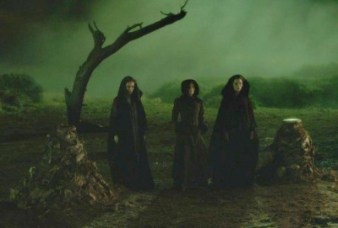
    The owl hooted on the oak,

    The crow cried in the dark;

    Dogs howled on the hills,

    Cats purred in the bushes;

    The Night was ripe and ready.


    Fee-fi-fo-fum, Fee-fi-fo-fum,

    The Three Witches began to hum

    Standing in the grim gray garbs

    With the gray eyes glaring in silence

    They were ready to tell his destiny.


    “Scotland, the jewel of thy crown,

    The sword calls for thy title to own,

    The blood is thy sacred power,

    As it runs redder and deeper.”

    Thus, the prophecy of his fate’s cast in

     Fee-fi-fo-fum, Fee-fi-fo-fum, Fee-fi-fo-fum!


    P.S.: This week’s #FairyTuesday theme on Twitter liberally encompasses witches, ghosts, and other supernatural beings, so my choice is the Graeae, the Three Sisters personifying the Fate of Man in the ancient Greek mythology. They had only one eye and a tooth to share, but the pre-Herculean Mycenan hero Perseus intercepted the eye when the Sisters fumbled with it in the air and forced them to answer the whereabouts of Medusa. They ultimately relented to the demand, whereupon Perseus set about killing Medusa. 

    This image of the Three Sisters is then also wondrously associated with the Three Witches of Shakespeare’s Macbeth by the sheer dint of the somber, dismal greyness of the three uncanny women. But as Mcbeth was a tragic figure consumed by guilt and greed, so were the Three Witches, malevolent and dystopian, vis a vis the somewhat faltering and fumbling Grey Sisters menaced by Perseus bullying them to elicit what he wanted to know. 

    This poem, however, is more of Macbeth’s Three Witches leading him to perdition because the grim image of the witches conjured up by Shakespeare is terrifically atmospheric and dismally spell-bounding without the pageantry of words and expressions. 


  • ‘Fairies: A Dangerous History’, by Richard Sugg – review

    Fairies: A Dangerous HistoryFairies: A Dangerous History by Richard Sugg

    My rating: 5 of 5 stars

    According to the races of the supernatural world, there are classes of spiritual beings that humans have arbitrarily defined with ostentatious pedanticism. For we treat the otherworldly guests of honors, such as archangels, angels, principalities, vampires, werewolves, trolls, big-foots, and even extraterrestrial aliens with awe-inspiring reverence. In contrast, fairies are regarded as sort of the underclass, juvenile guests reluctantly invited to a terrific festival of supernatural beliefs. Such spectral discrimination, argues author Richard Sugg in his Fairies: A Dangerous History, results from the fact that unlike demons, angels, and other ethereal beings of educated Christianity, fairies are in want of respectful scholarship codifying their existence and nature, cultural influence on arts and literature, and spiritual elements of faith/belief traditions in lettered authority.

    The book is a meta treatise on why the author himself believes in the belittled mystical beings’ existence. Sugg takes us to Shetland’s remotest area to listen to a nonagenarian man whose vivid memories about fairy sights are amusing. Thenceforth, the author brings the readers to the fantastic feasts of fairies as seen and described by William Shakespeare and Edmund Spencer as the rulers of the Vegetable Kingdom in their Elysium of poetic fancy, Sugg keeps us hooked on pages after pages filled with his magic spells of words because he sees and believes in fairies with their own dangerous history. It is dangerous because the truth about them is theologically reasonable, spiritually potent, culturally dominant, and physically palpable.

    In sum, this book is one fascinating account of fairies that serves the author’s purpose of educating and entertaining readers. The book is filled with the glamour spells of the author’s erudition. This book is something of the authorial account of the Fairy Folk.

    View all my reviews