Tag: arts

  • The Wild Swans

    bd89b1323a2812ff7f637940f9384d74_74
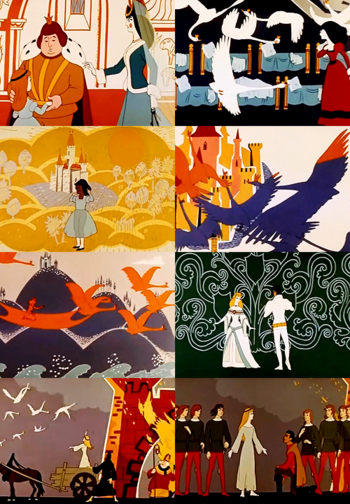
    The Wild Swans (1962)

    Once upon a time, in a kingdom of the shore

    A wicked witch queen out of envious spite

    turned her eleven stepsons into swans, wherefore

    Elisa the dolorous sister drifted away in a plight

    Till she chanced upon the fairy queen in her chariot

    Who saw the golden heart of the princess that moved

    The fairy caprice and told her with thorny nettles to knit

    Shirts for the swans to break the spells with her lips sealed;

    Such was Elisa’s vow, and the vow took her to her encounter

    With a gallant beauteous king of the strange land faraway

    Falling for her silent beauty, keeping her in his chamber of amour;

    But the zealous archbishop and his ilk viciously sent her away

    To a stake for witchery, for her silence was otherworldly;

    As the ambers of fire were bursting around her fast and faster

    The swans with crowns appeared in the dusky sky from the yonder

    And Elisa threw the shirts at the swans, and lo! the men stood there;

    Then the fiery fires blossomed into pretty white flowers around Elisa

    Lying on the bed of the flowers, which the king plucked and placed

    Upon his lover’s bosoms with drops from his welkin eyes, whereupon

    Her spirit returned from a departure to the ether exalted, elated

    By the end of the old and the beginning of a new life in the kingdom

    Where there’s no other world beyond the lovers’ union heart-to-heart. 


    P.S: One of my favorite fairytales of all time is “The Wild Swans” by Hans Christian Andersen because of the travails that the princess Elisa endured for the love of her brothers and her fathomless patience akin to that of martyrs of the early Church in spite of unthinkable pains of horrendous tortures and gruesome ways of execution for their unswerving faith. What’s more, I love the fact that the king was not only infatuated with her external beauty but also her internal virtue distinguished from all other beautiful women who would vie for his kingly attention. Their love was no less glorious than that of Romeo and Juliet, for the king loved her for the dangers she had passed, and she loved him that he loved all about her, still and ever. Hence this is my contribution to #FairytaleTuesday whose theme for today is a fairytale with an element of lovers in love on Twitter. 

  • Officially Haunted, Really

    2ddcc1fd40814bbf40437d087f498150

    Prologue: I wrote this post in March of this year upon reading an article about historic haunted places in the UK from a subscribed issue of ‘BBC History Revealed’. I wanted to contribute my knowledge about the Whaley Museum in Southern California in a letter to the editor. The new July issue arrived on my Kindle Fire this morning, and I saw my letter featuring therein. It was edited in the context, but only for the perfect perspicacity. The letter is, in fact, one of the fifth letters that have been so far published in the magazine. 

    Sometimes they either don’t know they are dead or wouldn’t accept it because of strong attachments to their once earthly abodes. You may think it’s a puerile imagining to believe in ghosts, but there are indeed more things in heaven and earth than are dreamed of in your philosophy. As someone keen on supernatural phenomena happening in the background of our ordinary landscape of daily life, it gave me a fillip when I came upon an article from my subscribed history magazine the other day about the historical capital punishments going horribly awry as though to use the grisly scenes of capital punishment as a reminder of societal retribution for an eye-for- an eye. It also reminded me of a story of the condemned whose ordeal of execution was so unbearably painful that he is still roaming around at his execution site as though with eternal lingering attachment to his earthly life.

    Here in Southern California, the story of James Robinson (aka Yankee Jim) who was executed for attempted grand larceny in San Diego in 1852, is something of haunted folklore that attracts tourists and ghost hunters alike. He was hanged on a gallows off the back of a wagon, but being a tall man with long legs, he resisted being killed by keeping his feet in the wagon but was at last pulled off. His body then swung like a pendulum until he strangled to death. And it was this very site of hanging that one Thomas Whaley, who happened to witness the execution himself, built his dream house where he and his family soon began to hear the unexpected phantom footsteps as if being made by the boots of a large man, walking noise, and the windows mysteriously unlatched and opened up. Lilian Whaley, the Whaleys’ youngest daughter living in the house until 1953 was certain that it was the ghost of Yankee Jim haunting their house. Now the Whaley House is the Whaley Museum, a California Historical Landmark located in Old Town, San Diego, California.

    However, ‘Yankee Jim’ still lives there because although unseen, his presence is felt and heard by visitors and staff at the museum. Never malicious or naughty, the ghost of the hanged man is said to rather shyly manifest himself by footsteps, markings on the wall, or opening and closing of windows. So much so that the Whaley Museum, along with the Winchester Mystery House, is certified by the US Department of Commerce that it is genuinely haunted. So if you live in Southern California, it’s worth visiting the Museum and Jim. I think I may pay a visit. The address is 2476 San Diego Ave, San Diego, CA 92110.

  • alchemist and four fairies

    all

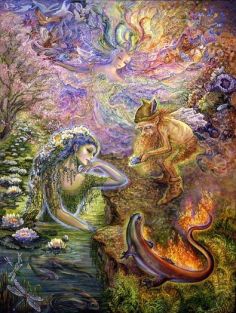
    An old alchemist had assistants

    Of Craft from Titania’s Kingdom

    And they worked for him at nights

    in return for fairy food abloom.


    Salamander belched out a fire

    Under the tripod holding a beaker

    In shrill forever fiery yellow ire

    that grew hotter and madder;


    Until Undine’s Purified Water

    From the well of Fairy Realm

    Boiled and bubbled in the beaker

    She watched with pensive calm;


    As Gnome put a sorcerer’s stone

    As black as the Stygian River

    From the bottom of Earth alone

    Into the Water like a wise thinker;


    While Sylph was breathing Air

    Into the Earth joined with the Water

    And the Fire in the Craft of Wonder

    Creating Gold and Elixir in Splendor.


    P.S.: The fundamental personality types are sanguine – red (hopeful), choleric-yellow (ireful), melancholic -black (shy), and phlegmatic -blue (calm). In fairy-tale theory, the following fairies represent the four elements: Sylphs – air (red), Salamanders – fire (yellow), Gnomes -earth (black), and Undines – water (blue) . Hence this poem is an amalgam of the aforesaid theories conjured up in my mind’s eye.

  • Fairy-Tale Tuesday: Queen Titania and her Courtesans

    P.S: It’s Fairy-tale Tuesday on Twitter, and this is my poesy contribution to the weekly fairy twitter feast for those of you who take a fancy to fanciful elements and dwell in the beauty of the mysterious nature.

  • the secret of the sea

    Scylla-and-Charybdis

    In the wilderness of the great ocean

    Lies a secret script of the Fate of Man

    Sealed in the silence of tidal motion

    In dissimulation of the opprobrious plan

    Harboring the secrecy of the Age of Man

    That gods so have kept to themselves alone.


    The Ages of Man, the Plays of Man

    On the Stages of Acts in Humanity –

    Those gods wrote and watched for fun

    In the theater of Comedy and Tragedy

    As the Wheel of Fortune decided what

    Would be played the next, and whatnot.


    The heart of the ocean sends a pulse thru me

    Of the secret hidden in the watery main

    With the sunny breeze that pushed Odyssey

    To sail forth against the forces of the divine

    To find and write a new Age of Man to witness

    The victory between the Scylla and Charybdis.


    P.S.: This is a poem written out of my existential crisis in the reflection of Herodutus’s theory of the Age of Man. I am not a fatalist but a believer of luck as Shakespeare was. I believe that time and chance are what ascribe to the fulfillment of your ends in life or for the nonce. Didn’t Thomas Alba Edison also corroborate that a genius is made of 1 percent of ingenuity and 99 percent of efforts? I want to embark on an Odyssey to claim my own destiny.

  • The Heroic Age Revisited: ‘The Tale of Troy’, by Roger Lancelyn Green – review

    The Tale of TroyThe Tale of Troy by Roger Lancelyn Green

    My rating: 5 of 5 stars

    History is a branch of literature woven by artists and artificers with stories full of events, places, and people embroidered on the latticework of time, which mirrors the invariable pith of humanity to posterity. In truth, history is a literary creation of reality in the habiliment of artistic imagination, which we call mythology. In this regard, The Tale of Troy by Roger Lancelyn Green is a refreshingly cracking retelling of historical Trojan War knitted together with mythological strands as though to be seen from a magical casement to the misty antiquity, which Herodotus defines as the Heroic Age of the Five Ages of Man (which, by the way, Ovid interestingly omitted in his Roman version of the Ages of Men) when divine immortals responded to your pleas directly and promptly and freely made love with their beautiful mortal subjects with unquelled divine lust.

    Drawn on a compendium of classical narratives of ancient writers, principally Homer’s Iliad, Green retells the beginning and end of Trojan War, reprises the scenes of the heroic characters and capricious Immortals, and remasters the thematic theater of dramas collapsing a great divide of time and space with his genius story-telling skills as an erudite but affable raconteur. Green takes you to the wedding banquet of Menelaus and Helen in Sparta where the goddess of discord Eris first presented an apple of discord, to Paris of Troy happily living with Oenone, a mountain nymph, on Mount Ida, to the Greek Camp outside the Wall of Troy where Agamemnon and Achilles were having a row over their beautiful Trojan female captives, and to Odysseus’s 10-year journey back home in Ithaca. The tale of Troy regenerates more stories about the fates of the characters following the end of the epic war, which leads to the dawn of the Iron Age, the Age of Man, in which we live. The Tale of Troy is a literary equivalent of Matryoshka, a frame story that presents manifold stories that delight you with pleasant surprises.

    The great Roman poet Horace once said it’s harder to treat a story in your own way. In fact, to retell a story is harder than to create one from void because it requires a special ability with the aid of natural wit to make the original source texts adapt to the contemporary readership of the time the author belongs to. To that effect, this book is a magical casement of the misty past told by a Homeric storyteller of our modern time who will take you to where the ancient ocean sends forth the breeze of the shrill Aegean Sea to let you sail an imaginary voyage with the Greek Kings and the Trojan refugees, while the Olympian gods are watching you from Mount Olympus.

    View all my reviews