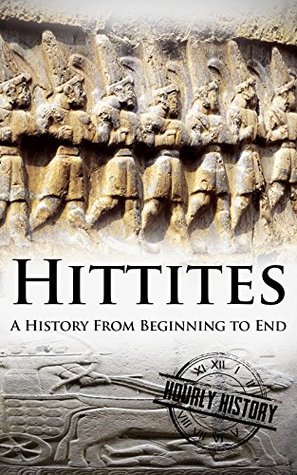
Hittites: A History From Beginning to End by Hourly History
My rating: 5 of 5 stars
The name Uriah always fascinated me from British Rock band Uriah Heep to the biblical Uriah, whose beautiful wife led him ultimately to death, willy-nilly, by King David infatuated with her sensuousness. When I learned that the ancestor of Uriahs was the founder of the Hittites race, being the great-grandson of Noah, the biblical patriarch, I had a Eureka moment. Consequently, I picked up this concise but comprehensive book on the Hittites to know a little more about the people whose founder had the great name.
Before the splendor of ancient Greek contributions to our human cultural progress as a collective enterprise, there was the forgotten but enduring legacy of the Hittites, the mysterious Indo-European trailblazers of civilizations at the crossroads of the East and the West in the vast plain of modern-day Turkey. The Hittites were an integral people to solve the mystery of mythological and biblical events anchored in the real world, thus dissolving fact and legend into one another like a genie from an empire that vanished into the dunes of time and comes alive in the calling. The calling of these mysteriously vanished people came first from British Reverends Archibald Henry Sayce and William Wright in the early 19th century. They discovered the artifacts and sites of the Hittites. Their discovery led to more remarkable discoveries. During the middle Bronze age and Iron age, the Hittites were the first to utilize iron from the region of present Armenia to craft tools and weapons. Also, the Hittites were deft at commerce, developing the city of Carchemish as an ancient mercantile hubbub in which they imported products from Phoenicia and exported them to Assyria (the North) and Babylon (the South) in Mesopotamia. In this fabulous ancient city, Israelites of the Old Testament acted as intermediaries in trade between Egyptians for exporting horses and chariots and the Hittites for importing them.
Like all those famous entertainers who sparkled then lost the lusters, the Hittites as a collective empire fell from splendor gradually by outside forces: some pointed the fingers at the Sea People, while the others blamed a certain barbarous Kaska people. But, perhaps, such clandestine ending of the Hittites is what makes them formidably alluring and mysteriously fascinating, blurring the boundary of fact and legend. Suppose you are keen on the history of ancient civilizations other than Greece and Egypt. In that case, this elegant primer for the history of the Hittites will equip you with fundamental knowledge enough to whet your craving for more and more profound knowledge about the Hittites.
View all my reviews

Tag: blogs
-
‘Hittites: A History From Beginning to End’ by Hourly History – book review
-
blah, blah, blah and lord of the flies
Greta Thunberg is an 18-year-old environmental activist who has risen to a child crusader against the corruption of the world, not for incorrigibly persistent unequal distribution of wealth within society and among nations, but for the blahs of the world leaders who irk her nerves for not listening to her pleas to save the earth. In all fairness and recognition of her endeavor to raise red herrings on environmental issues, I applaud her to the very echo. But why is it that I see in the face of Greta talking “Blah, Blah” the faces of the boys chanting “Kill the beast! Cut his throat! Spill his blood!” from William Golding’s Lord of the Flies? Or is it that I am a seriously near-sighted adult whom Greta forthwith denounces as politically and culturally blinded conventionalist speaking the Blah only?
It was interesting to read and watch Greta’s speech at Italy’s Youth4 Change, growing more prominent and bolder with a singular air of superiority. It bestowed upon her a right to mock the world leaders, including President Biden and Prime Minister Johnson, in their conference for environmental issues. Her English was flawlessly articulate, with accents that denote her fierceness of character and feistiness of personality. Indeed, such a high level of confidence is highly remarkable and undeniably recommendable. Still, there is a distinction between arrogance and confidence regarding the speaker’s manner of speech and demeanor. The subject brings me back to the wild Boys of the Lord of the Rings, in which the gentle-mannered protagonist Ralph is soon abdicated by the rebellious Jack, who provokes ids in the followers of Ralph to subvert the order and to rule the tribe. Greta’s rhapsody about youth as not being “blinded by realpolitik and the assumption of compromise” sounds like a youth manifesto from Peter Pan. He never gets old to build a society of the young only. But does Greta know youth is wasted on the young?
Also, I wonder what Greta thinks about those at her age and younger underprivileged, mistreated, and malnourished worldwide if she is so concerned about the earth’s well-being, for we are the earthlings. Does her activist profession disavow acknowledging and addressing the humanitarian crisis because it is trivial compared to the lofty environmental ideal? Come to think of it; I have seen fewer youths making substantial movements toward eradicating hunger or preventing child abuse, including but not limited to sexual nature systematically worldwide. It comes to mind that people who use children for their political and social ideologies don’t regard such concerns as being worthy of being mobilized with the child drummer in the front. What is the difference between a child soldier recruited elsewhere in the world and a child activist under a supervision of a master adult activist?
What I feel about Greta and her famous Blah address is probably no different from what Shakespeare must have supposed in Elizabethan England: “Woe to that land that’s governed by a child, tis much when scepters are in children’s hands, there comes the ruin, there begins confusion.” Maybe that is what William Golding envisions in his fictional island where children’s mutiny proved to be as catastrophic as those on the Bounty or even more. So that is my undiluted sentiment toward Greta, smiling, chanting “Blah, blah.”
-
meadow at dawn
The first ray of light from heaven dispels
The gray silence of night lost with lusters
With pale hues of the sun in the soft sweetness
Lingering in a lake of shimmering waters.Iris unfolds the wondrous seven colors
Weaved into an arch of dreams and hopes
Always new and fresh in never-ending grace
That fills with pleasure the hearts of beholders.Aurora releases dewdrops from crystal buds
Made of moonbeams, stardusts, and starlights
Kept from a visiting moon and traveling stars
Washing the faces of earth with heavenly pearls. -
Toro is back

St. Frances de Sales’s advice, “Have patience with all things but first with yourself.” is no more so than with the three weeks’ heartbreaking ordeal to win back my cat Toro’s trust in me. His traumatic visit to the veterinarian now seems to dissipate across the feline Elysium slowly, or so I want to think. He is not hiding under the bed in my presence, becoming a sweet writing company on my desk once more.

I have recently watched a YouTube that goes viral about an unlikely friendship between a stray cat and a young woman, which makes me think of my relationship with Toro and what it means to build trust between two lives. The woman found a stray tabby cat around her house and began to acquaint him with food. She named him “Tiger,” not least due to his perspicacious tiger stripes and adorable feistiness, giving him a distinct personality and charms that were all the more endearing to the sensitive woman who was also in need of company in her solitude.
Thenceforth, they became complementary to each other for consolation, security, and most of all, love. Tiger is still his feisty self, and the woman is still trying to adjust herself to his whims and caprice. Still, they feel comfortable in their presence and love. The tears welled in the windows of her soul when she said that building trust between two took time and patience. You can’t make someone love you arbitrarily by force. You don’t need a love spell or magic potion to enslave someone into your desire of possessing the body and mind, as the ancient Greeks and Romans used to. Without Psyche, Eros would not/could not have culminated in perfecting the art of love as a primordial god of Love.

Toro is in some way like Tiger: his name means a little tiger in Japanese with his distinctive stripes, and M signature proudly marked on his little forehead. Although not as feisty as Tiger, Toro has a remarkable personality of adventurousness, curiosity, playfulness, and resilience, all affectionately wrapped in his good nature. But I don’t take for granted that wonderful Toro is my cat, and therefore, I deserve his trust and love. Animals, especially pets, also have hearts that pump up the blood and feel the feelings. I regard them as friends, companions to enrich our existential human lives with a touch of sentimentality that we hardly express when we are among our species in fear of being regarded as a sign of weakness. And I am always thrilled to feel his little heart at my feet as a friend.
-
‘Forgotten Peoples of the Ancient World’, by Philip Matyszak
Forgotten Peoples of the Ancient World by Philip Matyszak
My rating: 5 of 5 stars
Forty years on our evolutionary scale amounts to a microsecond on our twenty-four biological clock. The millennium years, even Before Christ, feel so alienly anachronistic from our modern sensibility. The sense of time builds upon a fundamental element of consciousness as molded into a collective emotional experience as contemporary citizens of the world, just as the peoples of the misty pasts we tend to overlook felt the same for the civilizations before them. They were the titans of the pre-ancient Egyptian, Greek, and Roman cultures. They, like the evening sun in its full declination, vanished in the hazy horizons of the time, still dazzling with its scarlet hues of radiating halo lingering on the remnants of human civilization to this date.
Forgotten peoples of the Ancient World is an anthology of the peoples whose feeling of permanence and importance in their time of the world betrayed their fates buried in the tires of cities beneath the earth and returned to the dust in the winds. To illustrate, Akkadians were the first builders of the empire who elevated the Akkadian language to the cultural and political lingua franca of the late Bronze Age. The Hyksos were outstanding charioteers, and their military prowess benefitted their Egyptian subjects. The Bactrian culture was a delightful mixture of Greek and Indian heritages, while the Vandals gave a final, fatal blow to the already destabilized Roman Empire. These peoples affected the celebrity civilizations we are automatically associated with the ancient civilizations. As to why the forgotten peoples became peripheral in our realm of ancient history, it is a question of the immanence of the supreme being in the universe. However, what is certain is that they were the torch-bearers of the first civilizations passing the torch of society they had ignited and encouraged to the next in a relay run of collective humanity.
The book is an excellent anthology of these ancient peoples in chronological order from east to west, showing how civilizations expanded from the cradle across the plains, mountains, deserts, and seas to the Isles of Britons. Divided into the eras marking the epochal changes of history, Matyszak succinctly elucidates the peoples of the misty past with his trademark witty ways of describing historical contexts. Moreover, the exciting historical trivia resurrects the eras in a phantasmagorical display of faces and places.
To conclude, the stories about the forgotten peoples attest to the objectivity of truth applicable to any time of history that that which is here was there, has been, and will be. All things must pass, and there is nothing new under the sun. Our sense of time and culture is a likeness of truth, a matrix-like reality, because our facility is rather instinctive than reasoning, rather physical than metaphysical. Who would have known that people 100 years later now would think our time and us in this time anachronistic and antediluvian? Herodotus felt the same when he arrived in Egypt and saw the wondrous pyramids in awe that the people before his generations had built. So did the Babylonian king, who dug and discovered artifacts from centuries ago. We have seen the hungry ocean gain advantage of the kingdom of the shore, and the firm soil win of the watery main, increase with loss and loss with increase. The forgotten peoples and we are time’s subjects, and time bids are gone.
View all my reviews -
Paid forward by a Stranger
The French existentialist Jean-Paul Satre was a cynic when it came to the milk of human kindness. He smirked by saying that generosity was more or less a feelgood giveaway of the doer in the self-contentment of magnanimity. The intention is ego-driven, not altruistic. Satre may be a brilliant intellectual in the post-modernistic world, but he was essentially missing something, obviously not knowing it for the following reasons.
I still remember a lecture given by a religious sister whose spirituality bloomed in her charity and intelligence about the practice of charity in our daily lives, rather than doing it as a penance after a guilt-ridden confession. For you never know, the one benefitted from your kindness might be an angel in disguise (the mysterious shopper!) or even Christ himself (the Lord of Lords!) So, how will I interpret an act of generosity when a total stranger paid for my sandwich at Subway?
It was a rather gloomy afternoon today because of the disappointment with the general members of humanity that I felt most acutely painful to my glass heart. The things deemed trivial or insignificant matter to me, stay in there until I burn them with candlelight under moonlit tranquility of the mind. Samuel Johnson is right in saying that you cannot will away the unpleasant feelings in full force at once. That is why we object to despotic edicts of stoic austerity to quell the perturbed state of mind. The Sun was high, but the spirit was low, and I could not pretend to be cheerful and optimistic as if there was no word for Unpleasantness in my dictionary.
So when I was in a nearby Subway store during lunchtime, I felt wretched and wished that the time would go fast so that I could go home with the alacrity of departure. But no, the reality bit when a store clerk asked me if I wanted my bread to be toasted. No, I said politely and proceeded to the counter for payment, when the register guy told me that the man before me paid forward my sandwich. Really so? But I didn’t know him. There were two men, seemingly office workers from nearby, coming for some quick bites like me. And I still don’t know which man paid for mine, but what does it matter when both of them are total strangers anyway? Then I checked my reflections on the outside building’s crystal-clear glass windows and saw a woman decently presentable looking in thin figure clothed in a DKNY tweed jacket and Michael Kors jeans, which disqualified me for being a hobo woman. So why did he pay forward for my Tuna sandwich?
Whether he was a confessional penitent doing penance or an angelic agent is still a mystery, but then something is better to remain as it is, I think. The unexpected surprise from the stranger put my emotions on the continuum of low arousal on one hand and high pleasantness, on the other hand, creating satisfaction that my life could be likable and ultimately livable. It’s a small pleasure that keeps my sailing endurable and doable in a wide ocean alone against monsters, thunder and lightning, and doldrums. No wonder the sandwich tasted sweet.


You must be logged in to post a comment.