Aesop’s Fables by Aesop
My rating: 5 of 5 stars
Last week, I reread Aesop’s Fables as an adult (that is, in terms of the ages on an evolutionary scale) in the 21st century and found them just as attractive as the first time reading it as a child. What a feeling! A freed slave once, Aesop’s natural wit combined with protean imagination made him able to investigate the essence of things, the nature of things, and attribute it to human nature’s characteristics, which ultimately brought him mortal death and immortal life. He was, in a way, a lot like Hephaestus, the god of fire, blacksmith, presider of the arts, and the only legal husband of the goddess of love and beauty Aphrodite who found him unbearably unromantically ugly.
Aesop’s Fables still scintillates in the brilliance of affabulation and humor that nicely relates to Nietzsche’s concept of immanence, the understanding of nature of all things; the Natural Law called conscience the supreme ruler of the universe has inculcated in us. The Fables are full of lessons that are akin to Jesus’s parables employed in his teaching of ethical codes for Christians in daily life. Of course, Aesop was of the Pre-Jesus era. Still, his stories bespeak something of human nature that had already existed, which is ongoing and will continue as long as humanity exists. The cardinal virtues of prudence, justice, temperance, fortitude, and Christian values of faith, hope, and charity are all embroidered on the elliptical, imaginative, and impressive episodes of and among humans, animals, and even gods in this immemorial anthology of ancient wits. “The North Wind and the Sun” teaches about the force of gentility over the fear of intimidation. “The Woman and Her Hen” resonates with the timeless adage of everything in moderation. “The Milkmaid and her Milk Pail” corroborates the famous proverb that you should keep a bird in your hand than catch two in a bush. Treating others in a way you want in reciprocity illustrates the dinner scenes in “The Fox and the Stork.” And yes, I believe President Ted Roosevelt must have gotten inspiration from “The Astronomer” that you should look at the stars while keeping your foot firmly on the ground. And there are more stories to wow modern readers.
Aesop’s Fables are so practical and amusing that all of them collapse millenniums between his telling and our reading it. Besides, all of them read like Book of Proverbs or Psalms in free verse or prose version, which makes the reader unburdened with textual analysis to decipher meanings intentionally obfuscated by the high intellect the academic writers of the sort. The Fables are comprehensive to all, serving a purpose of providing tenets of reading; to bestow pleasure of the sense and satisfaction of reason in a way you do not consult a help of a dictionary or other lexical or literary reference. Reading the Fables gives a feeling of watching a TV cartoon, say Woody Woodpecker, which tells something about man’s nature wrapped in an animal hide. So do not fear reading Aesop’s Fables now. It is well worth spending your free time discovering the universality of the truth with that “A-Ha!” moment regardless of the subjectivity of time.
View all my reviews
Tag: book essay
-
Aesop’s Fables
-
From Egypt with Meow: ‘The Cat in Ancient Egypt’, by Jaromir Malek – review
The Cat in Ancient Egypt by Jaromir Malek
My rating: 5 of 5 stars
I admit that most of my posts relate to the cat nowadays. But what else should I write about when an orphan kitten enters my castle and in need of care and love? My five-month-old cat Toro is a domestic short-haired breed as subsumed by a vet at the shelter, but his appearance and characteristics make me believe that he must be a descendent of Egyptian Mau. My conjectural reconstruction of Toro’s possible ancient scroll of his family (paternal) led me to Jaromir Malek’s The Cat in Ancient Egypt, which tells all about how cats became naturally harmonious with humans, which played a significant role in the anthropological and social aspects of splendid ancient Egyptian civilization.The domestication of cats resulted from the advent of agriculture when man began to settle on the farm, and civilization came to blossom. It was about 1,500 years later than the domestication of dogs as hunting assistants to men. Of all the ancient civilizations, the Egyptians sow the seeds of love between the cats and humankind. Abounded with various fauna and flora benign to the human inhabitants, the jungle cats and African cats thrived and became familiar animals to the Egyptians, who began to use the cats to drive off pesky mice poisonous snakes threatening their lives and crops. Naturally, wild cats gradually learned to adapt their wild instinct to their new protective human environs.
The frequency of cats’ representations in ancient Egyptian art is a creditable source to understand cats’ familiarity and recognition as pets in the overall culture and society. The images of cats first sporadically appeared in the tombs of pharaohs built during the Old Kingdom period (2647 -2124 B.C) and became widespread mural art features by the New Kingdom (1549-1069 B.C.), which is also called the renaissance of the pyramids. Maybe it was because of the mysterious aura surrounding the inscrutable demureness of a cat, or it was the otherwordly aloofness wrapt in ethereal agility. Cats became popular hieroglyphic and effigial motifs for artists and priests alike in cultural and religious contexts decorating chambers within sacred tombs and temples. Also, cats were the aesthetic muse for women’s high fashion, used as motifs for the jewelry of queens and women of high society.
What evolved from a quid pro quo relationship between man and beast for the survival of the species found its way to the high seat in the eternal world. The familiarity and recognition of cats’ usefulness blessed with physical charm elevated the beastly origin into a divine status in the statuesque form of goddess Bastet, the sister of the Sun god Ra, representing female sexuality and fertility, which reflected the specific characteristics of the animal. The Sun god himself was also called the Great Tomcat because the god meowed during what he was doing. So much so that the ancient Persians used to equip the shields with live cats at war with the Egyptians, who dared not to harm their sacred animals.
On the other hand, cats were not altogether distant from the everyday lives of the ancient Egyptians. The Greek historian Herodotus further corroborated that the Egyptians shaved their eyebrows when their cats died as a sign of mourning. The more cats became domesticated, the more multiferous their features became. Artists started using cats as a caricature of specific human characteristics illustration of fables with a moral content, representing the absurdities of reality in a humorously wise way. Such artistic trend was most conspicuous during the Ptolomy period when Egypt was under the Hellenistic influence to resist foreign cultural force. Cats were symbolized as the animal inherently Egyptian to the land of pharaohs.
Beautifully written with sentences that conjure up the images of ancient Egyptian cats, Malek’s The Cat in Ancient Egypt serves its purpose of educating and entertaining the curious reader who wants to know more about his or her beloved feline creature at home. That doesn’t mean that this book is reserved only for cat owners or lovers. This book has refreshingly excellent archeological and anthropological knowledge about human civilization, impacting animal life. The affection is the elder sister of the understanding. I personally selected this book to read because I wanted to know more about my cat. Likewise, this book is for readers who want to know more about Nature and People’s history. -
‘Essays in Aesthetics’, by Jean Paul Sartre – review
Essays in Aesthetics by Jean-Paul SartreMy rating: 4 of 5 stars
Jean Paul Sartre was something of a celebrity in the European Intelligentsia in the Swinging Sixties; despite his rather homely exterior equipped with a pair of thick horn-rimmed spectacles covering the squint eyes, Sartre was brought into celebratory limelight with a panoply of illustrious epithets- L’Enfant Terrible of the European intelligentsia, a precursor of modern existentialism, and husband of Simone de Beauvoir, a trailblazer of modern feminism – The truth of the matter is that Sartre loved the attentions bestowed upon him. In fact, he thrived on it. On a question of fame relating to his celebratory statue as an intellectual, Sartre answered with forthrightness: “Fame is good, even at forty or fifty is desirable; there is happiness, an intense enjoyment, in pushing one’s way into the spotlight like this.” It is this unusual, feisty frankness in conjunction with his audacious existentialism vis-a-vis Viktor E. Frankl’s Logotheraphy that inspired me to find out more about the man’s school of thought in this book written by Sartre himself.
This light volume of essay collection draws on Sartre’s exceptional knowledge of the arts and the creators and yokes it to the tenets of existentialism, which means that the reader should have at least rudimentary knowledge about existentialism. The substratum of existentialism is the experience, the action taken by himself, which constitutes a man’s identity in the world. This might sound materialistic and even bathetic at first blush. However, do we not tend to judge our own self or other people based upon the manifested achievements or deeds, regardless of the character, personality, and/or other planes of circumstances pushing the doer into such actions? With every one of our actions, we particularize our self, thus creating a ‘self’. It is this realization of the abstract self existing as an abstract essence that results in the following dictum: Experience precedes our essence, establishing our own self identity in society.
In terms of existential analysis of a meaning of life or a sense of purpose in life, our actions becoming our experience make us responsible for our own lives, including our missteps and achievements. In other words, this explication of existence shows us how we look and what we are like as the touchstone of our existential selves in everyday life, as the Russian writer Anton Chekhov once said: “”Man will become better when you show him what he is like.” In this regard, existentialism coincides with Logotheraphy, which identifies a meaning of life, freedom of will, and will to meaning with fulfilling demands placed upon our daily tasks, to achieve ego qua meaningfulness.
In sum, Sartre’s existentialism strikes the zeitgeist of our time convoluted with reality shows, fake news, selfies, social media approbation, and grand collapsed narratives in which we often find ourselves uprooted in the midst of inflated self-aggrandization, however overtly and incorrectly exalted. Sartre tells us: “Man can will nothing unless he has first understood that he must count on no one but himself in the midst of his infinite possibilities without help.” That is, the purpose of our life is to live it, to taste experience to the utmost by actualizing our purposes amid our daily lives, for we are what we do and create our own reality of the world by acting out our ideation. This book will be a good primer on more in-depth world of Sartre’s existentialism with his no-nonsense perspectives on the nature of humanity and proverbial touchy-feely approaches to the real world and a man’s place as a human being therein, all marked in his literary craftsmanship that is all the more enjoyable to the reader.
-
Lord of The Flies – When Id controls Ego

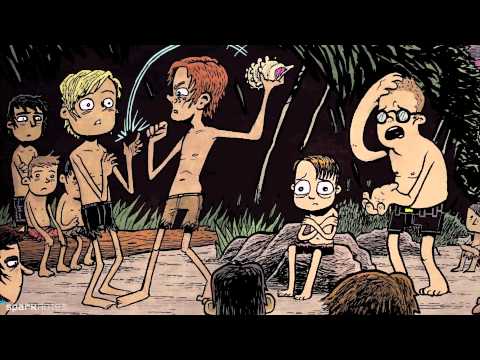
Lord of the Flies by William Golding is a mind-boggling story about a band of English young boys aged from 7 years and 12 years marooned in an island after a plane crush in the wake of atomic world war. Written in 1950s, the book questions the defects of human society in respect of the defects of human nature as symbolized by the stranded boys who have once civilized under the parental/societal guidance descends to savagery, the primitive state of human condition, which is operated by Id alone. And it only takes about 2 weeks or so to return to the instinctual stage of mankind. Which is all the more scary yet true whether we accept.
There are two extreme characters in the story: Ralph, a headstrong, sophisticated boy whose father is a naval officer. His primary goal is to be rescued by a ship, to return to the the world of civilization where all’s will be normal and he will live normal. So his main concern is to keep fire ablaze to signal his existence, the last remnant of civilization, the surviving Ego that “wills” his societal existence struggling for existential meaning that a civil community confers upon his singularity and uniqueness for recognition. As Ralph asserts, “No fire, No smoke, No rescue.” To him fire is Hope that will save him from falling into savagery by which other boys blindly and almost unconsciously have become animalistic, acting on instincts to satisfy their most basic desire only: Eating by Hunting.
The Hunters are led by obstreperous, belligerent choir leader Jack. In fact, the figure of Jack represents many interesting aspects of psychotherapy. In the respect of psychoanalysis by Fraud, he symbolizes Id that “drives” all his acts and modus operandi. To him fire does not seem to matter. He does not even want to be rescued. What he excites him is a process of hunting a pig – especially a female one – for provisional entertainment and survival on an island. In the view of individual psychology by Adler, gaining power over his “tribe” of the boys and becoming a chieftain by forcefully and unjustly abdicating the legitimate Ralph takes precedent of anything, including keeping fire and going back to the cradle of civilization. The limit of ego qua responsibility does not apply to Jack, who lets his Id dominate his being. According to logotheraphy by Viktor E. Frankl, Jack has ceased to fulfill his responsibilities as a cooperative cohort of Ralph to work together to protect themselves, to guard fire, to maintain their orders until a rescue comes their way.
And there is pitiful Piggy. We don’t know the real name of Piggy. But we know that he does not want to be called such but that the boys, including the civilized Ralph, who can blow a conch by the encouragement of Piggy. The narrative tells us that it’s not that the accents or fumbling that makes him a buffoon of the boys; it’s his corpulent appearance that loses him respect among the boys. Besides, he’s the only one that wears a pair of spectacles are used as a magnifying glass to gather heat to make fire. In fact, I view the figure of Piggy as a voice of the intelligentsia. As Ralph laments at the tragic death of Piggy, he’s the one who “talks sense.” In fact, his spectacles, cruelly damaged by the sneak ambush led by Jack and his savage tribe, symbolize the perspectives of the intellectual that view the state of human nature in danger of retrogression and decay to Zero, the raw, primitive nature devoid of existential meanings and values attached thereto. And the boys ridicule him, deriding his attempts to call their attention to reality of their situations and to address the substantial issues to be reckoned and resolved. Piggy is a Thinker, a voice of Rationality that does not seem to be a matter where Id and Ego stand in contention when human nature is stripped to its nakedness outside human society.
To recapitulate, Lord of The Flies by William Golding attests to loss of humanity as a result of catastrophic event in which a survival of the fittest seems only true. This may include a war in consideration of the year the book was written; it’s 1954, only 9 years after WWII. Golding saw the evils of the war – the countless deaths, the famine, the ruins of houses and building and nature – the Wholesale Destruction of Humanity. What had once been a great civilization fell into a great catastrophe by the hands of Humankind. A Paradoxical truth that ascertains decay of human society debased into brute savageness operated on ferocious instincts for survival… Lord of the Flies is the fable of the lost children for the adults.
P.S. This is my another bygone writing about William Golding’s dystopian novel Lord of the Flies that I had written prior to the inception of my blog.


You must be logged in to post a comment.