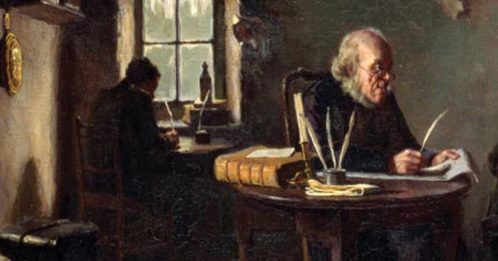
It was more than 10 years ago when I first read Herman Melville’s Bartleby, a short story about an unwonted young man employed as a scrivener by a Wall Street lawyer. At that time, Bartleby stroke me as a very eccentric, imprudent worker who had the temerity to reject his boss’s orders. He was just a mentally deranged man with only a few words, other than “I would prefer not to do …”
But now I see him different. Since I re-read the story this afternoon, I have felt bottomless sympathy for Bartleby. Mixed with pathos and sprinkles of humor in the narrative of his benevolent former employer, the figure of Bartleby evokes springs of human compassion and humanity itself. And my feelings for this tragic scrivener amount to what the narrator felt about his former employee.
I am not intent on “analyzing” the psychological aspects of Bartleby and his former Wall Street lawyer boss. And I think not that even the writer Melville himself had such psychoanalytical views on these characters in mind when he wrote the story. To me the story itself shows what made a sensitive man like Bartleby to such demise in the eyes of a compassionate man – and a decent employer seldom found these days. Loneliness, Hopelessness, Sorrow, and Reality of Death all packaged in written forms burned in flames stagnated the humanness in the forlorn scrivener. The Death of Humanity, that is. Having worked in the Office of Dead Letters at Washington would suffice it. Surely, there is no doubt that Bartleby was mentally disturbed, but who would hate or even despise him for his malaise?…
Then readers might object to the premise that it’s only a fictional story in which no such characters will/would exist in reality. But I think not so. As a matter of fact, I have always believed that fictions are always built upon factual elements of human life to a certain degree. Dismissing stories as creations of imaginativeness seems to miss the fundamental truths laid under changes and choice of our human life with a bit of creative imaginations. Ditto Stephen King, who has once said that the stories are artifacts that are not really made up, but that are based upon preexisting objects we discover.
The tall, lean, pallid and lugubrious image of Bartleby the Scrivener still lingers in my mind… Having dealt with tons of letters from those who died in despair, those who died hopeless, and those who died suffocated by insurmountable sufferings, Bartleby had lost his own sense of existence, feeling utterly dispirited, pessimistic, and lethargic in performing demands of his duty. It was the loss of meaning of life that made him passively resistant to all the ordinary functions of daily life which all seemed insignificant to him. The life itself was nihilistic and hence non-existential to Bartleby. Humanity in the expressions of feelings and emotions meant nothing to him; it had ceased to exist in the form of dead letter attesting to existential horrors, which had led the authors to death, which had taken the poor Bartleby as the witness thereof.
Thus, the lamentable outcry of the narrator still deeply reverberates in my mind even after I closed the book: “Ah, Bartleby! Ah, Humanity!”
P.S. This is my bygone writing about Herman Melville’s classic short story of “Bartleby, the Scrivener” that I had written prior to the inception of my blog.


You must be logged in to post a comment.