Grimm’s Fairy Tales: 64 Dark Original Tales by Jacob Grimm
My rating: 5 of 5 stars
When I was a child, Danish writer Hans Christian Anderson’s light tales were more fun than German Brother Grimm’s comparatively dark tales. Now that I have read Grimm’s Fairy Tales: 64 Dark Original Tales as a child in a grown-up body and mind conditioned in the anfractuous tidal waves of life, I now know why the Grimm’s tales are regarded as classic literature, not just for children for also for adults, especially those with defiant spirits of abandoning power to believe the mysterious and magical, all the spellbinding enchantment springing from these fascinating fairy tales the Grimm Brothers provide to readers.
The book contains 64 stories originally published in the Grimm’s The Nursery and Household Tales from 1812 to 1814 as separate volumes. The original intention of the compendium of oral German folk tales is to study German culture and literature that can also be referenced as an academic text. Both Wilhelm and Jacob were philology students, lexicography, history, and Germany’s literature while studying law at university. For this context, during the Third Reich, the Nazis liked to use the book as a token propaganda textbook to promote their racial ideology against Grimm’s volition to preserve the cultural artifacts and heritage in anthropological perspectives. Suppose the Grimm indeed meant to use the tales to prove Aryan superiority. Why would they include the sinister and even immoral contents of some of the collection’s stories without rewriting them to immaculately vivacious and blissfully happy fairy tales suitable for the best race endowed with goodness and beauty?
Some of the tales are shockingly straightforward about lacerating and killing characters, mostly with axes, even though the wickedness is worthy of such cruelty and urges readers to abandon pity. Even a king wants to marry his beautiful daughter in his beloved deceased queen wife’s likeness, who asked him to marry her mirror image. The incestuous labyrinth story is the queen’s stratagem of not letting her husband marry some other woman than her blood and flesh in the daughter’s form. To my dismay, the daughter at the end finds herself in the arms of her father – as a lover. The tale is too spectacular to suspect my cognitive faculty’s malfunction, but the tale’s re-reading confirms the truth of the incredible love story of father and daughter. The Grimm would have decided not to redact it from the collection to invoke such stupendousness of incestuous infatuation blinded by lust and envy nuanced in the simplicity of words. Otherwise, the tale itself remains a point-blank apocalyptic drama that leaves readers in the spinning saucers to the point of no returning of the senses at wonderland.
All the tales from this book are not, however, akin to the tales from the crypt. The Grimm’s tales are the fairy tales where animals talk, and humans listen, fairies and humans can bump into one another on the way home or work, and peasants marry royals with the help of magical instruments, all of which look common and natural. The Grimm’s fairy tales’ characters inhibit somewhere in the gray world of mirrored reality where the wheel of fortune is spined against in our favor because of the blindfolded goddess Fortuna’s whims and caprice in the game of chance. But however unlucky it may seem, time and opportunity happens to all of us at unexpected times and can multiply the delicious fruits with wits and touches of humor, which are the handmaids to a happy life. Grimm’s fairy tales are not pessimistically gloomy enough to attest to the harsh, treacherous reality of life. Instead, the tales are lessons for insatiable greed, insolent hubris, and uncontrollable passion that bring about downfalls, which are also principal narratives of Stephen King of our time.
View all my reviews
Tag: book reviews
-
‘Grimm’s Fairy Tales: 64 Dark Original Tales’, by Jacob Grimm – book review
-
Who discovered America?
The question of “Who discovered America?” lends itself to enlightening trivia pastime, spawning a series of plausible answers. Leif Eriksson and Christopher Columbus contend the discoverer’s title, possibly followed by Walter Raleigh and Francis Drake, except one John Cabot whose name is lost with his ship somewhere in the Atlantic Ocean just as his mysterious disappearance during the final voyage.
Giovanni Caboto, aka John Cabot, was a 15th-century Venetian maritime merchant, emigrating with his family to Tudor England in search of substantial royal sponsorship for his ambitious Far East expeditions. The age of expedition was imbued with the spirit of enterprise that propelled colonialism. England was no exception to the European competition. Spain and Portugal were the contenders for uncharted lands and undreamed waterways discovered by Christopher Columbus, Casco de Gamma, and Fernando Magellan. Cabot promised Henry VII that he would find the ways to the Shangri-La in honor of the land to the king with portions of profit for the homage. The king granted his royal patronage on the expedition in the hope of establishing a British mercantile empire around the world. After two misfortunate voyages, Cabot finally made it to what is now known as America in 1497 and called it “New Found Land.”
However, unlike his contemporary peers whose deaths are recorded either orally or textually, Cabot’s end as an explorer is undeservingly clandestine and amorphous. It is said that Cabot was a victim of mutiny among the seamen on his ship or that he settled in the New Found Land and died there. What is more confounding than the mystery of Cabot’s whereabout is the seemingly less recognizance of his achievement than that of the rival explorers of his time and posterity. Cabot was the first explorer who paved the transatlantic waterways between America and Europe, principally the British Isles, for the progeny.
Indeed, Columbus found the West Indies and the American continent by happenstance. Still, Cabot proved that rapid Atlantic travel was possible by sailing the west through the ocean, more substantially practical and influential than America’s ideologically symbolic discovery by Eriksson and Columbus. Would Cabot’s discovery of America under Henry VII’s banner be an issue for the recognizance of his achievement for independent minds of Americans liberated from the English sovereignty? Or, to put more blatantly, would the English royal sponsorship of Italian native Cabot’s exploration mar the spirit of American liberty? If England were still a Catholic country, would Cabot’s achievement have been of lesser brilliancy than those of his contemporary explorers? The questions of history require answers, but often they remain unheard and trail off in the wind of zeitgeist. -
Arthur Conan Doyle’s Search for Truth
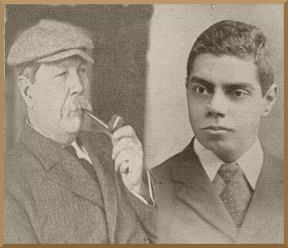
Sometimes the truth is so strange and mad that you wish yourself dreaming when you awake. That is what Sir Arthur Conan Doyle must have realized when he got a letter from one George Edalgi. The story read springing from Doyle’s Holmesian stories. Britain’s beloved author, partly curious and mostly indignant at the case’s stupendousness, felt responsible for searching the truth as the creator of his alter ego, Sherlock Holmes. So Doyle met the client Edalgi face to face in a hotel in January 1907.
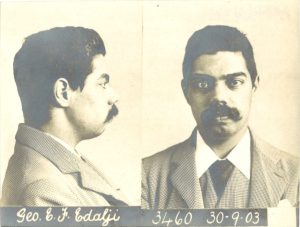
George Edalgi, the eldest son of Parsi-English vicar in the small mining village called Great Wyrley in England and former solicitor, served seven years of penitentiary servitude for the Great Wyrley killings of 1903 he claimed innocent. Edalgi’s case was an ipso facto example of miscarriage of justice on indubitably evident grounds of racially imbued personal vendettas against him and his family for who they were. The Edalgi family, despite Charlotte, the mother, and wife, being white, were regarded as heathen Indians encroaching upon the comfortable life of the English, or more precisely, the white privileges, which was the bastion of the eyes of the most villagers. Since the beginning of Reverend Edalgi’s vicarage, the family had been constant targets for racial slurs and hostility that perpetuated the peaceful family life. Even after George became a lawyer, the villagers continued to disrespect his presence, culminating in the notorious Great Wyrley killings of 1903 in which livestock, including horses and cows, were atrociously mutilated and left dead in horrible agony. As Wyrley was a closely-knit village of miners, the easy target for the blame goes for the Edalgis, especially for their eldest child George. He was a loner with distinctively ethnic physical features roving around alone in rumination on evenings. Any white person doing the same ritual would seem philosophical, sentimental, or poetic even, but it did not apply to George’s leisurely ceremony.
Upon consulting George, who must have thought Doyle as the only person on the British Isles to listen to his truth, Sherlock Holmes’s writer has the hunch that the client could not possibly have committed such an abdominal crime for the following reasons. The trappings are so fitting to a conspiracy that they stink:- George is noticeably near-sighted when reading. The animals’ mutilations indicate only good eyesight can perform such surgically precise cuts.
- The ethnic backgrounds of George and the cultural environment of the village are circumstantial evidence that the case is racially motivated from the beginning. If not, then the real culprit used George’s vulnerability to camouflage his crime.
- The police framed George for the killings, knowing the real culprit because of racialism led by the local aristocratic police chief GA Anson.
Doyle’s real motivation for campaigning for George’s amnesty is curious speculation. Yet, it was the darkest night of the soul when Doyle answered the call for justice. He lost his wife Louise to tuberculosis while he was in love with Jean Leckie. Doyle took Louise’s death as a pang of his consciousness for seeing another woman at the time of her illness and regarded the letter from George as redemption of his soul to redirect the ship adrift after maelstrom. Whatever it might have been, Doyle was one of the most ardent campaigners for George’s pardoning to reinstate his legal career and restore his tainted honor. The fruition bears two tastes of the victory: the case led to the establishment of the Court of Criminal Appeal in 1907, and George was allowed to practice law again, which he did in London. However, the official government’s compensation for George’s time from the malice of injustice yielded nothing. Soon the case and the name George Edalgi became a thing of the past unless Arthur Conan Doyle chimes the bell with the forgotten.

This story I read from a British history magazine makes me think of what an author should be. An author sees the corrupt humanity and ills that cause it, stands furious with the honest minds, and speaks to the corrupt minds amid the chaotic order of nature that goes against truths. Charlotte Bronte posited that an Author has a faithful allegiance to truth and nature. Bestselling or obscure, an Author represents humanity who can see what others oversee or trivialize in preference to magnitude in power and splendor in fame. In that light, Conan Doyle deserves special homage for his search for truth. That is why he is still a great author in posterity. -
music, the moody food for the mind
Music is a universal language of humankind, as perspicaciously illustrated in a segment of the film ‘Mission’ where benevolent Jesuit missionary Gabriel plays the oboe on the top of the stiff cliff surrounded by the heathen natives. The beautiful Gabriel’s melody enters the souls of the natives, stays there in wonder, enough to disarm all hostility toward Gabriel and open their hearts. The language of music intoxicates the heart and satisfies reason and nothing more.
But that is not what it is like in this world we live in. Music is perceived as an ideological, political tool for suppressing and propagating specific ideas by persecuting the proponent of a theory that irks the majority populace, as posited in scholar John McWhorter’s article “Is music theory really #SoWhite?” The article’s gist is that two music professors at Hunter College are in a row because of their different opinions about renowned Austrian music theorist named Heinrich Schenker criticized for his openly racist views on just about everything. Schenker is long dead, but his genius in musical theory still retains magnificence among academics worldwide, including those whom Schenker might not have regarded as kindly and respectfully. One of the proponents is professor Timothy Jackson, who highly esteems Shenker’s musical theories irrespective of his personal belief and ideas.
The nemesis comes in the name of professor Phillip Ewell. He is also a cellist and half-black, attacking his peer Jackson to defend Schenker’s racist views that are an essential part of his music theories, so to speak, campaign for Jackson’s dismissal from the college the count of racism. That is not the end of Ewell’s fury against Shenker and his admirer. The arrow also shots Ludwig Von Beethoven’s bust, whom Erwell thinks doesn’t deserve the genius composer’s high appellation because the panegyrics from white supremacists ornaments his abilities.
Reading the article with the images of the dead Shenker and the two professors at tirades, so to speak, in my mind’s vision, I feel like watching an inquisition tribunal or communist party’s kangaroo court where the innocent not committed crimes regardless of his/her personal faults or weakness is savagely summoned and tried without attorney testifying the truth. The truth, said Edgar Allen Poe, is the satisfaction of reason, the fulfillment of judgment. I understand Erwell’s fury erupted in the BLM movement’s wake, which brings the suppressed matters into the light. But the accusation of Jackson as a racist that hurled him to the center of controversial debates at the expense of his livelihood because Jackson spoke for Shenker’s work as values attributable to the benefits of arts doesn’t seem to hold water. You can have a heart burning with passion with a head kept in the cold with reason.
-
Avalon
Across the five continents and seven seas
Beyond the bridges of time over the Lethe
There is the Fortune Isle – enchanting Avalon
Where all things grow and perfect themselves
Not by physical labor but by nature’s magician
in the sovereignty of nine faerie queens’ realm
of Prudence, Justice, Fortitude, and Temperance
Adonized in Beauty, revered in magnificence
As Morgan Le Fay, the Queen of the queens
Keeps the Holy Grail under the Sacred Oak
With her half-brother, once mortal King Arthur
Whom the Queen has brought from the battlefield
By Black Boat from which her paramour Dane Ogier
Came to Avalon, where his journey ended in a tryst
With the Queen by the lake of shining waters
Where she brought her son Oberon into light
who became the king of faeries and married Titania.
Avalon is near and far, real and mythical from whither
Truth and wishes are sought after and eloped together.


You must be logged in to post a comment.