Tag: book reviews

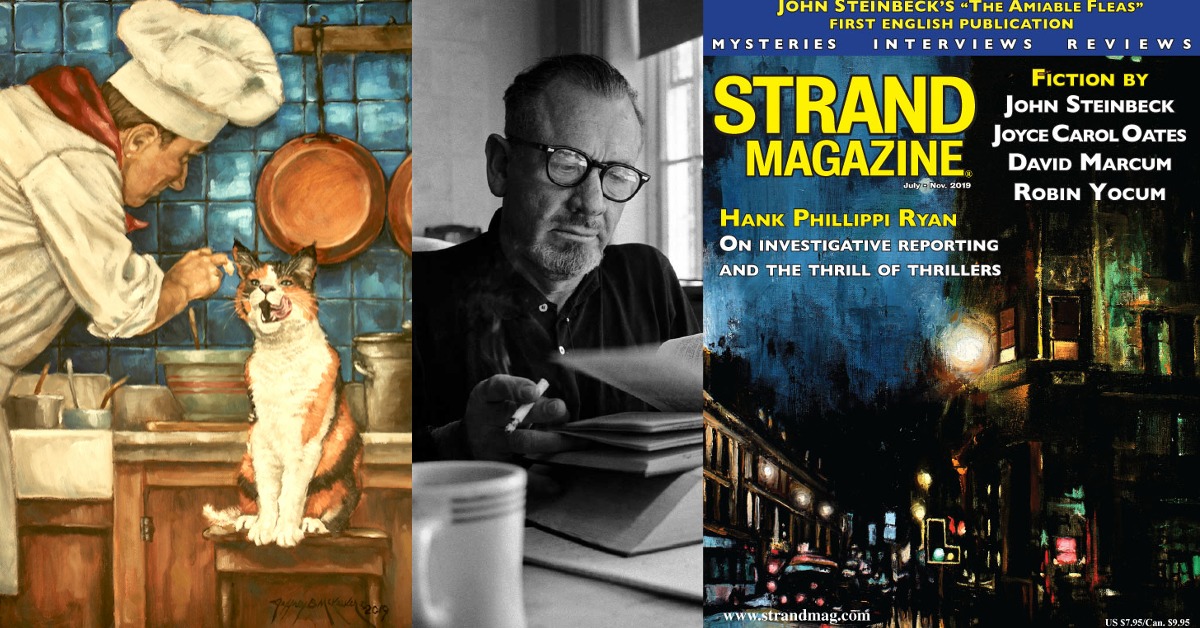
  • ‘The Amiable Fleas’, by John Steinbeck – review

    John Steinbeck was all man. He was a writer of muscles. I meant the powers of strong individuality that disagreed with grandstanding with the political in-vogue trends of his time with his writing as literature for an ideology of grand cultural context, not for the mind’s pleasurable satisfaction. In a word, Steinbeck appears to be in touch with the real world, with the characters realistic and stories palatable, not confined in the seclusion of a leisurely abstract world of the elite. The Amiable Fleas conveys all of the charms described above of Steinbeck as an attractive raconteur at his best: humorous, heartfelt, and honest in his tough cowboy appearance in a strange city filled with quaint aromas of the old civilization.

    The Amiable Fleas is Steinbeck’s testimonial narrative of the truth found in life’s ordinariness; the meaning of life realized in the joy of small pleasure against provisional needs of instant fame and worldly prestige. It’s an innate folly of human nature trying to reason against the significance of Serenity, Courage, and Wisdom as if they are remotely associated with Intellect. As Steinbeck held against criticism about avoiding the political and social issues of his time, he tried to reason his own reason for writing about such simple truth of life.

    The Amiable Fleas is the res ipsa loquiter of the value of small things that Steinbeck treasures, for it is what keeps the troublesome, pugnacious, bickering human tribe tamable and bearable with humor, which is a handmaid to hope and resilience. The amiable fleas represent the idyllic but oddly likable bunch of professionally intellectual people whose existence is a canvas of abstract painting that lacks a touch of realism. The poet, the architect, and the painter occupy their self-designated seats in the eponymous restaurants in Paris, doing nothing but contemplating about their artistic works in the selfishness of intellectual stasis. The excellent chef of the restaurant M. Amite embodies an artist whose ambition is the stir that his honest mind raises. The desire for fame is the infirmity of his admirably good, hearty nature. The star of the Michelin Guide is the apple of the discord, a symbol of outside influence that incites M. Amite’s ambition, not from his love of cooking to please his feline friend named Apollo. M. Amite is the image of an artist swayed by the great things of the world, even if it would cause him a loss of joyful dailiness.

    Originally published in the historically renowned French newspaper Le Figaro on July 31, 1954, as the tenth weekly installment of “One American in Paris,” The Amiable Fleas was published in English for the first time July-November 2019 issue of Strand Magazine. The background of this charming and heartwarming short story was that Steinbeck wanted to be himself, not how the French media imagined him to be or wanted to create their version of him from the counterproductive interviews with the American writer. And so he wrote a series of short stories that only he could tell with his quintessentially American way of storytelling. Yet the result is beyond the territorial boundaries and cultural enclaves, for the narrative reaches the hearts of not only the hard-to-please sophisticated Parisian readers but also the universal readers of all ages. Steinbeck is undeniably American to the core. Yet his love of realism that gives a new viewpoint upon dailiness of life enables readers of the world to get a fresh, bright hold upon our problems. Given that perspective, everything is something, and everyone is someone.

  • ‘Writers and Their Cats’ by Alison Nastasi – review

    Writers and Their Cats: (Gifts for Writers, Books for Writers, Books about Cats, Cat-Themed Gifts)Writers and Their Cats: by Alison Nastasi

    My rating: 4 of 5 stars

    If dogs are man’s best friends with their childlike artlessness and uninhibited affection, what are cats? Lucy Maud Montgomery, the author of Anne of Green Gables, answered thus: “Cats are so nice and selfish.” Writers and Their Cats by Alison Nastasi is a delightful illustration of such a relationship between writers and their cats with peek-a-boo glimpses of the celebrity authors’ unknown personal aspects behind the public façade.

    The fascination with the graceful demeanor and graceful capriciousness of cats is particularly intense among the volatile and imaginative writers as the muse of their lettered labyrinths. Edgar Allan Poe wished he could write as mysteriously good as his cat Catarina who liked to hover herself over Poe’s shoulders while he was writing. Mark Twain, whom I used to associate with something of a Dog Father, turns out to be a godfather of cats who rented cats to city dwellers during their holidays in the countryside. Twain also named his cats commensurate with his wicked sense of humor: Satan, Soapy Sal, Lazy, etc. Furthermore, Twain proclaimed that anyone who likes a cat is his friend. The imposing figure of rough and tough Ernest Hemingway may not match the delicate silhouettes of cats’ sophisticated society. Still, Papa Hemingway loved them with the tenderness he rarely showed even to his better halves.

    The book also introduces readers to various writers of our digital era whose love of cats takes them to the world outside their comfort zones in selective solitude. Patricia Highsmith, a high-strung, highly opinionated, no-nonsense author of The Talented Mr. Ripley, reveals her Tate-a-Tate moments by greeting her cat, “We are going to have a great day today.” Marion James, who wrote A Brief History of Seven Killings, met Tom the Cat at a café in Brooklyn, New York, who, like the writer, enjoyed being outside among people because both of them thrived on the liveliness of the world around them as a creative force. Then Peeti Shency, the Indian novelist and artist, writes about the experience of sharing a terrific story about her trip to the Kedar-Gouri Temple dedicated to the eponymous goddess with a particular fondness of cats, thus elevating them to the divine status of the immortals. Shency resurrects the legends of holy cats in the temple to our digitalized reality of the world and connects them to our need for their presence for nature’s mysteriousness.

    There are many other writers in the book whose love for their cats are touching. They all confess to their odes to cats that only cats can understand what they are and who they are. Whether or not cats have a supernatural sense of reading people’s minds, I have no intelligence. Still, I do know that a cat is good at observing your movement and facial expression from my observation of Toro, a 12-week old male brown tabby kitten, who likes to watch me what I am doing and where I am going. A cat is a curiously interesting beast, and it is this semblance of intelligence that makes a cat so attractive to the imaginative, high-strung writers. If you have a cat at home and a writer at heart, this book will present you with a delightful treat to your mind, packed full of beautiful pictures of writers and their cats not in grim portraiture but natural snapshots. Readers may tempt to show the writers’ photos with their cats to your cats.

    View all my reviews

  • ‘Witches of Pennsylvania: Occult History of Lore”, by Thomas White – review

    Witches of Pennsylvania: Occult History and LoreWitches of Pennsylvania: Occult History and Lore by Thomas White

    My rating: 5 of 5 stars

    Edmund Burke’s canonical adage of “Superstition is the religion of the feeble mind” fits the American perspective of witchcraft as well as other supernatural views on the world. No wonder literature and media are chockablock with adolescently burlesque images and sensational accounts of the mysterious phenomena in comparison with the European approach to the subject matter in terms of historical and social contexts. However, Witches of Pennsylvania: Occult History and Lore by Thomas White is an excellent antithesis to the stereotypical American attitude toward the thematic that should merit its place in the history of American civilization. The book is concise in its volume but rich in the spirit that deserves its academic and cultural contribution to the history of the New World.

    The book treats the thematic of supernatural accounts of witchcraft and magical folk (the equivalent of the British Cunning Folk) with a sense of respect for the belief tradition held by the Germanic settlers of Pennsylvania and the origins of it in academic approach. Based on his close and observant reading of the multidisciplinary subjects from history to religion, White fills the erudition pages after pages with many unknown historical facts about witchcraft before the infamous Salem witch trial in Massachusetts and the lasting legacy of the supernatural belief still alive among the common folk. The omission of the witchcraft elements found in other cultures, such as African-American and Native-American, is not a supercilious gesture disregarding their values charged with ethnic pride or cultural jingoism. It is to isolate belief tradition in the form of folk magic and witchcraft from a cultural identity of ethnic traits that many people like to associate. Instead, it intends to distinguish it from the established religion that has deeply affected the psyches of the ordinary people, which ultimately has become a folk religion of its own with efficacy.

    Whites provides insightful intelligence about the use of folk magic as a sense of control in the world beyond human control. Recourse to supernatural means of relieving the malady of hearts is the last straw a person can think of in a recurring series of losing streaks without jeopardizing his/her self-esteem. The story of Hex Hollow, for example, is the most well-known and representative of the subject matter, manifesting the effects of folk religion on the psyches of the residents in the predominately German-American region. To dismiss the culprits of the case as good-for-nothing superstitious crybabies looking for figures to blame for their unlucky strikes of lives is, therefore, an arrogant display of willful ignorance of the truth about folk religion and its impacts on the psychosomatic functions of individuals. The best illustration of such evidence comes in the form of The Long Lost Friend by one John George Hohman, a German-American Catholic printer, bookseller. It is an impressive collection of herbal remedies, magical healings, and charms that have been known for their potency for years with wide perennial circulation. The book is still going actively available on Amazon.

    This book is an excellent read for those craving for academic perspective on witchcraft and magic folk existent in the U.S. without the assistance of parapsychology, paranormal investigators, psychics, and mediums, distinct from the genuine witches, wizards, and hex doctors. It is a collection of supernatural events and narratives recorded in case law and annals of history, told in a plain language comprehensible to eager readers of mysterious knowledge. You will find the book read fast as if you were cast a spell on by its arresting attention and wondrous truths about the existent world we still do not know in its entirety.

    View all my reviews

  • ‘A Journal of the Plague Year’, by Daniel Defoe – review

    A Journal of the Plague YearA Journal of the Plague Year by Daniel Defoe

    My rating: 5 of 5 stars

    The biblical cyclicity of history proclaims that what is happening now happened before because there’s no new thing under the sun. As I agree with the cyclical history theory, I prefer stories that confirm the continuity of human nature, which results in this felicitous book I came across on the Kindle store. The precedent epidemic scares and the response to them in Daniel Defoe’s A Journal of the Plague Year, a classic 1722 account of the Black Death that devastated England from 1664 to 1665, do not read no less different than ours. Defoe’s recounting of the plague successfully resurrects the spirit of the epoch as his narrator guides the reader to the places and scenes of the seismic event in the capacity of a charitable and knowledgeable guardian of posterity, making them surprisingly familiar with ours.

    It is a literary eye-witness account of what happened during the resurgence of the bubonic plague that had ravaged Europe hundreds of years earlier in the semblance of a nonfiction narrative. Even though Defoe was only five years old when the plague swept England, his fictional narrator feels very real and the account telltale as though it had been written it in the spirit of Veni Vidi Vici. So much so that the story seems more veritable than the counterpart of Samuel Pepys, whose narrative feels comparatively prosaic without the personal charm of the narrator. The reader will also learn that the 17th-century modus operandi of dealing with a pandemic is not that far from the current 21st-century preventive measures of social distancing, personal hygienic disciplines, and other relevant systematic societal restrictions.

    Defoe holds up a mirror to his posterity that shows what it was like during the epidemic scare and what the people from days of yore did to sail through such calamity as a wise and warm advisor to our current global pandemic situations. In fact, while I was reading the book, I was surprised by how similar the cautious measures decreed by the authority were then to our own now. In my opinion, this book replaces Boccaccio’s The Decameron as a must-read during the pandemic, because of its power of reality drawn on empirical oral accounts so close to the lives of the ordinary folk that we can relate to our own time.

    View all my reviews

  • ‘Fairies: A Dangerous History’, by Richard Sugg – review

    Fairies: A Dangerous HistoryFairies: A Dangerous History by Richard Sugg

    My rating: 5 of 5 stars

    According to the races of the supernatural world, there are classes of spiritual beings that humans have arbitrarily defined with ostentatious pedanticism. For we treat the otherworldly guests of honors, such as archangels, angels, principalities, vampires, werewolves, trolls, big-foots, and even extraterrestrial aliens with awe-inspiring reverence. In contrast, fairies are regarded as sort of the underclass, juvenile guests reluctantly invited to a terrific festival of supernatural beliefs. Such spectral discrimination, argues author Richard Sugg in his Fairies: A Dangerous History, results from the fact that unlike demons, angels, and other ethereal beings of educated Christianity, fairies are in want of respectful scholarship codifying their existence and nature, cultural influence on arts and literature, and spiritual elements of faith/belief traditions in lettered authority.

    The book is a meta treatise on why the author himself believes in the belittled mystical beings’ existence. Sugg takes us to Shetland’s remotest area to listen to a nonagenarian man whose vivid memories about fairy sights are amusing. Thenceforth, the author brings the readers to the fantastic feasts of fairies as seen and described by William Shakespeare and Edmund Spencer as the rulers of the Vegetable Kingdom in their Elysium of poetic fancy, Sugg keeps us hooked on pages after pages filled with his magic spells of words because he sees and believes in fairies with their own dangerous history. It is dangerous because the truth about them is theologically reasonable, spiritually potent, culturally dominant, and physically palpable.

    In sum, this book is one fascinating account of fairies that serves the author’s purpose of educating and entertaining readers. The book is filled with the glamour spells of the author’s erudition. This book is something of the authorial account of the Fairy Folk.

    View all my reviews

  • wandering star

    1

    A puerile quest for a mirage, he rebukes

    A pristine request of the heart, she decries

    and begins a Ballard of a plain girl unknown;

    Since her star in the Milky Way lost

    its trail of Manifest Destiny shining the brightest,

    the heiress bereft of her heavenly bequest

    Without a speck of stardust has not been

    As others were – she has not seen

    As others saw – she has not known

    As others knew- she still can not find

    Where the tides of the ocean by wind

    Arise, rush, roll, and reach with the surge

    The silent silverly soil with the urge

    When the lost high star finds her at last

    And returns her overdue gifts of the best.

    P.S. I feel intimately acquainted with Charlotte Bronte, her fictional alter ego Jane Eyre, and Janice Sessions, the plain girl created by Arthur Miller in their quiet deportment, delicate feminity, sentimental loneliness, and plaintive want of beauty. They are, in fact, my spiritual sisters in whom I can confide my inmost feelings, repressed emotions, and provocative thoughts guarded by my own conceptions against the acerbic opinions of the brutish, insensitive rabble. Nevertheless, the aforesaid sisters all had the breakthroughs that led them to fortune, luck, happiness however it might have lasted or whatever they might have been. I feel that I am kept away from anything wonderful or even remotely felicitous ever happening to me by some unseen forces of godly or evil beings. Alas, woe is to me! Shakespeare believed that our lives are governed by the stars above us and that there are tides in the affairs of man, which taken at the right time, they will lead man to fortune. What with such cold reception of my first published e-book and what with my regret of having published it at first, I wonder when I can meet my tides and sail away into the wide ocean to reach the land of my destiny.

    Dear Reader: Hey, there! Thanks for visiting my blog and reading my post. And if you express it by pressing the button into the bargain, my spirit will surely be uplifted from the rut of my so-called life. And if you are further intrigued by my e-book recently published on Amazon Kindle and drop just a few lines of your thoughts about the story upon reading (but no words of derision or sarcasm), I will feel like a millionaire without the actual sort of money in my bank account. It’s only 57 pages in total, so the book won’t take much of your precious time. Just click on the below book cover with one touch of your fingertip, and it will lead you to the place where the story begins via wondrous witchcraft. Many thanks for reading with my whole heart! Best, Stephanie