Tag: books

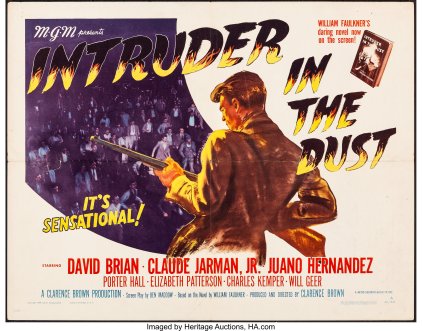
  • ‘Intruder in the Dust”(1949), directed by Clarence Brown – film review


    lf

    Justice is the truth, and the truth is the satisfaction of reason. Reason complements emotions triggered by the sense and guides a man to a purposeful action as a beacon of judgment. What motivates the teenage boy Chick Mallison and the lawyer John Gavin Stevens to help Lucas Beauchamp, a respectful and affluent black farmer, accused of killing a white man, is the desire for finding justice, the truth. “Intruder in the Dust” (1949), directed by Clarence Brown, shows that the search for truth excels in the infirmities of whimsical human characters based on William Faulkner’s selfsame novel published to a wide acclaim a year before.


    Shot in black and white, the thematic of truth in the darkness of ignorance blinded by racial prejudice manifests itself in the transparency of facial expressions of the characters like ancient Greek theatrical masks to magnify the emotions and feelings of performers on stage. Lucas (played by Juano Hernandez) is laconic like an old Spartan. Still, his a few words carry the authenticity of truth, emphasized by his dignified aura surrounding the natural, confident being that commands attention to himself. As Shakespeare’s adage of true nobility as being exempt from fear, Lucas counteracts the mob psychology driven by the vacuously temerarious inquisition of popular sentiment in poised stoicism pleading for truth, not feelings.
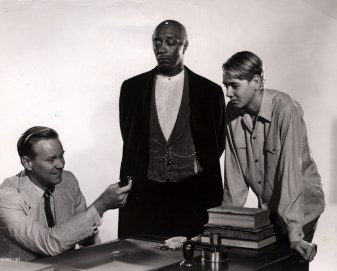
    Three stars in intruder

    The subject of humanity is likely to be invoked for the anodyne ingredient to resolve the racial tension. Still, Falkner’s “good” white folks are more driven by a curious concoction of investigative natures, intelligent propensities, and occupational instincts blended well in the egoistic sense of fulfillment wonderfully producing a diamond of truth as though it were a wondrous alchemical process. The teenage Chick (played by Claude Jarman Jr.) and Lucas’s lawyer John Gavin Stevens (played by David Brian) are conscientious and principled, with whom we can refer to “good” white folk. Still, they are not entirely free from their prejudices about the colored, especially the blacks. Even Chick becomes indignant and intentionally drops the money when Lucas declines it from him as a token of gratitude and orders him to pick it up. The lawyer Stevens is neither particularly jovial with his client in the way he would be with his white client. However, both Chick and Stevens intend to descry the truth behind the machination of unreason that rains on the minds of the white people in the town because they are inherently good, even though they are biased. They are good people because their reason prevails upon unreason, and their search for truth outshines their prejudice. It’s what matters to the justice and life of Lucas, the black man who is not necessarily a chum of theirs.
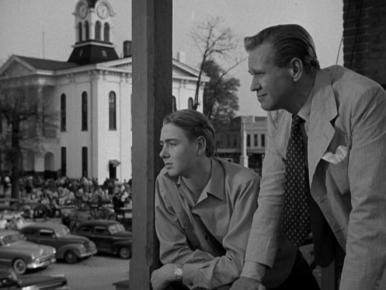
    intruder-ending

    “Intruder in the Dust” may be parallel to “Who Killed a Mockingbird?” because of its similar subject and genre of the film, let alone their original novels that were written by southern writers. But what gives to “Intruder in the Dust” is its sense of realism in the likeness of truth. I find the characters in “Intruder in the Dust” more ordinary, more plausible, and more human. This film delineates a congress of human characters amid a universe of varied emotions and a sea of dangerous adventures, which illustrates both the never-ending dilemma and possible solution. The stellar performance of the excellent cast orchestrated by the astute director based on an excellent textual basis by William Faulkner culminates in this American Classic Masterpiece Film.

  • ‘Witches of Pennsylvania: Occult History of Lore”, by Thomas White – review

    Witches of Pennsylvania: Occult History and LoreWitches of Pennsylvania: Occult History and Lore by Thomas White

    My rating: 5 of 5 stars

    Edmund Burke’s canonical adage of “Superstition is the religion of the feeble mind” fits the American perspective of witchcraft as well as other supernatural views on the world. No wonder literature and media are chockablock with adolescently burlesque images and sensational accounts of the mysterious phenomena in comparison with the European approach to the subject matter in terms of historical and social contexts. However, Witches of Pennsylvania: Occult History and Lore by Thomas White is an excellent antithesis to the stereotypical American attitude toward the thematic that should merit its place in the history of American civilization. The book is concise in its volume but rich in the spirit that deserves its academic and cultural contribution to the history of the New World.

    The book treats the thematic of supernatural accounts of witchcraft and magical folk (the equivalent of the British Cunning Folk) with a sense of respect for the belief tradition held by the Germanic settlers of Pennsylvania and the origins of it in academic approach. Based on his close and observant reading of the multidisciplinary subjects from history to religion, White fills the erudition pages after pages with many unknown historical facts about witchcraft before the infamous Salem witch trial in Massachusetts and the lasting legacy of the supernatural belief still alive among the common folk. The omission of the witchcraft elements found in other cultures, such as African-American and Native-American, is not a supercilious gesture disregarding their values charged with ethnic pride or cultural jingoism. It is to isolate belief tradition in the form of folk magic and witchcraft from a cultural identity of ethnic traits that many people like to associate. Instead, it intends to distinguish it from the established religion that has deeply affected the psyches of the ordinary people, which ultimately has become a folk religion of its own with efficacy.

    Whites provides insightful intelligence about the use of folk magic as a sense of control in the world beyond human control. Recourse to supernatural means of relieving the malady of hearts is the last straw a person can think of in a recurring series of losing streaks without jeopardizing his/her self-esteem. The story of Hex Hollow, for example, is the most well-known and representative of the subject matter, manifesting the effects of folk religion on the psyches of the residents in the predominately German-American region. To dismiss the culprits of the case as good-for-nothing superstitious crybabies looking for figures to blame for their unlucky strikes of lives is, therefore, an arrogant display of willful ignorance of the truth about folk religion and its impacts on the psychosomatic functions of individuals. The best illustration of such evidence comes in the form of The Long Lost Friend by one John George Hohman, a German-American Catholic printer, bookseller. It is an impressive collection of herbal remedies, magical healings, and charms that have been known for their potency for years with wide perennial circulation. The book is still going actively available on Amazon.

    This book is an excellent read for those craving for academic perspective on witchcraft and magic folk existent in the U.S. without the assistance of parapsychology, paranormal investigators, psychics, and mediums, distinct from the genuine witches, wizards, and hex doctors. It is a collection of supernatural events and narratives recorded in case law and annals of history, told in a plain language comprehensible to eager readers of mysterious knowledge. You will find the book read fast as if you were cast a spell on by its arresting attention and wondrous truths about the existent world we still do not know in its entirety.

    View all my reviews

  • Truth of Nostalgia

    claude-monet-impression-sunrise

    For all those years gone away,

    The home I have left behind anon

    where the sun lingers in the west

    draped in the soft fluttering chiffon

    of the twilight of the mystery unknown

    beckons me with memories of mirth

    that are lost beyond the innocent mist

    but I can’t go home again, not now, not ever.


  • Dokkaebi: the gullible goblin

    img_1901
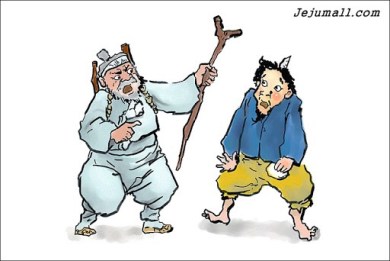
    Ireful old woodcutter castigating a not so menacing Dokkaebi

    The Dokkaebi is a mischievous, playful fairy-like spirit that is equivalent to the western counterparts of leprechauns in capricious temperament and of goblins in formidable appearance. The legend says it that an old broom made out of dried bush clover with bloodstains on will turn into a Dokkaebi, who will hold a spell over the mind of an unfortunate passer-by at night in the field or on the mountain. Befriending with a Dokkaebi can bring you a fortune at a house that he has lived as your protective spirit, but you must live there for precisely ten years only. Otherwise, the Dokkaebi will leave you with the ruins of your fortune and health. There are still people in Korea who believe this belief tradition by offering the Dokkaebi buckwheat cakes, spirited beverages, and steamed pork when they open businesses and move into new houses. Some people even report seeing them when walking alone in the thoroughfares or any lonely path where lights are dim at night between midnight and 4:00 am.

    main-qimg-603a724d0d501bab985518fa3c134c3f
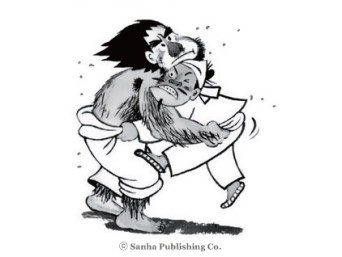
    A Dokkaebi likes to challenge a passer-by with a wrestling match.

    The Dokkaebi may seem to possess the caprice and whims natural to fairy-folk. However, it embodies the human characteristics of compassion, selfishness, naivety, shrewdness, durability, and formidableness. The Dokkaebi reflects the pathos of life indelibly embossed in the collective consciousness of the Koreans. They have endured the anfractuous national tragedies and yet maintained their unique language and culture.

    Faerie tales often belong to the days of yore before the advents of industrialization, and the fairies are either imaginative creatures or exaggerated figures of fashionably esoteric religions in the west. Still, the Dokkaebi is a living spirit in the minds of the Koreans and has wept and laughed with Koreans.

    kim-jung-gi2-444x356
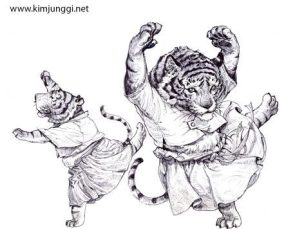
    A tiger is a Korean totemic animal that can mimic human voices.

    P.S. This post is my solipsistic response to #FariytaleTuesday, whose theme for today is the Asian fairies/spirits in folklore. The community is inundated with the wondrous tales of Japan and China but scarcely Korea. Koreans, like the Irish, love to talk and laugh with precious human sentiments, which result in the creation of the Dokkaebi. The Korean culture, as evidenced in the language, is closer to the cultures of the Ural-Altai language family, including the Finnish, the Japanese, the Turkish, the Hungarians, and the Mongolians.  Since there seems to be a scarcity of Korean spirits represented in the tweets, I felt responsible for writing about this playful Korean spirit with human characteristics.

  • about Emily Bronte

    file-20180822-149490-1ns34tc

    The 19th century has produced many a scintillating woman writer whose world of imaginations is beautifully interwoven by the gossamer strands of feminine sensibilities and literary sensitivities tinged with a passionate spirit addressing to that of the reader transcendent of times and spaces. Her world is one enchanting realm of the felicity of beauty, the ire of desire, and the tenacity of will in the witchcraft of words. Such a world belongs to no less a writer than Emily Bronte herself, the elder sister of Charlotte Bronte, who was born on the 30th of this month in 1818. This brief essay about Emily Bronte intends to manifest her commendable trait that is deemed inspiring to aspiring writers who feel estranged from the literary cliques that do not see the hidden jewel of their inner worlds.

    Educated mainly at home by reading of the books in her father’s library, Emily Bronte was something of an autodidact who was always seen with a book popped open and a notepad on her side while attending her daily chores at home. Her lack of formal schooling due to her weak disposition and introvert nature might have made her a poor speller. Still, her protean imaginations compensated furnished the marvelous world of her ideation carved by alluring latticework for her literary casements to her stories. Her fascinating imaginativeness creates the vivacities of the emotions, real and alive. Emily Bronte is a forerunner of Beat Generation, whose trailblazer Jack Kerouac championed a tenet of a stream of consciousness in writing. Kerouac, whose mother tongue was French, struggling with the English syntax, urged would-be writers to write without grammatical constraints impeding the flow of thought. The editing should come after the birth of an idea, which proceeds the mastery of grammar. In this regard, Jane Austen and Leo Tolstoy, who were also imperfect in grammatical aspects of writing, are in the libertine society of Emily Bronte and Jack Kerouac. They prove that imaginations precede imperialism of grammar.

    The lionization of Emily Bronte as an austere, astute literary Titaness in our time, obviates her weakness. It gives her a status infused with intellectual solitude of a learned woman writer and egoistic charge of modern-day celebrity writer. It reminds me of the way William Shakespeare, who was also mostly self-educated, is now revered in the grand fortress of the lofty academia as a figure of cultural and intellectual sophistication denoting one’s social status. So many people adulate the greatness of Emily Bronte and her Wuthering Heights in a simulation of her literary style and the romantic notion of solitude while diminishing her human characteristics that they regard dull and prosaic. She attended the household drudgery and took care of her sickly elderly father even in his peculiar habit of firing guns in the air from the top floor window in the parsonage as a warning to the Luddite civil unrest. Besides, she was not an academically brilliant student during her brief school years in childhood.

    I believe that Bronte would feel uncomfortable and discombobulated by such a famous rhapsody of blind admiration without understanding her personality and character that may not appeal to the readers and writers who do not see the beauty of doing simple things in daily life. Emily Bronte was neither Sylvia Plath, a woman of a privileged background whose poetry does not touch the hearts of universal readers, nor Emily Dickinson, a voluntary recluse ensconced in the solitude of leisure. Emily Bronte was an extraordinary writer in the semblance of ordinariness. She possessed imaginativeness that eclipses the brilliance of the other fashionable literary women writers of all ages. That is why her literary world is ao appealing to universal readers and writers, professionals, or amateurs.