Tag: english

  • why she wrote

    Like muffled drums in rains of thunder and lightening, her heart was still beating as the intuitive leap within her was on the verge of falling into the crevice of darkness. She hoped that life would be better or that if life wasn’t unresponsive to her hope, she could seek an elbow room in her writings blog, her glass castle of the soul. In this regard, her purpose of writing and that of George Orwell agreed that it was for sheer egoism of being an individual and recognizing it. For all she had read and seen, her spirit wanted to record it in writing before leaving the world without a trace. How pathetic it would be!

    If only. The girl hoped to articulate her thoughts to the unseen public somewhere out there. But above all, the girl used her writing practice as an autodidactic exercise to improve writing skills in the language she fell for. She loved the English language so much that she was ready to forsake the native language if she must choose one. She would have wished to possess the art of English Writing if a benign fairy had asked about what gift she would want. Perhaps she would have made a Mephistolean pact for the craft. Yet her love was alone because she loved the language more than it reciprocated the appreciation to her. How cruel it was!

    To pure lead into an open wound, the girl realized her brain was not as alert as it used to be in the locomotive of thinking. As thoughts shape language, she reasoned that a slowly deteriorating neuroplasticity in her brain might have contributed to her difficulty in reading and writing. Something ominous was happening to her, and it was gripping her spirit under its diabolic aegis for the sheer pleasure of tormenting the soul in hopelessness. Words she saw refused to make a coherently complete sentence and enter a faculty of thinking. The circuits to the control center of the brain felt blogged or damaged to the point of making telegraphic phrases swiveling at a vortex of frustration. It had never happened until last year. But why was it happening to her? Alas!

    She tried to find reasons for the ghastly maladies and self-diagnosed the following:

    1. Moving to California
    2. Demanding nature of her roles and tasks at the workplace
    3. Attending her elderly mother
    4. Approaching her end with no security for future

    She further decided that the existential frustrations were exhausting her will to essay her creative and experiential values in fulfilling her meaning of life to be expressed in writing. All of it was tantamount to the enormous boulder Sisyphus had to roll up on a steep hill in Hades as punishment for his trickery on gods. But the girl was more akin to a Caryatid, a sculptured female figure used as a pillar supporting an entablature of a building on her head. 

    But what then was her solution to untangle the web of the menacing spider? She had nothing but her will and resilience born of eruditeness and level-headiness. It helped her sail through some of the difficult adventures between the Scylla and Charybdis in her life’s odyssey. Like an earthling who never gives up hope on getting a signal from an extraterrestrial being via radio transmission, every day, she would write even if it would receive no response. Thereby hangs a tale told by a mad girl in hopeless love with words, full of words and madness, but signifying something.


  • wheel of fate

    She untangles the threads

    from Ariadne’s Ball

    and spins them in strands

    of lovely colors onto the Wheel

    of Fate holding Pandora’s Box

    she has purloined from gods

    to weave them into a new fate.

  • aeolian whisper

    Road in a beautiful forest in the morning

    Into the Alpine Path

    so winding, so unknown,

    A breeze brings mirth

    With aeolian melodies

    In whispering pianissimo

    thru the leaves of the trees

    And transfixes the flows

    Of time and beauty of youth

    Wantoning freely in ecstasy

    Sparkling like new hope.

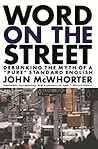
  • ‘Word On The Street: Debunking The Myth Of A Pure Standard English’, by John McWhorter – book essay

    Word On The Street: Debunking The Myth Of A Pure Standard EnglishWord On The Street: Debunking The Myth Of A Pure Standard English by John McWhorter

    My rating: 5 of 5 stars


    Sometimes, the courage to express my thoughts in English as a second language meets with insidious challenges between the grammarian Scylla and fault-finding Charybdis, lurking in the safety of anonymity on social media to stalk the prey with perverted joy. So, it is only natural for me to find encouragement from the books reassuring me that the mastery of language does not equate with intelligence. So, it is no wonder that I have the pleasure of reading  Word on the Street, an invigorating narrative told in scholastic zeal and impressive erudition flavored with street-smart audacity. McWhorter, who belongs to the constellation of brilliant linguists, such as Samuel Johnson and Steven Pinker, talks about language in terms of social and cultural contexts, making the academic subject a hot topic of a Charlie Rose talk show.

    McWhorter takes his view against language relativism that language shapes thoughts. The possession of words does not determine the thought process to contextualize the mentalese. Therefore, slang, idioms, and parlance outside the elite group of society and the educated middle class are not denigrated as improper English. In this sense, Pidgeon English, the quaintly charming admixture of scattered English words and a speaker’s native language, is not a corrupt version of pristine English but a hybrid of languages born out of the ingenuity of the human mind and changeability of language in nature. Isn’t English a living proof of the incredible amalgamation of languages still undergoing evolution? Who would have thought that English of the underclass would shine as a lingua franca?

    What strikes me most about the book, which concurs to his fellow linguist Pinker’s point of view on language not as a touchstone for one’s cognitive ability, is that solecism in spoken and written language does not reflect the user’s less desirable trait of academic ineptitude. To put it more bluntly, just because your grammar is besotted with errors doesn’t mean you don’t know what you are saying, or forthright, you are less intelligent. Take Leonardo da Vinci, the Renaissance polymath, who had no fewer than six grammar books on Latin and Greek to grasp the syntax of the classical dead languages he was so hopeless to learn thanks to his lack of formal education. In fact, da Vinci’s writings are ridden with misspellings and amorphous sentence fragments, just as Leo Tolstoy, Jane Austen, and Emily Bronte showed in their manuscripts. So, did their imperfect language skills overrule their force of imagination and contextualizing it in words? Does this betray that language shapes thought? 

    McWhorter can transcend the demarcation of race in the communication of this extensive knowledge about the subject drawn from a wealth of learning and scholastic industry with urban wit and debonair guy attitude to his readers, academic or general. His intelligence freely crosses over time gaps, chasms between class divide across continents and oceans with a universal theme of words that we, as human creatures, have spoken thus far. And he tells it using full of scintillating metaphors, examples, and anecdotes, which helps the reader comprehend otherwise monotonously academic subject without pressure and enjoyably. Samuel Johnson said that the possession of knowledge is to share it, and the possessor of the knowledge shines when he applies the knowledge to the crowd of life. Well, Word on the Street shows it all.


    View all my reviews

  • ‘The Twelve Months’

    The Twelve Months is a Russian fairytale about good-hearted Marushka meeting the spirits of the months led by the elderly January while hopelessly searching for violets, summer strawberries, and fall apples in the middle of winters as presents for her stepsister’s b-day. Alas, what a cruel task!

    The evil stepmother’s wicked demand for such a task exacts terror and inflicts pain on Marushka. But, the sprits help her and punish the wicked stepmother and sister as January Elder brings forth the mighty force of Winter upon them by the following incantation:

    “Winds, gales, storms, Blow as hard as you can, Rage the whole night long. Whistle in the chimneys, Drum in the skies, Twist and turn over the earth, Like a great white snake.”

  • The Race is to the Swift, and the Battle to the Strong

    It is the Mystifying Absurdities of Human Nature that seems to be more of animal instinct for the Survival of the Fittest. It always makes me wonder when I see people with a terrible temper and callous personalities being successful in their careers. Although Shakespeare said a fool thinks himself to be wise, people seem to think that fool to be wise in real life. That was what came to my mind while reading Samuel Johnson’s weekly essay, The Rambler, No.142, subtitled “A Rural Tyrant,” written on Saturday, July 27, 1751. (Come to think of the date, it seems that Johnson spent his weekend writing essays as in a journal, which is an admiring habit to emulate.)

    Johnson tells the readers about a swanky mansion he and his wealthy acquaintance named Eugenio, who had invited Johnson to his rural estate, happened to pass a swanky mansion surrounded by the grandeur of wealth and pretentiousness of power. Until Eugenio had told his learned friend that the villa was known for ghostly hauntings, Johnson’s natural curiosity piqued his search for truth; thus, he began inquiring about the whys and wherefores of the ghost inhabitant. The ghost was Squire Bluster, a bilious, despotic employer of his household personnel and ruthless landlord of his villagers. His capricious fission of tempest kept their financial securities at his whimsical mercy. Bluster enjoyed the powers of terror and, in the height of his perverted joy, insulted those imploring for his mercy with malice and enmity. No wonder nobody in the village repaid his vice with contempt and conferred perennial infamy on his epithet after death – at least corporeally. Notwithstanding the shame, Bluster cared nothing of it and still reigned in horror at his earthly abode because to delight in ghostly terror was his new afterlife enjoyment. Johnson lamented that the evil squire had only the gloomy comfort of reflecting that he was likewise feared if he was hated.

    In the same vein, the descendants of Squire Bluster are not a rare family but are ubiquitous boundless of territory, race, and gender. For example, employers are hardly magnanimous and altruistic in their expendable employees’ genuine wellness and demand their employees in the usual, professional pretext of constructive criticism packaged in belittling, castigation, and insulting for the sake of strictly business. But I never subscribe to such façade because we are not automats but with sense and judgment common to all human creatures. You can’t tell the other to grin and bear the insults because they are not supposed to mean personal. If you want your subordinates to do their job correctly, you must be worth receiving such quality labor from them by being respectful of your character. But alas, it is my only vain wish, an empty echo from the valley of my heart because the descendants of Squire Bluster are a multitude and will do whatever they think rightful and deserving. Don’t’ forget that respect from fear is a terror of the sense and a trademark of tyranny, exacting unchallenged obedience from people.