Tag: english

  • ‘The Amiable Fleas’, by John Steinbeck – review

    John Steinbeck was all man. He was a writer of muscles. I meant the powers of strong individuality that disagreed with grandstanding with the political in-vogue trends of his time with his writing as literature for an ideology of grand cultural context, not for the mind’s pleasurable satisfaction. In a word, Steinbeck appears to be in touch with the real world, with the characters realistic and stories palatable, not confined in the seclusion of a leisurely abstract world of the elite. The Amiable Fleas conveys all of the charms described above of Steinbeck as an attractive raconteur at his best: humorous, heartfelt, and honest in his tough cowboy appearance in a strange city filled with quaint aromas of the old civilization.

    The Amiable Fleas is Steinbeck’s testimonial narrative of the truth found in life’s ordinariness; the meaning of life realized in the joy of small pleasure against provisional needs of instant fame and worldly prestige. It’s an innate folly of human nature trying to reason against the significance of Serenity, Courage, and Wisdom as if they are remotely associated with Intellect. As Steinbeck held against criticism about avoiding the political and social issues of his time, he tried to reason his own reason for writing about such simple truth of life.

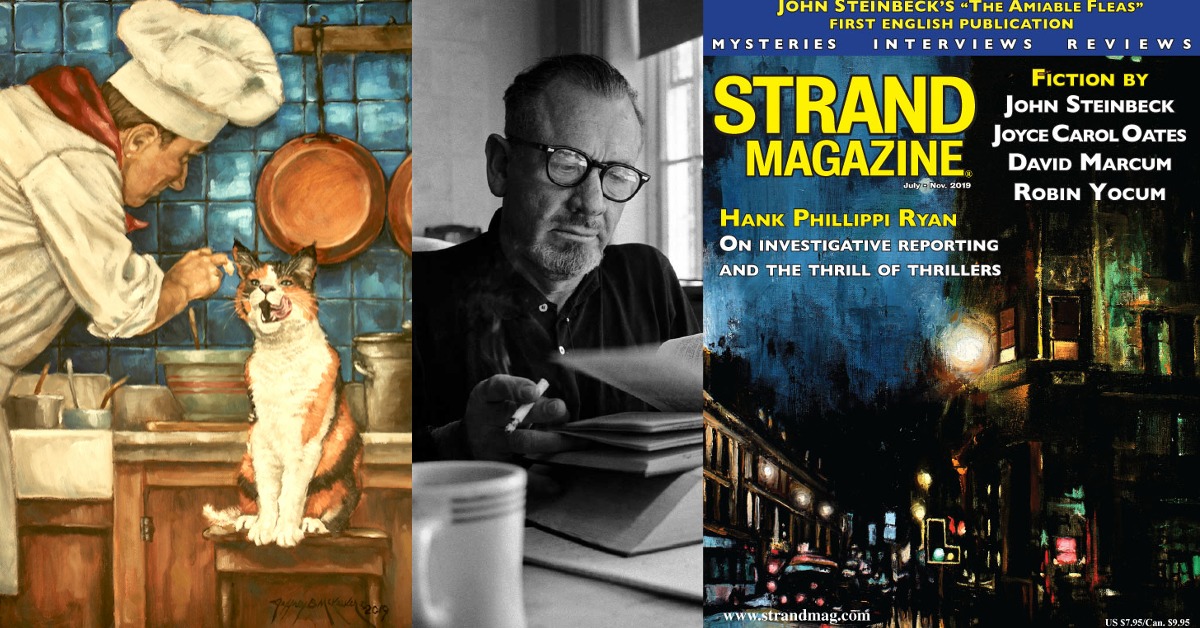
    The Amiable Fleas is the res ipsa loquiter of the value of small things that Steinbeck treasures, for it is what keeps the troublesome, pugnacious, bickering human tribe tamable and bearable with humor, which is a handmaid to hope and resilience. The amiable fleas represent the idyllic but oddly likable bunch of professionally intellectual people whose existence is a canvas of abstract painting that lacks a touch of realism. The poet, the architect, and the painter occupy their self-designated seats in the eponymous restaurants in Paris, doing nothing but contemplating about their artistic works in the selfishness of intellectual stasis. The excellent chef of the restaurant M. Amite embodies an artist whose ambition is the stir that his honest mind raises. The desire for fame is the infirmity of his admirably good, hearty nature. The star of the Michelin Guide is the apple of the discord, a symbol of outside influence that incites M. Amite’s ambition, not from his love of cooking to please his feline friend named Apollo. M. Amite is the image of an artist swayed by the great things of the world, even if it would cause him a loss of joyful dailiness.

    Originally published in the historically renowned French newspaper Le Figaro on July 31, 1954, as the tenth weekly installment of “One American in Paris,” The Amiable Fleas was published in English for the first time July-November 2019 issue of Strand Magazine. The background of this charming and heartwarming short story was that Steinbeck wanted to be himself, not how the French media imagined him to be or wanted to create their version of him from the counterproductive interviews with the American writer. And so he wrote a series of short stories that only he could tell with his quintessentially American way of storytelling. Yet the result is beyond the territorial boundaries and cultural enclaves, for the narrative reaches the hearts of not only the hard-to-please sophisticated Parisian readers but also the universal readers of all ages. Steinbeck is undeniably American to the core. Yet his love of realism that gives a new viewpoint upon dailiness of life enables readers of the world to get a fresh, bright hold upon our problems. Given that perspective, everything is something, and everyone is someone.

  • ‘Writers and Their Cats’ by Alison Nastasi – review

    Writers and Their Cats: (Gifts for Writers, Books for Writers, Books about Cats, Cat-Themed Gifts)Writers and Their Cats: by Alison Nastasi

    My rating: 4 of 5 stars

    If dogs are man’s best friends with their childlike artlessness and uninhibited affection, what are cats? Lucy Maud Montgomery, the author of Anne of Green Gables, answered thus: “Cats are so nice and selfish.” Writers and Their Cats by Alison Nastasi is a delightful illustration of such a relationship between writers and their cats with peek-a-boo glimpses of the celebrity authors’ unknown personal aspects behind the public façade.

    The fascination with the graceful demeanor and graceful capriciousness of cats is particularly intense among the volatile and imaginative writers as the muse of their lettered labyrinths. Edgar Allan Poe wished he could write as mysteriously good as his cat Catarina who liked to hover herself over Poe’s shoulders while he was writing. Mark Twain, whom I used to associate with something of a Dog Father, turns out to be a godfather of cats who rented cats to city dwellers during their holidays in the countryside. Twain also named his cats commensurate with his wicked sense of humor: Satan, Soapy Sal, Lazy, etc. Furthermore, Twain proclaimed that anyone who likes a cat is his friend. The imposing figure of rough and tough Ernest Hemingway may not match the delicate silhouettes of cats’ sophisticated society. Still, Papa Hemingway loved them with the tenderness he rarely showed even to his better halves.

    The book also introduces readers to various writers of our digital era whose love of cats takes them to the world outside their comfort zones in selective solitude. Patricia Highsmith, a high-strung, highly opinionated, no-nonsense author of The Talented Mr. Ripley, reveals her Tate-a-Tate moments by greeting her cat, “We are going to have a great day today.” Marion James, who wrote A Brief History of Seven Killings, met Tom the Cat at a café in Brooklyn, New York, who, like the writer, enjoyed being outside among people because both of them thrived on the liveliness of the world around them as a creative force. Then Peeti Shency, the Indian novelist and artist, writes about the experience of sharing a terrific story about her trip to the Kedar-Gouri Temple dedicated to the eponymous goddess with a particular fondness of cats, thus elevating them to the divine status of the immortals. Shency resurrects the legends of holy cats in the temple to our digitalized reality of the world and connects them to our need for their presence for nature’s mysteriousness.

    There are many other writers in the book whose love for their cats are touching. They all confess to their odes to cats that only cats can understand what they are and who they are. Whether or not cats have a supernatural sense of reading people’s minds, I have no intelligence. Still, I do know that a cat is good at observing your movement and facial expression from my observation of Toro, a 12-week old male brown tabby kitten, who likes to watch me what I am doing and where I am going. A cat is a curiously interesting beast, and it is this semblance of intelligence that makes a cat so attractive to the imaginative, high-strung writers. If you have a cat at home and a writer at heart, this book will present you with a delightful treat to your mind, packed full of beautiful pictures of writers and their cats not in grim portraiture but natural snapshots. Readers may tempt to show the writers’ photos with their cats to your cats.

    View all my reviews

  • Pets are not of a fad but for life.

    I read the Guardian article “A dog is for life, not Just lockdown” by Donna Ferguson (September 13, 2020 issue) with intimately acquainted feeling shared by our understanding of pets as family members with care, not as luxurious commodities treated with whims and caprice. Her search for a Poochon puppy for her daughter reminds me of my own story of the recent adoption of a tabby kitten from a shelter.

    As I was going to move into a pet-friendly apartment, I was excited to bring a dog into my new home to share companionship. However, during my search for a canine company, I became aware of the ugly reality of “pet business” intent on swindling and ripping off naïve would-be pet owners. Ferguson’s experience of encountering sellers of puppies suspected of scamming or deceiving chimed the bell of my experience in which a dubious welsh corgi breeder insisted on “shipping out” a puppy to me in the convenient pretext of Covid-19 protocol. Even legitimate ones are not exempt from my continued disappointment: Shiba breeders in Southern California had their waiting lists closed. One pet shop owner on the phone revealed to me that since the outbreak of the Covid-19 and California state made it difficult to sell and buy a pet at a pet shop. Hence the supply and demand for pets have become disproportionately unbalanced, skyrocketing the price of dogs immensely. Worse, the procedure of adopting dogs from shelters makes it excessively challenging and disheartening for bona fide would-be owners disappointed with the requirements of a near-perfection environment for dogs.

    Maybe all the disappointments and disillusion of having a dog meant to lead me to the world of cats because now I have a 12-week old brown male tabby named “Toro,” a masculine form of Tora, meaning in a little tiger in Japanese. I brought him from Ventura Animal Services three weeks ago. He is a smart, capricious kitten charged with a sudden pop of energy to stalk and play with the toy rat and anything moving from the frills of my skirts to dangling straps of my iPhone cover. Watching Toro peacefully cuddle up on my laps or my desk when I read or write, I can’t agree more with Ferguson that our cat and dog are not for our pandemic solace but our wish to share our homes with the lovely creatures.

  • sea ghost

    EfmZSLgUMAAwhMc

    Under the mast of destiny

    I sail away, far and wide

    in an unpathed seaway

    with or without luck’s aide

    to uncharted shores

    where my voyage anchors

    in love’s meetings.

  • Moon World


    EfPSWz6VAAA-ZfR

    The luminescence of the lunar beauty alone

    Quells the untamed roar of the wild ocean,

    Illuminates the somber kingdom of the shore,

    And pours the perched heart with pleasure.

  • ‘The Molly Maguires’ (1970) – film essay

    e867caa5-600f-4a39-8db8-3c6906605de3_1.383b15b9c449c0199f453c0ee7fa40e2

    There are two kinds of morality: one is speculative morality by which your thinking directs you to find the truth about the way things are. The other is practical morality, in which your eyes dictate you to find the applicability of your moral precepts to real-life situations. Since your ultimate end is happiness in life, you choose what deems to be reasonably advantageous means to achieve the purpose. Now here is where your moral dilemma arises from a crossroad of modus vivendi and modus operandi often directive of ego, the appetite of the sense, in the sovereign of free will beyond the boundary of Natural Law.

    the-molly-maguires-original-movie-still-n02-8x10-in-1970-martin-ritt-sean-connery

    The question of conditional morality in the face of life’s challenges is the thematic context of “The Molly Maguires” (1970), an American film directed by Martin Ritt. It is a drama of the secret society of Irish immigrant mineworkers led by Jack Kehoe (played by Sean Connery) battling to better conditions in the Irish immigrant community of coal miners in the 1870’s Pennsylvania. The story begins when Pinkerton Detective James McParlan (played by Richard Harris), employed to infiltrate the organization, arrives at the poverty-stricken mining village. McParlan himself is also an Irish immigrant from Ulster and sees his fellow compatriots slaving away at the worst working conditions in the gate of a subterranean pit of anthracite with the danger of death always lurking in all wither. The proverb of “Blood is thicker than water” may have smeared in his tortured muscles because McParlan can not be immune from the anger and vengeance that binds the Mollies together as he shares his sweats and laughs with them. The Mollies sabotage the means of production in their ingeniously effective ways and even kill the members of the powers that be if necessary, to deliver their resentment to the oppressors of failed wishes and frustrated dreams in the necessity of meager livelihood. The biblical message of “Refrain from anger, turn from wrath. Do not fret” rings hollow in the selfishness of leisured life that has no regard for those whose fortune’s malice overthrows their states.

    MOLLYMAGUIRESLC1

    The moral dilemma in which McParlan finds himself results from a clash of his id, speculative intellect, and ego, practical intellect, that binds him in the natural inclination to happiness, which he intends to obtain from a love of his landlady and prestige of social standing. Besides, as the fellowship of the Mollies enters a realm of his newfound fraternity of brotherhood, McParlan forces himself to subject natural human feelings to a rationalization of thinking under the sway of the reason for success. He sets his virtue by compromising moral precepts to realistic means of life in choosing what deems to be the most practical way of achieving his ultimate ends via a chariot of ambition without the charioteer.

    images

    This film does not turn out to be a grand social movie that its synopsis seems to present but a compelling drama of human nature and actions in contemplation of what constitutes moral actions. This film is not only about the Irish immigrant coal miners but also about those whose precious dreams and wishes are hard to materialize in the harsh reality of life. You will see that values are variable, and that virtue is a settled way of performing what you think right. Perhaps, Oscar Wile is right in saying, “Morality, like art, means drawing a line someplace.” Nevertheless, one thing is sure that you cannot do an immoral act for moral reasons, even if every human action is just as such right, come what may.

    download