Tag: essay

  • Gaslighting

    einstein

    There is no more wondrously enigmatic than a man, as betokened in the Spinx’s riddle about the metamorphosis of a man from a quadruped to a tripod. A metaphysical shapeshifter, an astute apprentice to whatever entity is deemed promising, a man is by nature spiritually tenuous in its consistency of adhering to principles of Reason. Concerning the duplicitous nature of a man, no one but Albert Einstein has perspicacious knowledge about human nature. Einstein himself was a genuinely curious admixture of polarities: mad, smart, indifferent, humane, distinguished, ordinary, failing, and excelling, without a hint of arrogance in a semblance of condescendence ingratiating himself with the populace. Accordingly, I find his wise sayings apposite to the several swings of things I have seen in every spectrum of daily life.

    The fallacy of human judgment deprived of sensitivity that is apparent in most of the social phenomena aptly applies to Einstein’s following adage: “Two things are infinite: the universe and human stupidity.” A man knows one thing but disregards the other in the glorified appellation of a lofty cause of elevated human dignity that people are likely to oversee in the ordinary daily landscape. To illustrate, the current campaign against the systematic police brutality in the wake of the deaths of George Floyd and Michael Brown is indubitably just and noble in its effort of ending the institutionalized racism in the States. However, the people actively involved in the movement – politicians, activists, celebrities, and the rest of the populace – do not seem to include the feelings of others who are socially outcast whom they can see everywhere in the daily landscape.

    x1080

    The category of the weak and the persecuted should not be limited to people of particular creed or race. Still, it should also encompass those who suffer from daily persecutions by their superiors, peers, and even family members in that relaxed and light-heartedly enforced “Just a job,” “Just a kidding,” or “just a passion of the moment,” which doesn’t mean much. This disguised bullying is an illustration of “Gaslighting,” manipulating someone by callously and sordidly psychological means into doubting his or her sanity when it does not fault the faculty of the mind. The spirit of the victims of gaslighting is only too acute and perceptible to ignore, and the result of the virtuous endurance of socially acceptable bullying is the high rate of suicide and mental illness that people tend to overlook.

    30610249_1300x1733

    The slogan of “Black Life Matters’ itself indicates the ignorance of other lives as well in the sense that it only promotes the dignity of specific people. Whereas, many other people are subject to daily mistreatment of individualities and dignities based on personal differences in external elements and dispositions that make them distinguished from the majority. Take the fictional Arthur Fleck, the wretched man behind the mask of Joker. Fleck is a victim of abuses that have stunned his growth into a confident individual finding meaning in life. Instead, because of his timid appearance dubbed in fumbling mannerism, Fleck is a subject of ridicule, a good-for-nothing clown whom all the members of society regardless of race and gender from top to bottom taunt and ignore. His invisibility caused by ignorance of people carries him over the edge of his sanity. However, people love to hate him, accuse him of being a villain to wreak havoc on the innocent people loved by all. What’s appalling about the plenary inquisition of Fleck is that it happens in the reality of life where many suffer from the inward pain of separation and misunderstanding from the society that is supposed to protect them. The community turns its back on the nameless individuals who do not fit into the social category of the Weak.

    merlin_161549535_81876d30-60ee-4253-a651-402f6b45568f-superJumbo

    The fatuous conception of social equality is then null and void in advocating the well-being of the weak in all aspects of social life. The definition of the weak includes all who feel vulnerable, prone to emotional scars callously inflicted by the brutes of the sense. The Twitter Community, for instance, is the most exclusive of all other social media under the disguise of the magnificent liberality of free opinions. It can hurt the soft-spoken and people of delicate constitution trying to find a supportive community where they can share and spread knowledge regardless of elitist discrimination. The high number of followers is the prerequisite of respectability in the digital social meritocracy. The insularity of each community from within is reminiscent of Salem, the island of the lords of flies, and other subliminal lands of nowhere you are likely to imagine in SC-Fi fictions. The viscosity of educational achievements, social appellation, and physical appearance decides the affability of your tweets, making you endear to the qualification of the followers that your twitter pal has amassed. The more unique tweets are, the less popular they are. Forget the lexical queerness due to different linguistic families. The tweets denoting solipsistic musings or solitude in sadness are not welcome. In other words, tweets should be as delightful as an ascending lark. Otherwise, they will not even bother to read your considerate tweets.

    The stupidity of people amazes me in every possible variety of forms and degrees, and the reaction to their reflection is all the more mesmerizing in superb wonderment. I wonder if people know that when they champion one cause, they are also excluding the other, which is closer to where they live and work. On the train, on the bus, in stores, in offices, people are ignoring the weak. All of this is the comedy of errors, the infinite stupidity of humans. Einstein saw and knew it, and I am confident that he continues to see it with his arms folded, looking down upon his posterity from his chair of knowledge of the eternal universe, and say, “I told you so.”

    unnamed

  • Magical windows of the misty past

    The story of man and beast decorates the wondrous latticework of the enchanting casement of Greek mythology. The ancient Greek weavers of stories used their poetic license to mirror the human traits, both attractive and unattractive, through the figures of the beast in scintillating ways. The resultant mythology created an aura of mysteriousness wonderfully anchored in reality whose thematics were originated in, such as the following tales from Greek mythology that reflect the nature of humankind as mirrored in the perspectives on the natural elements of animals and the relations to it.
    Cretan_Bull
    The Cretan Bull
    • The Cretan Bull and the Minotaur 

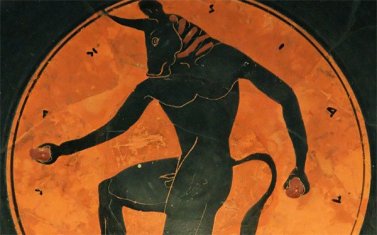
    The story of a half-bull and half-man monster known as the Minotaur epitomizes the primordial thematic perspectives of mankind juxtaposed along with the law of nature representing the mysterious force. It became a subject of belief tradition peculiar to its natural and cultural environs. The conflicting sentiments of reverence toward the awe-inspiring nature’s creatures and the ambition for domineering them as the ruler of the universe give birth to the bestial creature in the figure of the terrific Minotaur who was fated to be slain by the Athenian hero Theseus. 

    minotaur
    The Minotaur

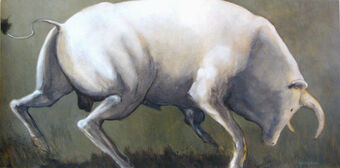
    King Minos betrayed Poseidon by keeping his beautiful snow-white Bull, instead of sacrificing it to the expectant god, who, in turn, made his wife Pasiphae unquenchably infatuated with the Bull. She copulated with the beast by taking herself into the form of a hollow wooden cow designed by the Athenian architect named Daedalus. The result was the Minotaur kept in a Labyrinth by the selfsame designer of the wooden cow. The Minotaur showed no human feelings or emotions as the mythology did not treat him any more than a horrible bestial creature from the unnatural union of a woman and a beast. 

    A Bull in the ancient Greek culture was a chthonic animal associated with fertility and vegetation and also represented the sun and the might. In fact, the famous figure and paintings of bull-leaping are seen inside of the Minoan mausoleum in Knossos as first discovered by the eminent English archeologists Arthur Evans, who also found Linear A and B letters, the mother of the ancient Greek language, at the turn of the 20th century, 

    Unknown
    Argos finally uniting with Odyssey.
    • The dog – the best friend of mankind

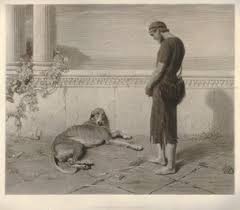
    The perspective on the dog as the loyal canine companion collapses the millenniums between the ancient Greek’s time and ours. Even the Cerberus, the three-headed guard dog of the Hades look tamable with a piece of sweet cake, making it look less of a menacing beast necessitating the blood and flesh of man. This goes without saying that it was Argos, the paragon of the faithful canine, who recognized his travel-weary employer Odyssey after 20 years of absence from home and put forth what might think he had to approach him with a wagging tail. He died as his long-waited boss in incognito passed by him with his heart pounded by a surge of pathos dubbed in warmth. Of all the gods, goddesses, heroes, and even his family, it was Argos who showed genuine, artless unconditional affection to Odyssey and thus rendered his heroic owner all the more humane and sympathetic. 

    Laelaps_web
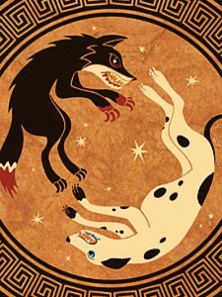
    Laelaps, the dog that never fails to catch

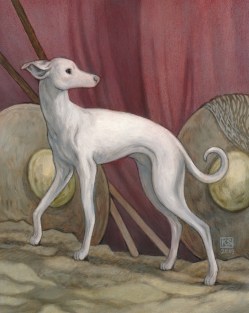
    Speaking of loyalty, Laelaps, a Greek mythological dog that never failed to catch what it was hunting, also denotes how the ancient Greeks perceived the dog as their life companions. Laelaps was initially a gift to Europa from Zeus, then bequeathed to Minos, who gave it to his concubine Procris whose sister included Pandora. She gave the hound to her husband Cephalus as a token of her unbroken love for him Cephalus used the hound for hunting the Teumessian Fox that could never be caught. Then Zeus turned both of the animals into the stars as the constellations Canis Major (the dog) and Canis Minor (the fox).

    12916666_f496
    The Eternal Catch-Me-If-You-Can between Canis Major (the Dog) and Canis Minor (the Fox)

    Consequently, the use of the animals above in the thematic context in the Greek mythology evinces that mankind cannot exist alone as part of nature. Man finds his meaning of what it means to be a human and its purpose in life by rendering the values and precepts of natural law emblazoned in the human consciousness to the meta figures of the mythology. The mythological animals, whether wild, imaginary, or ordinary, are the reflection of the human traits interbred with imaginary creatures from the Elysium of Fancy. It became the substratum of a belief tradition administering to the modes of social behaviors in society, and thus developed into an organized religion by way of syncretism in the era of Christianity. 

  • ‘The Legend of Sleepy Hollow’, by Washington Irving – essay

    51phPvWhOmL._SX381_BO1,204,203,200_

    Shakespeare once said that ghosts were amiable, harmless in want of company to console their haunting loneliness, lost in the crossroads between this world and that world. But that is not the case of the headless ghosts – the angriest and most terrifying of all other specter ilks, evoking the most primitive sense of fear to the eyes of beholders by the sheer eeriness of the appearance.  Because they despaired and died in oft violent ways, the headless ghosts are putatively the most furious and vengeful with the domes of their souls forever lost. No wonder there are legends of headless knight riders prevalently existent in the universal world.

    Meet the famed headless nightrider of the Sleepy Hollow in New York. Originally hailed from a province of old Germany, he used to be a soldier fighting on the British side during the Revolutionary War who was decapacitated by an American cannonball. His battle buddies buried him without the missing shattered head. The residents of Sleepy Hollow believed that the soul of the unfortunate young German soldier risen from his grave by his supernatural ire burning with vengeance against the earthlings that killed him was restlessly riding his phantom horse at night furiously brandishing a Jack-o’-Lantern in a semblance of face made out of a displaced pumpkin as his a makeshift head, glowing in a flame of fury as to light his nightly way.

    The indelible image of the restive headless horseman is terrifically and vividly resurrected by the literary alchemy of the great American writer Washington Irving in “The Legend of Sleepy Hollow” in which the unlikely protagonist of a meek, naive, willowy school teacher of New England by the name of Ichabod Crane stumbles into his frightful encounter with the Horseman on his fateful night during his doomed journey home. Woe betided the unfortunate benevolent schoolteacher believed to be spirited away with the headless horseman to the legion of wandering spirits in between the world of the living and that of the dead till the eternity.

    Apart from the spectral elements of the story, Irving’s characters in the story convey the displaced post-colonial sentiments of unease for the present and uncertainty for the future in the chaotic aftermath of the war that was supposed to beget promptly promising bright outcomes to the post-colonials. The nervous semi-detachment from the old world’s cultural and political authority and the unsettled practical value of the war due to all kinds of border chicanery in the still socially volatile post-war valence of setting intersperse the story in the fumbling figure of naïve Ichabod haunted by the furious ghost of a fallen soldier from the war. The legend of Sleepy Hollow is Irving’s superb storytelling of the birth of a new culture begotten from its old motherland at its infant stage of building a national character afresh with its own cultural capital, such as folklore endemic to the new land of hope that Irving so cherished.

    The good teacher Ichabod Crane

    Flees from the Headless Horseman

    With all his gentle might in vain

    For the ghost rider outruns the man.

    Now the riders roam in the shadow

    Looking for recruits in Sleepy Hollow.

    P.S. This short essay on Washington Irving’s ‘The Legend of Sleepy Hollow” is my contribution to a weekly Twitter event whose theme for this week is ‘The Headless Horsemen”, which seems to prevalently existent throughout the cultures of our global village. What uncanny synchronicity is to come upon this subject matter since I am currently reading Irving’s eponymous book that also contains many other stories from his wonderful ‘Sketch Book’.  

  • To readers

    additional_7a1d79197752605194d5b4ab7d9c394967566b14-8
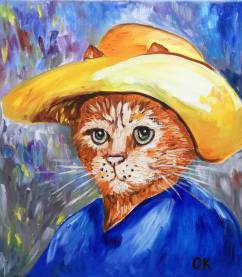
    Cat in a hat La Vincent Van Gogh by Olga Koval

    Normally, I don’t post a crude litany of woes or untamed outcry of malaise because that’s not what I want my blog to be filled with. However, today is an exception to the rule because for the last couple of days the receptions to which my published posts have been particularly detrimental to my disposition and averse to my sensitivity. Well, I don’t think it really matters to any of you out there who happens to stumble into my hermit blog, but then I don’t really care what you think about it because it’s my sovereign blog, which is my only safe niche, an elbow room amidst this crazy existential daily life constantly threatening my sanity, bullying my sensitivity, knowing that I am distinct for that “Positive Thinking in Thick Skin” facade.

    First of all, I don’t understand how people can follow a blog without liking any of my posts. Are they fishing in for their potential followers? I have noticed so many of them out there without liking any of my posts and following my blog, which I find it very insulting and odd. I am not here to foster an online relationship with anyone out there but to practice my writing skills as well as to use it as my creative, intellectual outlets yearning to surface from within because I can’t just will out what I feel and think without letting it out. Besides, I don’t want my existence to disappear into oblivion, which is a great injustice to my sovereign freedom of expression. That said, I don’t want to build up popularity by getting mindless followers either haughtily not bothering to like my writing or stopping to like it for whatever reasons. That breaks my heart to the extent to which it can’t be sawed up or replaced by a steel heart. It’s imbecility to have followers who are unappreciative of what I write.

    Secondly, to pour hot lead into my already wide-open gap of the wounded heart and soul, I saw the stats that although people read my last post about 6 movies from the 60s celebration of National Classic Movie Day yesterday and today, only four people voted for likes! Such disastrous comeuppance made me so disappointed and disheartened that I could not but think that writing could also be a Modus Operandi of detecting all about yourself from the way you looked to where you were from. This betrayed my primal idea about being capable of metamorphosis and travel to become all that I want to be, to do, and to go under the protection of faceless stealth. Faceless because your face could be a hindrance to expressing your self in a true glass of the mind. In order to ascertain the cause of such an outrageously heartbreaking result of the last post, I have read my post over and over again, but there appears to be no sophomorically pesky solecism whatsoever.  Further to the attempts, I visited the blogs of others about the same subject, but none of them is hard to regard it as a magnum opus! Do they think my post is inaptly conceived and professionally benighted or just plain average? And they even had comments from their members of the coterie eulogizing how great their picks were! Seeing all of this in my very eyes, I could not help agreeing with Edgar Allan Poe criticizing a clique formed among the New York Literati that excluded any writer outside the league of their own. I don’t think any of them appreciates my writing, and it makes me feel like such a fool that from now onwards, I vow that I will NOT volunteer to do any contributory writing unless I am asked to.

    Thus I have reorganized a list of followers because I think it necessary for me to do so for the love of my broken heart and wounded soul. I see writings of others, which are not tours de force but filled with a rhapsody of why their inane posts are great. Jealousy? What hokum! It’s such amusement to see even writings can become a tool for attracting strangers as a social get-together platform. Here I am, a hobbyist amateur writer working 9 to 6 to pay bills and rents but whose literary ambition is as great as Ben Jonson and Charlotte Bronte. Charlotte Bronte had been rejected to have her work published many times and was of the same disposition as I am. (Yes, I am closer to her in temperament and sensitivity than any of you out there who likes to think you are or wants to think you are when you are not!). She and I are in agreement in thinking that any appreciation from a considerate and intelligent reader for our writings is highly appropriate and proper as decorum to the author. You know what I mean?

  • This I think.

    EXQiN_gWkAEqnA5

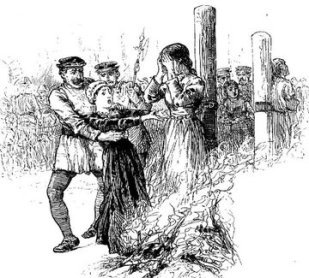
    “The concept of witchcraft as devil-worship by the church unleashed authoritarian control, & the denigration of women, many of whom were burnt at the stake, drowned, etc., simply for growing herbs or liking cats! For me, these are heroines & warriors.”

    I happened on the above-quoted tweet, which impelled me to unravel in me a thread of complex feelings about a common popular conception of witchcraft as institutionalized persecution of women of unique professions and different opinions and canozing them as martyrs of Feminism or Paganism.

    First of all, it wasn’t just that iconic ‘Men v. Women’ or ‘Christianity v. Paganism’ facade that dominated the thematics of witchcraft. Of course, religion played an important role in enforcing the authority of the church as the one absolute administrator of justice and punishing anyone who dared to defy it. However, when the Church itself incorporated paganistic esoterism in its rites of ceremony and mechanical device of prayer, it cared less about the divinity of a pagan deity that the cult worshipped, unless it openly threatened the dogmatic foundation of the teaching of the Church. Rather, it was more of a societal practice of giving a tight rein in communal harmony that allowed no misfits or outsiders or recluses. It was grudge-filled, insular-minded, and jealousy-driven vendetta against whom you wouldn’t particularly like or whom you would harbor a kind of animosity because the targeted subject looked unpleasing, unprepossessing, or simply ugly of introverted disposition.

    Women were the worse. Forget Community of Sisterhood. The Daughters of Eve can be both ecstatically passionate and formidably vengeful. A single unmarried woman, both young and old, living in the bliss of solitude, minding her own business away from the vociferous melee that she didn’t feel related was likely to be a lamb savagely herded by the hateful melee to the inquisitional slaughterhouse. Modus vivendi of social norms was the armor that would protect her from the arrows and spears of the public attack on sovereign individuality that we take for granted in our time.

    Witchcraft is neither synonymous with Feminism nor Liberalism, both of which as proverbial party ideology have beocme the dogmatic foundations of Arts and Huaminities. It’s not a grand unified campaign against smart women with peculiar religious belief when you contemplate the fact that greatness results from simplicity, which is the answer to all complexities. The inquisition of popular sentiment in practice overrides freedom of individuals asserted in theory. Albert Einstein knew exactly about the dualistic nature of humanity that would return to the basic animalistic instinct such as persecuting the innocent because of their individuality: “Two things are infinite: the universe and human stupidity; and I’m not sure about the universe!” For this reason, I dare to defy the notion that the persecution of witchcraft was synonymous with the denigration of women in general.


  • glittery wild west

    I have recently read an article about California Gold Rush from my subscribed British history magazine with particular interest as it was somehow relatable to my own experience of being a recent single pioneer woman from the East to the West with new prospects for the future. Although the article was informative in unpicking the social manifest and latent dysfunctions of Gold Rush, there were also new and innovative modes of business as spearheaded by adventurously daring individuals who paved the way to the prosperity of the Wild West in years to come. 

    Wells, Fargo & Company, founded by Henry Wells and William G. Fargo, started and prospered the West’s all-purpose business, consisting of transportation, security, and communication agents, buying gold from prospectors and selling them paper bank drafts and delivering the valuables and mail guarded by a hired detective against outlaws. Pony Express, founded by William Russell, Alexander Majors, and William B. Waddell, was the first express courier service in the U.S., delivering mail from California to New York in fifteen (15) days by dedicated excellent employees on horseback day and night until the transcontinental telegraph was established. And there’s the famed Levi Strauss, the founder of the iconic Strauss & Co., who made the first blue jeans for miners, cowboys, etc. 

    California Gold Rush prompted a huge spike in the demand for changes in various sectors of the American society, which was an inevitable calling of the ethos, Manifest Destiny, and it also begot some of the most interesting and impressive enterprising spirits whose establishments are still among us and whose names are made into the history of the U.S.