Tag: film reviews

  • ‘Major Dundee’ (1965) – film essay

    download

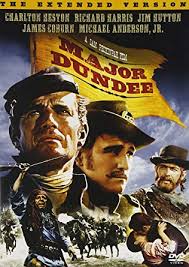
    Ambition, made of sterner stuff, is the solder’s virtue that chooses gain, which darkens him. Bravery, comprised of nobler spirit, is the solder’s honor that elevates the soldier’s merit to the echelon of Homeric virtue of arete, the excellence of man leading to achieving a supernatural feat of heroism. An excellent soldier with arete knows no boundary of political, religious, social, or racial division and transcends the subjectivity of time. Major Dundee (1965), an American western film directed by Sam Peckinpah, cogently translates a balanced, objective equilibrium to test the validity of the soldiers’ virtues on the continuum of the Homeric arete in the background setting of the American Civil War.
    images

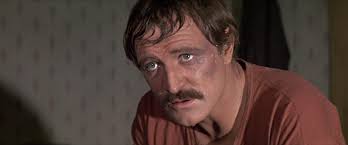
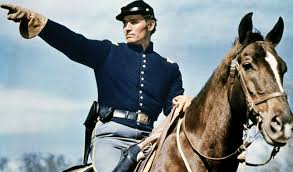
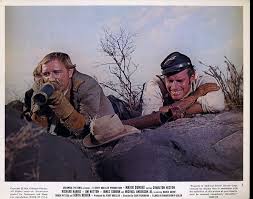
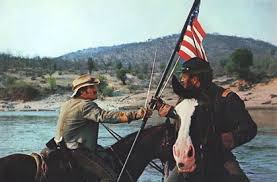
    Major Amos Charles Dundee of the Union Army (played by Charlton Heston) is a man of primitive ambition of glory sent to head a squalid prisoner-of-war camp in the New Mexico Territory. There he meets his former friend turned foe Confederate Captain Benjamin Tyreen (played by Richard Harris), who bears a grudge against Major Dundee for his betrayal of friendship. The notable tension between the two always remains even after their uneasy but necessary collaboration. Still, the esprit de corps consisting of unlikely but able-bodied characters sets to take out the Apache War Party in the new territories. Major Dundee sets out for the campaign not of pure divine patriotism but his glory despite his contentions with Captain Tyreen, who is more morally honorable and culturally sophisticated than himself.
    960full-major-dundee-screenshot

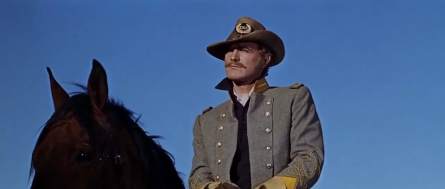
    It is Captain Tyreen, the renegade leader of the southern rebels who embodies the model of the arete, combined with moral integrity and soldierly fitness fabulously demonstrated in his effortlessly stylish habiliment. He is a dandy gentleman with decency and learning and an exemplary soldier and leader with justice and bravery. The refinement of civility as incarnate in the figure of Captain Tyreen is vividly contrasted with the rough intransigence of Major Dundee through the exterior appearances and actions of the two opposite characters. Even Captain Tyreen’s attitude toward the colored Union soldiers surpasses Major Dundee’s languid attitude toward his colored soldiers fighting for the same cause.
    images

    “Major Dundee” is a new type of western that abandons its common thematic elements consisting of noble savages, self-righteous lone gunslingers, the arch-villains, and beautiful women in pursuit. It is a new type of western that begins to be aware of the societal changes in the reflection of the nature of humanity with bold actions of likable bravado and admiring characters that are not circumscribed in the extreme ambit of norms and conventions with an artistic touch of vivid realism. Despite the rather unsatisfying commercial success of the film when it first came out, I find this film both entertaining and thoughtful in the historical background of the Civil War, showing true bravery equipped with respectful integrity of a person, friend or foe. There is no better sign of excellence in man than the bare demonstration of the act.
    download

  • ‘The Molly Maguires’ (1970) – film essay

    e867caa5-600f-4a39-8db8-3c6906605de3_1.383b15b9c449c0199f453c0ee7fa40e2

    There are two kinds of morality: one is speculative morality by which your thinking directs you to find the truth about the way things are. The other is practical morality, in which your eyes dictate you to find the applicability of your moral precepts to real-life situations. Since your ultimate end is happiness in life, you choose what deems to be reasonably advantageous means to achieve the purpose. Now here is where your moral dilemma arises from a crossroad of modus vivendi and modus operandi often directive of ego, the appetite of the sense, in the sovereign of free will beyond the boundary of Natural Law.

    the-molly-maguires-original-movie-still-n02-8x10-in-1970-martin-ritt-sean-connery

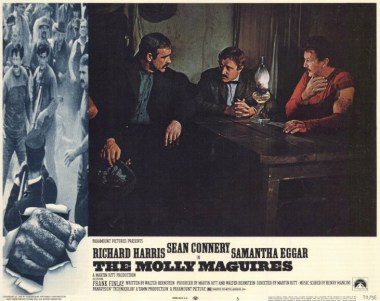
    The question of conditional morality in the face of life’s challenges is the thematic context of “The Molly Maguires” (1970), an American film directed by Martin Ritt. It is a drama of the secret society of Irish immigrant mineworkers led by Jack Kehoe (played by Sean Connery) battling to better conditions in the Irish immigrant community of coal miners in the 1870’s Pennsylvania. The story begins when Pinkerton Detective James McParlan (played by Richard Harris), employed to infiltrate the organization, arrives at the poverty-stricken mining village. McParlan himself is also an Irish immigrant from Ulster and sees his fellow compatriots slaving away at the worst working conditions in the gate of a subterranean pit of anthracite with the danger of death always lurking in all wither. The proverb of “Blood is thicker than water” may have smeared in his tortured muscles because McParlan can not be immune from the anger and vengeance that binds the Mollies together as he shares his sweats and laughs with them. The Mollies sabotage the means of production in their ingeniously effective ways and even kill the members of the powers that be if necessary, to deliver their resentment to the oppressors of failed wishes and frustrated dreams in the necessity of meager livelihood. The biblical message of “Refrain from anger, turn from wrath. Do not fret” rings hollow in the selfishness of leisured life that has no regard for those whose fortune’s malice overthrows their states.

    MOLLYMAGUIRESLC1

    The moral dilemma in which McParlan finds himself results from a clash of his id, speculative intellect, and ego, practical intellect, that binds him in the natural inclination to happiness, which he intends to obtain from a love of his landlady and prestige of social standing. Besides, as the fellowship of the Mollies enters a realm of his newfound fraternity of brotherhood, McParlan forces himself to subject natural human feelings to a rationalization of thinking under the sway of the reason for success. He sets his virtue by compromising moral precepts to realistic means of life in choosing what deems to be the most practical way of achieving his ultimate ends via a chariot of ambition without the charioteer.

    images

    This film does not turn out to be a grand social movie that its synopsis seems to present but a compelling drama of human nature and actions in contemplation of what constitutes moral actions. This film is not only about the Irish immigrant coal miners but also about those whose precious dreams and wishes are hard to materialize in the harsh reality of life. You will see that values are variable, and that virtue is a settled way of performing what you think right. Perhaps, Oscar Wile is right in saying, “Morality, like art, means drawing a line someplace.” Nevertheless, one thing is sure that you cannot do an immoral act for moral reasons, even if every human action is just as such right, come what may.

    download

  • ‘Planet of the Apes (1968)’ – film essay

    71oadYuBx+L._AC_SY879_

    Imagine this. You are the only person marooned somewhere far away from your world. You have all heard the dystopian chimes of every brave new world from George Orwell’s totalitarian society of 1984 to William Golding’s terrifying Lord of Flies and Aldous Huxley’s eponymously prophetic Brave New World. Yet, you have not realized how it would be like until you enter such a world alone. The world you face now is the amalgamation of all the worlds described above that exist in the selfishness of lettered cases. What would be your impulsive action toward the stupendousness of the incredible event? Besides, what if your best work a la your reason and hope as good as your pride and hubris can present turns out to be a grand Faux pas?

    planet-of-the-apes-soldiers-pose

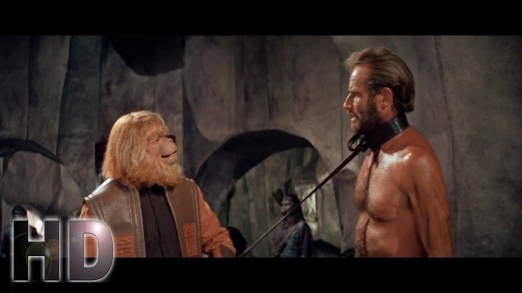
    Planet of the Apes (1968), directed by Franklin J. Schaffner, is a crackling Sci-Fi movie that translates the dystopian thematic of a world in a phantasmagorical display of primal humans and intelligent primates that upends the existing hierarchy of creations and reconstructs the fundamental doctrines of the Origin of Species. It is an advanced society of chimpanzees and orangutans that talk smart, which the 20th-century American astronaut George Taylor (played by Charlton Heston) is hard to stomach with human pride. He then becomes a deformed kind of human slave of the apes in this new brave world where from their God to a prison guard, the apes are the master of the humans. What a wonder this brave new world, that has such apes in it.

    maxresdefault

    The movie is a visually compelling Juvenalian satire that mercilessly but humorously mocks the targeted human hubris that brings about its destruction in an attempt to replace the role of God. The thinking, talking, and even kissing apes mirror the social behaviors that are no more particular to humans who fail to preserve humankind’s prerogatives by the self-destruction of humanity from catastrophic nuclear war. Taylor embodies the hubris in the optimistic veneer of audacious hope that he will find a way home, to his kinds. It is this hubris that causes the downfall of humankind and himself. He hunts desire and hopes together in the constant resistance against the apes despite the impossibility of returning to earth with the defunct spaceship. His faith is nothing but a waking dream, haughty defiance against the reality, dreaming an awareness of odds in his favor.

    charltonhestonplanetoftheapesgeorgetaylor

    The figure of Taylor is one oddly fascinating mixture of panache and wit, sarcasm, and heart, wrapped in the likeliness of Shakespeare’s Macbeth. Talyor represents dramas of human characters wonderfully packed in the imposing physique, towering the apes as if to manifest the sovereignty of man over the apes. The pathos of Taylor in the climactic denouement of the movie reveals his frailty in recognization of the collapsed grand narratives of hope, disillusioned wishes, and shattered dreams as uttered by Macbeth: “Life is but a walking shadow, a poor player that struts and frets his hour upon the stage. And then is heard no more. It is a tale told by an idiot, full of sound and fury, signifying nothing.” Will this be an empty outcry of failed civilization, echoing the collective pathos of the human consciousness for the corrupt world at its heart?

    planet-apes-ending

  • About ‘Ben-Hur’ (1959)

    img_1989

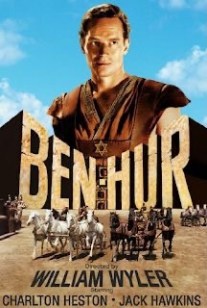
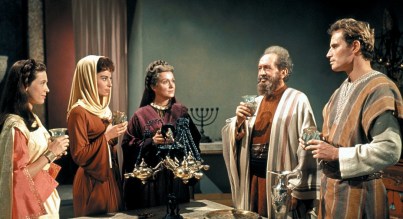
    A great film with a sincere message about life and human nature transcends a divide of time and a boundary of the territory. I believe that a good movie has a lasting sensory impact on the viewer and cultivates the mind with a visual efficacy of precipitation. In this regard, the epic historical drama ‘Ben-Hur’ (1959), directed by William Wyler, is an epitome of masterpiece cinema not for a time but all seasons. The remarkable triumvirate of the outstanding screenplay, the excellent performance of the cast, the fascinating cinematography produces supreme one of art that resonates with spiritual elements of humanity in the witchcraft of motion picture.

    ben-hur

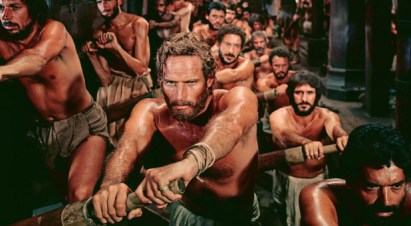
    The film follows a history of Judah Ben-Hur, a young Jewish prince whose life is forfeited by a betrayal of trust and corruption of friendship. From the height of his prime to the fall, then to redemption, it is heroic acts of high human drama wonderfully conjoined with a tale of Christ whom Ben-Hur encounters by Providence. His wrath is untamed, and anger is the roaring of a lion. Ben-Hur chooses vengeance as a will to live in the march of death in the desert and the prison galleys on the Ionian Sea. He feeds on ire and utters curse every day until he intends to execute vengeance upon the perpetrator with recourse to the old retributory law of an eye for an eye, tooth for a tooth. Who can calm the turbulent vortex of the soul in despair and save him from the night of the soul?

    download

    The film revolves around Christ, and Ben-Hur is another disciple of his teachings through conversion into faith, charity, and hope. The figure of Christ is the central theme of the film, but his face is unseen, and his voice unheard. We can only see his rear, but it is the mysteriousness of the person of Christ that elevates the story of Ben-Hur to the sphere of hagiography. The providential encounters with Christ in the climactic moments of his life lead him to the way of Christ, which mirrors the process of Ben-Hur’s redemption from Wrath to Grace, from Desolation to Hope.benhur-christ-a

    Whether or not you believe in Christianity is not a prerequisite to appreciating this excellent epic drama because it would be a loss to any lover of arts to forego the spectacular beauty of the cinematography, not to mention the spiritual thematic of one man’s redemption from hopelessness. The grand epic scale of cinematography that depicts the tale of Ben-Hur in the trail of Christ from the Nativity to the Crucifixion is akin to watching Michelangelo’s remarkable frescoes of the Sistine Chapel that illustrate the story of humanity from the Genesis to the Last Judgment under God’s mysterious plan for mankind. In conclusion, ‘Ben-Hur’ is not a movie about a hero but about a triumph of hope over the desolation that saves a man’s soul from self-destruction, resonating with ‘Dum spiro, Spero,’ meaning ‘while I breathe, there is hope.’

    ben hur 3

  • ‘Intruder in the Dust”(1949), directed by Clarence Brown – film review


    lf

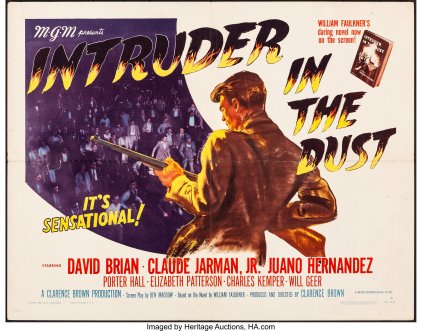
    Justice is the truth, and the truth is the satisfaction of reason. Reason complements emotions triggered by the sense and guides a man to a purposeful action as a beacon of judgment. What motivates the teenage boy Chick Mallison and the lawyer John Gavin Stevens to help Lucas Beauchamp, a respectful and affluent black farmer, accused of killing a white man, is the desire for finding justice, the truth. “Intruder in the Dust” (1949), directed by Clarence Brown, shows that the search for truth excels in the infirmities of whimsical human characters based on William Faulkner’s selfsame novel published to a wide acclaim a year before.


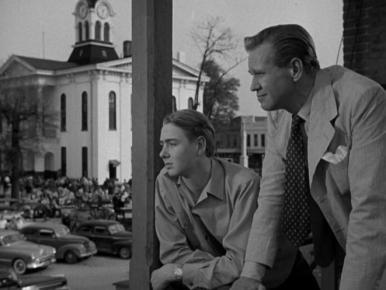
    Shot in black and white, the thematic of truth in the darkness of ignorance blinded by racial prejudice manifests itself in the transparency of facial expressions of the characters like ancient Greek theatrical masks to magnify the emotions and feelings of performers on stage. Lucas (played by Juano Hernandez) is laconic like an old Spartan. Still, his a few words carry the authenticity of truth, emphasized by his dignified aura surrounding the natural, confident being that commands attention to himself. As Shakespeare’s adage of true nobility as being exempt from fear, Lucas counteracts the mob psychology driven by the vacuously temerarious inquisition of popular sentiment in poised stoicism pleading for truth, not feelings.

    Three stars in intruder

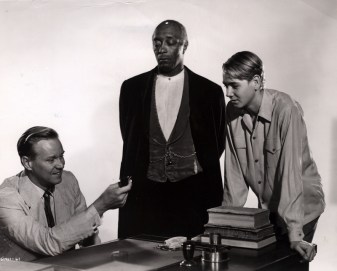
    The subject of humanity is likely to be invoked for the anodyne ingredient to resolve the racial tension. Still, Falkner’s “good” white folks are more driven by a curious concoction of investigative natures, intelligent propensities, and occupational instincts blended well in the egoistic sense of fulfillment wonderfully producing a diamond of truth as though it were a wondrous alchemical process. The teenage Chick (played by Claude Jarman Jr.) and Lucas’s lawyer John Gavin Stevens (played by David Brian) are conscientious and principled, with whom we can refer to “good” white folk. Still, they are not entirely free from their prejudices about the colored, especially the blacks. Even Chick becomes indignant and intentionally drops the money when Lucas declines it from him as a token of gratitude and orders him to pick it up. The lawyer Stevens is neither particularly jovial with his client in the way he would be with his white client. However, both Chick and Stevens intend to descry the truth behind the machination of unreason that rains on the minds of the white people in the town because they are inherently good, even though they are biased. They are good people because their reason prevails upon unreason, and their search for truth outshines their prejudice. It’s what matters to the justice and life of Lucas, the black man who is not necessarily a chum of theirs.

    intruder-ending

    “Intruder in the Dust” may be parallel to “Who Killed a Mockingbird?” because of its similar subject and genre of the film, let alone their original novels that were written by southern writers. But what gives to “Intruder in the Dust” is its sense of realism in the likeness of truth. I find the characters in “Intruder in the Dust” more ordinary, more plausible, and more human. This film delineates a congress of human characters amid a universe of varied emotions and a sea of dangerous adventures, which illustrates both the never-ending dilemma and possible solution. The stellar performance of the excellent cast orchestrated by the astute director based on an excellent textual basis by William Faulkner culminates in this American Classic Masterpiece Film.

  • celebration of National Classic Movie Day

    6 from the 1960s Blogathon
    courtesy of Classic Film & TV Cafe

    FOREWARD: In celebration of today’s National Classic Movie Day, this post is written as my contribution to 6 from the ’60s Blogathon for National Classic Movie Day’ as hosted by Classic Film and TV Cafe. Thank you, Rick, for this awesome invitation 🙂

    Ah, the 60s. Doesn’t it chime the bells of your cultural acknowledgment that resurrect all the images related to this provocative era? Whether or not you were a child of the ethos,   it was the age of new wave, it was the age of revolution, it was the epoch of change, it was the epoch of experimentation. The zeitgeist of the 1960s called for a new mode of thinking. Through the seditious waves of societal changes, the thematics of films needed swiftly to adapt to the changing circumstances. That’s why I regard the 60s as a renaissance of the film, which I dare say elevated its status to that of the classical theaters in terms of quality of the thematics that attempted to portray the complexities of human nature amid the changing social norms and values at variance. That said, here are my best films of the 60s.

    Paul-Newman-Melvyn-Douglas-Hud

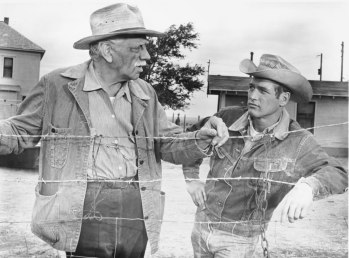
    “The Hud” (1963) – Although dubbed as a western, this film betrays its habiliment by representing the eclipsed glory days of cowboy machismo that seems incongruent and anachronistic amid the rapidly changing social circumstances. The characters struggle, tenaciously gasping on their cattle and Modus Operandi, but the results are all over but the shouting. I think it is also Paul Newman’s best performance that shines through the film as a fictitious embodiment of the collapsed grand narrative of American machoism. 

    ACE180613.original_ySIVHdd

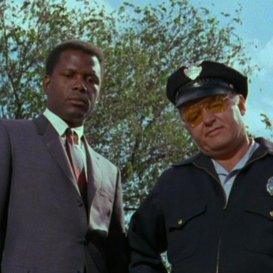
    “In the Heat of the Night” (1967) – Attempts to portray social injustice are most cleverly and artistically translated in this excellent film about policemen of members on the opposite social continuum. Rather than antagonizing the characters, the film connects them with a mutual goal of finding truth and justice in their own ways that are seemingly diametric yet ironically similar in their steadfastness in upholding the most common human nature: pride, ambition, and compassion.

    Sidney-Poitier-To-Sir-with-Love-James

    “To Sir with Love” (1967) – Based on a true story, this British drama is packed full of visual and audio delicacy. This film doesn’t, however, turn out to be a grand grave social activist movie about racial tensity. It shows how a dedicated teacher with mind and heart can lead his recalcitrant but misunderstood students to responsible adulthood without sanctimonious pedagogy or reign of terror. It reflects Plato’s cardinal virtues of Prudence, Justice, Temperance, and Fortitude embedded in the way the brilliant teacher treats his students despite their outward rebelliousness and general distrust in adult figures. The selfsame song by Lulu gives the atmosphere of the film all the more alluring and unforgettable. 

    okmrdt5f33sooom3

    “A Man and a Woman” (1966) – This French film that won a Grand-Prix in the Cannes Film Festival is an art itself, with beautifully ambient cinematography, doubled by the hypnotic leitmotif of a main musical theme that invokes the idea of ideal love that is never vociferously effervescent but quietly enduring, a perfect admixture of eros and psyche. The love between a man and woman can be this beautiful, and even smoking looks so artistically suitable to the theme of the film, making it all the more riveting.

    Unknown

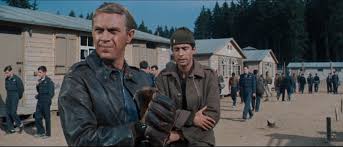
    “The Great Escape” (1963) – What I like about this film is not the luxuriant cast of top-class Hollywood actors but the underlying theme of fortitude, courage, and patience, wrapped in a package of humor even in the times of trial. Although this is regarded as a war movie, no undertones of the campaign against the enemy or propaganda promoting wartime vitriol are underlined here as the dichotomy between the captors and the captives is often blurred by their day-to-day personal interactions within the ambit of conscience and humanity. That said, even the Nazi prison authority headed by stern but fair and conscientious officers is hard to invoke animosity or contempt.  It’s more of personal ambition of achieving success in what the characters are driven to do – whether it’s escaping the prison or preventing it – This film is not about who escaped but who survived. 

    gbu33

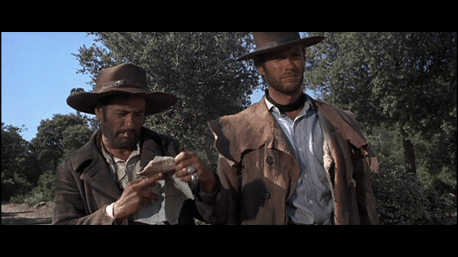
    “The Good, the Bad, the Ugly” (1966) – Who says that you have to be born into the culture if you want to talk about it? Often dubbed as a Macaroni Western, this is the most iconic western film made by a brilliant Italian director whose fascination with the Old West and artistic ingeniousness made him capable of crisscrossing time and territory as if he had been born in the 19th Century American west. Besides, unlike many American-made westerns, this film does not have black-and-white ethical characters, either extremely evil or angelically good in nature, nor does it propitiate moral values or didactic lessons. It also employs the music by Ennio Morricone as an effective vehicle for creating the mood of the film without superlative narratives or gratuitous action scenes. It’s all about the naked human nature surfacing when temptation beckons with irresistible allure. What’s more, the film was entirely shot in Spain that looked so much like California. 

    In sum, the aforesaid films are innovative in incorporating visual presentations of stories with ambient music to translate the world of make-believe reality onto the screen in the most natural way. They are also bodacious in choosing the thematics that reveal the changed look on society in general, rendering the verisimilitude to the stories in order that the audience can feel relatable and sympathetic. For these reasons, my selection of the six films, I think, stand the test of time and merit their own places in the classic canon of masterpiece theater of motion pictures.