Tag: films

  • ‘Planet of the Apes (1968)’ – film essay

    71oadYuBx+L._AC_SY879_

    Imagine this. You are the only person marooned somewhere far away from your world. You have all heard the dystopian chimes of every brave new world from George Orwell’s totalitarian society of 1984 to William Golding’s terrifying Lord of Flies and Aldous Huxley’s eponymously prophetic Brave New World. Yet, you have not realized how it would be like until you enter such a world alone. The world you face now is the amalgamation of all the worlds described above that exist in the selfishness of lettered cases. What would be your impulsive action toward the stupendousness of the incredible event? Besides, what if your best work a la your reason and hope as good as your pride and hubris can present turns out to be a grand Faux pas?

    planet-of-the-apes-soldiers-pose

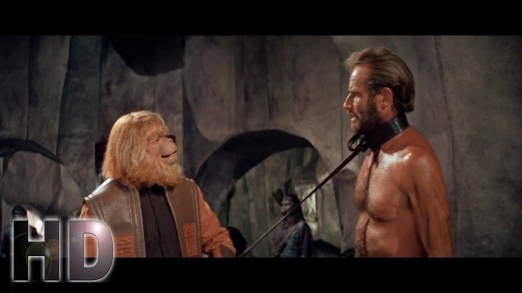
    Planet of the Apes (1968), directed by Franklin J. Schaffner, is a crackling Sci-Fi movie that translates the dystopian thematic of a world in a phantasmagorical display of primal humans and intelligent primates that upends the existing hierarchy of creations and reconstructs the fundamental doctrines of the Origin of Species. It is an advanced society of chimpanzees and orangutans that talk smart, which the 20th-century American astronaut George Taylor (played by Charlton Heston) is hard to stomach with human pride. He then becomes a deformed kind of human slave of the apes in this new brave world where from their God to a prison guard, the apes are the master of the humans. What a wonder this brave new world, that has such apes in it.
    maxresdefault

    The movie is a visually compelling Juvenalian satire that mercilessly but humorously mocks the targeted human hubris that brings about its destruction in an attempt to replace the role of God. The thinking, talking, and even kissing apes mirror the social behaviors that are no more particular to humans who fail to preserve humankind’s prerogatives by the self-destruction of humanity from catastrophic nuclear war. Taylor embodies the hubris in the optimistic veneer of audacious hope that he will find a way home, to his kinds. It is this hubris that causes the downfall of humankind and himself. He hunts desire and hopes together in the constant resistance against the apes despite the impossibility of returning to earth with the defunct spaceship. His faith is nothing but a waking dream, haughty defiance against the reality, dreaming an awareness of odds in his favor.

    charltonhestonplanetoftheapesgeorgetaylor

    The figure of Taylor is one oddly fascinating mixture of panache and wit, sarcasm, and heart, wrapped in the likeliness of Shakespeare’s Macbeth. Talyor represents dramas of human characters wonderfully packed in the imposing physique, towering the apes as if to manifest the sovereignty of man over the apes. The pathos of Taylor in the climactic denouement of the movie reveals his frailty in recognization of the collapsed grand narratives of hope, disillusioned wishes, and shattered dreams as uttered by Macbeth: “Life is but a walking shadow, a poor player that struts and frets his hour upon the stage. And then is heard no more. It is a tale told by an idiot, full of sound and fury, signifying nothing.” Will this be an empty outcry of failed civilization, echoing the collective pathos of the human consciousness for the corrupt world at its heart?

    planet-apes-ending

  • celebration of National Classic Movie Day

    6 from the 1960s Blogathon
    courtesy of Classic Film & TV Cafe

    FOREWARD: In celebration of today’s National Classic Movie Day, this post is written as my contribution to 6 from the ’60s Blogathon for National Classic Movie Day’ as hosted by Classic Film and TV Cafe. Thank you, Rick, for this awesome invitation 🙂

    Ah, the 60s. Doesn’t it chime the bells of your cultural acknowledgment that resurrect all the images related to this provocative era? Whether or not you were a child of the ethos,   it was the age of new wave, it was the age of revolution, it was the epoch of change, it was the epoch of experimentation. The zeitgeist of the 1960s called for a new mode of thinking. Through the seditious waves of societal changes, the thematics of films needed swiftly to adapt to the changing circumstances. That’s why I regard the 60s as a renaissance of the film, which I dare say elevated its status to that of the classical theaters in terms of quality of the thematics that attempted to portray the complexities of human nature amid the changing social norms and values at variance. That said, here are my best films of the 60s.

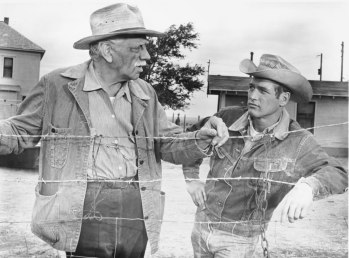
    Paul-Newman-Melvyn-Douglas-Hud

    “The Hud” (1963) – Although dubbed as a western, this film betrays its habiliment by representing the eclipsed glory days of cowboy machismo that seems incongruent and anachronistic amid the rapidly changing social circumstances. The characters struggle, tenaciously gasping on their cattle and Modus Operandi, but the results are all over but the shouting. I think it is also Paul Newman’s best performance that shines through the film as a fictitious embodiment of the collapsed grand narrative of American machoism. 

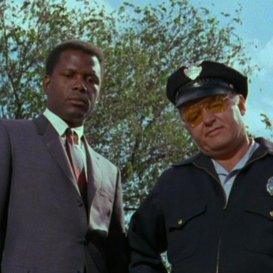
    ACE180613.original_ySIVHdd

    “In the Heat of the Night” (1967) – Attempts to portray social injustice are most cleverly and artistically translated in this excellent film about policemen of members on the opposite social continuum. Rather than antagonizing the characters, the film connects them with a mutual goal of finding truth and justice in their own ways that are seemingly diametric yet ironically similar in their steadfastness in upholding the most common human nature: pride, ambition, and compassion.

    Sidney-Poitier-To-Sir-with-Love-James

    “To Sir with Love” (1967) – Based on a true story, this British drama is packed full of visual and audio delicacy. This film doesn’t, however, turn out to be a grand grave social activist movie about racial tensity. It shows how a dedicated teacher with mind and heart can lead his recalcitrant but misunderstood students to responsible adulthood without sanctimonious pedagogy or reign of terror. It reflects Plato’s cardinal virtues of Prudence, Justice, Temperance, and Fortitude embedded in the way the brilliant teacher treats his students despite their outward rebelliousness and general distrust in adult figures. The selfsame song by Lulu gives the atmosphere of the film all the more alluring and unforgettable. 

    okmrdt5f33sooom3

    “A Man and a Woman” (1966) – This French film that won a Grand-Prix in the Cannes Film Festival is an art itself, with beautifully ambient cinematography, doubled by the hypnotic leitmotif of a main musical theme that invokes the idea of ideal love that is never vociferously effervescent but quietly enduring, a perfect admixture of eros and psyche. The love between a man and woman can be this beautiful, and even smoking looks so artistically suitable to the theme of the film, making it all the more riveting.

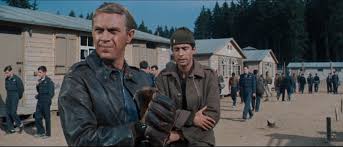
    Unknown

    “The Great Escape” (1963) – What I like about this film is not the luxuriant cast of top-class Hollywood actors but the underlying theme of fortitude, courage, and patience, wrapped in a package of humor even in the times of trial. Although this is regarded as a war movie, no undertones of the campaign against the enemy or propaganda promoting wartime vitriol are underlined here as the dichotomy between the captors and the captives is often blurred by their day-to-day personal interactions within the ambit of conscience and humanity. That said, even the Nazi prison authority headed by stern but fair and conscientious officers is hard to invoke animosity or contempt.  It’s more of personal ambition of achieving success in what the characters are driven to do – whether it’s escaping the prison or preventing it – This film is not about who escaped but who survived. 

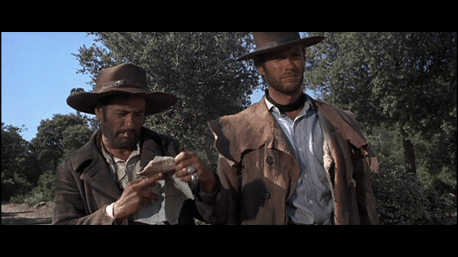
    gbu33

    “The Good, the Bad, the Ugly” (1966) – Who says that you have to be born into the culture if you want to talk about it? Often dubbed as a Macaroni Western, this is the most iconic western film made by a brilliant Italian director whose fascination with the Old West and artistic ingeniousness made him capable of crisscrossing time and territory as if he had been born in the 19th Century American west. Besides, unlike many American-made westerns, this film does not have black-and-white ethical characters, either extremely evil or angelically good in nature, nor does it propitiate moral values or didactic lessons. It also employs the music by Ennio Morricone as an effective vehicle for creating the mood of the film without superlative narratives or gratuitous action scenes. It’s all about the naked human nature surfacing when temptation beckons with irresistible allure. What’s more, the film was entirely shot in Spain that looked so much like California. 

    In sum, the aforesaid films are innovative in incorporating visual presentations of stories with ambient music to translate the world of make-believe reality onto the screen in the most natural way. They are also bodacious in choosing the thematics that reveal the changed look on society in general, rendering the verisimilitude to the stories in order that the audience can feel relatable and sympathetic. For these reasons, my selection of the six films, I think, stand the test of time and merit their own places in the classic canon of masterpiece theater of motion pictures. 


  • ‘Papillon (1973)’ – film review

    6daa8bbc3333a0740fe55fecd9b16439

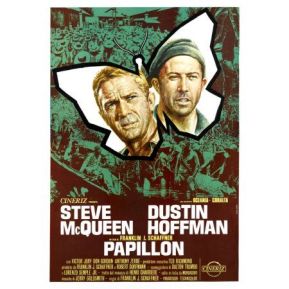
    From Shakespeare to Hemingway, the resilient human spirit rising above life’s challenges is always a high human drama. Nietzsche said: “What does not kill you only makes you stronger.” This paean to a noble human spirit against the existential strains of life has been a paramount theme for masterpieces of arts, especially in literature and cinema appealing to the universal audiences, touching the deepest valleys of human consciousness and pulling at the heartstrings all in a polyphony of humanity. It is this very reason that Papillon (1973), directed by Franklin J. Schaffner, still evokes ineffable inspiration and indelible impression so powerfully displayed on the screen with the authenticity of a true story of a real-life character.

    DagmEaVV4AENyWE

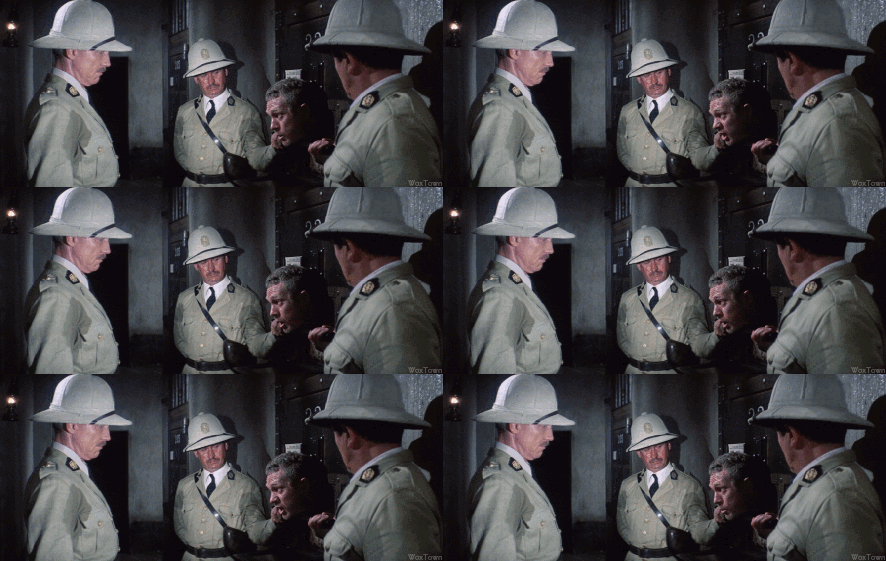
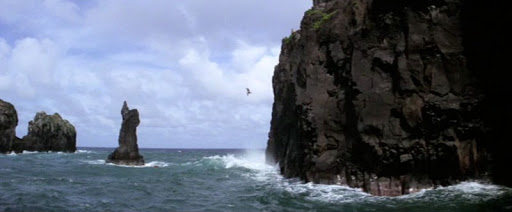
    Papillon, a butterfly in French, is a nickname of Henri Charriere (played by Steve McQueen), a safe-cracker framed for having murdered a pimp because he has a butterfly tattoo on his chest. Henri was sentenced to life imprisonment in French Guiana and decides to escape from the man-made inferno where death is the only way out of the murderous maltreatment doubled with dysentery and hard labor, which makes me wonder if the Nazis, especially Himmler and his ilk of the Final Solution, adapted the French Penal Colony system into concentration camps during World War II. And yet, Papillon’s will to escape and to live as a free man supersede the hellish daily realities fraught with endlessly cruel labor, inhumane solitary confinements, prolonged starvation, and deaths of his fellow inmates, all of which seem to conspire to break his will to live to conform to the totalitarianism of inhumanity in the name of punishment of his crime that he didn’t commit. Escape after escape, hope against hope, and betrayal after betrayal is fortune’s malice trying to overthrow his sovereign state. Still, Papillon’s sturdy mind exceeds the compass of her will, even if it takes him to the furious watery main and the murderous cliff in the Devil’s Island.

    source

    The stellar performance of Steve McQueen, playing the role of Henri Charriere, renders a sense of verisimilitude of the character and the story so convincingly that you dive into his emotions without realizing a boundary between a screen and yourself. Upon watching the film, you feel that you have contracted a severe biological strain of Stockholm syndrome with the Henri character on whose biography the film is based, which bestows the power of reality and the authenticity of truth upon your mind. Steve McQueen, often referred to as the King of Uber Cool, is excellent in portraying the convict with extraordinary feats of endurance and rebellion against the totalitarian penal system that wrongly imprisons his free spirit. McQueen’s abilities as a character actor shine when he commands his presence in a way that seems wholly authentic without overt gestures and contrived charisma but with his eyes sparkling even in the filthy prison uniform that speaks a thousand words surrounding him like a radiant halo as a token for his strong will to freedom.

    This film is, in a way, reminiscent of Ernest Hemingway’s ‘The Old Man and the Sea’ in terms of old Santiago’s indomitable burst of pep to fight the shark appropriating his hard-won big fish. The old man might look feeble and weak in comparison with the mighty power of the vast sea. Still, it is his will to win the battle against the force of sea that is sublimated into a victory of the human spirit with the resounding  dictum of this feat of humanity: “Man can be conquered, but cannot be destroyed.” That’s what comes to my mind while watching this excellent film about an ordinary human being with an extraordinary power of will to freedom. Hamlet uttered: “To be or not to be, that is the question.” To Henri Charriere, such contemplation is a meaningless echo of a defeatist. Henri is more of Macbeth working out on his plan for life as a free man with stubborn courage: “We fail! But screw your courage to the sticking-place, And we’ll not fail.” And Lo! Did he not take the advice of the Bard! And so, splendidly!

    unnamed

    Author’s Note: I watched the film last night and was immersed in the characters and the story. Not that I am an admirer of Steve McQueen but that he’s one of the greatest actors who vanished like a meteor gives a special meaning to this film. It is one of the best performances in his acting career and will always linger in our hearts. 

  • 150 miles to El Dorado

    foggy-morning-in-a-meadow

    Judy begins to feel like a whimsical paramour leaving for a new object of love at sight. What was pleasingly solitary in nature seems to be prolonged isolation from the world that Judy so wanted to escape, and her coquettish dalliance with the wild rugged nature is no longer wanted as the Sun is slowly moving westerly to cave into the Evening Star and the Moon. It might be still early for calling it a day to you with your weekend frolics still left to re-calibrate your kicks for another week, but it’s late for Judy, who would rather mourn for a passing of the last day of a weekend at home than rebel against it in a frenzy of nocturnal bacchanalian orgy elsewhere outside the comforts of her den. Now the anxiety holds a grip on her, and she begins to fret, and the miasma of the ill-feelings begins to effuse the uneasiness to Nena who begins to whimper and to the accidental trio of strangers observing every move that this girl makes as they are nearing to her, part perplexed, part bewildered. What a curious mixture of emotions she puts on her face! Rufus, Ben, and Raphael become curiouser and curiouser as they get nearer to the porcelain doll in their eyes.

    ‘Howdy! Lass! What are you doing here?’ Raphael, the talker, begins the talking. ‘We are headed west toward Los Adios Mountain. Do you know where it is?’ Judy incredulously looks up the mounted man with a mustache and a sombrero and thinks that he looks very convincingly like Sancho Panza, Don Quixote’s faithful servant. There’s something about the man, thinks Judy. The diction, the ambiance, and the deportment are rather anachronistic or incongruous even to the social media era where people flag their selfies on the internet as if they were on a popularity contest and compete for likes and comments as emotional security and collateral for their forged so-called self-confidence. My Dear Reader, don’t misunderstand that it’s immoral for you to hang your beautiful pictures on a digital platform for popular admiration. It’s just that this act of self-promotion serves as a springboard for testing your marketability and your mobility as a result of winning the competition for likability based upon looks and frivolous comments that do not mean much, much at all. Amid this train of thought, Judy despite being agitated by the lateness of the time warms to this amiable man and decides to answer him. ‘This is Wildwood Park, sir. Los Adios Mountain is 150 miles away from here. And you should go northward. You are far off from your destination.’ It is a sight to behold – the face of Raphael grimaced partly and bewildered partly, all in dazzling chemistry of emotions that is hard to describe. So much so that this display of indescribable human emotions on Raphael mollifies Nena’s agitation and puts the tempestuous waves of her emotions at ease. Now Judy feels refreshed and happy.

    Rufus and Ben are within an earshot of this dialogue between the pretty lass and Raphael and cannot but be disappointed by the fact that they are once again on the wrong track, which seems to be forever chasing after a phantom of the dead Union soldier obfuscating them lest they should find where the buried treasure is. Where’s the Aztec gold? When can they find it? Maybe the miasma of frustration and agitation that hovered over Judy must have been transmitted to Rufus and Ben on the stead because now their faces mirror the symptoms of a malady of broken hearts. Then suddenly, Nena now recovered from the plague of uneasiness, springs forward and wags its chubby tail and bark toward the firmament as if it were looking at a thing invisible to your and my human eyes. Nena keeps barking and looking at the puzzled crowd behind as though it were trying to explain to them that there is something in the air that only Nena can see but we can’t see. ‘What is it, Nena? What do you see?’ Judy knows that dogs and cats can see supernatural things because their eyes can look through the souls of the living and ghosts of the dead. Judy tries to follow the direction where Nena is looking and barking and sees a gossamer trace of haze vanishing into the air like the vestige of a propeller plane soon to be effaced across the skies. The more Judy tries to scrutinize it, the faster it disappears. And Nena keeps barking, looking in front of the curious crowd. What is it that the dog is seeing?

  • In defense of Arthur Fleck adv. People

    The movie ‘Joker’ has taken the world by storm. The citizens of the four cardinal directions of a compass all seem to flock to the screening of the movie and feel gobsmacked or spellbound even by the stellar performance of actor Joachim Phoenix in his soul-wrenching portrayal of Arthur Fleck before his rebirth as Joker. The aftercome of the movie is a great legion of tweets rhapsodizing about the character and the man behind, which is deemed meritorious, justifiable, and agreeable. However, most of the tweets about this outstanding movie disappoints me because of their opinions that seem to miss the gist of the movie, the logotheraphical nuance of the movie itself that director Todd Phillips tries to express on the screen. Is this movie about a clinically crazy man, a so-called “psychopath” who wallows in killing-sprees? Why do people suddenly seem to care about a man whose existence is constantly slighted and ignored when they unconsciously or consciously do the same to the ilk of Arthur Fleck in everyday life? Will the movie change their attitudes toward those struggling to make their presence amid constant ridicule and estrangement?

    As I previously stated in my review of the movie, this is about a man whose efforts to preserve a sense of purpose in the world and a tenacious grip on recognition are ruthlessly vanquished. Everyone from all social strata, including those recognized as underprivileged underlings, not to mention the upper crust of society, indiscriminately ignores him. And the reason for such unanimously consented mistreatment of Arthur Fleck is not so much due to his low social class as due to his unlikeness that manifests itself, so visible that it makes onlookers regard him as a tacitly public domain of disdain and estrangement. He is a public whipping boy, a modern-day equivalent of a cunning man accused of witchcraft or dark magic, bestriding on the verge of madness as a result of concerted social alienation, which forces him to choose none other than being Joker. Hamlet’s existential question of “To be or not to be, that is the question.” seems too pat and gives a fillip to the loneliest, darkest, and saddest moment of Arthur Fleck when he feels pushed into the edge of his conscience. He surrenders himself to the death of his old, bullied, slighted self because it’s better that way than spends his life misunderstood and ignored to the end.

    Alas, poor Arthur Fleck! I know him, my dear reader. For however fictional the character may be, an Arthur Fleck is here in our ordinary landscape of everyday life. Workplaces, schools, supermarkets, buses, trains, streets, hospitals, and houses that you go and live are where you see him but not regard him, hear him but not listen to him, speak to him but not talk to him. If you protest, then you are probably feeling guilty of doing the same thing that they did to Arthur Fleck whom writers call a misfit, employers an incompetent, social workers/psychiatrists a basket case, and a detective a psychopath. That whom we call him by any other names will remain the same as neglectful and insignificant.

    In sum, those of you who rave about the movie in terms of the outburst of the suppressed shall regard it not as a liberal cause of partisan ideology or a demotic social manifesto but as a visual memoir of a very lonely man who cries inwardly every day for the wounds of his estranged soul. For what Arthur Fleck wanted was very human and basic as appreciated by American philosopher and psychologist William James many years ago: “The deepest principle in human nature is the craving to be appreciated.” Praising what is missing and ignored makes the remembrance dear. This is about one man’s struggle against finding a meaning of life, will to meaning, stumbling into a vertigo of his existential horrors of daily life. That is the message.

  • ‘Joker (2019)’, directed by Todd Phillips- review


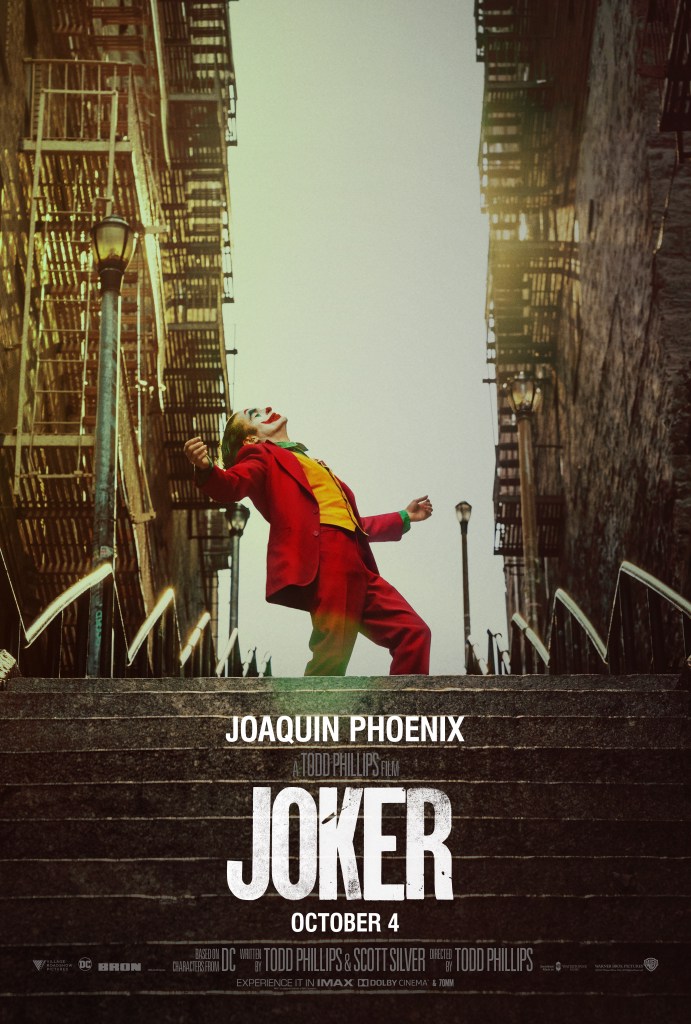
    He’s nobody to whom people neither listen nor talk. He’s alone, alone, all alone on a vast gaping sea of people who continuously berate the person and the dream and the existence of himself ruthlessly. Francis Bacon’s phrase of ‘Magna Civitas Magna solitude’ bethinks the case of Arthur Fleck. The Joker is a man trying so hard but futilely to preserve a sense of purpose and a tenacious grip on social recognition at the bottom rung of social hierarchy. Even the goddess Fortuna seems to vent her usual aeonian capricious nature on the fate of this unfortunate man whose Wheel of Fortune is destined to be positioned to True North of Tragedy. If this sounds maudlin enough to frown over that “just a movie” façade, then think of what Charlie Chaplin elegantly sums up thus: “Life is a tragedy when seen in close-up, but a comedy in long-shot.” This is a life of Arthur Fleck, and it is here where he becomes Joker, the archenemy of Batman and the good citizens of Gotham City. It all begins here in ‘Joker,’ directed by Todd Phillips, who seems to have an eye for the absurdities and hypocrisies in our society.

    fragileArthur Fleck is said to be mentally insecure, seeing a social worker every week who only cares about her civic duty to talk but not listen so that he can get his usual five different psychotic medications. He is conditioned to be mad amidst the licensed incivilities of the people indiscriminately. He is a victim of severe bullying and taunting for his bouts of uncontrollable laughers and gawkish rail-thin appearance in which his piercing blue eyes are the only resilient torches of his soul that defy the injustice and humiliation by society. It is the society that slowly maddens Arthur with those multiple chemical prescriptions and willful neglect of his presence. Must I chant his litany of woes further?

    The clown mask of Arthur Fleck becomes the persona that gives him a new personality with a sense of empowerment by freeing him from conscience in the heat of passion. According to the ancient Greek thespian idea of drama, the tragic actors were heavily disguised with a religious purpose in honor of Dionysus, the god of ecstasy, for the actor was to give up his identity to let another (i.e., the mask character) speak and act through him. In this regard, Arthur’s clown face betokens his suppressed self, drenched in vindication against the tyranny of societal conformity that allows no place for anyone like him. It’s certainly a tragedy in the sense that the painted mask becomes paradoxically the real character that imbues people with fearful attention to him, not the entire bare face of the man. The Joker’s face is stark defiance to the hypocrisies and absurdities that slight his existence as a person. As Melpomene, the muse of tragedy is portrayed as wearing a mask of sadness and a buskin, Arthur Fleck wears a clown mask with a buskin hiding his tears from his heart. The uncontrollable bouts of his laughter are, in fact, a cry of his wretched soul.

    At the heart of this film lies a heartfelt performance of actor Joachim Phoenix, who is said to have lost about fifty-two pounds in response to the director’s request to portray the linchpin as a gaunt man to render his vulnerability and alienation from people. The dedication to the character that is never easy to play shines through Phoenix’s stellar performance on the screen. The deliverance of the characterization is so realistically touching that it pains my heart to follow through the life of Arthur Fleck, oozing out insurmountable pathos and that even his chain-smoking is deemed less toxic and vice-signaling. We see him alone in his apartment, on the bus, and on the street, even among the crowd. We see him slowly abandoning himself to a bottomless pit of despondency as the world around him, including his mother, shuns him from humanity. His crime is to be condemned, but is this not a man who is more sinned against than sinning? Joker is a kind of movie that makes you go thinking after the lights are off.