Tag: literature

  • The Lonely Heart

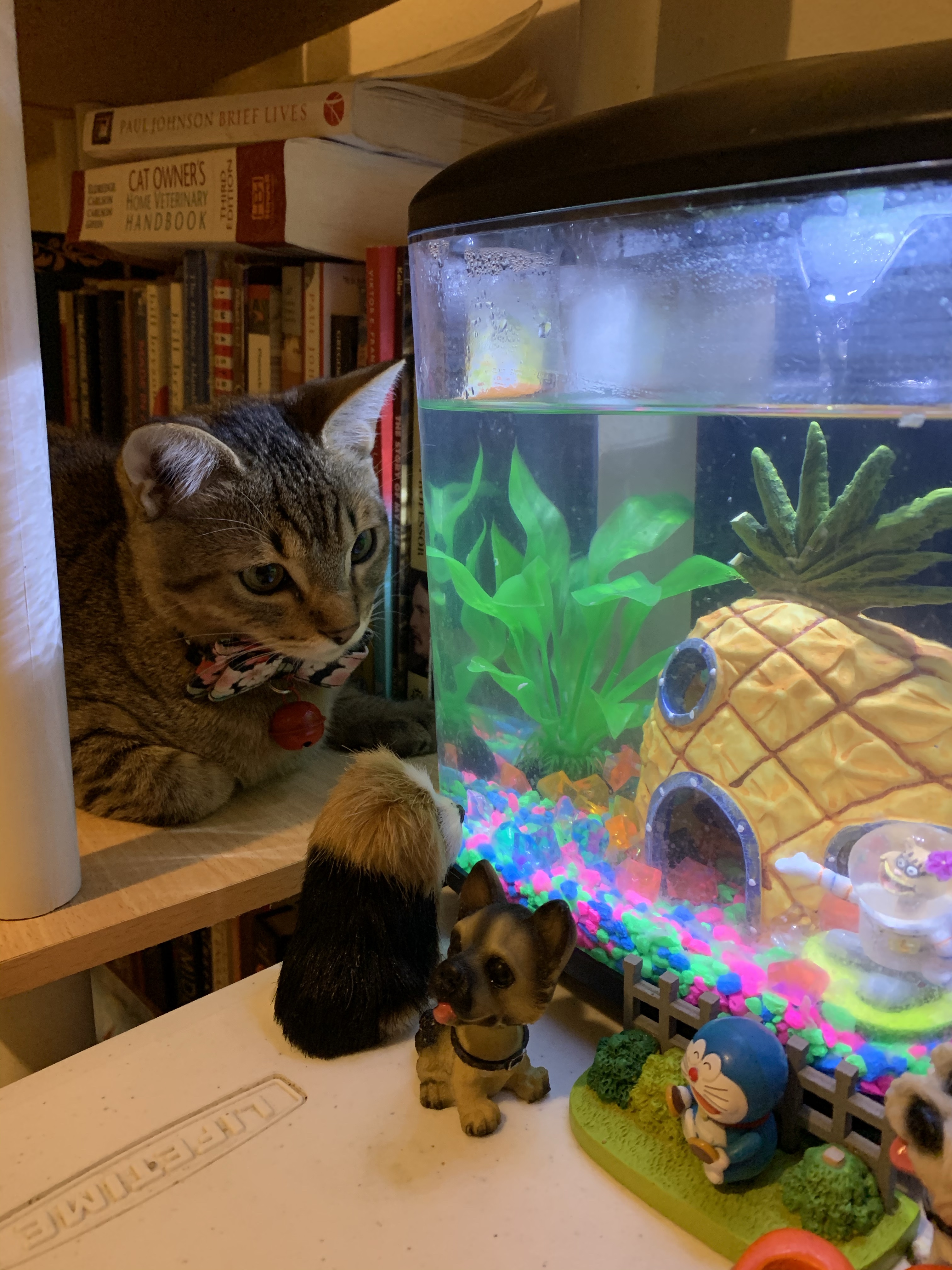
    The Romp Pomp Bunter is a Little Kitten living on Kenmore Avenue
    Whose natural curiosity becomes day by day Curiouser and Curiouser.
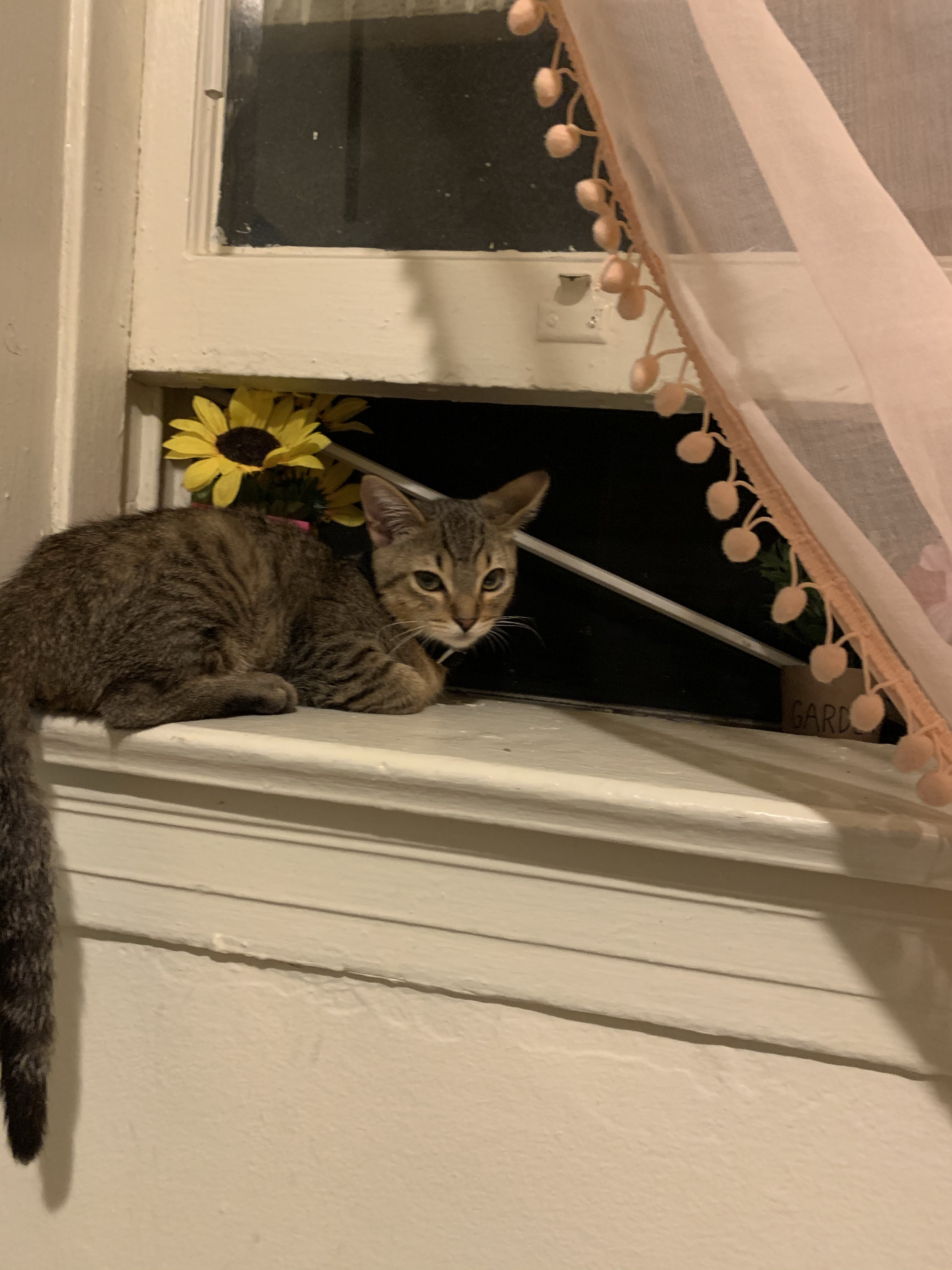
    From the windows, he watches the World below and the Sky above
    Day and night, till the Doves on the roof fly away higher and farther.

    Left in the silence of loneliness that becomes the sound of sadness,
    The Little Cat, friendless always, goes to a Fish called Hope, as always
    In the vain hope of friendship, for he is also alone, or so it seems,
    And knocks on the door of the aquarium and waves at him with his paws.

    Alas, Poor Little Cat! I know him! Hope wants no friendship with the Cat! 
    He hides in the pineapple castle in his watery kingdom, safe and sound
    For his loneliness is submerged in water and dissolves into watery mote,
    Leaving the Little Cat in the silence of friendlessness round and around.

  • From Egypt with Meow: ‘The Cat in Ancient Egypt’, by Jaromir Malek – review

    The Cat in Ancient EgyptThe Cat in Ancient Egypt by Jaromir Malek

    My rating: 5 of 5 stars

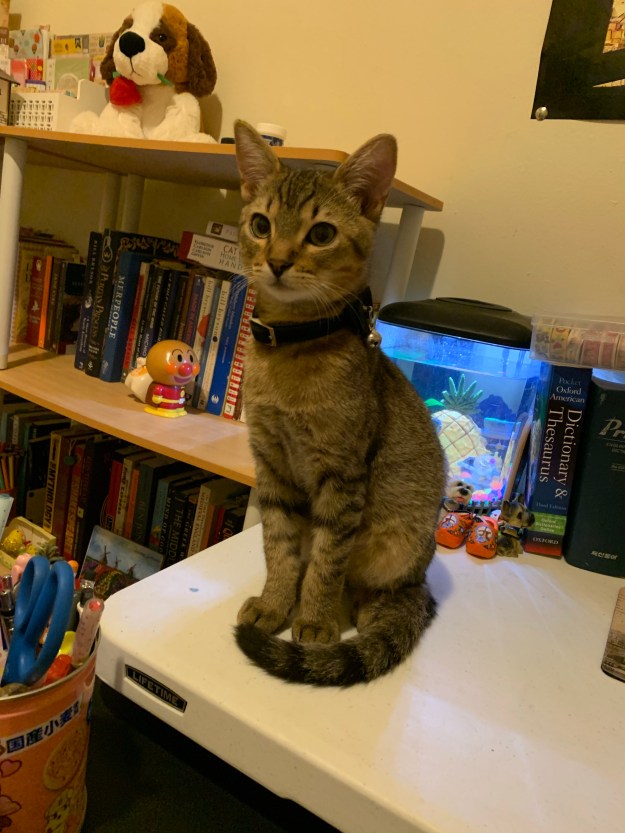
    I admit that most of my posts relate to the cat nowadays. But what else should I write about when an orphan kitten enters my castle and in need of care and love? My five-month-old cat Toro is a domestic short-haired breed as subsumed by a vet at the shelter, but his appearance and characteristics make me believe that he must be a descendent of Egyptian Mau. My conjectural reconstruction of Toro’s possible ancient scroll of his family (paternal) led me to  Jaromir Malek’s  The Cat in Ancient Egypt, which tells all about how cats became naturally harmonious with humans, which played a significant role in the anthropological and social aspects of splendid ancient Egyptian civilization.

    The domestication of cats resulted from the advent of agriculture when man began to settle on the farm, and civilization came to blossom. It was about 1,500 years later than the domestication of dogs as hunting assistants to men. Of all the ancient civilizations, the Egyptians sow the seeds of love between the cats and humankind. Abounded with various fauna and flora benign to the human inhabitants, the jungle cats and African cats thrived and became familiar animals to the Egyptians, who began to use the cats to drive off pesky mice poisonous snakes threatening their lives and crops. Naturally, wild cats gradually learned to adapt their wild instinct to their new protective human environs. 

    The frequency of cats’ representations in ancient Egyptian art is a creditable source to understand cats’ familiarity and recognition as pets in the overall culture and society. The images of cats first sporadically appeared in the tombs of pharaohs built during the Old Kingdom period (2647 -2124 B.C) and became widespread mural art features by the New Kingdom (1549-1069 B.C.), which is also called the renaissance of the pyramids. Maybe it was because of the mysterious aura surrounding the inscrutable demureness of a cat, or it was the otherwordly aloofness wrapt in ethereal agility. Cats became popular hieroglyphic and effigial motifs for artists and priests alike in cultural and religious contexts decorating chambers within sacred tombs and temples. Also, cats were the aesthetic muse for women’s high fashion, used as motifs for the jewelry of queens and women of high society.

    What evolved from a quid pro quo relationship between man and beast for the survival of the species found its way to the high seat in the eternal world. The familiarity and recognition of cats’ usefulness blessed with physical charm elevated the beastly origin into a divine status in the statuesque form of goddess Bastet, the sister of the Sun god Ra, representing female sexuality and fertility, which reflected the specific characteristics of the animal. The Sun god himself was also called the Great Tomcat because the god meowed during what he was doing. So much so that the ancient Persians used to equip the shields with live cats at war with the Egyptians, who dared not to harm their sacred animals.

    On the other hand, cats were not altogether distant from the everyday lives of the ancient Egyptians. The Greek historian Herodotus further corroborated that the Egyptians shaved their eyebrows when their cats died as a sign of mourning. The more cats became domesticated, the more multiferous their features became. Artists started using cats as a caricature of specific human characteristics illustration of fables with a moral content, representing the absurdities of reality in a humorously wise way. Such artistic trend was most conspicuous during the Ptolomy period when Egypt was under the Hellenistic influence to resist foreign cultural force. Cats were symbolized as the animal inherently Egyptian to the land of pharaohs.

    Beautifully written with sentences that conjure up the images of ancient Egyptian cats, Malek’s The Cat in Ancient Egypt serves its purpose of educating and entertaining the curious reader who wants to know more about his or her beloved feline creature at home. That doesn’t mean that this book is reserved only for cat owners or lovers. This book has refreshingly excellent archeological and anthropological knowledge about human civilization, impacting animal life. The affection is the elder sister of the understanding. I personally selected this book to read because I wanted to know more about my cat. Likewise, this book is for readers who want to know more about Nature and People’s history.


  • New Possum’s Book of the Curious Cat


    There’s once a cat name Romp Pomp Bunter, aka the Curious Cat,
    who liked to romp with pomp and bunt his head against
    his guardian, the woman with the beautiful but lonely heart.
    She named him in rapt contemplation of the thought, of the thought
    of his name; his ineffable, effable name, debonair and extraordinary.

    The Romp Pomp Bunter has a secret that no one knows it:
    The Romp Pomp Bunter once saw a grand statue of Bastet
    In a book on the history of cats originating in ancient Egypt
    And was so impressed with the splendid grace of the goddess
    That he wanted to emulate the mysteriously beguiling poise
    Even if he was a Californian moggie tomcat of Los Angeles.

    But the Romp Pomp Bunter, ever the Curious and Adventurous,
    An orphan kitten whose parents nobody knew or cared even,
    Felt that he was originally from the Ancient World with a reason
    That he looked nothing like the ordinary domestic short-haired,
    The insignificant, the common, the trite, the obsequiously tamed
    Breed of Cats that contrasted the Egyptian Mau, the First of Firsts
    Endeared to Pharaohs, Queens, Priests, Soldiers, Farmers, and Artists.

    So, the Romp Pomp Bunter believed that he was the Royal Descendant,
    The indolently elegant, adoringly capricious, the inscrutably alluring
    Egyptian Mau, the paragon of the goddess Bastet, divinely beguiling.
    You see, that is why his name is the Romp Pomp Bunter, the Curious Cat.


  • The Song of the Romp Pomp Bunter

    The Romp Pomp Bunter is a Curious Cat:
    If you give him a toy, he would prefer a bottle cap,
    If you offer him a play, he would rather sit by the window atop,
    If you feed him a chicken pate, he wants a tuna fillet.

    The Romp Pomp Bunter is a Green-Eyed Beast:
    He wants you to be with him when you don’t,
    He wants to eat what you eat when he shouldn’t,
    He wants to play with you when you can’t.

    The Romp Pomp Bunter is a Timid Kitten:
    He would startle at the drop of a needle,
    He would tremble at the sounds of rain,
    He would tremor when birds flap the wings.  

    Yes, the Romp Pomp Bunter is a Curious Cat,
    And there’s no use in changing him anyway.
    For he will do so as he does so, and that’s that,
    And there’s nothing you can do about it!

  • ‘Ancient Greek Cavalry’ and Alexander the Great’s Companion – review

    Ancient Greek Cavalry: The History and Legacy of Classical Greece’s Forgotten SoldiersAncient Greek Cavalry: The History and Legacy of Classical Greece’s Forgotten Soldiers by Charles River Editors

    My rating: 4 of 5 stars


    The image of a gallant bedight knight on a steed heading for a romantic journey for El Dorado or a noble cause for joining a loyal cavalry would have been a laughing stock of the ancient Greek soldiers. They regarded cavalry soldiers as aristocratic good-for-nothing redundant auxiliary to the mighty phalanx composed of ordinary foot soldiers called hoplites. From the Bronze Mycenean age until the emergence of Macedonia as the Greek military superpower, the historical context of the ancient Greek cavalry reflected the signs of military and sociopolitical developments in the 5th century BC Greece and the world beyond. The book informs the reader of the background of the rise of the cavalry in ancient Greek society thanks to Alexander the Great and its effects on military and societal contexts proven to be timelessly brilliant.

    First of all, the geographical factor of the Greek islands, in general, made it difficult for the effective use of horse-driven chariots in battles due to its mountainous terrain as illustrated by the Oracle of Delphi in the valley, the Mount Olympus, and other divine earthly places. The rocky roads were not conducive to heavily charged chariots, preventing them from maneuvering the moves swiftly in warfare. In fact, the introduction of a horse race in the Olympic Games where the wealthy horse breeders reconciled the equestrian equipment’s military value to a sports game’s monetary value.

    Secondly, horses were expensive to breed and maintain, as they still are in our time, and only a few wealthy (the oligarchs) were able to own horses. So much so that Aristotle acknowledged that horse-breeding was not easy to do unless you were rich. Accordingly, the democratic ideal of the mingling of titles and the exertion of the synchronized force from the collaboration of duties for the common good excluded the value of cavalry whose soldiers were also outside the Homerian value of Arete, the highest soldierly code of honor consisting of military finesse and personal integrity. To the democratic minds, the pampered nobility on horseback in battlefields had a better chance to escape on a horse than its hoplites on foot who had to confront the rains of lances and strokes of swords showered in blood.

    However, Philip II of Macedonia and his son Alexander the Great saved the grace of the falling Greek cavalry by the brilliant military innovation that reflected society’s progress in the economy and political contexts. Along with its loyal ally Thessaly, Macedonia was an oligarchy unlike its contemporary city-states run by the democratic populace that usually lacked the foresight of tactical military strategy due to a general contempt for the art of war held by experienced noble soldiers. Macedonian nobles, especially the young and ambitious noblemen, made up most of the excellent Macedonian army that fully utilized the offensive and defensive cavalry force into the phalanx. The offensive on the phalanx’s right flank, the Companion, consisted of 2000 trusted and honored members of the king’s inner circle, the oldest noble families of Macedonia. The defensive on the left side, “The Thessalian,” proved to effectively outflank the enemy force with as least casualty as possible on the Macedonian side. Such cracking military operational order surpassed the Persian scythed chariots’ hideousness, cutting men in halves, mangling the still breathing fragments on the wheels and the scythes.

    The unprecedentedly thriving economy due to the discovery of gold and silver mines and minting of coins meant a stable government and expensive military maintenance. The state’s wealth made it possible for financing a standing cavalry in peacetime and on a campaign. The minting of coins under the unified currency system paid salaries to professional soldiers, unlike the unorganized military structures where soldiers were ill-equipped and poorly trained in the other Greek city-states’ armies.

    Upon reading this book, I felt that the title should have been “The Wooden Trojan Cavalry of Macedonia” or “Alexander the Great and His Cavalry” for the staging of Macedonian Alexander the Great in the arena of the world’s superpower upended the archaic military organization, let alone ineffective strategies. The role and value of mounted soldiers corresponded with the notion that the economic progress propelled by the natural wit of a leader who integrated all society members, high and low, won the war most productively. Alexander’s democracy in military strategy elevated the status of contemptuous willy-nilly horseback soldiers to gallant bedight warriors. It shows the reader that true democracy means the magnanimous participation of all classes for the commonwealth of a country.


    View all my reviews

  • Paid forward by a Stranger

    The French existentialist Jean-Paul Satre was a cynic when it came to the milk of human kindness. He smirked by saying that generosity was more or less a feelgood giveaway of the doer in the self-contentment of magnanimity. The intention is ego-driven, not altruistic. Satre may be a brilliant intellectual in the post-modernistic world, but he was essentially missing something, obviously not knowing it for the following reasons. 

    I still remember a lecture given by a religious sister whose spirituality bloomed in her charity and intelligence about the practice of charity in our daily lives, rather than doing it as a penance after a guilt-ridden confession. For you never know, the one benefitted from your kindness might be an angel in disguise (the mysterious shopper!) or even Christ himself (the Lord of Lords!) So, how will I interpret an act of generosity when a total stranger paid for my sandwich at Subway?

    It was a rather gloomy afternoon today because of the disappointment with the general members of humanity that I felt most acutely painful to my glass heart. The things deemed trivial or insignificant matter to me, stay in there until I burn them with candlelight under moonlit tranquility of the mind. Samuel Johnson is right in saying that you cannot will away the unpleasant feelings in full force at once. That is why we object to despotic edicts of stoic austerity to quell the perturbed state of mind. The Sun was high, but the spirit was low, and I could not pretend to be cheerful and optimistic as if there was no word for Unpleasantness in my dictionary.

    So when I was in a nearby Subway store during lunchtime, I felt wretched and wished that the time would go fast so that I could go home with the alacrity of departure. But no, the reality bit when a store clerk asked me if I wanted my bread to be toasted. No, I said politely and proceeded to the counter for payment, when the register guy told me that the man before me paid forward my sandwich. Really so? But I didn’t know him. There were two men, seemingly office workers from nearby, coming for some quick bites like me. And I still don’t know which man paid for mine, but what does it matter when both of them are total strangers anyway? Then I checked my reflections on the outside building’s crystal-clear glass windows and saw a woman decently presentable looking in thin figure clothed in a DKNY tweed jacket and Michael Kors jeans, which disqualified me for being a hobo woman. So why did he pay forward for my Tuna sandwich?

    Whether he was a confessional penitent doing penance or an angelic agent is still a mystery, but then something is better to remain as it is, I think. The unexpected surprise from the stranger put my emotions on the continuum of low arousal on one hand and high pleasantness, on the other hand, creating satisfaction that my life could be likable and ultimately livable. It’s a small pleasure that keeps my sailing endurable and doable in a wide ocean alone against monsters, thunder and lightning, and doldrums. No wonder the sandwich tasted sweet.