
Out of Chaos comes the Universe,
and the Sky covers the Earth.
As Darkness joins with Light,
so does the Day with the Night,
making Alpha of Omega and
Omega of Alpha, Cycles in Epicycles.
Out of Chaos comes the Universe,
and the Sky covers the Earth.
As Darkness joins with Light,
so does the Day with the Night,
making Alpha of Omega and
Omega of Alpha, Cycles in Epicycles.
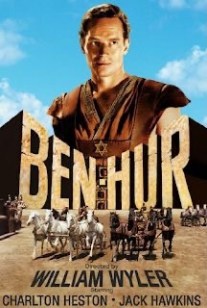
A great film with a sincere message about life and human nature transcends a divide of time and a boundary of the territory. I believe that a good movie has a lasting sensory impact on the viewer and cultivates the mind with a visual efficacy of precipitation. In this regard, the epic historical drama ‘Ben-Hur’ (1959), directed by William Wyler, is an epitome of masterpiece cinema not for a time but all seasons. The remarkable triumvirate of the outstanding screenplay, the excellent performance of the cast, the fascinating cinematography produces supreme one of art that resonates with spiritual elements of humanity in the witchcraft of motion picture.

The film follows a history of Judah Ben-Hur, a young Jewish prince whose life is forfeited by a betrayal of trust and corruption of friendship. From the height of his prime to the fall, then to redemption, it is heroic acts of high human drama wonderfully conjoined with a tale of Christ whom Ben-Hur encounters by Providence. His wrath is untamed, and anger is the roaring of a lion. Ben-Hur chooses vengeance as a will to live in the march of death in the desert and the prison galleys on the Ionian Sea. He feeds on ire and utters curse every day until he intends to execute vengeance upon the perpetrator with recourse to the old retributory law of an eye for an eye, tooth for a tooth. Who can calm the turbulent vortex of the soul in despair and save him from the night of the soul?

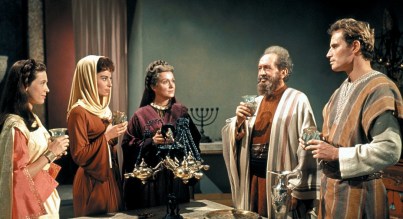
The film revolves around Christ, and Ben-Hur is another disciple of his teachings through conversion into faith, charity, and hope. The figure of Christ is the central theme of the film, but his face is unseen, and his voice unheard. We can only see his rear, but it is the mysteriousness of the person of Christ that elevates the story of Ben-Hur to the sphere of hagiography. The providential encounters with Christ in the climactic moments of his life lead him to the way of Christ, which mirrors the process of Ben-Hur’s redemption from Wrath to Grace, from Desolation to Hope.
Whether or not you believe in Christianity is not a prerequisite to appreciating this excellent epic drama because it would be a loss to any lover of arts to forego the spectacular beauty of the cinematography, not to mention the spiritual thematic of one man’s redemption from hopelessness. The grand epic scale of cinematography that depicts the tale of Ben-Hur in the trail of Christ from the Nativity to the Crucifixion is akin to watching Michelangelo’s remarkable frescoes of the Sistine Chapel that illustrate the story of humanity from the Genesis to the Last Judgment under God’s mysterious plan for mankind. In conclusion, ‘Ben-Hur’ is not a movie about a hero but about a triumph of hope over the desolation that saves a man’s soul from self-destruction, resonating with ‘Dum spiro, Spero,’ meaning ‘while I breathe, there is hope.’


To see the pretty summer sky is poetry breathing life. The world outside books provide the optical pleasure that sparks up otherwise monotonous landscapes of everyday life. Indeed, it was such a beautiful morning that would make you forgive your persona non-grate with the love of mankind. It was a kind of jolly morning that made the whole world seem kin. So Tuco took a lovely jaunt in the beautiful historic Santa Barbara County Courthouse this morning. He went there alone in the bliss of solitude that always flashed upon his inward eye for creative inspiration. One casual glimpse at Tuco might give you an impression of an ordinary guy with beer-belly spending his evening time and Sundays in front of a TV set. Contrary to his embonpoint, avuncular physiognomy, Tuco is an artist, a poet, a thinker. He is, what Edgar Allam Poe would call without hesitation, an intellect with passion.


Tuco chose the Santa Barbara Country because its Spanish colonial architectural style reminds him of the familiar civic landscapes of his childhood hometown. The Courthouse, located at 1100 Anacapa Street, in downtown Santa Barbara, California, is famous for the Spanish Colonial Revival Style building designed by Charles Willard Moore and completed in 1929. It was designated a National Historic Landmark in 2005 for its beautifully distinctive colonial-style respective of the Spanish cultural heritage harmoniously attributing to the aesthetic character and history of California.
 While strolling around the Courthouse, Tuco’s eyes were suddenly fixed on a white doll attached to the palm tree. It was a tawdry but scary-looking doll that gave him the creep down on his spine. ‘Did someone who had a beef with the court’s decision put this voodoo doll here as a curse to the Courthouse?’ Trepidation for the unknown terror began to spring from his tactile sensory organs, making him momentarily delirious. He was becoming unsure of whether it was a wise decision to take a picture of the evil doll or even to come to the Courthouse. Was it an omen? ‘Oh, come on. Are you kidding me? It’s just a doll, more or less. No need to waste your energy on contriving meaning to the ugly voodoo doll.’ With this sudden forceful exercise of affirmation, Tuco wended his way toward the beautiful scenes of the earth, the sky, and the view of the world.


Tuco exclaimed, “How hard it is to hide the sparks of nature!” The sky was high and blue, the lawn was full and green, and his eyes filled with pleasure. Today was the end of his vacation, and he lamented about returning to work for livelihood. However, the beauty of the scenery made his otherwise grim and dreary Sunday lovely, and Tuco thought life was not supposed to be all that hard and unbearable.
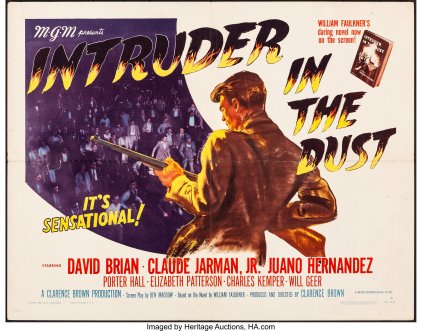
Justice is the truth, and the truth is the satisfaction of reason. Reason complements emotions triggered by the sense and guides a man to a purposeful action as a beacon of judgment. What motivates the teenage boy Chick Mallison and the lawyer John Gavin Stevens to help Lucas Beauchamp, a respectful and affluent black farmer, accused of killing a white man, is the desire for finding justice, the truth. “Intruder in the Dust” (1949), directed by Clarence Brown, shows that the search for truth excels in the infirmities of whimsical human characters based on William Faulkner’s selfsame novel published to a wide acclaim a year before.


Shot in black and white, the thematic of truth in the darkness of ignorance blinded by racial prejudice manifests itself in the transparency of facial expressions of the characters like ancient Greek theatrical masks to magnify the emotions and feelings of performers on stage. Lucas (played by Juano Hernandez) is laconic like an old Spartan. Still, his a few words carry the authenticity of truth, emphasized by his dignified aura surrounding the natural, confident being that commands attention to himself. As Shakespeare’s adage of true nobility as being exempt from fear, Lucas counteracts the mob psychology driven by the vacuously temerarious inquisition of popular sentiment in poised stoicism pleading for truth, not feelings.
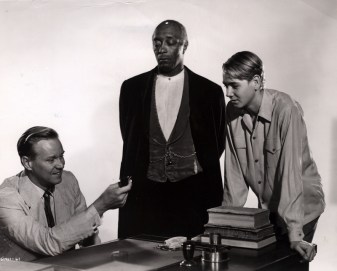
The subject of humanity is likely to be invoked for the anodyne ingredient to resolve the racial tension. Still, Falkner’s “good” white folks are more driven by a curious concoction of investigative natures, intelligent propensities, and occupational instincts blended well in the egoistic sense of fulfillment wonderfully producing a diamond of truth as though it were a wondrous alchemical process. The teenage Chick (played by Claude Jarman Jr.) and Lucas’s lawyer John Gavin Stevens (played by David Brian) are conscientious and principled, with whom we can refer to “good” white folk. Still, they are not entirely free from their prejudices about the colored, especially the blacks. Even Chick becomes indignant and intentionally drops the money when Lucas declines it from him as a token of gratitude and orders him to pick it up. The lawyer Stevens is neither particularly jovial with his client in the way he would be with his white client. However, both Chick and Stevens intend to descry the truth behind the machination of unreason that rains on the minds of the white people in the town because they are inherently good, even though they are biased. They are good people because their reason prevails upon unreason, and their search for truth outshines their prejudice. It’s what matters to the justice and life of Lucas, the black man who is not necessarily a chum of theirs.
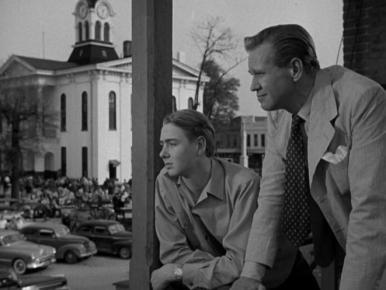
“Intruder in the Dust” may be parallel to “Who Killed a Mockingbird?” because of its similar subject and genre of the film, let alone their original novels that were written by southern writers. But what gives to “Intruder in the Dust” is its sense of realism in the likeness of truth. I find the characters in “Intruder in the Dust” more ordinary, more plausible, and more human. This film delineates a congress of human characters amid a universe of varied emotions and a sea of dangerous adventures, which illustrates both the never-ending dilemma and possible solution. The stellar performance of the excellent cast orchestrated by the astute director based on an excellent textual basis by William Faulkner culminates in this American Classic Masterpiece Film.

The high stars
in the black sky
On a wide ocean
Light a scene
Of play on stage
In three acts ere
the curtains are
Drawn for a new.
 Witches of Pennsylvania: Occult History and Lore by Thomas White
My rating: 5 of 5 stars
Edmund Burke’s canonical adage of “Superstition is the religion of the feeble mind” fits the American perspective of witchcraft as well as other supernatural views on the world. No wonder literature and media are chockablock with adolescently burlesque images and sensational accounts of the mysterious phenomena in comparison with the European approach to the subject matter in terms of historical and social contexts. However, Witches of Pennsylvania: Occult History and Lore by Thomas White is an excellent antithesis to the stereotypical American attitude toward the thematic that should merit its place in the history of American civilization. The book is concise in its volume but rich in the spirit that deserves its academic and cultural contribution to the history of the New World.
The book treats the thematic of supernatural accounts of witchcraft and magical folk (the equivalent of the British Cunning Folk) with a sense of respect for the belief tradition held by the Germanic settlers of Pennsylvania and the origins of it in academic approach. Based on his close and observant reading of the multidisciplinary subjects from history to religion, White fills the erudition pages after pages with many unknown historical facts about witchcraft before the infamous Salem witch trial in Massachusetts and the lasting legacy of the supernatural belief still alive among the common folk. The omission of the witchcraft elements found in other cultures, such as African-American and Native-American, is not a supercilious gesture disregarding their values charged with ethnic pride or cultural jingoism. It is to isolate belief tradition in the form of folk magic and witchcraft from a cultural identity of ethnic traits that many people like to associate. Instead, it intends to distinguish it from the established religion that has deeply affected the psyches of the ordinary people, which ultimately has become a folk religion of its own with efficacy.
Whites provides insightful intelligence about the use of folk magic as a sense of control in the world beyond human control. Recourse to supernatural means of relieving the malady of hearts is the last straw a person can think of in a recurring series of losing streaks without jeopardizing his/her self-esteem. The story of Hex Hollow, for example, is the most well-known and representative of the subject matter, manifesting the effects of folk religion on the psyches of the residents in the predominately German-American region. To dismiss the culprits of the case as good-for-nothing superstitious crybabies looking for figures to blame for their unlucky strikes of lives is, therefore, an arrogant display of willful ignorance of the truth about folk religion and its impacts on the psychosomatic functions of individuals. The best illustration of such evidence comes in the form of The Long Lost Friend by one John George Hohman, a German-American Catholic printer, bookseller. It is an impressive collection of herbal remedies, magical healings, and charms that have been known for their potency for years with wide perennial circulation. The book is still going actively available on Amazon.
This book is an excellent read for those craving for academic perspective on witchcraft and magic folk existent in the U.S. without the assistance of parapsychology, paranormal investigators, psychics, and mediums, distinct from the genuine witches, wizards, and hex doctors. It is a collection of supernatural events and narratives recorded in case law and annals of history, told in a plain language comprehensible to eager readers of mysterious knowledge. You will find the book read fast as if you were cast a spell on by its arresting attention and wondrous truths about the existent world we still do not know in its entirety.


You must be logged in to post a comment.