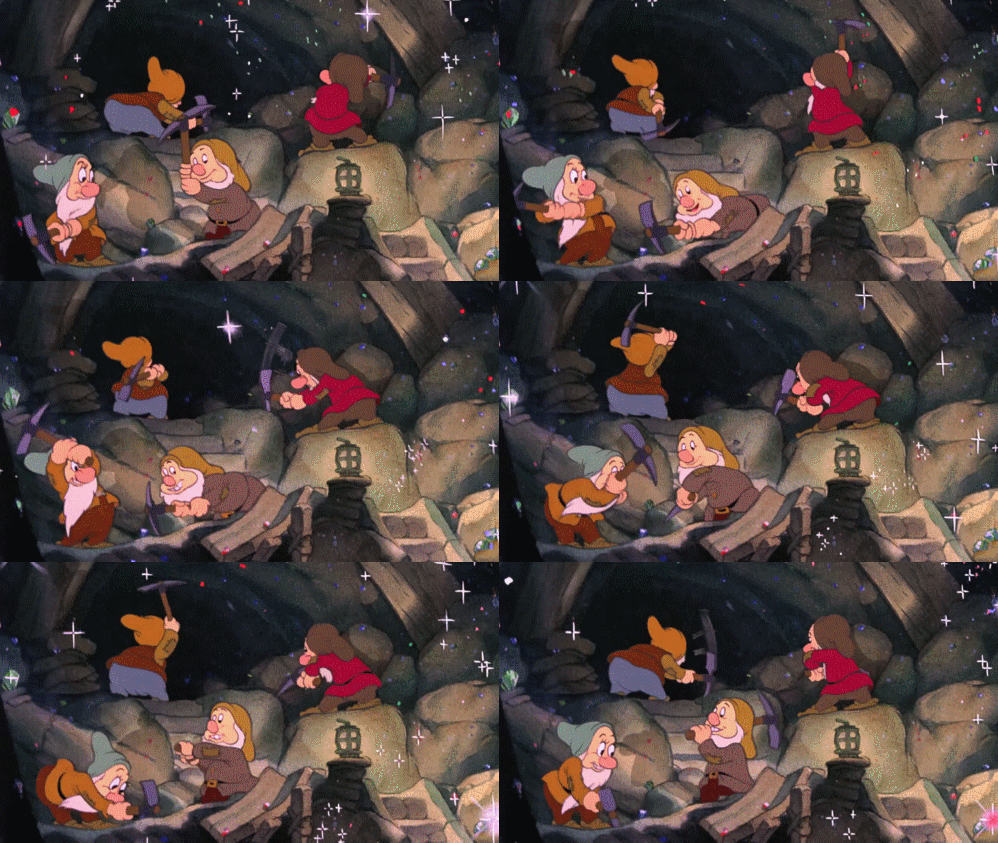
Fee, fi, fo, fee, fi, fo.
Day is halfway gone;
It gives way to night.
Daily tasks are done;
It gives life delight.
Heigh-Ho, heigh-ho!
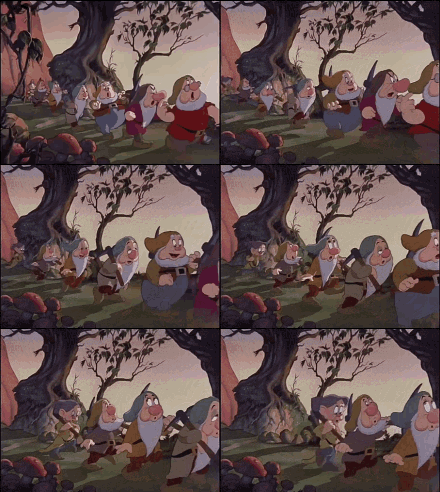
Fee, fi, fo, fee, fi, fo.
Day is halfway gone;
It gives way to night.
Daily tasks are done;
It gives life delight.
Heigh-Ho, heigh-ho!

The movie ‘Joker’ has taken the world by storm. The citizens of the four cardinal directions of a compass all seem to flock to the screening of the movie and feel gobsmacked or spellbound even by the stellar performance of actor Joachim Phoenix in his soul-wrenching portrayal of Arthur Fleck before his rebirth as Joker. The aftercome of the movie is a great legion of tweets rhapsodizing about the character and the man behind, which is deemed meritorious, justifiable, and agreeable. However, most of the tweets about this outstanding movie disappoints me because of their opinions that seem to miss the gist of the movie, the logotheraphical nuance of the movie itself that director Todd Phillips tries to express on the screen. Is this movie about a clinically crazy man, a so-called “psychopath” who wallows in killing-sprees? Why do people suddenly seem to care about a man whose existence is constantly slighted and ignored when they unconsciously or consciously do the same to the ilk of Arthur Fleck in everyday life? Will the movie change their attitudes toward those struggling to make their presence amid constant ridicule and estrangement?
As I previously stated in my review of the movie, this is about a man whose efforts to preserve a sense of purpose in the world and a tenacious grip on recognition are ruthlessly vanquished. Everyone from all social strata, including those recognized as underprivileged underlings, not to mention the upper crust of society, indiscriminately ignores him. And the reason for such unanimously consented mistreatment of Arthur Fleck is not so much due to his low social class as due to his unlikeness that manifests itself, so visible that it makes onlookers regard him as a tacitly public domain of disdain and estrangement. He is a public whipping boy, a modern-day equivalent of a cunning man accused of witchcraft or dark magic, bestriding on the verge of madness as a result of concerted social alienation, which forces him to choose none other than being Joker. Hamlet’s existential question of “To be or not to be, that is the question.” seems too pat and gives a fillip to the loneliest, darkest, and saddest moment of Arthur Fleck when he feels pushed into the edge of his conscience. He surrenders himself to the death of his old, bullied, slighted self because it’s better that way than spends his life misunderstood and ignored to the end.
Alas, poor Arthur Fleck! I know him, my dear reader. For however fictional the character may be, an Arthur Fleck is here in our ordinary landscape of everyday life. Workplaces, schools, supermarkets, buses, trains, streets, hospitals, and houses that you go and live are where you see him but not regard him, hear him but not listen to him, speak to him but not talk to him. If you protest, then you are probably feeling guilty of doing the same thing that they did to Arthur Fleck whom writers call a misfit, employers an incompetent, social workers/psychiatrists a basket case, and a detective a psychopath. That whom we call him by any other names will remain the same as neglectful and insignificant.
In sum, those of you who rave about the movie in terms of the outburst of the suppressed shall regard it not as a liberal cause of partisan ideology or a demotic social manifesto but as a visual memoir of a very lonely man who cries inwardly every day for the wounds of his estranged soul. For what Arthur Fleck wanted was very human and basic as appreciated by American philosopher and psychologist William James many years ago: “The deepest principle in human nature is the craving to be appreciated.” Praising what is missing and ignored makes the remembrance dear. This is about one man’s struggle against finding a meaning of life, will to meaning, stumbling into a vertigo of his existential horrors of daily life. That is the message.
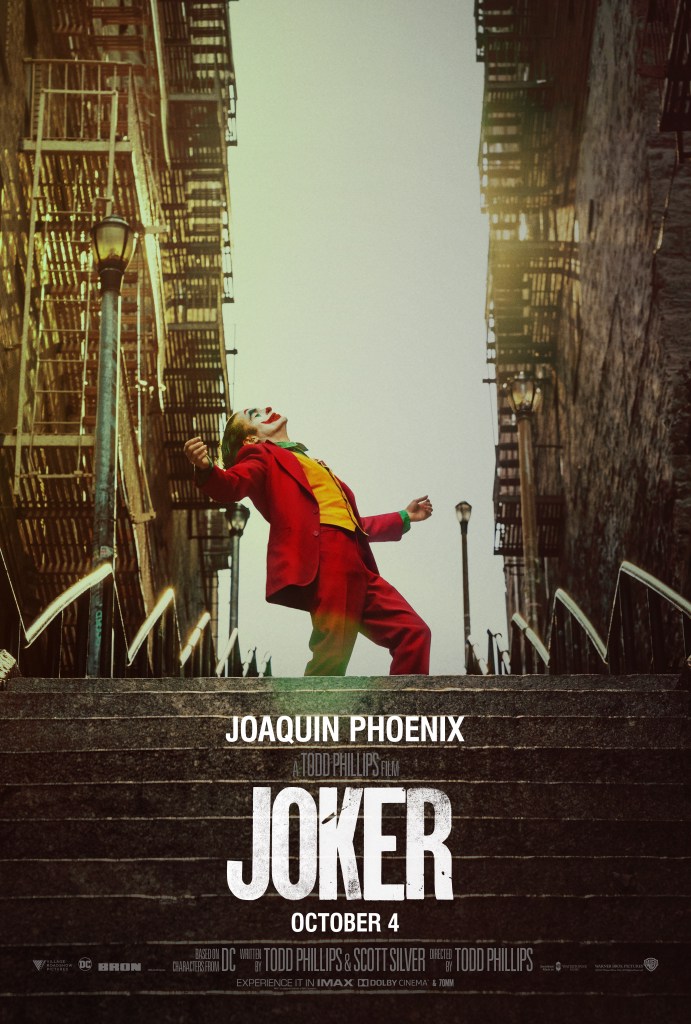
He’s nobody to whom people neither listen nor talk. He’s alone, alone, all alone on a vast gaping sea of people who continuously berate the person and the dream and the existence of himself ruthlessly. Francis Bacon’s phrase of ‘Magna Civitas Magna solitude’ bethinks the case of Arthur Fleck. The Joker is a man trying so hard but futilely to preserve a sense of purpose and a tenacious grip on social recognition at the bottom rung of social hierarchy. Even the goddess Fortuna seems to vent her usual aeonian capricious nature on the fate of this unfortunate man whose Wheel of Fortune is destined to be positioned to True North of Tragedy. If this sounds maudlin enough to frown over that “just a movie” façade, then think of what Charlie Chaplin elegantly sums up thus: “Life is a tragedy when seen in close-up, but a comedy in long-shot.” This is a life of Arthur Fleck, and it is here where he becomes Joker, the archenemy of Batman and the good citizens of Gotham City. It all begins here in ‘Joker,’ directed by Todd Phillips, who seems to have an eye for the absurdities and hypocrisies in our society.
fragileArthur Fleck is said to be mentally insecure, seeing a social worker every week who only cares about her civic duty to talk but not listen so that he can get his usual five different psychotic medications. He is conditioned to be mad amidst the licensed incivilities of the people indiscriminately. He is a victim of severe bullying and taunting for his bouts of uncontrollable laughers and gawkish rail-thin appearance in which his piercing blue eyes are the only resilient torches of his soul that defy the injustice and humiliation by society. It is the society that slowly maddens Arthur with those multiple chemical prescriptions and willful neglect of his presence. Must I chant his litany of woes further?
The clown mask of Arthur Fleck becomes the persona that gives him a new personality with a sense of empowerment by freeing him from conscience in the heat of passion. According to the ancient Greek thespian idea of drama, the tragic actors were heavily disguised with a religious purpose in honor of Dionysus, the god of ecstasy, for the actor was to give up his identity to let another (i.e., the mask character) speak and act through him. In this regard, Arthur’s clown face betokens his suppressed self, drenched in vindication against the tyranny of societal conformity that allows no place for anyone like him. It’s certainly a tragedy in the sense that the painted mask becomes paradoxically the real character that imbues people with fearful attention to him, not the entire bare face of the man. The Joker’s face is stark defiance to the hypocrisies and absurdities that slight his existence as a person. As Melpomene, the muse of tragedy is portrayed as wearing a mask of sadness and a buskin, Arthur Fleck wears a clown mask with a buskin hiding his tears from his heart. The uncontrollable bouts of his laughter are, in fact, a cry of his wretched soul.
At the heart of this film lies a heartfelt performance of actor Joachim Phoenix, who is said to have lost about fifty-two pounds in response to the director’s request to portray the linchpin as a gaunt man to render his vulnerability and alienation from people. The dedication to the character that is never easy to play shines through Phoenix’s stellar performance on the screen. The deliverance of the characterization is so realistically touching that it pains my heart to follow through the life of Arthur Fleck, oozing out insurmountable pathos and that even his chain-smoking is deemed less toxic and vice-signaling. We see him alone in his apartment, on the bus, and on the street, even among the crowd. We see him slowly abandoning himself to a bottomless pit of despondency as the world around him, including his mother, shuns him from humanity. His crime is to be condemned, but is this not a man who is more sinned against than sinning? Joker is a kind of movie that makes you go thinking after the lights are off.
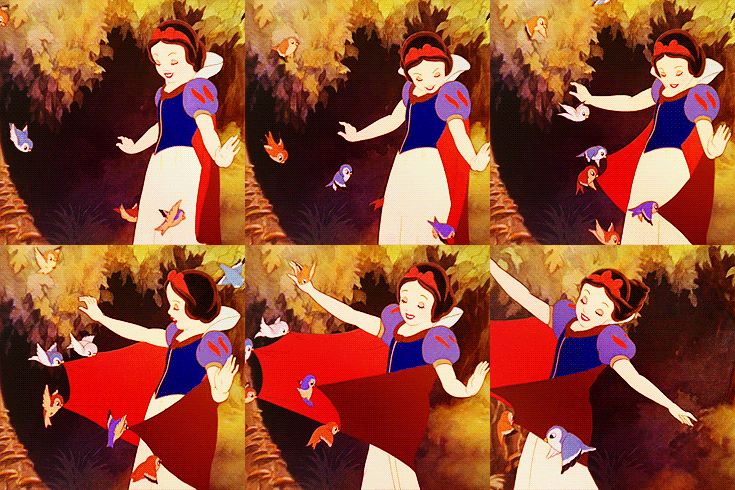
A high blue sky
It hangs a rainbow
Its sight reigns
Its colors glow.
Lark is ascending…
Sweet caroling is a melody
Small wing stroke opens a new day
Misty eyes see hope ascending…

 Thirty Seals & The Seal Of Seals by Giordano Bruno
My rating: 3 of 5 stars
The art of memory has been a popular subject for occultism and academicism throughout the centuries. The subject deals with our incredibly flexible human intelligence with its general multipurpose learning strategies that can work wonders if the doors of imagination are opened to the mystery of the knowledge without constraints of religiosity and fears of the unknown territories of human possibilities. Of the intellectual trailblazers of the craft of memory, none other than the figure of Giordano Bruno stood out blazingly even at the burning stake as an accused wizard. For it was akin to a witchcraft of perfect knowledge as expounded in his Thirty Seals & the Seal of Seals, the book banned by the Church in fear of losing the faithful to the Power of Knowledge.
The book illustrates a set of “basic” rules that reads more like Euclid’s Elements or Pythagorean Theorem, which means it is not written for general readers. This is because the book was part of a job application for a teaching post at the Oxford in the Elizabethan England, demonstrating his admirable erudition, superb command of the English language as a foreigner, and naked flattery to the academics at the university. Bruno got a few lecturing opportunities at the Oxford, but his cerebral mind devoid of wit in addition to his short, unprepossessing appearance was regarded as far-fetched and unfavorable to the attainment of the sought-after position at the Oxford. In fact, this book does not provide the reader with special spells for obtaining perfect memory but gives the method of encoding letters or syllables of the name of the thing into a set of predetermined images. It is magic in the sense that if this method is perfected, it works wonders. It’s a psychological mind game, the magic of psychology per se.
This magical book, this banned book will betray anyone who expects it to be something of magical Rosetta Stone for obtaining the secrets of perfect or better memorization. But that doesn’t mean the book is entirely abstruse to enjoy; the idea of the intellectual trinity comprised of Pallas Athena (The Senses), Vulcan (Imaginations), and Mars (Judgment/Reason), all of whom are overseen by Jove (the Soul) is quite intriguing and related to Socrates’s idea of reasoning. As a matter of fact, this book is not so much an esoteric book as deeply psychological literature that boasts Bruno’s indomitable intelligence and recalcitrant individualism that stigmatized him as a renegade. Maybe that’s the reason this illustrious intellect was burned at the stake as a dangerous pagan.

Merry hearts, pleasant faces, light walks,
Birds tweeting, dogs frolicking, people chatting;
The sun’s risen, and the day’s at the morning.
The weekend’s on Friday, and the joy begins.


You must be logged in to post a comment.