Tag: logotheraphy

  • Loveliness blooms in Logotheraphy

    img_0598

    A thing of beauty is a joy to them. Its loveliness increases. It never passes into nothingness. Oscar Wilde, who extolled physical beauty as a form of virtue manifested in a physical form, once flamboyantly remarked: “Crying is for plain women. Pretty women go shopping.”  Although Seraphina Rabitte and Mathilda Beare demur at such uncharitable notion of meritocracy of women’s appearance, they love visiting beauty stores in a way that little children love going to candy stores (or toy stores to be more realistic these days). For the ladies like to keep themselves prim and proper in the belief that presentable appearance (not a physical symmetry per se) indicates how one takes cares of herself by realizing her creative, attitudinal and experiential values in everyday life.

    img_0599

    The belief is grounded in Logotheraphy, one of the three Viennese School of Psychotherapy founded by Dr. Viktor E. Frankl, a neurologist, thinker, psychiatrist, but above all, a remarkable human being who endured personal experiences of Promethean hardships and suffering in Nazi concentration camps and conquered them in triumph of will to meaning. Fashionable and knowledgeable Matilda and Seraphina are students of Logotheraphy, the theory that human nature is motivated by search for a life purpose that is unique to each individual. Unlike other schools of psychotherapy and many other subdivisions thereof, Logotheraphy encompasses a wide scope of the humanities and of course, neuroscience, making it a brilliant multidisciplinary school of thought. In fact, it is a paradigm of the consilience of the knowledge of the humanities and that of science. So, in the context of regarding Logotheraphy, the fashionable ladies’ attitudes toward appearance betokens their ways of preventing noogenic (existential) frustration by engaging themselves in activities to dispel a hint of depression or inertia from their minds, even if it means only going to shopping.

    img_0601So, you see it isn’t a symptom of conspicuous consumption as a result of our hyper industrialized social environment that Matilda and Seraphina like pampering themselves with cosmetics. Besides, who can blame them for having none other than a woman’s reason? Didn’t Queen Elizabeth also proclaim herself to have a lion’s heart in a woman’s hide? Also, did the Queen not show fierce attention to fairness herself by putting the most fashionable make-up and dresses and hairstyles of her time? Well, these modern ladies are no less different them from their loyal member of sisterhood in the race of Humankind. In fact, Matilda and Seraphina have aristocratic bearings in appearance and manners due to their fine upbringing and sweetness of the mind by nature, so whenever they go, they give admirable impressions on people whom they encounter. They are the paragon of a virtuous woman as John Milton extolled in Paradise Lost: “Those graceful act, those thousand decencies that flow from all her actions and words.”

    Author’s Note: Many thanks to the attendants at the Cosmetic Company Store in Camarillo Premium Outlets who kindly permitted me to take pictures in their store. 

  • Live to Tell: ‘Hold the Sun in Your Hands: The Erika Jacoby Story’

    Hold the Sun in Your Hands: The Erika Jacoby Story from Cheri Gaulke on Vimeo.

    Great Philosopher Spinoza advised the mankind of how to endure suffering in days of yore: “Emotion, which is suffering, ceases to be suffering as soon as we form a clear and precise picture of it.” The essence of this suprameaning of emotional suffering, which Spinoza also poetically termed Amore Feti (Love of Fate), is to endure what you can’t change but to accept it as it is, for there is a meaning to it in the dark night of the soul.  In the terrible ordeal of the tormented soul, one has two choices to make: to yield to the force of deception calling for total abandonment of hope or to force oneself to turn to the voice of hope to sustain strength of the heart. The sovereignty of humanness is manifested by this holy office of selecting the spiritual choice in the darkest hour of the soul in the deepest valley of the abyss. “Hold the Sun in Your Hands: The story of Erika Jacoby”, a short documentary produced by Harvard Westlake-School, is one such tale of a survivor from the atrocity of moral and physical turpitude as a young child at Auschwitz during World War II.

    A curious alchemy of illustrative animation and neorealist documentary delivers a momentum of pathos without elaborately scripted lines or special effects in the most powerfully elliptical way, which adds to the authority of truth that the story itself owns. Ms. Jacoby’s straightforward narration without a prolix litany of her woeful past is felt through the heart of the viewer, and it communicates to the mind of the viewer her smothered traumatic experience at Auschwitz, where she had to witness the death of her beloved and the enormity of evil reincarnate in the Nazis’ mass killing of the Jews and the violence against humanity through the eyes of a young girl.  Accordingly, the film is seen in the perspective of a young child whose innocence betrays ingenuousness of the story and thus delivers the profoundness of such experience that sublimates it into the highest form of Art in the context of regarding Da Vinci’s aphorism of “Simplicity is the ultimate sophistication.”

    This short documentary has chimed the hearts of thousands, including those judges at the Cannes Film Festival, which is one of the most highly regarded film festival (note that it’s not an “award” ceremony where only gowns and jewelry and tuxedos and fake smiles are visible.) in the world. It will be shown at the American Pavilion at Cannes this month as part of a series on young, emerging film makers, one of whom includes Ian Kim, who is son of Mr. Harry Kim, a corporate lawyer at a law firm I am privileged to work. The creators of this documentary will appear on stage at Cannes, ergo it will be a festivity of creation, a festivity of humanity. Above all, the fruit of this film is a triumph of human will that rose above the carnage of war and the degradation of dignity and a manifestation of meaning of life, will to meaning, freedom of will as also corroborated by Dr. Viktor E. Frankl, founder of Logotheraphy and also a survivor of five concentration camps during World War II. Ms. Jacoby shows us what it means to have hope as long as she lives. Dum Spiro, Spero. This documentary will strike the highest notes of your heartstrings.


  • yesterday, today, tomorrow

    img_0398

    Doubtful, Mindful, Rueful,
    Yesterday was Forgetful.

    Purposeful, Suspenseful, Resourceful,
    Today was Eventful.

    Faithful, Trustful, Hopeful,
    Tomorrow will be Cheerful.

  • saturday, celebrate!


    Cheerfulness and rest are handmaidens to productivity. They come in tandem and frame your mind to mirth and merriment, which stunts malaise and spreads happiness. For the mind is the foundation of the universe. The modes of enjoyment are subjective according to an individual’s taste and personality: creativeness by doing creative things or experience by appreciating works of arts. Whatever it may be, it does good on your soul and body. “Mans sana in coporore sano,” a Latin maxim meaning “Sound mind in healthy body” applies to the all of the above.
  • three philosophies

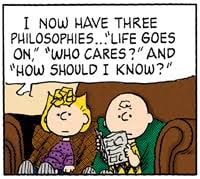
    images-1Before calling it a day to say hello to a new tomorrow on a hard day’s night, to happen on this comic strip of my all-time favorite Peanuts seems almost too pat. Provident, even. It chimes the bells of my heart and soul that are dented with the shrapnel of existential vertigo in the most impressively elliptical way: that none other than simple tenets of life are needful to live a less stressful life.

    As Sally elegantly puts: Life does not end at one fell swoop even if I stumble into an imbroglio of misadventures; any such mistakes or misdeeds betray that to err is human; and that I should not fall into the bottomless pit of worries and anxiousness, for tomorrows are always new with their own unknowns.

    What Sally blithely professes strikes the chords of Logotheraphy, a 3rd Viennese school of psychotherapy founded by Dr. Viktor E. Frankl based on existential analysis focusing on ego qua meaningfulness, a purpose of living a meaningful life. With these simple but potent tenets of life in mind, I can say good-bye to this spent day with the alacrity of departure for nightly dreamscapes to rest myself.

  • The Beautiful World of Henri de Toulouse-Lautrec

    220px-Lautrec_moulin_rouge,_la_goulue_(poster)_1891
    Moulin Rouge La Goulue 1891by Henri de Toulouse-Lautrec

    On my desk now, I have a lovely little music box made out of a replica of Lautrec’s Moulin Rouge La Goulue 1891 that pleasingly plays “French Can Can” when I wind up a handle attached aside to the box. The sweet melody played from the vivacious four-color lithograph affords a delightful digression during my study, which sparks off the subsequent musings on the artist and the arts, self-proclaimed, would-be,and aspiring artists and the act of creation itself.

    A creator of the arts is a solipsistic benefactor of humanity whose congenitally proud egotism is a grand collective reflection of his cultivated trauma, sadness, frustration, anguish, and anger. With this in mind, an artist is endowed with a certain kind of poetic license to be freely and respectfully egoistical because an act of creation – or sometimes referred to as “intellectual drudgery” – demands of an unusual degree of courage, imagination, imaginativeness, knowledge, confidence and patience, all in a frenzy of his imago already existing or incipiently forming, by pouring out everything that is in him unsparingly, furiously into his creation. In fact, creative originality of standing quality often reflects high resources of courage, especially when the artist will not yield to his formidable foe in the form of biological determinism. Such was a noble spirit of Henri de Toulouse-Lautrec (1864-1901), a French painter and illustrator who sublimated his existential cross into his glorious laurel through the medium of art, the creation of his own reality of the world as he saw and felt in his mind’s eye.

    bio_toulouse_lautrec_henri
    Henri de Toulouse-Lautrec (1864-1901)

    Anyone who is interested in the Post-Impressionist paintings by Cezanne, Gogh, and Gauguin, might have come across Lautrec’s bold but gorgeous posters of actresses and dancers of Paris cabarets and theaters during the Belle Epoch period (1870-1914). Lautrec’s inherited disabilities as a result of his aristocratic familial consanguinity blighted him with grotesque physical deformities and congenital weakness: a midget taking a feral resemblance to a cross between a bull frog and a monkey. If you think that this physical misfortune alone merits his artistry or self-inflicting sybaritic lifestyle, you are probably not seeing the forest for trees. True, that he was often too ill to paint any and frequently visited the brothel to dispel his existential loneliness due to his pronounced external features. However, it was his preservation of a sense of purpose in life and tenacious grasp on his artistic existence, his recognition of the values he possessed and talent to express them to mark his standing in the world. The wisely chosen attitude toward things that he could not change but accept speaks to our world of post truths, grand fustian narratives, fake news, and fleeting ambitions that demerits  courage and patience, which are the handmaids of genuine confidence as a reservoir of creativeness.

    4147-2
    Le Rire Les Grans Concerts De L Opera 1897  by Henri Toulouse Lautrec

    Being an admirer of the works of this amazingly daring and talented artist, I believe anyone struggling to better the self can relate to a prodigy of courage and effort demonstrated by Lautrec at the darkest hours of his life, when in fact it was the most creative time of his artistic career as a highly sought-after illustrator of French entertainment industry that provided visionary artists and technicians the substantial grist for the mill of their subsistence. Into this dazzling new luminous conflation of art and technology staged Lautrec, lord of the blank space and the bold line, to claim his dominance as the bell epoch’s master of artistic poster designer not only of his time but also of our time. The capital difference between Lautrec and his contemporaries was his daring characterization of the models and ambience he portrayed; the individuality was in the expression of the colors, lines, and perspectives, making the subjects into work of new creation, elevating their planes and milieus into the artistic ether of exquisite beauty and peculiar charm, giving unforgettable impressions on the minds of the beholders.

    Lautrec proves to be a human testament to triumph of will over biological/social inhibitions during difficult times. His decision to work through his sadness by painting comes closer to serving as a sovereign remedy to the existential ills than any other semblance to solution thereof. In light of the above, it occurs to me that to practice any form of art, however good or bad, is not a prerogative of a professional or publicly recognized artist with more than hundreds of followers. The actualization of ideation, i.e., an expression of yourself in writing or painting, is a noble act of claiming your sovereignty, your own intractably unique self that attests to your existence, a sense of purpose in life. A life is not fully realized unless you actually live through it by unlocking what’s inside you. Be it ever called a cathartic effect or solipsistic satisfaction through the medium of creative act, just as Aristotle defined the primary function of the Arts as an imitation of natural beauty. That is why I write, and so should you.

    저장