Tag: love

  • On Reading “Student of Desire” — Adelle Waldman

    Saturday, August 22, 2026

    “Can intellectual recognition itself become desire?”

    Will an intellectual man fall in love with a woman of equal or greater intelligence? The question has become so entangled with sexism that it seems to invite textbook answers such as, “Beauty is only skin-deep.” But this is not about feminism or social activism. It is an intimate question: “Can you love me even if I am smart but not so pretty?” Waldman’s disappointmentpromptss her to ask about her existential value as a woman, not merely as a writer or intellectual, because the personal stakes are toohighg to ignore.

    Seeing her ex-boyfriend with a beautiful woman is painful enough to prick the pride of an intellectual woman who is supposed to believe that real love resides not in looks but in the mind. Or so it seems. Waldman extends the existential question into the erotic hedonism of The Professor of Desire, whose protagonist seems to vacillate between a whore and a virgin but never reconciles himself to the truth, always yielding to the pleasures of the senses. While I understand Waldman’s disappointment at seeing a smart man fall for a bimbo, she seems to explain his gorgeous new girlfriend as the result of animal instinct: Eros alone, without marrying Eros to Psyche.

    Call it the male subconscious urge to prove sexual prowess. Or immaturity. To me, a man’s intelligence or cultural refinement does not necessarily equate to his moral fitness. Think of the ancient Greek symposium and its beautiful and intelligent courtesans. Men, I think, are often more readily stimulated by the visual than women are. I remember reading that Updike had a voracious sexual appetite and engaged in sexual excesses. And that’s not the end. Arthur Miller’s marriage to Marilyn Monroe—even though she was herself intelligent, read books, and took literature classes at night—and his novella Plain Girl: A Life tell us that intellect does not necessarily determine physical attraction. After all, the plain girl finds her soulmate in a blind musician who loves her not with his eyes but with his mind.

    I know how Waldman felt when she saw him with such a beautiful woman. I think Waldman wants to believe that she is right: that a woman’s intellect can stand equal to beauty—par pari. I think Shakespeare is great because he recognized this human nature in everyone, including the rivalries of love:

    “Love looks not with the eyes, but with the mind;
    And therefore is winged Cupid painted blind.”

    But remember: Cupid is blindfolded. He does not know whom his arrow will strike.

  • On A Woman’s Story by Annie Ernaux

    On returning to the quiet joy of reading, one discovers that some stories are not only theirs but yours too. Annie Ernaux’s A Woman’s Story was one of those stories—hers and mine.

    It was one of the days I visited my mom at the convalescent hospital for the elderly when I started reading this story, sitting by her bedside. Call it providence if you are religious or coincidence otherwise, but I wasn’t expecting it to become my story as well about my mom, who had been hospitalized since her stroke in January of this year. It was as though Ernaux was speaking to me as a daughter to daughter about her mom and mine, collapsing time and place and the cultural and social differences between us. No wonder I wanted to finish reading it at one sitting.

    This book is not of a certain literary genre. To call it a biography of her childhood and her mom’s influence on her misses the point of why it took her a year to finish the book. It’s much more than that. The absence of her mom made the author realize her mom’s place in her memory. Her mother was the first witness to Ernaux entering the world naked, and later, to her becoming the woman she is. It’s both a biological and an existential view of the author’s raison d’être. That there is no longer anyone on the other side of the first relationship, which has ended forever. It aches. It lingers. It evanesces. And before all of this will vanish into the ether, Ernaux lives to tell about the presence that was so familiar with her being that not seeing, hearing, and feeling it is painful to bear without letting it take the form of writing because writing is personal yet public, pensive but assertive, and quiet but powerful.

    I can understand the kind of ache the author felt after her mother’s death. Whether you loved her or not, you would never see her in life again. She may live in your vision of the past, but her person as a presence does not exist in this world. And that realization of forever disappearance would throw you into the abyss, stifled, blinded, and muffled—by the ineffable sorrow mixed with mystical longing.

    I think about my mom and me. What if she leaves this world soon—tomorrow, the day after, or anytime soon? Oftentimes, I wake up with indescribable terror at the thought that soon I will lose her to eternity if I breathe, like a panic attack. And it dawns on me that it is this feeling of detachment from the relationship, as the bond between mom and daughter is severed forever.

  • Chasing Shadows: The Cycle of Love and Loss

    Ariadne, Dido, and Clytie—

    ancestors of the tribe called Beautiful Losers.

    Their loves were alone, half-met,

    steeped in the clandestine ache of disappointment.

    Spring meets Summer.

    Summer elopes with Fall.

    Fall yearns for Winter.

    Winter chases after Spring.

    The cycle of lovers’ tales.

    Some loves are born to be forever chasing.

    Even beauty cannot possess the souls of the beloved.

    Votives of curse are lit for Hecate.

    Still, Ariadne found herself

    in Dionysus’ arms—god of wine and pleasure.

    Dido let Aeneas touch her aching love in a cave.

    Clytie burned for Helios,

    who left her for a mortal princess.

    But I am chasing the shadow of his past,

    the ghost of a lover no longer himself—

    his eyes, the blue sky—so beautiful, so sorrowful

    they puncture my heart with helpless longing.

    I write his name on papyrus,

    seal it with the candle’s tears,

    and burn it in the quiet flame,

    calling his name within.

    The doors of time close.

    Candlelight flickers in the wind of the hour.

    Wistful images of his face—young, old—

    even those I would forget, I cannot forsake.

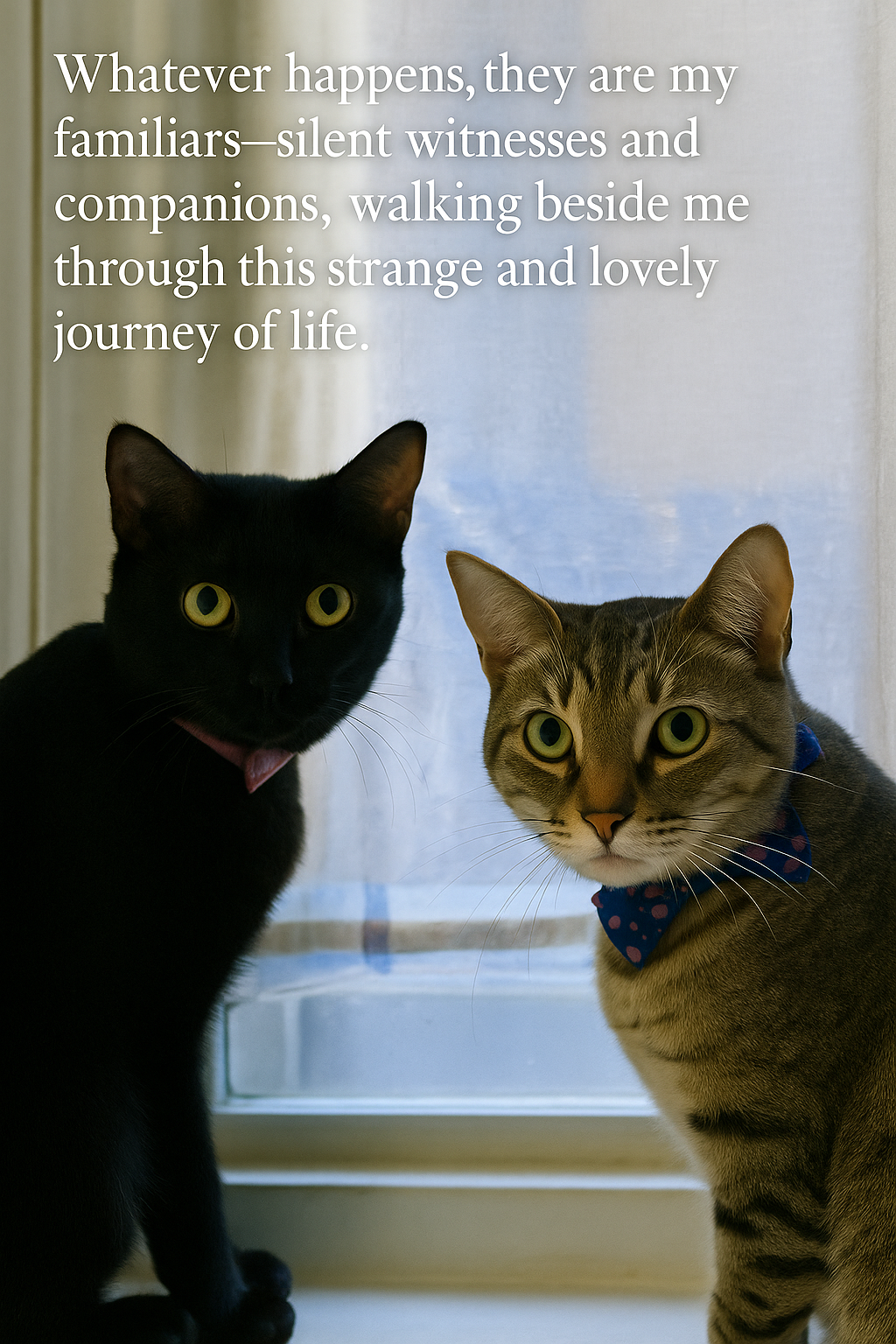
  • 🐾 Understanding Cats as Mirrors of My Soul

    They say pets reflect the personalities of those who care for them. The way they respond to others and express their feelings seems to mirror how they’re treated at home—or perhaps how their owners reveal the rawness of human emotion, unfiltered and instinctive.

    My two cats, Toro and Camille, mirror my ego and superego, respectively. Toro is a sensitive soul, easily shaken by the outside world and never shy about his emotions, almost like a little human. Camille, in contrast, is calm and observant. He watches me in silence, as though he sees through to the very center of me. At times, I think of Toro as the General Cat from Cat’s Eye, and Camille as Jiji from Kiki’s Delivery Service.

    Sometimes, I wonder if they are the little brother and sister who were never born—that they somehow returned in fur and paws to be near me… and, strangely, near my mother, who once chose not to bring them into the world.

    Whenever they curl beside me, their small hearts pulsing gently against mine, I feel the wonder of life swell within me—a quiet awe at its vividness, like a tide of feeling stirred with reverence for the mystery of creation, and the One who makes all things beautiful.

    Rudyard Kipling once said that a cat walks by himself. But perhaps he never met mine.

    Whatever happens, they are my familiars—silent witnesses and gentle companions, walking beside me through this strange and lovely journey of life.

  • prompt 212 – fish out of water

    Tell us about a time when you felt out of place.

    Hopeful when alone

    When I read the story of the stranded Beluga whale who died in France’s Seine River in 2022, I felt like my spirit was in communion with hers because I could feel what she might have felt—what was once hopeful turned into disappointment and loneliness.

    No one knew what caused her to separate from her pod and end up in the river, but I think she wanted to see the world herself, with the images of kind humans she had once seen on the ocean in her memory. So she came to our world full of expectations for welcoming faces and smiles, but instead, she found herself in a murky gray urban river that made her loneliness more conspicuous, more incongruent.

    Likewise, that’s how I feel when I find myself surrounded by crowds that make my presence awkwardly conspicuous, shielded by an invisible wall of willing ignorance.

  • Shape of Love

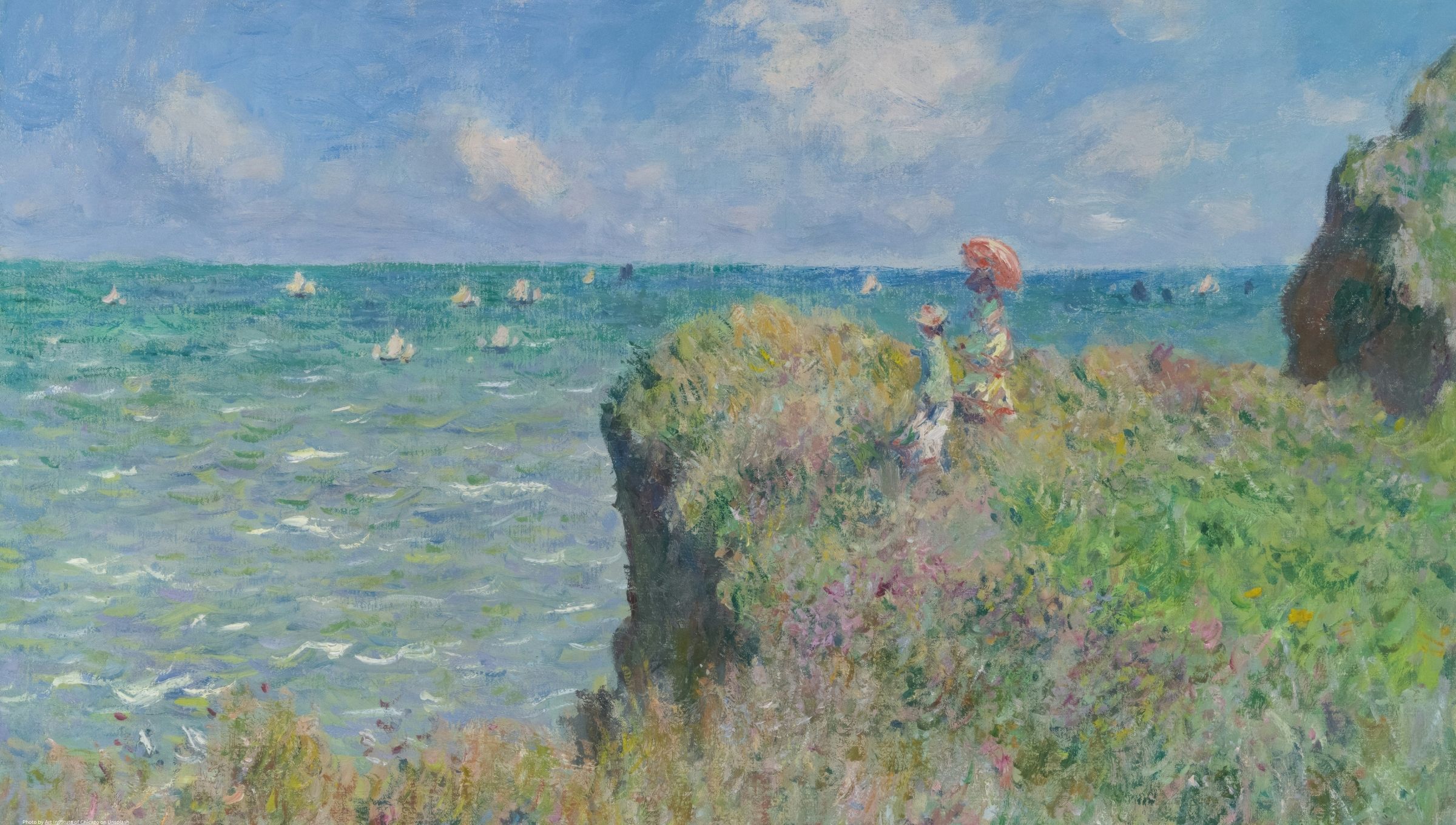
    “View From the Cliff at Pourville Bright Weather” by Claude Monet

    What is a shape of love?

    Have you seen a shape of love?

    If you have, tell me about it. 

    Does it look like a heart?

    -Pumping the red streams

    Gushing the river into veins

    Thumping, pounding,

    Speeding fast forward

    The reason of the mind

    Covered with dessicated

    Leaves of the dreams

    Where joy once danced

    Frolicking, humming 

    Like a beautiful butterfly

    In derilious delight. –

    Is this what you have seen

    The shape of love?