Tag: movie reviews

  • ‘Planet of the Apes (1968)’ – film essay

    71oadYuBx+L._AC_SY879_

    Imagine this. You are the only person marooned somewhere far away from your world. You have all heard the dystopian chimes of every brave new world from George Orwell’s totalitarian society of 1984 to William Golding’s terrifying Lord of Flies and Aldous Huxley’s eponymously prophetic Brave New World. Yet, you have not realized how it would be like until you enter such a world alone. The world you face now is the amalgamation of all the worlds described above that exist in the selfishness of lettered cases. What would be your impulsive action toward the stupendousness of the incredible event? Besides, what if your best work a la your reason and hope as good as your pride and hubris can present turns out to be a grand Faux pas?

    planet-of-the-apes-soldiers-pose

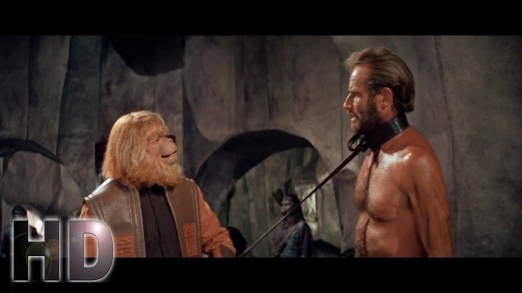
    Planet of the Apes (1968), directed by Franklin J. Schaffner, is a crackling Sci-Fi movie that translates the dystopian thematic of a world in a phantasmagorical display of primal humans and intelligent primates that upends the existing hierarchy of creations and reconstructs the fundamental doctrines of the Origin of Species. It is an advanced society of chimpanzees and orangutans that talk smart, which the 20th-century American astronaut George Taylor (played by Charlton Heston) is hard to stomach with human pride. He then becomes a deformed kind of human slave of the apes in this new brave world where from their God to a prison guard, the apes are the master of the humans. What a wonder this brave new world, that has such apes in it.
    maxresdefault

    The movie is a visually compelling Juvenalian satire that mercilessly but humorously mocks the targeted human hubris that brings about its destruction in an attempt to replace the role of God. The thinking, talking, and even kissing apes mirror the social behaviors that are no more particular to humans who fail to preserve humankind’s prerogatives by the self-destruction of humanity from catastrophic nuclear war. Taylor embodies the hubris in the optimistic veneer of audacious hope that he will find a way home, to his kinds. It is this hubris that causes the downfall of humankind and himself. He hunts desire and hopes together in the constant resistance against the apes despite the impossibility of returning to earth with the defunct spaceship. His faith is nothing but a waking dream, haughty defiance against the reality, dreaming an awareness of odds in his favor.

    charltonhestonplanetoftheapesgeorgetaylor

    The figure of Taylor is one oddly fascinating mixture of panache and wit, sarcasm, and heart, wrapped in the likeliness of Shakespeare’s Macbeth. Talyor represents dramas of human characters wonderfully packed in the imposing physique, towering the apes as if to manifest the sovereignty of man over the apes. The pathos of Taylor in the climactic denouement of the movie reveals his frailty in recognization of the collapsed grand narratives of hope, disillusioned wishes, and shattered dreams as uttered by Macbeth: “Life is but a walking shadow, a poor player that struts and frets his hour upon the stage. And then is heard no more. It is a tale told by an idiot, full of sound and fury, signifying nothing.” Will this be an empty outcry of failed civilization, echoing the collective pathos of the human consciousness for the corrupt world at its heart?

    planet-apes-ending

  • ‘Intruder in the Dust”(1949), directed by Clarence Brown – film review


    lf

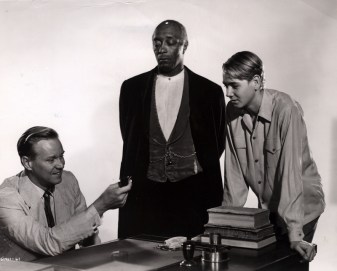
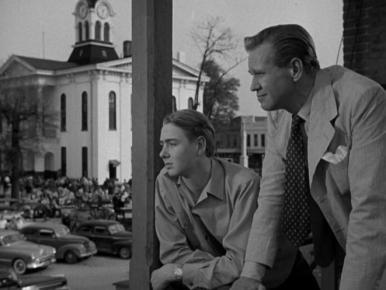
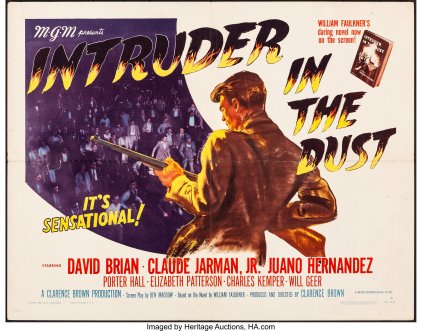
    Justice is the truth, and the truth is the satisfaction of reason. Reason complements emotions triggered by the sense and guides a man to a purposeful action as a beacon of judgment. What motivates the teenage boy Chick Mallison and the lawyer John Gavin Stevens to help Lucas Beauchamp, a respectful and affluent black farmer, accused of killing a white man, is the desire for finding justice, the truth. “Intruder in the Dust” (1949), directed by Clarence Brown, shows that the search for truth excels in the infirmities of whimsical human characters based on William Faulkner’s selfsame novel published to a wide acclaim a year before.


    Shot in black and white, the thematic of truth in the darkness of ignorance blinded by racial prejudice manifests itself in the transparency of facial expressions of the characters like ancient Greek theatrical masks to magnify the emotions and feelings of performers on stage. Lucas (played by Juano Hernandez) is laconic like an old Spartan. Still, his a few words carry the authenticity of truth, emphasized by his dignified aura surrounding the natural, confident being that commands attention to himself. As Shakespeare’s adage of true nobility as being exempt from fear, Lucas counteracts the mob psychology driven by the vacuously temerarious inquisition of popular sentiment in poised stoicism pleading for truth, not feelings.

    Three stars in intruder

    The subject of humanity is likely to be invoked for the anodyne ingredient to resolve the racial tension. Still, Falkner’s “good” white folks are more driven by a curious concoction of investigative natures, intelligent propensities, and occupational instincts blended well in the egoistic sense of fulfillment wonderfully producing a diamond of truth as though it were a wondrous alchemical process. The teenage Chick (played by Claude Jarman Jr.) and Lucas’s lawyer John Gavin Stevens (played by David Brian) are conscientious and principled, with whom we can refer to “good” white folk. Still, they are not entirely free from their prejudices about the colored, especially the blacks. Even Chick becomes indignant and intentionally drops the money when Lucas declines it from him as a token of gratitude and orders him to pick it up. The lawyer Stevens is neither particularly jovial with his client in the way he would be with his white client. However, both Chick and Stevens intend to descry the truth behind the machination of unreason that rains on the minds of the white people in the town because they are inherently good, even though they are biased. They are good people because their reason prevails upon unreason, and their search for truth outshines their prejudice. It’s what matters to the justice and life of Lucas, the black man who is not necessarily a chum of theirs.

    intruder-ending

    “Intruder in the Dust” may be parallel to “Who Killed a Mockingbird?” because of its similar subject and genre of the film, let alone their original novels that were written by southern writers. But what gives to “Intruder in the Dust” is its sense of realism in the likeness of truth. I find the characters in “Intruder in the Dust” more ordinary, more plausible, and more human. This film delineates a congress of human characters amid a universe of varied emotions and a sea of dangerous adventures, which illustrates both the never-ending dilemma and possible solution. The stellar performance of the excellent cast orchestrated by the astute director based on an excellent textual basis by William Faulkner culminates in this American Classic Masterpiece Film.

  • ‘Let Me In (2010)’, by Director Matt Reeves – review

    71wrP9sh2IL._RI_SX300_Love is really everything except what it is.  In the moments of violent delights of the ecstasy, it creates synchronicity of the two minds by surrendering to each other and becomes inseparable from one another. Whether it is erotic or agapeic, everyone regardless of any biological, social, or existential plane deserves this sweet surrender of love. George Sand, the French novelist whose love story with Frederic Chopin is better than a fiction, affirms: “Everyone deserves to love and be loved.” That is everyone, even if that one is a vampire or a misfit.

    “Let Me In” directed by Matt Reeves is a story about this love based upon his Shakespearean interpretation of ‘Love”. It is about friendship that develops into love because the word “Friend” is derived from a Proto-Germanic word “fraendi,” meaning “lover.” As it is a recurring theme of William Shakespeare’s plays, the meaning of friend and love is interchangeably conveyed on screen by the cinematographic recounting of the fateful love in the veneer of friendship between the two main characters, Owen and Abby, who are bound by loneliness and heartaches. In fact, the story of these two very young characters will conjure up the very young figures of lovelorn Romeo and Juliet by the side of the screen lurking in the corner eager to deliver their legacy of love that means to be forever beyond River of Styx. The only difference is that Abby, who is a vampire, never tells her love, but her concealment feeds on her crimson lips by devouring other people’s lives. She only sees Owen, the sensitive boy with a beautiful heart, for none other than a woman’s reason. Abby pines in thought, and with a red and gray melancholy, she watches Owen like Patience on a tree, smiling at grief for what she is.

    There is an original Swedish version of this selfsame film, but this Reeves’ version is more intelligently rendered and is hauntingly riveting with its surrealistic imagery and the stellar performance of the cast beautifully alloyed in the alluring alchemy of cinematography. It is an innovative synthesis of  artistic European neo-realism and a burst of the American no-nonsense realistic pep in the straightforward screenplay. This is a kind of film that makes you walk on the borderline of fantasy and reality, revolt and conformity, fear and courage, and doubt and trust, all of which will make you long for everything that love can come by. Forget Fear. This film is at its most compelling when you follow it with your open mind and let it in.