Tag: mythology

  • Moonstruck

    50A0D646-5D03-461B-847D-1C7F89A49D77

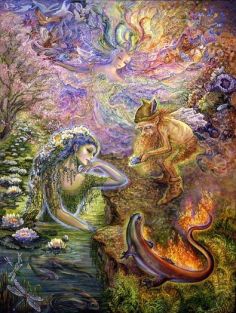
    Up in the misty airy mountain yonder

    Where trees and flowers never wither

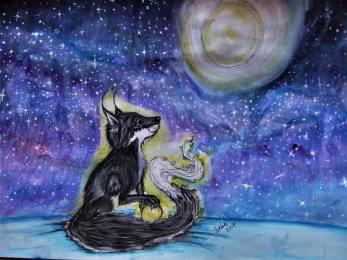
    The lunar beauty comes upon her

    and covers her with a veil of silver

    with a wreath of stars on her hair

    In the luster of amaranthine glamor;


    Then her eyes gather light and fire

    Burning with felicity, rapture, or desire

    Like a condensed colossal meteor

    Wrapped in mystic eternal camphor

    in serene brilliance of Moon’s Sphere

    growing bright and glowing brighter;


    Nymphs and fairies weave into the ether

    The melodies of Aeolian harps sweeter

    Softer than the milky way’s gossamer

    Allaying the wild untamed waves of dander –

    Her heart entranced with elevated Passion

    Forgetting the nobility of exalted Reason.


    P.S.: Fairie-tale is a fantastic means of translating an Author’s inmost feelings, deep-set emotions, and solipsistic philosophy smothered under the necessity of fulfilling demands placed upon daily tasks in existential life in the safest and, therefore, the most eloquent fashion the Author can rely on. As Edmund Spencer, William Shakespeare, William Wordsworth, and John Keats all used faeries as their faithful and wonderful subjects of their imaginative kingdoms, so do I take the liberty of doing the same as a way of escapism to the Otherworld where I can become all I want to morph into and enjoy what I covet without a moral qualm in the reign of religiosity. Here the subject of the poem is a maiden desiring of beauty which she believes to have been forfeited or deprived of by the callously whimsical play with her fate by the supernatural powers-that-be on a lark. 
  • alchemist and four fairies

    all

    An old alchemist had assistants

    Of Craft from Titania’s Kingdom

    And they worked for him at nights

    in return for fairy food abloom.


    Salamander belched out a fire

    Under the tripod holding a beaker

    In shrill forever fiery yellow ire

    that grew hotter and madder;


    Until Undine’s Purified Water

    From the well of Fairy Realm

    Boiled and bubbled in the beaker

    She watched with pensive calm;


    As Gnome put a sorcerer’s stone

    As black as the Stygian River

    From the bottom of Earth alone

    Into the Water like a wise thinker;


    While Sylph was breathing Air

    Into the Earth joined with the Water

    And the Fire in the Craft of Wonder

    Creating Gold and Elixir in Splendor.


    P.S.: The fundamental personality types are sanguine – red (hopeful), choleric-yellow (ireful), melancholic -black (shy), and phlegmatic -blue (calm). In fairy-tale theory, the following fairies represent the four elements: Sylphs – air (red), Salamanders – fire (yellow), Gnomes -earth (black), and Undines – water (blue) . Hence this poem is an amalgam of the aforesaid theories conjured up in my mind’s eye.

  • on the labyrinth

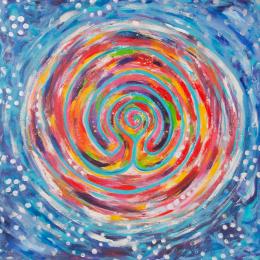
    1-rainbow-labyrinth-lucy-h-pearce

    The labyrinth has two natures: Beauty and Chaos

    Concealed in its untrodden paths of dazzling mysteries:

    Light and dark, birth and death, mastery and terror

    All curled in wreaths of coiled bewilderment in alterations

    Encircled in the visceral entrails of  great serpentine

    Paths that allure you with a riveting promise of delights

    From erotic games of licentious pursuits of pleasure hunts.

    Lo! Somewhere in the corners of paths hides a blue marble

    That promises you magical power of all that you want to be

    Immersed in the deepest bottom of your secret bleeding heart

    Wrapped up in the divine power of the magical beauty, 

    Which is the messier, the prettier, the madder, the better. 


    P.S.: The inspiration for this poem comes from the Greek mythology of the Labyrinth. The story, pattern, and design fascinate me and evoke a wide arc of thousands of imaginations. Riveting. 

  • Spellbound

    il_fullxfull.1256037986_tho4

    When they got to a ranch below Santo Christo Mountain, the golden chariot of Apollo was about to finish its daily race in the sky hippodrome, making a way for the staging of the nocturnal goddesses in Moon and Evening Star dresses. The earth was changing its mood from vivaciousness of a pretty young starlet to sensuousness of a beautiful mature actress with sultry duskiness of impending sunset. The wild plain looked as if it were waiting for the sensual pleasure that the goddesses would bring to the rough and tough arms of the ruggedly handsome wilderness for their nightly play of love when the celestial blanket of Uranos, the god of the sky, softly covered the body of Gaia, the goddess of the earth, to ravish her divine being all night long. As a constellation of stars was starting to appear in the heavenly vault, the tribe of adventure was also starting to call it a day’s journey and hurrying their horses to the gate of the ranch. They were all hungry and tired, but the spirits were still resisting saying good night to the world. What they really wanted at that time was a sumptuous repast, consisting of fresh fruits, hot meals, and warm bread with butter and jams. Soup and drinks would complete the repast if the host would turn out to be a generous one. Raphael, who was the hungriest of all, knocked on the door and waited for a welcome response. A high hope for blissful heaven, indeed.

    “I am coming!” answered the voice from the other side of the door with the playfulness of an adultescent grown man, which might sound impish to the quiet ears of those who fiercely protective of privacy. That’s how it sounded to Judy and her canine companion Nena who started barking as the footsteps from the other side were coming closer to the wandering tribe. Looking at Nena incredulously, Judy began to feel nervous about who would open the door because Judy had an acute sense of detecting any sign of supernatural and natural beings from this world and the world beyond; it was an uncanny ability that she inherited from her also unusual mother estranged from her own family for the unreasonable reason. For they had persecuted her for being a witch, condemned to eternal damnation, because it was against their Catholicism they believed in a medieval fashion, and even put her in a mental ward for being crazy. Yet Judy knew that her mother was from a long and mysterious line of ancient sibyls existent in all cultures even before the birth of Christ and believed that the reason she and her mother had been born into such scurrilous, Scythian family of hypocrites was a mysterious reason she had to figure out by herself. And she believed that this adventure with the offbeat trio was part of this mystery. What’s more, the irritably vivacious man’s voice from the inside must be a tessera that the Fates had intentionally put in an inscrutable puzzle that had challenged Judy to solve – all alone.

    The wooden door was opened when Judy fell into the moments of mental vertigo, and there appeared a tall, good-looking man with blond hair and very pale blue eyes that sparkled even in darkness like the fluorescent lights on the deck of Flying Dutchman. Judy was properly aghast at the extraordinary sight of the beauty and instantly forgot all, including Rufus, Ben, and Raphael who were not as surprised as the lass by the sight the comely fella. But Nena was still barking at him more fiercely than before as if the man had been a malevolent spirit in a handsome actor’s hide. Nena was barking harder and longer as though to wake up Judy from a portent evil spell. The beautiful man, the mysterious owner of the ranch, looked at the scene in silence and smiled at them like a spectator of an amateur comedy on stage. The night was still very young.

  • The Poesie by Titan: poetry in painting


    images
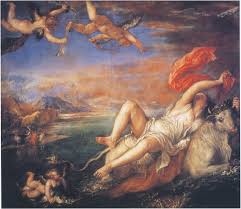
    Europa by Titan

    Although art is territorial, it’s never divisional; it crosses over the branches of art and begets a hybrid of wondrous beauty that spreads through the mind of the beholder and lingers there in alterations, evoking an arch of endless imaginations and a well of inspirations, appealing to our human faculty that is rather physical than metaphysical, sensual than intellectual. It’s a mating of the Senses, a marriage of Reasons perfected in letters or paintings, all in the mastery of stories, colors, and forms begotten by divine madness of artists copulating with a sensation of the flesh in putting a method of expression to its love bed of paper or canvas. Such a love child of arts results in Titan’s riveting masterpiece the ‘Poesie.’

    Titan (1488-1576), one of the most celebrated artists of the Italian Renaissance, created the ‘Poesie,’ a cycle of 6 mythological paintings inspired by Ovid’s ‘the Metamorphoses,’ stories about famous mythological figures in poetry, which was the very reason that Titan chose it as his subjects. Originally commissioned by Phillip II, the life-sized portrait of whose father Emperor Charles V catapulted Titan to stardom in European courts, the ‘Poesie’ gave him the artistic freedom to experiment with different styles of painting incorporating secular subjects that attracted the welcome attention of intellectually ambitious aristocrats. The ‘Poesie,’ meaning poetry in French, is a hexaptych of human emotions expressed in mythological figures that are all too familiar and universal common to all human creatures. It displays the vagaries of human emotions, ranging from euphoria to anguish, passion to regret, and greed to pain, all the artistry in each of the paintings. Titan wanted to create the visual equivalent of the poetry in which Venus burning in passion for her young object of desire Adonis, Europa ravished by Zeus in a bull’s hide, Actaeon chancing upon Diana’s bath and other divine and mortal beings, such as Danae, Perseus, Andromeda, and Calisto intermingled in sensual pursuits were to be translated by strokes of a brush, plays of colors, and dramas of human feelings and emotions. In fact, it is this Titan’s talent both as a storyteller and a painter that sets him apart from his contemporaries and renders the work immortally enshrined in the atrium of universal arts.

    The ‘Poesie’ is currently on display in London’s National Gallery exhibition for the first time in over 4 centuries, following an example of Vatican’s concomitant display of Raphael’s tapestries at the Sistine Chapel. Notwithstanding the thematic and geographic differences, the works of the masters delight the eyes of ours as harbingers of art as artifacts of human civilization consisting of the standard of taste and reason universal in all human creatures as regards the principles of judgment and sentiment common to the eyes and minds of all mankind.

  • fortune’s compass

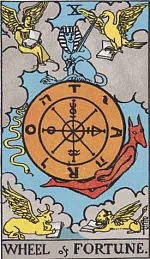
    150px-RWS_Tarot_10_Wheel_of_Fortune

    Her eyes are blindfolded, her hands are rapid

    In a paroxysm of wild ecstasy at the Great Rotary,

    Spinning it around and around like a delirious maenad,

    Changing the positions of the compass willy-nilly,

    Bringing tears and sorrows, beams and windfalls

    To the names of the stars the compass indicates

    till the stars above fall, the earth below collapses

    and her game of fortune the god of gods terminates.

    Author’s Note: This self-evident poem is about the Wheel of Fortune, a popular medieval folk belief that human lives are governed by the whims and caprice of Goddess Fortuna. She is said to spin the wheel at random, blindfolded, by which human fates are decided despite our efforts through constant trials and errors. It may sound bleak and fatalistic, but it also means that it’s not our faults to go through the ordeals of life, but that such is our fates, a force majaeur circumstance beyond our mortal controls, that we have to endure with stoic attitudes toward the vicissitudes of life. It is also a way of positive outlook on life because by attributing the ups and downs of life to the force of fates, we don’t jeopardize our self-worth and thus blame ourselves.