Tag: Poetry

  • When cranes dance

    Kranich-Tanz_Bruno_Dittrich

    Their wings fluttering gracefully by the lake

    Guarded by dryads, naiads, elves, and dwarfs

    Shimmering iridescently in midnight moonlight,

    The ancient birds dance along the borderlines

    between mythology and history, hither and thither

    Till daybreak and fly away beyond the Misty Arc.

    P.S. Elsewhere in the world, people have believed that cranes dance at night when no mortals are around to transform themselves into human forms; then they choreograph their courtship, wooing and wooed. Mysterious and ancient, a crane is a bird of the misty past, of the uncertain present, and of the unknown future. Its regal poise makes wherever it stays a heavenly palace and entrances me into the whirlwind of Magic and Myth. 

    저장

  • The Fall of the Unicorn

    Hunter and hunted, quiet and questing,
    Tamed and wild, chaste and insatiable,
    It’s man and woman at its will shifting
    Its nature but the beauty still admirable
    As the Unicorn fell from a noble creature
    To a profane beast with Death of Adventure.

    P.S. The divinity of the unicorn suddenly declined during the Renaissance period (14th~16th centuries) and like Lucifer, the Fallen Angel, it became a symbol of bacchanalian debauchery associated with lust and a harbinger of moral corruption. Even J.K. Rowling’s unicorn is devious and ghoulish, which is antithetical to my perception of unicorn as a divinely beautiful being evoking a wide arc of imaginations in my mind’s eye that has become sore to the dreary sights of the existential vertigo I sometimes stumble into.

  • Eros and Psyche: Sweet Sublimation

    M-17-343x450

    His love was fixed but unsought
    By the ostentation of Eros’s Play,
    The casual making-love façade
    With no precondition of the soul;
    But that which it consummates
    Is a union of the two existences
    Of Body and Soul, the sovereign
    Surrender of the self to the beloved
    Becoming a whole, an ensemble
    metastasizing  “I” lovingly, willingly
    Directed toward “Thou” entirely
    In trust of one another wholeheartedly
    making him of her and her of him magically.

    P.S.: A short essay called “A Courtship of Twenty Years” by John Stuart Mill (1806-73) reveals his infatuation with his friend’s wife, who eventually became his wife. It’s a rhapsody of his admiration of everything about her, her moral character, intellectual gifts, and graceful beauty. This secret affair of the heart is not, however, tinged with a lascivious desire for his friend’s wife thanks to his elucidation of her virtues that benefited him to become wiser and more wholesome; his love for her is a sublimation of the ego, which was capable of integrating the sexuality of the id into the personality. Nowadays reductionism is responsible for interpreting love as a mere sublimation of sex and conscience merely in terms of the superego. But love is the precondition of sex, not the result of the sublimation thereof. What might have been his physical attraction to her at the inception of his love affair was elevated to the actuality of Love, the wholeness of Eros (Body) and Psyche (Soul), which is the essence of love between the lovers. 

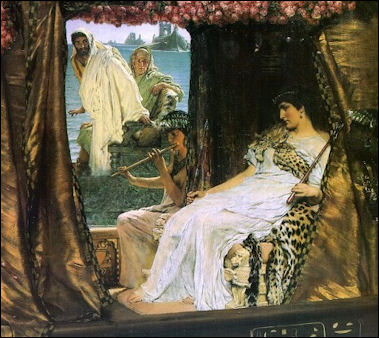
  • She bewitches Marc Anthony

    20120219-Antony_and_Cleopatra Lawrence_Alma-Tadema_

    All about her beggared all description,
    For she was none other than herself
    Femininity incarnate vested in erudition
    That no other woman could ever excel.

    Her beauty was a perfect federation of
    Sensuality and Intelligence dazzlingly
    Pleasingly enchanting all in the contact
    With the Last Hellenistic Queen of the Nile.

    One day, she rode in a gilded barge with sails
    Dressed as Venus with her entourage as cupids
    And nymphs to meet a Roman general who was
    Marc Anthony with untamed virility like Hercules.

    For her own person as Venus, the goddess of love
    And beauty, she bewitched the general and made
    Him her slave of love with all her charms spelled
    With the most delightful voice he had ever heard.

    AUTHOR’S NOTE: Last night, I read an anecdote of how Cleopatra encountered Marc Anthony for the first time as described by Plutarch in The Lives. The most interesting thing I learned about the proverbially seductive queen was that she was not exactly a gorgeous woman with a face that would launch a thousand ships. Rather it was her demonstration of all-around erudition, intelligence of speaking a variety of languages in such an euphonious voice, and her general demeanor, all of which curiously made her enchanting to anyone in contact with her.

    This irresistible charm of Cleopatra corresponds to the principles of aestheticism expounded by Thomas Aquinas, which are: (1) Element of being – her existence as a woman; (2) Actuality of Form –  her presence as a woman achieved a higher level of perfection in its form by being beautiful to the degree in which she perfectly attended to the form of femininity; and (3)  Actuality of Action – the manifestation of her intelligence contributed to the perfection of her beauty as regards the aforesaid principles by grounding beauty in whatever she did, thus making her being a beautiful person.

    I think Cleopatra was more beautiful and real femme fatale than Helen of Troy, who was said to have a face that launched a thousand ships. It seems to me that Cleopatra’s attractiveness will be no less appealing to the eyes of the modern men than those of the ancient men. 

  • Passing over

    01a14x14ChildeHassamWomanReadingdetail

    Divine Pleasure of Reading travels
    To the world of imaginations
    Perceived by the eye that decodes
    Words thru a rapid firing of cells
    At the behest of the frontal lobe
    Mustering the neuronal minions
    To the seat of the noble spirit of
    Feelings breathing life into letters
    Linking to the sovereign experiences
    With the intellectual flexibility to the
    Fore to prepare your soul to pass over
    To the beyond and the far beyond thither
    In a brand new mind evolving evermore.

    • AUTHOR’S FOOTNOTE:  “Passing over” as used herein is interpreted as immersing yourself in the world of a book you are reading or you have read by identifying yourself with the characters and/or the authors. The term was coined by the late American Roman Catholic priest and theologian John S. Dunne (1929-2013). He referred it to a spiritual experience of entering into the psyches of others and building empathy with them in order to understand their woes, travails, and frailties. This simple but profound concept of spiritual togetherness is wonderfully cogently  applied to the principles and development of our reading brain as the apotheosis of why we read in Proust and the Squid by Dr. Maryanne Wolf. Hence this seemingly riddle-like poem of mine reflects a meaning of reading that depicts a reading process starting from the sensory perception of texts to decoding the perceived texts through reptinotophic organization in neuronal circuits, and to the understanding of the texts in our brain, the final destination to get ready for a journey into the minds of others. 
  • Practical Poet

    01279

    Beauty is a Nature’s Ecstasy,
    Calming tempest of chaos,
    Lighting the lamps of the eyes
    Of all to whom it appears in bareness
    With tender and thrilling tensity.