I remember the first time I saw Renoir’s painting, “Girls at the Piano,” hung on a restaurant wall when I was a first-grader in elementary school. I loved the vibrant warmth of the colors and the softness of the girls’ expressions. Since then, Pierre-Auguste Renoir (1841-1919) has become one of my favorite painters. Given that preference, my reading of this book about the master was long overdue. Still, I am pleased to learn that Renoir was what I had imagined him to be – a creator of art whose eyes are set on the stars and foot grounded on earth.
Renoir was a master of the French Impressionism troika led by Claude Monet and Camille Pissarro, pioneering a new painting style as the epoch needed a new cultural ethos for the upcoming new century. Although the masters of French Impressionism were on the same musical note, their timbres were various. While Monet and Pissarro were idiosyncratic and liberal in techniques and subject figures of their artistic creations, Renoir was a conservative in keeping a tradition of Paul Rubens in his celebration of feminine beauty surrounded by the realism of nature and life.
A pursuer of the natural and ideal beauty existing in the physical world, not the spheres of the heavens, Renoir used the ideal to perfect the real, adapting traditional techniques to his visions of the worlds conjured in his mind’s eye. Renoir’s fascination with sensuous beauty in the expression of vivid but soft hues of vibrant colors and rounded, smooth figures of models in his paintings show his unintentional application of Aristotelian aesthetic theory: beauty inherent in itself and beauty by its use. Renoir’s paintings are replete with the beautiful colors, the warmth of the ambiance, pleasantness of the moment, and equilibrium of the backgrounds, all the mastery of using the ordinary with a profound sense to elevate it to art, giving art its true meaning. That might be a reason why German composer Richard Wagner, the creator of “Nibelungen’s Ring,” chose Renoir among other famous painters of the time to produce his portraiture. Or perhaps it was why Americans first found Renoir’s paintings so appealing that the goring sales in America brought Renoir fame and wealth.
After reading this elegant biography of Renoir, I liked him even more because he was an artist who had an artistic vein of genius and a practical sense of responsibility. He was a devoted father who even took care of his illegitimate daughter from his first girlfriend before marrying his model wife Aline Chariot, from whom he kept it a secret for life. Renoir might have had preconceptions about specific beliefs and people, but who would not have them secretly hidden in their mind’s closet? I believe that art serves its purpose when it gives the beholder a delightful sensation, not a dangerous illusion of distorted reality drawn from an artist’s disillusioned mind. Now I have a replica of Renoir’s “Two Girls at the Piano” from Amazon posted on my bedroom wall. It still has the first impression of the painting that has stayed in my heart with delightful nostalgia, enveloping me in the longing for the bidding the time’s return, which only Renoir could do the magic.
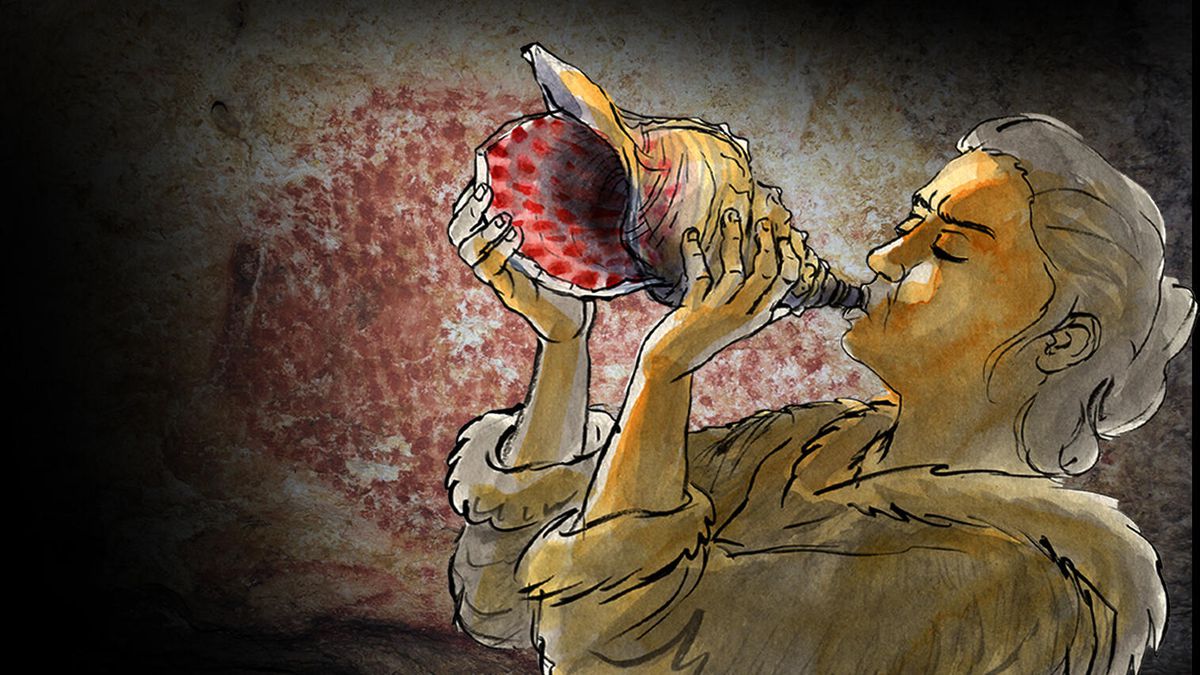
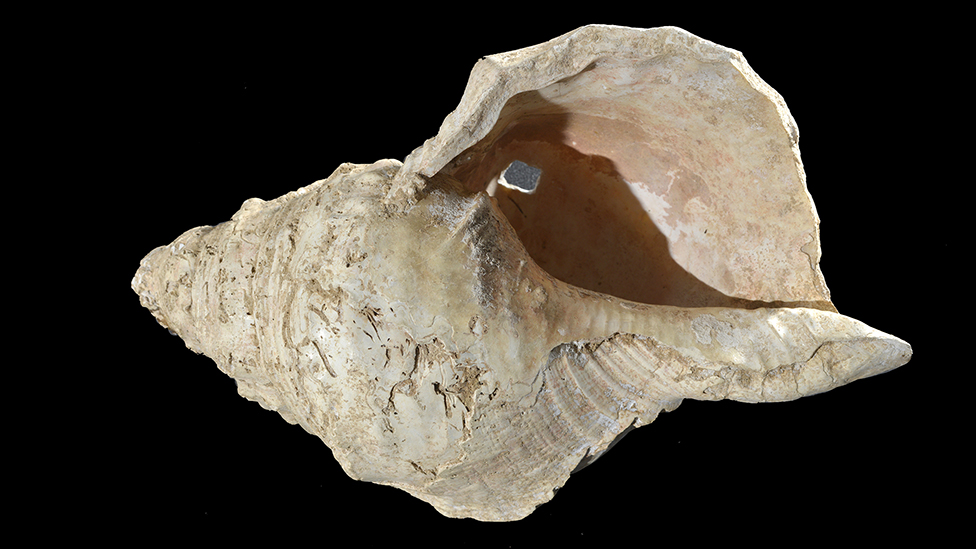
A team of scholars has recently reexamined a conch horn discovered around the Marsoulas Cave in southern France, the famous cave art site, and concluded that the conch was more than just an ornamental artifact used for a drinking vessel or any other trivial purpose in Upper Paleolithic Age, aka Old Stone Age, dating from around 17,000 to 12,000 years ago. It was an age when Cro-Magnons, a Homo Sapiens nomadic tribe in western Europe, emerged as formidable hunter-gatherers of reindeers and horses from a new cold and gray prehistoric horizon in the dawn of the ages of man. They were Magdalenian, named after a rock shelter located in the French Pyrenees where the artifacts and human remains were discovered. They left the prehistoric legacy in the form of the Magdalenian conch.
By using a carbon dating system and other state-of-art scientific apparatuses, the scholars posited that the conch horn was a musical instrument to enjoy the prehistoric Magdalenian symphony in the cave. The cause of reason for the hypothesis is a purposefully cut-off apex of the conch horn as if to adjust for blowing and making sounds. In fact, a modern music player tried playing it at its initial discovery and found out that the tunes were ranged close to the notes of C, C Sharp, and D, making it the oldest wind instrument of its kind to this date. Moreover, the conch patterns were similar to those appearing in the pictures of cave walls, which scholars deduced that they were significant in denoting cultural functions in the communes.
However, although the connections between the cave art and the conch horn are intelligent hypotheses, the idea of the conch as a musical instrument doesn’t quite hold water to me. First of all, the image of a conch horn always conjures up the dystopian vision of the boys in William Golding’s Lord of the Flies. In the story, boys blow the conch whenever they convoke meetings, which usually spring from sinister motives resulting in gloomy consequences. Also, the god of sea Poseidon blows a conch when he heralds his formidable divine presence, shaking the waves of the oceans. The use of the conch was to be more of notification of alarm for political or social events, not of a musical instrument for cultural appreciation. Besides, as aforesaid, a conch is often associated with the sea, unfittingly matched with hunter-gatherers in the mountain or sea-locked regions. Although scholars pointed out that the Magdalenian could travel to the shore and brought a conch as a souvenir, using it as a pastime wind instrument is a bit of stretch, a romantic imagination about the cave people differentiated from ruthless, animalistic, highly advanced kinds of ape.
If the scholars’ educated guess becomes a theory, then the Magdalenian conch horn will be entitled to the first place in the history of musical instruments. But considering the geographical reason and natural tendency related to a conch shell drawn upon historical and literary contexts, the Magdalenian conch shell must have been either a curiously collected souvenir from a trip to the shore or a valuable instrument to call upon meetings in the communes. Also, it could have been a convenient alarm to indicate a sight of animals for a hunt or protection. For melodious variations pleasing even to uncultured ears, the sounds of strings made from the leftovers of hunted animals hung on pieces of wood would be perfect for their hunter-gatherer entertainment.
A paragon of femme fatale with a name meaning Eye of Dawn in Indonesian, Mata Hari has become an unlikely figure of feminism that elevates a famous courtesan into a tragic martyr against male chauvinism. Some even have turned Europe’s first-class exotic dancer into an innovative artist, surpassing the great French-American creative dancer Isadora Duncan. Although Mata Hari expressed her unbridled erotic charge on the influential men in an era when the ideal victorian femininity still reigned in the social consciousness, she was hardly any more creative to the art of dance than Isadora Duncan and less manipulative than Delilah. This concise bioptic narrative about Mata Hari leaves the image of her open to creation on the reader’s perception of her.
Before her rebirth as Mata Hari, Margaretha Geertruida MacLeod was a divorcee from a Scottish-born dutch army officer. Her divorce from her husband was a ticket to her freedom from conventional womanhood whose place was home, tending her family and domestic affairs. Mata Hari used her womanly prowess tinkered with an exotically alluring atmosphere surrounding the sultry appearance that she used for the glamorous life. While reading the book, I found Mata Hari hard to sympathize with her, commiserate with her when she was hoodwinked by the men she fluttered with, and she believed to fall in love with. A life of courtesan she was leading was dangerous and ephemeral, and she didn’t seem to bother making her livelihood without toiling her hands into specks of dirt, as most of the poor women in her time had to earn a living.
It is not to say that her wayward lifestyle was meted with her unjust execution, which conspired to use her as a political and diplomatic scapegoat during World War One. She was an easy target to put all the misdeeds of the men involved with her and the faux-pas they wanted to conceal in consideration of her reputation as a persona non-grata with a questionable reputation. The trial of Mata Hari was nothing but a Kangaroo court procedure that only showcased the famed woman under an international spotlight behind which the real culprits of the espionage were hiding. However, her trust in beauty as a sexual prowess over men should not be confused with a woman’s symbol of an unyielding independent spirit under the pretext of being a divorcee without long-term financial security. The spirit of womanhood that evokes a feeling of camaraderie lacks in the figure of Mata Hari.
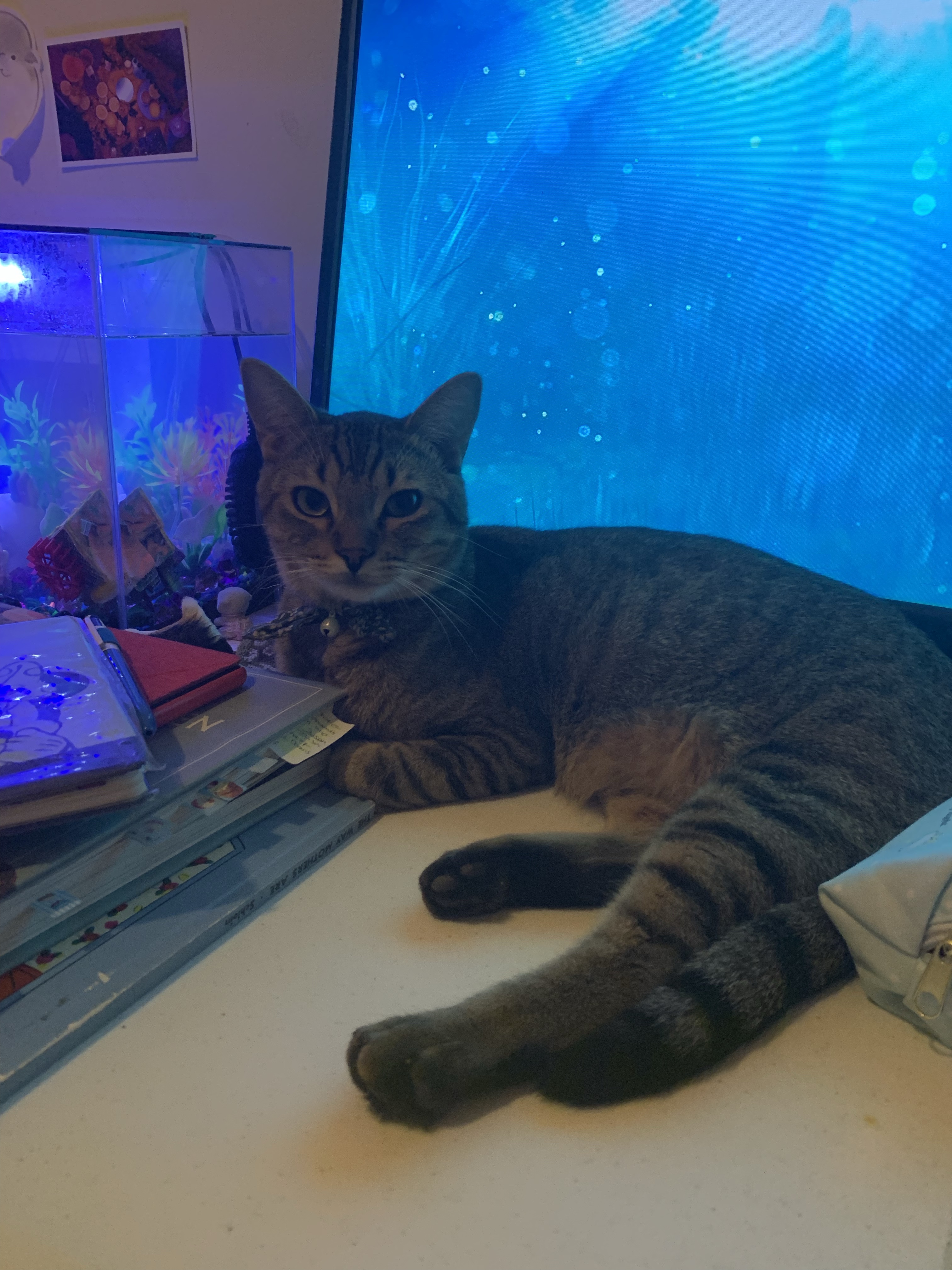
When my eleven-months old cat Toro started drooling in white foams last Wednesday evening after swallowing a tiny flying insect in my bedroom, I was in a panic. I called nearby emergencies, describing the state Toro was in, but they told me his symptoms were not regarded as critical. Instead, they told me to monitor him, so I did. He stopped drooling the next day and drank a lot of water. Nevertheless, my concern was still growing, doubled with regret that Toro should have met an owner in a vast, spacious home with that which would make him happy. The pang of grief punctuated my already broken heart, and I was distraught.
“I am not feeling very well.”
Luckily, a vet to whom I had previously taken Toro for his difficulty in excreting in Little Tokyo said she could see Toro on Saturday morning. The waiting period until the appointment was an ordeal by the torture of the heart. My spirit was sunk in a sea of sadness, blaming myself for not providing Toro the optimum environment to thrive in his best feline nature. The bedroom is so tiny that it is more of a den, and the living room where my elderly infirm mother spends most of the day intermittently is off-limit to Toro by keeping him alone during the day when I am working. My evening playing with him might probably bore him to death because my lack of creativity fails to invent more stimulating kinds of play that will perk up his energy. I cannot help but think that I am becoming a bane of Toro’s existence, the cause of his unhappiness.
Pre-idopathic cytitis diagnosis time when Toro liked me
To pour lead on my open wound in the heart, when I finally took Toro to the vet on Saturday, she diagnosed him with idiopathic cystitis. She showed me a scanned copy of Toro’s mildly swollen bladders with information on the illness caused by stress. That’s it. The diagnosis realized my imagination and shattered a slim hope of something other than STRESS. I see all the cares I had given to Toro as best as I could beyond my measure by taking him to vets and telling him how much I loved him as much as I could dissipate into the elusive dreams of my little happiness with Toro. My happy moments with Toro vanished into yesterdays, bidding farewells to tomorrows.
“More exciting play!”
It’s been a week since the diagnosis, and now Toro has changed. Toro now hides under the bed, doesn’t come up to my bed, and avoids me when I am home. Besides, he doesn’t eat as much as he used to, about which the vet told me to be patient because that could be the effect of changing his prescriptive diet from gastrointestinal to urinary care. What is strange about his sudden change of behaviors is that he was never like this from his previous visits to vets. Come what may, Toro seems to be unhappy, and I am very downtrodden for his changed behavior. He was the only one who showed me his affection.
Toro in his whimsical mood for playing
I still remember his adorable, curious big eyes peeping out of an opening from a box carrier when I brought him from Ventura Animal Shelter last August at the age of nine weeks. Purring and kneading are long gone. My reason suggests that re-homing Toro is the best I can do for his happiness, yet my heart tells me not to listen to it and look for another place for a better living environment. Nevertheless, I yield to my heart’s voice and want to believe that there is still hope for us to be happy in a better living condition. I hope to see mirth wonton around us and happiness sparkle before our very eyes soon.
Like muffled drums in rains of thunder and lightening, her heart was still beating as the intuitive leap within her was on the verge of falling into the crevice of darkness. She hoped that life would be better or that if life wasn’t unresponsive to her hope, she could seek an elbow room in her writings blog, her glass castle of the soul. In this regard, her purpose of writing and that of George Orwell agreed that it was for sheer egoism of being an individual and recognizing it. For all she had read and seen, her spirit wanted to record it in writing before leaving the world without a trace. How pathetic it would be!
If only. The girl hoped to articulate her thoughts to the unseen public somewhere out there. But above all, the girl used her writing practice as an autodidactic exercise to improve writing skills in the language she fell for. She loved the English language so much that she was ready to forsake the native language if she must choose one. She would have wished to possess the art of English Writing if a benign fairy had asked about what gift she would want. Perhaps she would have made a Mephistolean pact for the craft. Yet her love was alone because she loved the language more than it reciprocated the appreciation to her. How cruel it was!
To pure lead into an open wound, the girl realized her brain was not as alert as it used to be in the locomotive of thinking. As thoughts shape language, she reasoned that a slowly deteriorating neuroplasticity in her brain might have contributed to her difficulty in reading and writing. Something ominous was happening to her, and it was gripping her spirit under its diabolic aegis for the sheer pleasure of tormenting the soul in hopelessness. Words she saw refused to make a coherently complete sentence and enter a faculty of thinking. The circuits to the control center of the brain felt blogged or damaged to the point of making telegraphic phrases swiveling at a vortex of frustration. It had never happened until last year. But why was it happening to her? Alas!
She tried to find reasons for the ghastly maladies and self-diagnosed the following:
Moving to California
Demanding nature of her roles and tasks at the workplace
Attending her elderly mother
Approaching her end with no security for future
She further decided that the existential frustrations were exhausting her will to essay her creative and experiential values in fulfilling her meaning of life to be expressed in writing. All of it was tantamount to the enormous boulder Sisyphus had to roll up on a steep hill in Hades as punishment for his trickery on gods. But the girl was more akin to a Caryatid, a sculptured female figure used as a pillar supporting an entablature of a building on her head.
But what then was her solution to untangle the web of the menacing spider? She had nothing but her will and resilience born of eruditeness and level-headiness. It helped her sail through some of the difficult adventures between the Scylla and Charybdis in her life’s odyssey. Like an earthling who never gives up hope on getting a signal from an extraterrestrial being via radio transmission, every day, she would write even if it would receive no response. Thereby hangs a tale told by a mad girl in hopeless love with words, full of words and madness, but signifying something.









You must be logged in to post a comment.