Tag: reviews

  • French Dinner, Lords’ Supper

    IMG_3985
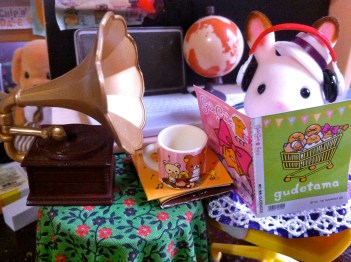
    Getting ready for the dinner

    Nice Christmas office dinners are all alike. Any not-so-nice Christmas office dinner is boring in its own fashion. It all depends on a venue and invitees, and a host of the occasion that create an ambiance and conjure up a spirit of the minor revelry. That said, this Christmas office dinner Seraphina attended last night was a nice and delicious revelation of characters, personalities, and tastes served with a fashionably delicious Haute cuisine at a fashionably cultural restaurant in downtown nearby the office. It was an unusual raillery of lawyers – the lords of the firm as Seraphina would like to think – whose stiffness seemed to be temporally suppressed by the intoxication of prime red wine. All of this became a valuable empirical addition to Seraphina’s quest for a meaning of her life, a voyage into the heart of the world, the terra incognita, charting her emotional course according to the winds of her unknown destiny.

    wp-1545534401344.jpg
    The course menu designed for the lords’ banquet

    The dinner began at La Boum, a new European fusion restaurant in town, at 6:30 PM. As Seraphina wended her direction toward the restaurant, she bethought herself of Somerset Maugham’s adage: “At a dinner party one should eat wisely but not too well, and talk well but not too wisely.” It was one of the best sagacious and elliptical advice on how to conduct oneself at such occasion, thought she. Or was it just a universal principle to be a civilized guest at a social event? It’s just that when such common sensible etiquette is uttered by a notable person like Maugham, it carries a tone of authority, power of significance. Come to think of it, the Little Prince in the eponymous novel by French aristocrat, writer, poet, and aviator Antone de Saint-Exupery thought the same when a Turkish astronomer dressed in the traditional costume presented himself at an academic convention, no one paid attention to him but belittled his outstanding scientific achievements. It was not until he changed his costume to a well-tailored suit that his fellow astronomers took him seriously and attended to his remarkable scientific contributions. Well, that’s one of the human foibles and follies that we all stumble upon no matter how educated and good-hearted we are, contemplated Seraphina, Lady Philosopher, as she was approaching near La Boum.

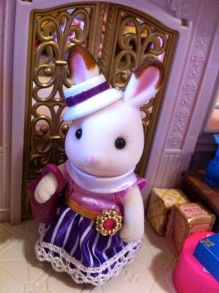
    IMG_4002
    The marvelous chef and proprietor of La Boum Monsieur Randy Beaver

    All the partners of the firm had already been expecting Seraphina’s elegant entrance into the restaurant. Always a principled, reliable, and capable assistant, Seraphina was their sine qua non, and they all could not exert their years of expertise on their areas of law, ranging from corporate to litigation, without her existence at the office. So they could not help but beam with smile at her beautiful presence into the dinner table that would have been rather drab and dreary without her graceful presence like Beatrice serving as Dante’s guide through Hell and Purgatory in Virgil’s Divine Comedy. So the course of dinner commenced with a glass of red wine made in 1986. It was amazing to see how just one sip of wine making a person agreeable and sociable quite contrary to his usual stiff and standoffish self. That might be the reason why Dionysus, the god of wine and anything relating to intoxicating spirits, was indiscriminately revered by all regardless of status, sex, and age in the antiquity. And the cult is still going strong all over the world.

    Amid the intoxicated euphoria under a glowing chandelier, Seraphina was observing the faces of the partners, the purveyors of her sustenance, her daily victuals, her existential livelihood. In the dusky glow, her minor and major bosses seemed full of amiable qualities. Seraphina liked their polished frankness, their intelligence, their sense of humor, their lack of snobbishness. Even the occasional moroseness and astuteness which sometimes were so like abrasiveness now seemed the natural sign of social ascendancy belonging to the station. They were lords of the world she now decided to care for, and they were ready to accept her only if she was willing to make it her primary world, not the secondhand, which had been that world she was now beginning to turn herself in. Or so it seemed at the moment. But one thing was certain that she felt within her a secret allegiance to their standards, an acceptance of the demands imposed upon her unavoidable obligations, a scornful pity for the people who would put their ideal ideas before existential needs and adhere to abstract abracadabra of metaphysical philosophy of life. Now she began to despise all such feckless rabbles, the starving intellectuals without the gumption, the proud egoists who put forward their own doctrines of life in which Seraphina would not want to find herself. Already she was beginning to feel like a new person at the denouement of the dinner. And her qualms about leaving for her imago bespoke a vestige of her abstract self that only lived in a textual world.

    porky

  • ‘The Rational Optimist’, by Matt Ridley -review

    The Rational Optimist (P.S.)The Rational Optimist by Matt Ridley

    My rating: 4 of 5 stars

    If you are anxious about when the sky will fall upon your head, you sure need to read this book that will awaken you from the ghastly trance  cast by populists who make living out of scaring people. The fallacy of popular pessimistic views on the impending end of the world resulting from overpopulation, a lack of food, or any other apocalyptic reasons befitting a doomsday scenario, arises out of sheer ignorance of the nature of the human progress and/or of willful negligence of acknowledging it so as to populate epidemic scare across the globe for sensational attention and personal gains on the part of the popular authors of such doomsday scenarios.

    This book by Matt Ridley is a fresh breath of air that gives people of the world a beacon of truth. Ridley asserts on the grounds of rational evidence and explanation that the progress of the human race within the historical times ranging from the ancient Greek/Roman times to the modern time has been made possible by collective human intelligence by which we exchange our ideas, skills, and knowledge in the form of specialized division of labor. This social collectivism, whether tacitly or unconsciously realized by doers, appertains to synchronicity, a kind of inter-brain entrainment in which information based on experience is exchanged between individuals, which is also known as collective phenomenon. This collective intelligence is a vital essence of cultural evolution which results from selection by imitation of successful institutions and habits. It is this element of cumulative culture that makes us singularly different from beasts. Since this social trait is innately pre-programmed in mankind, there is no inevitable end to specialization of efforts and talents that keeps this collective phenomenon going. In fact, more jobs will be produced in more specialized areas contrary to brooding premonition that technology will push out manpower from work.

    In sum, Ridley aims to enlighten readers about the necessities of changes as part of cultural evolution for the betterment of mankind and the world itself. In the human history, no other time period has produced the better living conditions and cultural developments than those we have now due to a continued cumulative cultural evolution, which links to the evolution of the origins by natural selection. This book renders me a feeling that how wasteful it would be fretting about the uncertain and dark future that looks darker by popular theories of dystopian economic and social future. Just as Ridley will remain a steadfast rational optimist, I will continue to perform demands imposed upon daily tasks of life as a contribution to the orderliness and constancy of the world just as my ancestors did because I know the world will not fall in calamity as long as we as a collective body of the human race exist.

  • The perfect Victorian wedding

    IMG_4047

    Marriage is an official commitment of love. A man and a woman tie the knot of conjugal relationship in which both of them promise to remain true blue till death do them apart. Call it anachronistic or incongruent or even antediluvian, but even in this era of the social media and reality entertainment, this traditional sense of marriage is still valid, complacently being moored to societal conventions and traditions. Well, anyway, it really doesn’t matter to Lady Seraphina, who remained maiden, still remains maiden, and will remain maiden, unless Aphrodite concocts the same kind of love-play on her as the one she did on Dido thousands years ago. But readers can rest assured because it is hardly ever so that Lady Seraphina will likely relinquish her maiden license which permits her to regale herself with romantic solitude as her sanctuary. She is above her class, she is above her sex, she is above her race. Seraphina belongs to her own class that resembles none other than itself. That’s probably why she stays unsullied by leering eyes of the undesirable.

    Notwithstanding the aforesaid account of Seraphina’s maiden ladyship, she does not eschew the subject of wedding if it involves historical anecdotes and interesting vignettes, such as the following facts about the Victorian wedding she came upon from her reading. Always a student of history, especially about everyday life of ordinary folks and eccentricities of aristocrats (the persons of Sandwich and Portland conjured up suddenly), Seraphina read about it with a kind of cheeky relish conflated with a social superiority that reminded her of her uniqueness on par with Pythia, Artemis, and Vestal Virgins. Anyway, the facts about the Victorian wedding were quite interesting to compare the bygone customs and norms with those of modern day (come to think of it, the “modern day” will be a bygone day in any time soon.) The following were what Seraphina learned from the read:

    • Selection of the perfect partner (so to speak): The right status and temperament were the elemental basis of a desirable husband. Love? Enough of it was believed to follow upon marriage, as St. John Rivers proposed to Jane Eyre whom he regarded as a suitable wife of a missionary in India, a female apostle. In fact, the creator of Jane Eyre Charlotte Bronte urged a friend to consider a proposal of marriage even if she felt disgusted for the man, so long as he had common sense, a good disposition, and a manageable temperament. However, crossing over the boundaries of classes was a rarity. It’s probably why a romance between Mr. Edward Rochester and Jane Eyre, a governess under his employment, was quite sensational to readers of the time. The average ages for marriage were 26 for men and 24 for women. However, girls at 12 and boys at 14 could also marry under the consents of their parents.
    • Where to tie the knot: All marriages were to be performed according to the rites of the Church of England with the exception of Jews and Quakers (Note that Catholics were still disfranchised in the realm of societal privileges due to England’s being staunchly anti-papist.) However, thanks to the Marriage Act 1836, couples were able to marry in a register office and according to their own religious rites, as long as they did so in a registered place of worship with a civil register in attendance. In fact, many an eloped couple and bigamist preferred a civil ceremony that gave them more privacy than a religious ceremony. Think of Jane Eyre and Mr. Rochester who married in front of a magistrate as the narrative hinted at the end of the story.
    • Selection of wedding dates: Spring and summer wedding days were in-vogue among the city bourgeoisie and country aristocrats, whereas among farmers October was the most popular following the harvest season. In the wake of Industrial Revolution, Sunday became the most favorable wedding day for city workers in urban areas. Until 1886, weddings had to take place between 8:00 AM and noon with an extra half-day off given to urban laborers. Thereafter, the hours were changed to 3:00 PM to reflect both the working hours of the lower classes and change of social habits of the upper class.
    • Post-Wedding activities: The bigger and more extravagant wedding banquet was, the wealthier the host thereof – usually at the home of the bride – was regarded as. It was usually breakfast served at the banquet. After the procession of the guests and ceremonial functions, the newly-married were hurriedly off to a love nest where they could be left alone to get to know each other in the most intimate and loving way. Which attests to what George Elliot, who was in fact never officially married, said of the nature of honeymoon as aiming “to isolate two people on the ground that they are all the world to each other.” This honeymoon ritual became an important part of the process of getting married and was called “a wedding holiday,” so to speak. But alas, for some couples it was a time when the flaws and faults of a partner were laid bare, revealing cardinal irreconcilability in naked truth.

    IMG_3985So the Victorian wedding was more of a social function that displayed one’s status and wealth. And with respect to the honeymoon occasion, it was something to be reckoned with in this modern time when the idea of marriage has become nothing more than official proclamation of legal co-habitation that is subject to be a void under the convenient pretext of irreconcilable differences between the partners. Besides, marriage now is more of a serial monogamy due to a fashionable trend of divorce. Seraphina thinks that although time changes and people change, marriage should be a sacred rite of starting a new family, the basic unit of society, a cradle of civilization that should not be dealt with a whimsical or capricious spark of passion soon to be extinguished time after time. Hasty marriage seldom proves well. Seraphina may be an old-fashioned lady with traditional values and pristine ideas about love and romance, but she believes that marriage as a time-honored institution throughout our civilization that has been preserved for thousands of years should be respected and kept alive as William Shakespeare concurred: “Marriage is a matter of more worth than to be dealt in by attorneyship.” And mind you that the real act of marriage takes place in the heart, not in a grand hotel or church. It’s a capital choice you make that is reflected in the way you treat your partner. Which also links to what Oscar Wilde advised to would-be lovers: “Never fall in love with one who treats you like you are ordinary.” How rightly so!

    thanks-for-reading-Rok-Hardware

  • Celts Vs. Romans?

    51n6uMCA63L
    Asterix (L) and Obelix (R)

    In The Adventures of Asterix, a popular Franco-Belgian comic strip whose protagonists Asterix and his friend Obelix in a village of Gauls during the Roman occupation in 50 BC outwitted their Roman colonialists with Druidic magic potion and spontaneous ingenuity laced with Celtic sense of humor and and mysticism, the Gauls were constantly at war with the Romans in the reign of Julian Caesar, who was bent on subjugating the culture of the colonials, let alone the recalcitrant Celtic spirit, to that of the empire. But it wasn’t always like that, pace popular conception of the Roman ruling of the Gauls and the Britons as widely portrayed in popular culture. The relationship between the Romans and the Celts was quite peaceful and even surprisingly symbiotically beneficial – that is, at least prior to the emergence of Caesar and Claudius.

    The Romans and the Celts were in Apollonian co-existence bound by flourishing trade and cultural exchange between the two peoples. There was a long period of peaceful trading between the Mediterranean Romans and the Celts of Gaul inhibiting modern-day France with exports and imports particular to each of the regions. To illustrate, the Gauls were known for their penchant for diluted Mediterranean wine that was transported by boat on the sea and wagon in land from the Peninsular. The Romans received in return Celtic slaves who never seemed to be short of a supply because there was a surplus of slaves in Gaul where frequent raiding among the tribes was the sine qua non of such abundance of exploited manpower to be used to tend the Roman vineyards and other aristocratic estates. Gaulish chieftains offloaded excessive number of newly acquired slaves by trading them off for proverbial Roman wine to distribute it to his followers as an ostentatious display of their wealth and prowess in their tribes. In fact, the Gauls’ love of the Roman wine was so undeniably famous that among the Romans the stereotypical image of the Gauls as drunkards slurping wine through their long, drooping mustaches was widely circulated in the empire.

    hqdefault
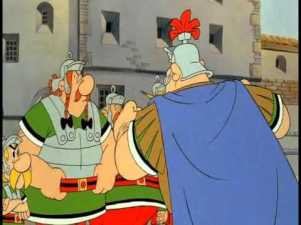
    Asterix and Obelix in the Roman Army

    Olive oil, tableware, jewelry, and other luxuriant goods were among the popular Roman exports, however expensively they were sold by canny Roman traders, who then bought metals, cured hams, beer, and hunting dogs from the Celts at low prices. Notwithstanding such discontentment in terms of fair trade, the prosperous bartering of the goods between the colonials and the colonialists brought the grist to the mill of effective management of the colonies in the context of regarding economic and political stability that could/would have been otherwise in turmoil as a result of despotic constraints on the preexisting native social and political structures characteristic of colonialism. This favorable symbiotic relationship between the Romans and the Celts (the Gauls in France and the Britons in Britain) greased the wheel of the cultural and political expansion of the empire by egging the Celts on to adopt Roman-style systems of government and the young ones on to enlist in the Roman army as auxiliaries.

    R22b
    Julius Caesar

    However, the pacific era of the Roman-Celtic relationship saw cataclysmic waves of change that would punctuate the stability of the status quo as destabilizing forces loomed large in Western Europe: Firstly, the prospect of Germans occupying the Alps was a cause of concern to the Roman Elite. Secondly, Julius Caesar, the ambitious Roman ruler who was seeking for a popular acclaim to fortify his rulership in the empire as well as booty enough to get himself out of debts, determined to impose his despotic rules on the peoples of the conquered lands as portrayed in The Adventures of Asterix. Then later, there came Claudius, the lame and slightly deaf emperor who was spared of his life by his nephew Caligula perhaps on account of such physical defects. Claudius launched a campaign of conquest in northern Europe to attain military prowess in the region and thus enforced totalitarian policy on the management of the colonial systems, discouraging autonomous trading and social and cultural exchanging between the colonial and the colonialist.

    In light of the above, the relationship between the colonialist and the colonial sometimes begets unexpectedly mutual benefits in terms of cultural exchanges between the two peoples counter-intuitive byproducts, such as attested in the case of the Romans and the Celts, which could lead to diversification of native cultures, enriching the wealth of cultural legacies that would become another mode of new culture. If the Celts had been vehemently resisted against the cultural influences of the Romans as a result of the conquest of their lands, the cultures and history of Western Europe would and could have become very different from what we have known today, such as the English language, architectural and other historical artifacts, and political systems. In my opinion, sometimes, the colonial regime is not altogether downright evil in the sense that it somehow results in amalgamation of cultures favorable to both of the ruling and the ruled, not out of the benevolence of the former for sure but of the necessity of governing the conquered in the most effective way in order that the conqueror may quell the social and political dissonance arising out of the inept administration of the colonial affairs. In point of view as held by Ancient Athenian historian Thucydides, one must listen to the other less popular side of the story to transcend the subjectivity of times and to test the validity of truth. In this regard, I opine that however adamantly one may object to the benefits derived from the Roman-Celtic relationship, it attests to the fact that it enriched the cultures of both of the peoples and helped them reshape their ideas of epicurean ways of life that has passed on to the present progeny.


    Author’s Note: The inspiration of this essay comes from my reading of “Traders to Invaders,” written by Barry Cunliffe, formerly professor of European archeology at the University of Oxford, from December 2018 issue of BBC History Magazine.

    저장

    저장

    저장

    저장

  • ‘The Memoirs of Sepp Allerberger, Knight’s Cross’, by Albrecht Wacker -review

    Sniper on the Eastern Front: The Memoirs of Sepp Allerberger, Knight's CrossSniper on the Eastern Front: The Memoirs of Sepp Allerberger, Knight’s Cross by Albrecht Wacker

    My rating: 4 of 5 stars

    Many books on Germany during the Second World War are written in a victor’s perspective. In the context of regarding the objectivity of the events, the point of views in which books on the Third Reich are written is oftentimes biased toward the perpetrators of the war without regard for the underlings, such as foot soldiers compulsorily drafted to the fronts who want to voice out for themselves. This tendency betrays ancient Athenian historian and general Thucydides’ definition of historical record as the ultimate objective to provide the most accurate record of the events “by recognizing certain commonalities, free from bias and embellishment”. One must also listen to the other side’s story to transcend the subjectivity of times and to balance objective equilibrium, wherefore my choice of this true story about the Eastern Front by a former Wehrmacht’s prime sniper was an act of impartial treatment of the history so overflown by untamed populist opinions on the volatile subject.

    The narrator of the book is Josef “Sepp” Allerberger, the second most successful sniper of the German Wehrmacht and an awardee of the Knight’s Cross as a private soldier. Originally from Austria as a son of a humble carpenter, he was conscripted to the Wehrmacht as a machine gunner in the Russian Front in 1942. Allerberger’s fitness in marksmanship soon shone through and was forthwith selected as his regiment’s only sniper specialist thanks to his commendable traits of disciplined mind and bravery in the battlefield.

    In his blatantly frank discourse of what he experienced and witnessed in the Russian campaign, it is unlikely to feel sympathy toward the Red Army soldiers and partisans who were as equally cruel and violent as their invaders. No German Prisoners of War were guaranteed to live once they were captured by the Soviets and the partisans alike. Instead, they were met with the most atrocious way of being tortured and executed against the Geneva Conventions. As a result, the whole scenery of the Eastern Front was the killing field of humanity, perhaps even more bloodstained and catastrophic than that of Trojan War.

    Allerberger is not apologetic nor sentimental about his actions as a German sniper. Nevertheless, his narrative is honest without adding any lyrical adjectives or warm recollections of comradeship shared with a Red Army soldier as often depicted in movies and fictional stories. The book resulted from a series of interviews with Allerberger by the author Albrecht Wacker, who was also Austrian feeling a need of transcribing them and publishing the account of the veteran as a book. This telltale narrative is worth being read as a historical artifact that is important to understand what it was like to be a soldier in a war that he and his country knew was losing but tried to fight until the end with valor and might for their country and battle buddies in the face of the utmost atrocity.


  • ‘The Open Boat,’ by Stephen Crane – review

    The Open Boat and Other StoriesThe Open Boat by Stephen Crane

    My rating: 4 of 5 stars

    Four men in a dinghy adrift on a sea for 30 hours. The tempest of waves and a great shark occasionally circling around the perimeter of the boat. And the men rowing endlessly as if it were their only tangible way of protesting against their fates. It all happened in reality because the author Stephen Crane himself experienced the ordeal as one of the four men from the sunk SS Commodore off the coast of Florida en route to Cuba, where Crane had been sent as a war correspondent. The short story of the Open Boat is as realistic as it can be based upon a factual event the author himself was fatefully partaken in.

    The four survivors of the vessel were aggregates in a dinghy bound by a remote hope of finding a rescue crew in the middle of the ocean that moved them with terrible grace of waves. The men were a captain, a cook, an oiler, and a correspondent, who was the author himself. There was a subtle brotherhood of men built in the boat who took care of each other. Crane surmised that the captain’s heartfelt devotion to the safety of the motley crew resulted in comradeship, which the author himself had always regarded as a hypocritical concept of men until then.

    There were indeed moments of despair as their drifting became protracted, and the author saw this as nature not regarding human as important. He would jeer at any signs of nature in any deity form because thinking of the captain and the two other seamen who had worked so hard on the sea in such distress was the abominable injustice.

    Stephen Crane was a great American realist writer who later influenced Ernest Hemingway. Born in 1871 as a ninth child of Protestant Methodist parents in Newark, NJ, his literary talent began when he wrote his first poem at the age of eight. Although brilliant, Crane was not academically inclined, so he left University of Syracuse and became a kind of itinerant writer. It is said that Crane was a naturalist writer who emphasized observation in the portrayal of reality based on scientific principles of objectivity and detachment applied to the story of human characteristics. However, in my opinion, he was more of a realist writer who focused on objective, truthful presentations of details of the ordinary lives influenced by Gustave Flaubert and George Eliot. In this story, Crane’s use of vocabulary was pithy and straightforward with elegant expressions of emotions and feelings that so appropriately described the situations in which the characters were trapped.

    After Crane’s untimely death at the age of twenty-eight in a Black Forest sanitorium in Germany, Crane’s works began to gain their long overdue acclaim, one of which was this story of the sunk vessel and his own experience thereof. Stephen Crane’s works should deserve wider readership because he’s the first and foremost American writer in Realism literary movement who paid attention to the lives of the ordinary by being the experience of living among the ordinary and writing the existential presentations of the ordinary lives.

    저장