What more can I say? I am simply thrilled by his recognition of my thoughts on the book. Which can say more than this rich praise, that you alone are you?
Tag: reviews
-
‘Cursed Britain: A History of Witchcraft and Black Magic in Modern Times’ by Thomas Waters – review
 Cursed Britain: A History of Witchcraft and Black Magic in Modern Times by Thomas Waters
My rating: 5 of 5 stars
Witchcraft as popular belief system may sound anachronistic, if not extinct, in our age of the Internet, Satellite TVs, and planned colonization of the Moon, in the same way, that people in Renaissance regarded the Medieval times culturally backward and religiously superstitious. Yet, it has survived the leaps of time and waves of persecution, withstanding like a flickering candlelight in hours of stormy dark nights and remains in modern landscapes of buildings, cars, airplanes, and people with mobile phones on their hands.
Thomas Waters in his Cursed Britain: A History of Witchcraft and Black Magic in Modern Times tells us how this ancient belief system of faith-based healing at its lightest and of maleficent bewitching at its darkest has kept its vitality from the rural areas of provinces to the bustling streets of cities in Great Britain throughout the centuries based on his extensive research of historical documents and scholarly analysis on the uncanny but very real phenomena that grips your attention on every page of this fascinating book.
If you are keen on historical facts and anthropological evidence of human nature in relation to the ancient esoteric knowledge that looks so appealing and tempting, this is an excellent book.
-
Better a witty fool, than a foolish wit
 Shakespeare said that fool thinks he is wise, but the wise man knows himself to be a fool. This also means that a wise man knows what and when to speak. In this respect, simulation and dissimulation according to English Philosopher and statesman Francis Bacon is wisdom providing you with a strong heart to discern the opportune time to tell truth and to do it in protect of yourself against derisive remarks and false opinions on you by whom you talk to at work and any other social occasions. In Other Words: you take false shadows for true substance lest you should lose yourself under the misapprehension that revealing all of yourself will develop rapports for socialization.
In this “Express Yourself” era that lionize glory of show-it-all and tell-it-all in the form of memoirs and selfies, vying for a legion of followers cossetting juvenile mentality of the authors, Bacon’s tenets of veiling yourself may be deemed anachronistic and unreconstructed. However, it would contradict the importance of self-respect if we let ourselves peddled by the melee nitpicking someone’s weaknesses. That said, the advantages of simulation and dissimulation and how to do according to Bacon are as follows:
- Advantages
- To quiet opposition and to surprise
- To reserve a fair retreat to yourself. By concealing yourself to a certain degree, you can protect yourself in a situation that you fee inappropriate to you.
- The better to discover the mind of another by letting the other party open him/herself without sacrificing yourself to disclosing your inner thoughts that might be incompatible to the other, and that will generate a false impression on you.
2. How-to-do
- Have openness in appearance, such as smiling countenance and civil manner of listening to another.
- Keep your true feelings and thoughts to yourself. I have read that the former British Prime Minister David Cameroon was good at being canny enough not to speak of his opinions on politics during his university years, lest he should ruffle other students of different political opinions.
- Pretend to be what you are not if there seems to be no other way than to speak your mind in a setting where your true opinion will be unwelcome.
The aforesaid may seem boring or passé, but then there’s good reason why a wealth of wisdom shared by great minds of history still ring true, resounding through the leaps of time and borders of nations and boundaries of cultures. The prudent keep their knowledge to themselves and speak their minds when their ripe judgment of Reason deems the time apropos. Maybe it’s high time we got off the bandwagon of “Follow Me” and took a nice long walk alone around in romantic solitude and reflection thereof.
-
Ballad of Dido and Aeneas
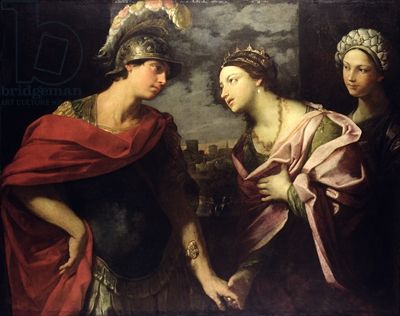
Aeneas leaves Dido, courtesy of pinterest From a land ravaged by a wooden horse with a golden apple for the fairest of the divine beauties appearing to a prince so young, so impetuous in judgment thereof,
There came a poor beautiful stranger destined for the supernal fate to rule the mortal to the diamond eyes of a maiden queen ethereal in beauty, graceful in act and hapless in love.
Blindsided by Juno’s machination, swept by passion growing strong, growing stronger for the stranger,
The queen bade him with tears and roses in succession day and night, in desperate attempt to keep his presence, his body and his soul, all but an entreaty so futile,
So forlorn, with a promise of her kingdom and her fidelity in return for nothing but his surrendering of himself to her and herself to him till the mortal fate was ended, till one had to cross the River of Styx.
Alas, but the queen’s to be thwarted, she’s to be abandoned by the divine plan forced by the arrival of Mercury, god of war whispering to the poor stranger for the imminent departure for destiny far more magnificent, far more supreme,
As dictated by Jupiter, god of all regions crossing death and life forever who put forward a divine plan over mortal feelings however pitiable.
Thus did the stranger set to sail the seas full of perils ever more.
The queen defied, she cried, she pleaded, but all ended in nought as the poor stranger was to depart cruelly with no tender words of love that’s planted, nourished,
And admired by the queen so now distraught by his betrayal of her love with her plea wreathed in tears and flowers.
Now her love became her poison consuming all of her ever more,
Now he became her foe ravishing all of her in surrender of love.
But what of it when all’s ended in a sea of heartaches thousand times, with no reason to reign as a queen without her lover by her side?
Nothing, nothing’s to remedy her spirit that’s broken thousand times, for nothing, nothing would console the lonely queen in cruel abandonment,
But the last will to burn her body and soul consumed in madness of passion on an ancient funeral pyre that engulfed every part of her whispering to her departing spirit that love would come never more – Nevermore!
-
‘Kiki’s Delivery Service’ by Hayao Miyazaki (1989 film) – review
 Being a witch can be this fun. She can fly on a broomstick anywhere faster, higher and further and see the world in her own eyes, which takes her to a higher plane of existence. Perish the titular image of a spooky hag with an equally evil-looking black cat flying together on an old broomstick on Witches Sabbath as a medieval invention of a woman laden with sexual and spiritual depravity. For a witch can be young, innocent, good-hearted and hard-working into the bargain who tries to live purposefully and meaningfully with what’s given to her as a result of responding genuinely and humanly to life’s challenges. Such is a growing tale of Kiki’s Delivery Service, aka Witch’s Delivery Service.
Kiki, a thirteen-year-old witch, leaves her mother and father for an independent one-year training of witchcraft at a faraway place where no other witch lives. Her companion is a witty and trusty talking black cat named Jiji that is more of kin than a pet. When Kiki finds a place in the port city of Koriko that has the outlook of San Francisco, Marseilles, and Nice beautifully combined, she sets up a delivery service as a messenger flying on a broomstick passed down to her in a long line of witchery by her witch mother. The business is in bloom because of her excellent customer service, positive attitudes, and beautiful heart, boosting her self-confidence, filling her heart with the love of humanity. Her broomstick and craftiness in flying with amazing navigation skills are part of witchery. Still, her real magical power is her empathy with people that infatuates all with a sense of euphoria. Kiki comes to know that the real magic comes from within, not from supernatural entities.
Kiki’s Delivery Service is a 1989 Japanese animated film that was written, produced, and directed by great Hayao Miyazaki, which was an adaptation of the 1985 eponymous novel by Eiko Kadono. The fineness of Japanese animation is at the meticulous rendering of an original literary source text to the animated version without losing the authenticity of the unique theme and maximizing the emotional and visual effects. Also, there is a polyphony of pathos and affabulation found in Miyazaki’s animations, such as Graves of Fireflies, My Neighbor Totoro, and his other television works, as presented in The World Masterpiece Theater. Kiki’s Delivery is a bildungsroman film of an adolescent girl who tries to establish her place in the world while growing up, independent of the comforts of her home and conformity of lifestyles that are likely to be pinned down on her by a society’s convention. In a way, it is reminiscent of Jonathan Livingston Seagull in terms of his search for self-identity and growing into adulthood through the difficulties of life. However, Kiki’s rite of passage seems more adventurous, more libertine, and more animated, all in the artistic mastery of Miyazaki’s creation of La Vie de Rose, according to the eyes of young and resilient witch Kiki. Young, Old, Man, Woman, regardless of where you are or what you do, this is a film that will bring you all to the world of fantasy wonderfully anchored in the reality that will entertain you with beautifully rendered scenery in detail and a story worth the keeping at heart.
-
my thoughts on the ainu according to Thucydides’s historical perspective

The Ainu in Hokkadio, Japan The article on the Ainu as featured in October 2019 issue of BBC History makes the interesting parallels with the history of the Anglo-Saxon and the Celts in Great Britain. The Wajin, or more widely known as Yamato people elsewhere in the Far East, are the major ethnic group of the Japanese archipelago, many of whom are the descendants of the ancient Silla (57 BC – 935 AD), a kingdom located in a southern part of the Korean Peninsula. (The Anglo-Saxon). The Ainu whose wherefrom and wherefores are still a mystery primarily inhabited in Hokkaido (The Celts or the Welsh).
However, it must be known that the Yamato were not hell bent on obliterating the Ainu culture but in effort to unite the divided provinces by Shoguns under the newly established monarchy of Tenno, which was in fact modeled after Papacy of the West during the Meiji Restoration. And it wasn’t that the Japanese mercilessly persecuted the Ainu under the reign of terror. Rather, they tried to indoctrinate the Ainu modern way of life, which in many ways improved their primitive quality of living by conforming to the reformed policy in favor of their betterment.
True that the Ainu were often subject to discrimination by their unique ethnicity, just as the Welsh and the Irish experienced it from the English, but part of their diminutiveness of presence resulted from the juggernaut of the modernization that necessitated the swing of things.


You must be logged in to post a comment.