Tag: sociology

  • Tears for Children

    People like to blame deities for tragedy of human lives to avert their fury to the forces unseen. But most problems in the world are manmade and not entirely unresolvable. Such is the case of the children of present-day Ethiopia. They are maimed or killed by weapons of political hegemony, territorial dispute, and ideological subjective for which no gods but humans are responsible.

    According to an article from the Reuters, 3,320 children have been either killed or maimed as a result of stepping into buried explosives from the civil war between Prime Minister Ably Ahmed’s government and Tigrayan forces commanded by leaders of the TPLF, the party that controls most of the Tigray region and used to run the federal government. It is this TPLF’s use of land mines that destroys the lives of the children in the region. The number above of children casualties is, in fact, only a fraction of the reality when more children are becoming guiltless victims of furious greed and evil ambition. These children are put into a deadly game of Squid Game against their will, and it is a form of violation against children. In the west, people associate child abuse with sexual exploitation by default, whereas they are more exposed to physical beatings and mental harassment. The present case of Ethiopian children’s casualty applies to physical and psychological violence because the effects are indelibly carved on their bodies and minds, changing the course of their lives. If a fifteen-year-old girl stepped onto a landmine while trying to collect water from a river, would she be liable for losing her leg for life?

    When it comes to war ranging from a domestic, familial fight to a full-scale national war, the memories become traumas that become lifelong narratives, depending on a child’s degree of sensitivity. But the children’s minds are like blanket slates where they write what the eyes see, and the ears hear. All children in the world, even in the remotest touch of civilization, are innocent and to be loved with care. However, my head swivels in wonderment when people seem to care more about children based on their countenance, preferably familiar with their kinds or attractiveness. Not only do Ukrainian refugee children deserve our attention, but Ethiopian children call our attention to stop this vile violence against children of any kind. So why not campaign against it with an international movement? Would Greta Thunberg be interested in the cause? I wonder.
  • Believe it or not

    The morbidity of cannibalism is often associated with the primitive obscure tribes living on a faraway island or in the deepest heart of the darkest jungle over the other side of our comparatively Atlantis-like world. To put it more blatantly trenchant, it was a practice of uncivilized non-European races reported by European explorers of the age of voyage until the mid-twentieth century. As it is always dark under the lamp, the idea of eating human flash ipso facto overrides the fact of consuming it in one way or another yet purposefully. The evidence is the existence of mummia in recent Europe.

    Mummia was human flesh or excretions mostly imported from the Middle East as medicinal palliatives in apothecaries’ shops, a prototype of a modern-day drugstore. It was made of desiccated human corpse matter from mummified bodies and ingested for its supposed healing powers in the same sense that the ancient Egyptians and Romans crushed up mice to put on cavities to cure toothaches. Farther to the east, people believed that the leg of a fresh corpse was to be a panacea to any incurable disease during the Chosen Dynasty in Korea. For mummia in the 16th and 17th Europe, it was recently deceased bodies of executed criminals, a youth of violent death, or unfortunate socially disfranchised. The former two kinds are the flash of passion that rushed thru the veins to the brain, resulting from a sudden frenzy of instantaneously leashed sensations. Such corpses were believed to possess magical feeling power akin to aphrodisiac or love potion, aka pharmaka, enveloped in an Egon spell with the aid of a demon. Mummia of the corpse was famous for abscesses, carbuncles, menstrual problems, and pestilence, all of which are directly or indirectly connected to blood circulation-related illness.

    Believe it or not, the presence of mummia was conspicuous in British pharmaceutical catalogs until 1908. I think some people might have bought it without the information about the source. But even if they knew about it, if the poor people could not afford to see the doctors cure their painful illness, the abomination of a corpse would yield to the need. The intuitive preference of judgment by resemblance applies to the folk religion, especially in the form of magic or witchcraft to which ordinary villagers often had recourse in need of an instant response to their wishes without rigidity and arrogance of the church putting dogmas before hearts. So, I like to believe that the use of mummia was on the same continuum. After all, it was different from Druids, Mayans, and Aztecs, who killed humans in the most defiantly brutal ways as sacrifices to their devil gods.

  • Emperor Titters

    The news that Elon Musk, the CEO of Tesla and Space X, has recently become the largest shareholder of Twitter Inc. is grist to the mill of the media with hoots and huhs. Musk has ascended to the throne and begun to wield his power to shake the Twitter Empire from inside and out. He expressed a design of converting the Twitter HQ into a homeless shelter while contemplating changing the name Twitter to Titter, egged on by a popular vote of consent he instigated a while ago on the portal. So the question is, has Musk already gone mad in the fury of retaliation against the Twitter Senate? Or is it out of his pure, unscrupulous intention drenched in the wine of humanity?

    My perception of Elon Musk may be an illustration of heuristics and biases to form a systematic judgment of error and make a decision based on resemblance shaped by intuitive preference. But such a design of machinery of cognition is also complemented by System 2 of slow thinking requiring analytical reasoning. Were it not for Tesla’s lawsuits brought by racism in the work environment and Musk’s nonchalant attitudes toward them adorned with his flamboyant gestures, I would applaud him to the end of the earth riding on a Tesla flying on a Space X. Perhaps, such acrid regard of him is akin to accusing a socially estranged woman of being a witch without a preponderance of the evidence. But Musk is anything but a pitiful figure deserving our pity with his immense universal wealth, doing businesses on earth and heaven. Although, as the saying goes, “A tree is known by its fruits,” the racially-motivated lawsuits betoken the dispiriting work environment of Tesla tells something about Musk’s personality. I find it very hard to regard Musk’s declaration of converting the Twitter HQ into homeless housing. It seems an adrenaline-driven uppercut blow to the foe as sweet vindication with Tittering.

    I read that Jeff Bezos, the executive chairman of Amazon and the owner of a private galactical tourist company, consented to Musk’s profound charitable remark. Nowadays, celebrities have all negative heuristics and biases against social media. Nevertheless, they feed on attention and thrive in it, so any such uttering of disaffection with the media is a sign of entrepreneurial solidarity. Not that I have the same sentiment toward Bezos, who is more intelligent and reticent than his slightly younger rival, but that they are astronomically rich and universally famous. It’s called class consciousness, by which the members of the same class share the same social statuses and cultures to guard themselves against those of another class. Musk’s sensational promise to give housing largess to the homeless and change the world’s famous media platform reminds me of Emperor Nero. Truth or false, he was said to play the cithara singing while Rome was burning and then distributed stipends to the homeless due to the great fire.

  • ‘The Maid’ by Nita Prose

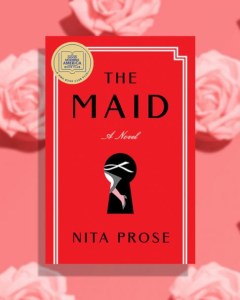
    The Maid by Nita Prose is a one-of-kind, touchy-feely novel without collapsed grand narratives and vehement subjective rhetorics about existential vertigoes in life that burdens the reader with a duty to interpret the philosophical, the intellectual meaning of a story, all fragmented and adrift. Instead, the story uses the real to perfect the ideal delightfully blended with a taste of Murder She Wrote with relatively ordinary characters doing the most extraordinary things like you never know.

    The Maid is one lonely young Molly Gray. She is a Maid of Maids, taking her job religiously in a hotel that does not quite reciprocate her dedicated service but sees her as a quiet oddball because of her reclusive comportment. But Molly is a swan in a lake of ducklings and geese, a harpist among percussionists, whose feet constantly move beneath reality’s surface. Molly is anachronistically muliebral and incongruously proper. She belongs to a preceding era of decency, saying early Edwardian London as a chambermaid, a coveted position for working-class women. To judge Molly as a misfit is downright callous and heartless because she inwardly craves recognition from those she thinks of as sympathetic souls who use her as a pawn in their game of passion and avarice. The more we learn about Molly as the narrative deepens, the better we know of her as if we were contracted severe strains of Stockholm Syndrome. Hence, our better angels persuade us to forgive and forget the stupendousness of truth that Molly confides to us at the end of the story’s labyrinth.

    This fictional Maid by Nita Prose and that real-life Maid by Stephanie Land are stories about working-class women struggling with the realities of life by themselves. The only difference is that the former has a blessing of luck in the form of sympathetic and resourceful supporters who rescue her from a dungeon of hopelessness. It is understanding because, as Charlotte Brontë expressed, one of the reasons she wrote was to be a kind creator for her stories’ heroines otherwise to whom no sweet soft touch of warmth and love would caress their weeping heads. However, Molly, the Maid is not all melancholic, a damsel in distress, a clueless loner succumbing to a subtle form of gaslighting because she is the one who laughs the last laugh with intelligence wrapped in a maid’s hide. Molly Gray the Maid may have a woman’s body but has the king’s stomach and heart in the most magnanimous way. Therefore, don’t mess with Molly – and the likes.

  • ‘American Made: What happens to people when work disappears’ by Farah Stockman

    Howard Stern might not be everyone’s friend, but he’s got the point when he articulated in his radio show a decade ago that what was eating out this great nation was not racism but classicism. The recent unionization movements among service industry workers, such as Amazon and Starbucks, indicate that the demand for the dignity of workers supersedes ideological politics that discourage the growth of American esprit de corps. American Made is a story about this American class consciousness that will put together disintegrated tesserae of the collective national mosaic made by the people and events.

    The author follows the three principal workers of the now-defunct Rexnord Factory in Indiana: Wally, a black man whose diligence and amiability promoted him to a coveted position in the factory; Shannon, a single white woman with an abusive partner taking pride herself in being a wielder, a male-dominated position, and John whose fortitude and conscience never left him during his long, turbulent unemployment days. Sex and race don’t matter when it comes to losing their jobs, let alone loving them because the importance of what they do for a living and the need for their livelihood are their commonalities that build a sense of camaraderie. In fact, class solidarity can never be achieved if class consciousness is transcendent of racial prejudice to be achieved first. Unfortunately, the antebellum wealthy southern plantation owners systematically destroyed the poor white laborers’ wage systems by replacing their workforce with the free labor of African slaves, thus planting the seeds of racial hatred in the hearts of the poor whites. The vicious cycle of devious racialized economic caste system has since firmly constituted the American economic system ethos under “Separated but Equal.” The author sees the absurdities of American society as a result of the disintegrated labor movements primarily due to racial prejudices, which is why worker’s solidarity is a way forward to achieve national unity.

    Wally, Shannon, and John are not just working-class Americans. The author emphasizes differentiating her elite station characterized by expensive private higher education and intellectual “profession” from those with hardened coarse hands of workers in the factory. They are ordinary people, a majority of Americans making up this country, ubiquitous in the landscape of our daily life. They are expendable at the whims and caprice of profit-driven employers who see their employees as no more than living at-will automates. That is what happened to the Rexnord Factory, where workers’ lives were no less than collateral damage for a successful operational mission of the company.

    At times, the author positions herself as a conscientious liberal intellectual, paralleling her fortunate environment with her unfortunate subjects. Perhaps it’s an occupational hazard for being an NYT journalist. Nevertheless, the book succeeds in pointing out a lack of national cohesion resulting from the politicization of racial rhetorics into bipartisan ideology, which falls by the wayside of solidarity of labor movement overcoming institutionalized racial prejudices. Recently, I have read that the workers of Starbucks and Amazon in New York have voted to unionize. American Made is a story about them and us too because the dignity of work makes us who we are.

  • ages of man

    No matter how many leaves have fallen from a tree as the wind of changes has been blown – sometimes placidly and many times harshly – I still feel like a girl who has refused to enter into adulthood, shunning away from the nature of things. Cicero said the ages of man have their stages of nature with sovereign rights, so anything you fly in the face of them will ask for troubles. But then Cleopatra declared to reject the forces of mortality, and Shakespeare thus praised her courage and fortitude by saying: “Age cannot wither away, nor customs can stale her infinite varieties.” Oh, and there is also Cher, now rightly revered as a dame of celebrity, and she has recently decried acknowledging her age on our evolutionary scale. So why not me with my consistent resistance against the fate of a mortal in all aspects with all my might, with all my soul, and with all my heart?

    It’s not only the inevitable awareness of the passing of generations by me. With the recent death of Sidney Poitier, the eminent actor famous for his unforgettably charismatic roles in ‘In the Heat of the Night’ and ‘To Sir with Love, it has begun to dawn on me that those who lived through WW2 and pre and post Second Vatican Council are now gone with the wind to the haze of time, a new breed of generations has germinated, sprouted, and dispersed across the lands and oceans, just as mammals began to stage after the extinction of dinosaurs. It’s a nature of the universe, but still hard to accept it, especially when everything else but I change, or seems it so. The difference between the millennials and the Me generation seems as far and wide as that between the Victorians and the Flappers, so to speak. Less than 50 years must have felt a great leap of 100 years to the opposite generations, I gather. But that’s not hyperbole, I believe.

    Greek gods knew too well about such a human yearning to be agrasia and played the weakness in favor of their everlasting egoism. Otherwise, why did they keep nectar made with ambrosia to themselves on the Mount of Olympus? Demeter, the goddess of harvest and corn, put the baby of her master who took the goddess in the guise of a poor woman as her baby son’s nurse in a sacred flame on the pretext of making him ageless as a favor to the kindness of her lesser mortals. And it doesn’t end with Greek gods. Jesus never became old, preserved in his prime days of preaching travels with stylishly long hair that reminds me of a famous musician or poet. So was Mary, the mother of God. In the end, only humans stand in the audience, appreciating the agrasia beauty and immortality, comparing the presence of eternal youth to the absence of it.

    What with the flow of time and what with the present state I am in now, inching toward the end of the era, is already enough to blow me away into the twilight zone, where things are unlike Alice’s Wonderland but Vincent’s Price’s Haunted House. Magic is no joke and is real for sure, but you always have to pay for what you wish for. But I think it’s a mindset that significantly impacts physical reality, which is magic turning you forever young.