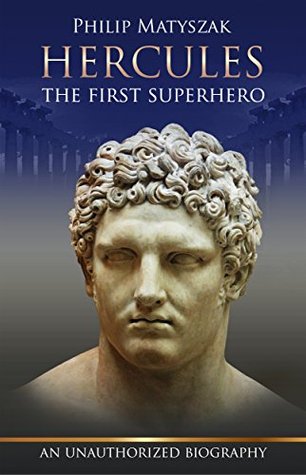
Hercules – The first superhero: by Philip Matyszak
My rating: 5 of 5 stars
The ancient Greek superhero Hercules always has a status of a modern-day Mount Hollywood celebrity with Paparazzi-conscious showmanship. He also reminds me of an advantaged individual who could get away with wrongdoings. Hercules was an impulsive egoist and an irascible aristocrat for what was worth the ancient Greek superhero, a paragon of masculine heroism with a view to celebrity. This uncommon biography about the superhero whose name still rings red herrings after millennium flows of time evolves around the legendary performance of the Twelve Labors, anchoring them to the historical events of a man with a colossal ego.
With a wealth of knowledge on ancient Greek history and extensive research on the subject, Matyszak puts in the capacity of Hercules’s counsel per se in the tribunal between humanity and divinity, who searches for truth based upon factual findings. Matyszak’s defense for his now divine client Hercules is erudite and comprehensive, with exhibits drawn from classical Greek and Roman historians and writers whose wits and reasons were anything but those of Hercules. In addition, the author’s trademark storytelling narrative makes the story of the ancient Greek killer all the more vivid and engaging that each chapter holds the attention of the reader in the phantasmagorical display of images as depicted in Grecian urns or vases.
Notwithstanding the attractiveness of the narrative and the narrator, there are reasons I disapprove of Hercules as a hero, an antithesis of the other half-god, half-man Jesus of Nazareth in millenniums later. The Labors resulted from his egotistical attempt to free himself from the guilt of killing his family in moments of passion. However, he was neither remorseful nor appropriately punished for killing his music teacher Linus whose head his recalcitrant prince pupil Hercules shattered with a lyre he was trying to teach him how to play the way it should. As a prince of Thebes, Hercules had no qualms of consciousness for killing his elderly music teacher whose social status was beneath him, and gods condoned it because he was a son of Zeus.
His peremptory sense of entitlement knows no boundary because of his arrogance and hubris. For example, during his Fourth labor of capturing Erymanthian Boar, Hercules killed almost the entire race of centaurs, driving them to near extinction. But Hercules himself was the cause of the killing spree because he intimidated Pholus, a wise, kindly centaur, to open a jar of undiluted wine, a gift from Dionysus to centaurs, who became intoxicated and attacked Hercules out of stupor. Yet, his killing of the drunken centaurs was not even a subject of guilt and was regarded as collateral damage because centaurs were known as lustful creatures. But didn’t Hercules also sleep around with women – and only the beautiful – wherever he went to, and sire children, one of whom became the founder of the Scythians?
To summarize, the story of Hercules boils down to a conclusion that Hercules was a representative figure of a human whose essence is both divine and mortal, always on a chariot race with two horses of desire and reason. Some revisionists claim Hercules was an ancient Greek psychopath who took pleasure in killing people, beasts, and demi-gods. To me, a psychopath loses either the shackle of the ego or the supervisor of the superego, running a mind chariot alone even it drives to a pit full of fire. Methinks, Hercules was a cossetted brat without disciplines that controlled his power of reason, which is apart from mental acuteness or ingenuity. Adler’s will to power embodies the figure of BC man-God hero without regard for compassion and charity. Hercules was anything but Samuel Johnson’s conception of a biographic figure who empathizes for the common characteristics of life in the principle of universal judgment and sentiments. I now know why Christianity has won favors from poor and ordinary people and become the subject of persecutions from emperors and kings because Jesus of Nazareth, begotten by God and born of Virgin Mary, is gentle yet strong, kind but firm, which seems simple but divine.
View all my reviews

Tag: thoughts
-
Hercules the first superhero – book review
-
ghost whispers

The plain girl who thought she was kept away from all things pleasant and pretty because of a suspected hex cast on her was walking toward the setting sun sinking into the west end of the horizon, smearing the sky with scarlet halos. The sky was burning, burning with a day’s unfulfilled passion, aborted wishes, and ridiculed hopes until a moon and stars appeared from the west and calmed the fiery sky that was still ablaze with shattered dreams. The sky was her heart as though someone with magical power had been watching the poor, plain girl all along, or so she thought.
Nothing miraculous would happen to her unless a kindly immortal being made her life merry and worthy of living because the plain girl was heading to her death. So first, through the forest paths out into a field of flowers, then upon the hill overlooking the wavering ocean, she loved so much for its wild, untamable nature that resembled her own.
The moon was full and high now, and the world became alive with spirits and sprites rejoicing the serenity of the night and the silence of the day. The plain girl saw the souls of the dead at sea rise from the tidal waves and walk on the crest of waves toward the mysterious melodies coming from the west of the moon. They all looked enchanted, so she coveted the enchantment and followed the watery paths she believed would lead to meet the Fates and ask them to give her a new fate.
-
John Dee, Queen Elizabeth’s Gandalf who designed 007 – book review
John Dee: The Life and Legacy of the English Occultist, Alchemist, and Philosopher Who Became Queen Elizabeth I’s Spiritual Advisor by Charles River Editors
My rating: 5 of 5 stars
Ben Jonson’s alchemist Subtle in his famous Elizabethan play ‘The Alchemist’ is a knave quack intent upon doing a lucrative occult business by luring the gullible, rich or poor, learned or general. But John Dee, Queen Elizabeth I’s English-Welsh astrologer, was anything but. He was a highly educated man graduating from Cambridge University with a penchant for esoteric knowledge beyond the realm of the physical world, and brilliant engineering feat contributed to his epithet as the queen’s occultist to the eyes of those who regarded him as something of Rasputin in the queen’s retinue. To me, Dee was a curious figure of science and magic, fact and mystery dissolving into one another.
From the cradle to the grave, John Dee’s life appears to be starlit with mystical numbers and stars that govern his destiny to pursue the knowledge of the beyond. Born in the household of a well-to-do textile merchant on July 13th, 1527, Dee’s fate was already revealed in the combination of the lucky number 7 and the ominous 13. He was endowed with intellect and heart, which is not typical for an astute scholar with a high education degree. Also, an ingenious engineer in stage productions of plays, Dee created the modern-day equivalent of special effects employing a man-powered crane and other apparatuses used as a counterweight fly system. He was fascinated with the science behind mathematics and used it to know astrology and celestial navigation in understanding human lives. He chose the coronation date for Elizabeth when Jupiter juxtaposed alone with Venus, opposing Saturn, and conjecturing Mars. The astrological interpretation betrays the virgin queen’s reign with the beauty of the goddesses and the power of the god of gods. Methinks, Dee’s interpretation must have attributed to the queen’s famous Tilbury Address in which she described herself as possessing “the body of a weak, feeble woman but the heart and stomach of a king.” Furthermore, the famous secret code of “007” was an invention of Dee used between Dee and the queen meaning “For your eyes only” as in “00” as a symbol of eyes and “7” Dee’s favorite lucky number.
Dee had a bona fide intention to use his knowledge to benefit people of all classes. During his post as royal astrologer under Queen Mary’s reign, Dee proposed to the queen that she establish a national library accessible to all for the universal education of the minds. This revolutionary idea was unprecedented and rejected. Dee was a man of books and used his learning from reading for the welfare of England. He propelled England into the Age of Exploration. He legitimized the British expansion of territories, including America, to which, according to Dee’s certification, a Welsh prince sailed in 1170, which was three centuries before Columbus’ voyage. Patriotic stargazer elucidated further that it was Grate Britain’s destiny to gain all of the territories supposedly appropriated by King Arthur by coining the term “The British Empire.”
After the death of his beloved Queen Elizabeth, Dee dwindled in his career and fell into obscurity, not least because he lost favor with the successor King James I, the scourge of god against witchcraft and magic as deviltry. We don’t know whether he was secretly in league with the devil in his once magnificent personal library. The opinions on John Dee are still debatable, if not controversial. Some might say he was a would-be Merlin or Gandalf. Some might call him a Rasputin who tricked the virgin queen into believing superstitions with his mephistophelean pact for the souls to populate the circles of hell. I want to say Dee was akin to Atlas, one of the Titans who was also fascinated with astrology and astronomy and generous with munificent generosity in the form of divine fire to mortals, for which he was condemned to bear the weight of the celestial globe.
View all my reviews -
republic of heaven
Come with a cheer or come with a call,
Come with a dream or not at all;
Up the rainbows and down the valleys
Good will prevails, hope sparkles;
Humor is a jolly good friend as always,
The joy of the world your spirit finds;
Your smile shines through the gray sky,
The soul flits on the avenues of ecstasy.
Republic of heaven is here, come what may.
-
Renoir Forever – Book Review
I remember the first time I saw Renoir’s painting, “Girls at the Piano,” hung on a restaurant wall when I was a first-grader in elementary school. I loved the vibrant warmth of the colors and the softness of the girls’ expressions. Since then, Pierre-Auguste Renoir (1841-1919) has become one of my favorite painters. Given that preference, my reading of this book about the master was long overdue. Still, I am pleased to learn that Renoir was what I had imagined him to be – a creator of art whose eyes are set on the stars and foot grounded on earth.
Renoir was a master of the French Impressionism troika led by Claude Monet and Camille Pissarro, pioneering a new painting style as the epoch needed a new cultural ethos for the upcoming new century. Although the masters of French Impressionism were on the same musical note, their timbres were various. While Monet and Pissarro were idiosyncratic and liberal in techniques and subject figures of their artistic creations, Renoir was a conservative in keeping a tradition of Paul Rubens in his celebration of feminine beauty surrounded by the realism of nature and life.
A pursuer of the natural and ideal beauty existing in the physical world, not the spheres of the heavens, Renoir used the ideal to perfect the real, adapting traditional techniques to his visions of the worlds conjured in his mind’s eye. Renoir’s fascination with sensuous beauty in the expression of vivid but soft hues of vibrant colors and rounded, smooth figures of models in his paintings show his unintentional application of Aristotelian aesthetic theory: beauty inherent in itself and beauty by its use. Renoir’s paintings are replete with the beautiful colors, the warmth of the ambiance, pleasantness of the moment, and equilibrium of the backgrounds, all the mastery of using the ordinary with a profound sense to elevate it to art, giving art its true meaning. That might be a reason why German composer Richard Wagner, the creator of “Nibelungen’s Ring,” chose Renoir among other famous painters of the time to produce his portraiture. Or perhaps it was why Americans first found Renoir’s paintings so appealing that the goring sales in America brought Renoir fame and wealth.
After reading this elegant biography of Renoir, I liked him even more because he was an artist who had an artistic vein of genius and a practical sense of responsibility. He was a devoted father who even took care of his illegitimate daughter from his first girlfriend before marrying his model wife Aline Chariot, from whom he kept it a secret for life. Renoir might have had preconceptions about specific beliefs and people, but who would not have them secretly hidden in their mind’s closet? I believe that art serves its purpose when it gives the beholder a delightful sensation, not a dangerous illusion of distorted reality drawn from an artist’s disillusioned mind. Now I have a replica of Renoir’s “Two Girls at the Piano” from Amazon posted on my bedroom wall. It still has the first impression of the painting that has stayed in my heart with delightful nostalgia, enveloping me in the longing for the bidding the time’s return, which only Renoir could do the magic.
-
Toro is back

St. Frances de Sales’s advice, “Have patience with all things but first with yourself.” is no more so than with the three weeks’ heartbreaking ordeal to win back my cat Toro’s trust in me. His traumatic visit to the veterinarian now seems to dissipate across the feline Elysium slowly, or so I want to think. He is not hiding under the bed in my presence, becoming a sweet writing company on my desk once more.

I have recently watched a YouTube that goes viral about an unlikely friendship between a stray cat and a young woman, which makes me think of my relationship with Toro and what it means to build trust between two lives. The woman found a stray tabby cat around her house and began to acquaint him with food. She named him “Tiger,” not least due to his perspicacious tiger stripes and adorable feistiness, giving him a distinct personality and charms that were all the more endearing to the sensitive woman who was also in need of company in her solitude.
Thenceforth, they became complementary to each other for consolation, security, and most of all, love. Tiger is still his feisty self, and the woman is still trying to adjust herself to his whims and caprice. Still, they feel comfortable in their presence and love. The tears welled in the windows of her soul when she said that building trust between two took time and patience. You can’t make someone love you arbitrarily by force. You don’t need a love spell or magic potion to enslave someone into your desire of possessing the body and mind, as the ancient Greeks and Romans used to. Without Psyche, Eros would not/could not have culminated in perfecting the art of love as a primordial god of Love.

Toro is in some way like Tiger: his name means a little tiger in Japanese with his distinctive stripes, and M signature proudly marked on his little forehead. Although not as feisty as Tiger, Toro has a remarkable personality of adventurousness, curiosity, playfulness, and resilience, all affectionately wrapped in his good nature. But I don’t take for granted that wonderful Toro is my cat, and therefore, I deserve his trust and love. Animals, especially pets, also have hearts that pump up the blood and feel the feelings. I regard them as friends, companions to enrich our existential human lives with a touch of sentimentality that we hardly express when we are among our species in fear of being regarded as a sign of weakness. And I am always thrilled to feel his little heart at my feet as a friend.


You must be logged in to post a comment.