Tag: thoughts

  • ‘Conan Doyle for the Defense’ by Margalit Fox- Book Review

    Conan Doyle for the Defense: The True Story of a Sensational British Murder, a Quest for Justice, and the World’s Most Famous Detective Writer by Margalit Fox

    My rating: 4 of 5 stars


    Sometimes, life is stranger than fiction, imitating art, and vice versa. Picture this. A man on losing streaks decides his last bet on life in the New World. But, instead, he finds on arrival himself surrounded by the grim-faced henchmen of law with the gray eyes scanning the debonair foreigner’s appearance, measuring his moral value, judging his life at face value. The compass of Goddess Fortuna’s Wheel indicates the downfall of Oscar Slater in the direction of HM Prison Peterhead in Scotland. But, even though fortune’s malice has thrown Slater overboard, it certainly has not deprived him of a lifeboat in the person of Sir Arthur Conan Doyle.

    The case of Oscar Slater is often dubbed a sensational Edwardian murder mystery characterized by a scandalous wrongful conviction by the stupendousness of a miscarriage of justice in the history of any subject related from social justice to penal system, from police investigation procedures to forensic science. It follows from a death of a wealthy elderly woman brutally assaulted in her Glasgow home in 1908 when the Victorian prejudice against poor immigrants and foreigners, especially Jewish extraction, was PC all over on the isles. Slater being a secular German Jew with dark eyes and hair contrasted with the fairness of angelic British blonde, the blue-eyed ideal figure was the poster man of a criminal among the police and became their convenient suspect without due diligence and beyond a reasonable doubt. The Scottish police applied none of the evidentiary truth to the Slater case. On the contrary, they projected all of prejudice and complacency into the person of Slater, who was a sort of likable roguish streetwise swinger whose attractive suaveness and sleekness are reminded of Puck in a Midsummer Night’s Dream. But Arthur Conan Doyle s helped Slater set free after twenty years of hard labor at the prison for the crime he had not committed. Suppose a true writer sees the world’s corruption at its heart and stands furious with people instead of grandstanding with rants and slurs. In that case, Conan Doyle stands along with Voltaire, George Orwell, Ralph Waldo Emerson, and Henry Wadsworth Longfellow in the pantheon of the great writers who lived in the crowd of life.

    Although Conan Doyle himself could not entirely be free from the conventional preconception about lower-class foreign immigrants and the jews, his integrity and charity exceeded the flaws. They changed the fate of the wrongly convicted man, which should be highly esteemed for universal recognition of all times. In the particular alchemy of literature as connecting the reader to the universal empathy, Doyle’s support of Slater’s innocence seems particularly conspicuous in the current humanitarian crisis in Afghanistan. The British general whose Toyota Jeep took up the already limited space could have held more Afghan evacuees in an airplane. Also, the former British Royal Marine chose to take 200 dogs and cats from the shelter with him over his Afghan workers and their families. But that’s not the end. The former Afghan employees of the British Embassy in Kabul are still clinging onto a thin ring of hope that their British ambassador boss for whom they had worked even during the Covid-19 pandemic scare would come to rescue. Would there be another Arthur Conan Doyle who would act on his principle of morality in the spirit of humanity who regard the lives of the oppressed Afghans as equally valuable as their own or similar kinds- that is, white and Christians?

    My reference of Doyle’s involvement in the Slater case to current Afghanistan and refugee situations may seem a bit of a stretch with over-flowing maudlin sentimentalism. But I think Doyle’s determination to help Slater cause following the case of George Edalji, another miscarriage of justice based on racial discrimination, stems from his good natural good-heartedness aided by the brilliant mind searching for truth. It is a triumph of good over evil in the semblance of law and order. Unfortunately, I have a hard time finding a famous writer or poet who actively puts thinking into action, just as Doyle, Voltaire, Dickens, and Sand, whose brilliance of the minds resembled the magnificence of the Sun benefitting the life on earth. Where are such great writers now?


    View all my reviews

  • the world in my eyes

    On one fine day, a tiny Bushman in Southern Africa comes upon an empty coke bottle thrown from the cockpit of an airplane to desert sand. Thinking it is a gift from the gods, the man sets out a journey to return it to them. Along the journey, the Bushman encounters a pastiche of humanity in a kaleidoscope of the events he comes upon till he reaches an edge of a high cliff mysteriously enveloped by the rings of clouds and throws the bottle into the deep, exclaiming, “The Gods Must Be Crazy!” As I see now, I am in the chorus with him on the top of the cliff overlooking the world.

    Nevermore than now have I witnessed the epic moments of history that appear to be atavistic in terms of nature, motive, and consequence. A convenient way of relating the human tragedies to the scourge of gods and God will only put me on a par with Pangloss, the ever-positive pious philosopher who thinks all is God’s will for the best in the best of all possible worlds. The Taliban chanting the name of Allah in their will, Christians taking pride in being a new chosen people, and other zealots of any religion all have had recourse to their deities and used their belief systems as weapons of dominance over others. From the Coronavirus pandemic that forever changed our ways of life to the collapse of democratic Afghanistan by the Taliban and the devastating effects of Hurricane Ida in Louisiana, I see a phantasmagorical display of people’s faces in sorrow and distress in my mind’s theater.

    Following the news about the current situations of Afghanistan and its people links me to the Trojan War, which lasted about ten years with the Greek allied powers destroying Troy in the end. From the burning city of Troy comes Aeneas, a royal warrior who escapes the mayhem with his family, carrying his elderly father on his back, holding his little son’s hand besides. That image is always particularly heartfelt because of the Trojan hero’s humanness, unlike his more glamorous Greek victors. What happened in the past happens now and will always, such as the images of parents passing babies to soldiers across the sharp razor wire two young, Afghans falling from a plane climbing high in the sky, and the lifeless bodies of the young and the old, women and men strewn over the dusty ground outside the airport in the aftermath of suicide bombing.

    Back in the States, Hurricane Ida ravaged Louisiana, leaving thousands of people stranded, homeless without power (for about a month from now), and sufficient supplies of sanitation, clothing, and food. They lost everything, and nothing is what they have now. I cannot erase the image of a woman from a news interview who said the hurricane took everything from her family, then breaking into tears. Then there is news about an elderly man viciously attacked by an alligator in a flood presumed dead while his wife took a little boat to get help outside their flooded isolated community. Would the man have been swept away by the rapid stream of the flood? Would the alligator that had attacked the man have returned to him for more? Or would the man knowing or believing that was his end have let himself dissipated into the murky waters?

    Is this the same kind of significant feeling of epic moments I am experiencing as what George Orwell should have felt when witnessing the death of a Burmese condemned man on his way to the gallows, the carnage of WWII, and the tragedy of the Spanish Civil War? Orwell posited that one of the reasons he wrote was to record historical moments he was living with his own perspectives and feelings, not necessarily popular or compromising. My intention to write this essay is similar to Orwell’s but more with sheer egotism of getting the heartfelt sorrow off my chest and tears away from my eyes. But I am not so sure if that proves effective with the images still vivid in my mind.

  • Emerald Dreams

    There is a sky in the eyes
    Sparkling with sweet stars
    Made of fire, spirit, and dew
    Swirling in liquid emerald hue;

    There are secrets of the universe
    Across the oceans of galaxies
    Farthest into the unbeknownst
    One world more to the loneliest;

    There is an alchemy of a wizard
    Inside the magical windows
    Unlocking the magic beyond,
    Revealing the wonder inside.

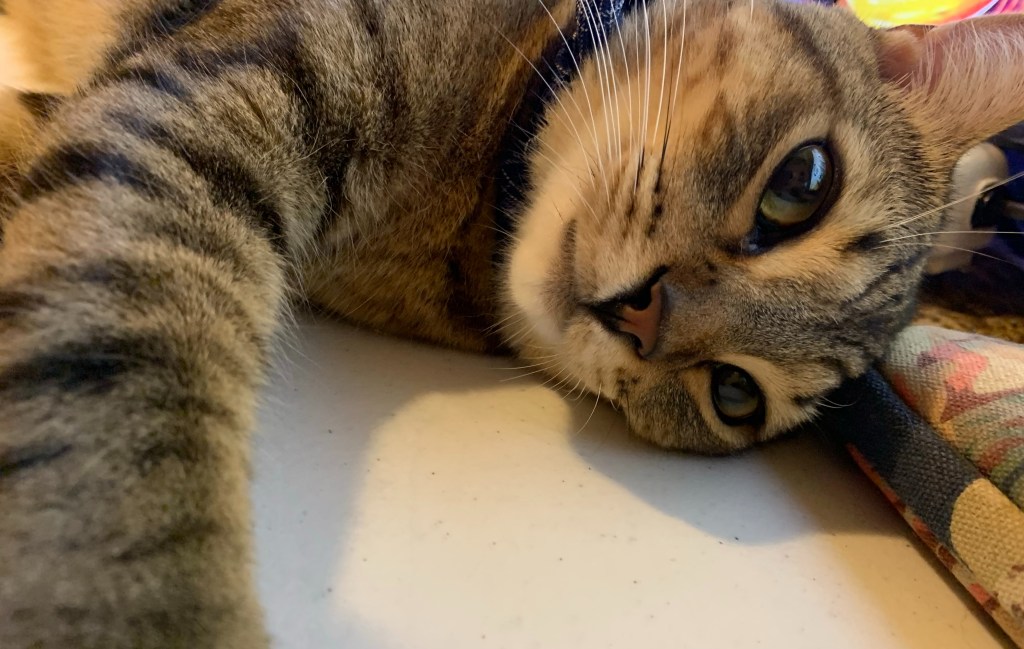
    P.S.: This little poem is written as an ode to my fourteen-month old cat Toro in celebration of one-year anniversary of his adoption from a shelter. When I look at his large light green eyes, I see a world of his own composed of stars, moons, and suns – all in the mystery of the unknown galaxy far away from the end of the farthest known star. As George Orwell referred one man’s death to a condition of one world less in the whole universe, my living with Toro means a cosmic show of birthing another world of stars from a beautiful emerald and diamond supernova.

  • St Francis and the Wolf of Gubbio

    I have recently read an article about how the prosperous presence of wolves reduces the number of deer road-kills because their very predatory sense intimidates their prey, one of which is the deer. Fewer traffic collisions mean fewer government funds to spend on the aftermath of car and traffic accidents from animal crossings. So far, so good. But what about the resolution about protecting livestock from wolves, which has become an economic issue disturbing the farming community? So here are my small suggestions that I deem mutually benefitting people and wildlife by virtue of Charity, Faith, and Hope.

    The article continues to support recolonization that the reduction of traffic collisions resulted in economic gains, which outweighed the costs of livestock losses by nearby cattle ranchers whose livelihood feels threatened by their lupine marauders. I remember reading newspaper articles and tweets about ranchers in Washington that the multiplication of wolf population engendered their livelihood and that clamoring for lupine rights outright disregarded human rights to make a living. When I commiserate with the woes of the ranchers at the same time, and also hope best for the great grey wolves, my mind’s eyes see the visceral images of the Maasai in Tanzania and African lions living in co-habitation. The Maasai find the most cost-effective and nature-friendly way of guarding their livestock against the lions by establishing chain-like fencing supported by the thorny African myrrh trees. I am sure the American contemporary can take cues from the Maasai and adapt them to their environment.

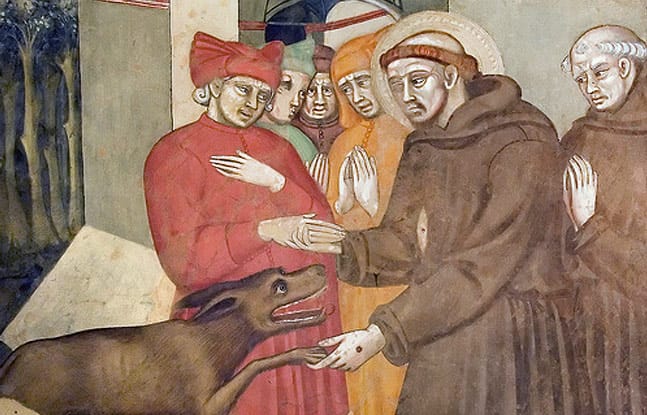
    I like wolves for their commendable fidelity to spouses and respectful sense of a society that emits from their majestic composure. I also admire the fortitude of cattle ranchers who are vigilant of the livestock their families subsist. Both beasts and men have reasons to live for and kill for. Yet, there should/must be a way of satisfying the needs without losses. Indeed, the medieval Italians knew exactly about the problem, but no more understanding and effectively than St. Francis of Assisi in meeting with the Wolf of Gubbio. Francis admonished him for his terror of fear over the people and made a pact with him publicly at a popular marketplace that if he ceased his predations, people would feed him from their very doors. The Wolf put his paw in Francis’ hand as a gesture of agreement, a sort of beastly hand-shaking. Can I make a wish for the miracle once again in my time? I believe I can, if they or we want to, for sometimes we as part body and part spirit can do beautiful things together.

  • ‘My Girl, Fiona: A Collection of Essays’ by Denise Gwen

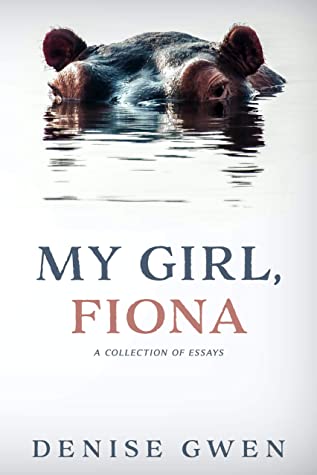
    My Girl, Fiona: A Collection of Essays by Denise Gwen

    My rating: 4 of 5 stars


    Sometimes we see ourselves in animals – here I mean the mammals, especially — and relate our mental images to them, whether they are pets living under the same roofs or wild ones in nature or zoos. That is why animals are apropos mediums to project our mirror images into their figures without exposing our naked selves outright. And that is what Denise Gwen does in her elegantly poignant collection of essays My Girl, Fiona.

    Fiona is a hippopotamus the author adopted emotionally from her struggling birth into the world at Cincinnati Zoo. Abandoned by her enormous mother, the vulnerable yet adorable baby Fiona chimed the emotional bell of the author on the octaves of her family. Fiona, the name of Gaelic origin, provokes the image of a vivacious fairy whose feistiness and resilience elements make her all the more mysterious and, not to mention, beautiful. But the beauty is uncommon and only kind, which strikes Edgar Allan Poe’s wise dictum that “There is no exquisite beauty without strangeness in proportions.” Then the adorable hippo Fiona becomes a kaleidoscope of images of women, representing the Exquisite Beauty Tribe. It consists of her youngest sister, whose name is also Fiona, her feisty Welsh late mother, and herself in midlife crisis blotted with sentimental reminiscences. Added to this tribe is Shrek’s wife is Princess Fiona. Her transformation from conventional slender beauty to a green-colored ogre-like her beloved hubby is a guest of honor in the Fiona Parthenon. One way or another, they all share the beauty marks of uniqueness, confidence, and self-esteem as the author brings them into life in the alchemy of words, brewing the images into a fascinating pastiche of the Fair Fiona.

    Animal stories charged with human emotions may well turn to the art of anthropomorphism in which animals speak like us with accents varied from Brooklyn to Los Angeles. But the author nuances the overtly human sentimentality in her narratives lest they should become schmaltz through Fiona, the lovely hippo. Also, the way she narrates with an elegantly apt choice of words and poignantly witty expressions is reminiscent of the British writing style I am familiar with. In fact, before finishing the book, I suspected her of being British for the reasons mentioned above. Consequently, I wasn’t miles away from the speculation because her mother was a proud Welsh who remained Welsh in her spirit and language during her lifetime. My Girl, Fiona is a thoughtful and heartful memoir disguised as short fiction apart from egotistical meanderings, which many celebrities nowadays indulge in stories that lack universal empathy. It is also a compact book you can read without leaps of attention and boredom in your spare time.


    View all my reviews

  • Braveheart

    Beneath a new visiting sun
    Sees a woman through tears,
    Sorrow of the heart she feels
    As it deepens into a sea of pain.

    Beside her an ailing old woman
    Lies in natural amnesia for woes
    She wishes to send away in vain
    When a life’s grip is relentless.

    Fear crowded, tension soaring
    Zealots of God clad in weapons,
    Fierce eyes searching for victims
    Outside is the terror reigning.

    Demands of life, duties of care
    A caryatid bears on her head,
    She faces the faces of terror
    With a brave heart for the fate.

    Author’s Note: Yesterday, I wrote about my essay on the current situation of Taliban-seized Kabul in Afghanistan but still could not take it off my head because I felt for their fear for unknown futures. An article of the day from Reuters was about the ordinary Afghans who had to make livelihood even against a possibility of danger that lurks around everywhere where thousands of people are attempting to escape from the new Taliban regime, often futilely. Therefore, this little poem, albeit insignificant willy-nilly, is my small tribute to the brave ordinary people on the frontline with life in Afghanistan who are just like you and me. The heroine of this woman is another Me in Afghanistan who shares a similar life story.