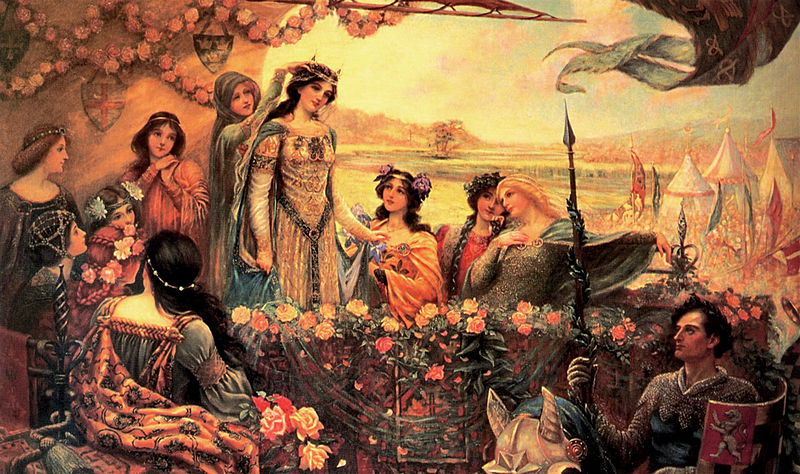
Across the five continents and seven seas Beyond the bridges of time over the Lethe There is the Fortune Isle – enchanting Avalon Where all things grow and perfect themselves Not by physical labor but by nature’s magician in the sovereignty of nine faerie queens’ realm of Prudence, Justice, Fortitude, and Temperance Adonized in Beauty, revered in magnificence As Morgan Le Fay, the Queen of the queens Keeps the Holy Grail under the Sacred Oak With her half-brother, once mortal King Arthur Whom the Queen has brought from the battlefield By Black Boat from which her paramour Dane Ogier Came to Avalon, where his journey ended in a tryst With the Queen by the lake of shining waters Where she brought her son Oberon into light who became the king of faeries and married Titania. Avalon is near and far, real and mythical from whither Truth and wishes are sought after and eloped together.
It is supposed to be about being a woman that binds all women regardless of race and ethnicity across a great divide of time. Forget all others and let us focus on the parallel circumstances and kindred experiences as women. But alas, that seems only a tale told by a romantic fool such as I am. If you think this is hyperbole, then I suggest you read the tweets and comments on the recent news that a black actress plays the role of Anne Boleyn, the second wife of Henry the Eighth and the mother of Elizabeth the First, in the upcoming British periodical drama, which went viral among the learned and the general. In addition to the vehemently acrid narratives on the racial authenticity of Anne Boleyn – especially from fellow women-, the juxtaposition of the two women’s images, the actress Jodie Turner-Smith and the queen Anne Boleyn itself, belies the popular sentiment as though to mock the actress’s appearance in the fashion of the Tudor period by making parallels with the classical portraiture of the Anne of 1000 days. It has produced vociferous tweets full of fury from people who regard the role as audacious cultural appropriation faithful to the PC ethos of the time.
Actress Turner-Smith’s playing the Tudor woman Anne Boleyn is indeed an innovational idea of breaking the typecasting based on the physical distinction for the roles thinkable and conventionally conceivable for the specific attributable characteristics of certain characters. Thus, non-whites playing the roles conceived for whites are seen as usurping the equilibrium of cultural heritage, upending the very foundation of national identity translated into racial identification, a sentiment prevalent even among the professed liberals anti-everything related to Trump, Republicans, and racism. The rejection of the race crossover representation on screen is supposedly due to the difficulty of following the story’s fluid narrative, unable to be absorbed in the story, not least because performers’ distinctive physical attributes mar the harmony of racial fluidity. But do we really?
I have watched a few good dramas (British) in which the races of performers do not pin down them to the racially charged roles. To illustrate, in Benedict Cumberbatch’s Frankenstein, the wife of Victor Frankenstein was played by a black actress. Besides, his father, M. Frankenstein, is a black actor, a fine ensemble of excellent thespians whose energetic performance brought Mary Shelly’s original Gothic story to a theatrical feast to the eyes and the mind. While watching the drama, I was not distracted by the black performers’ appearances being the father and Genevan Victor Frankenstein’s wife. Instead, the powerfully emotional and assiduously methodological performances resurrected the textual characters to real humans, full of pathos with vigor and wonder. Also, British Asian actress Gemma Chan, who played the role of Elizabeth Hardwick in ‘Mary Queen of Scot’s,’ is known for her versatile roles transcending her racial background. Her recent performance as a cyborg with a touch of humanity named Anita in ‘Humans’ is as naturally harmonious as streams of a river flowing into a great ocean, not highlighting her physical differences.
L-R Laura (Katherine Parkinson), and Mia (Gemma Chan) from ‘Humans’
So why the fuss full of sound and fury of the people who cannot accept the black queen in the Tudor drama when they are boastful of the most advanced mind since the age of Enlightenment? In the wake of the global Black Lives Matter movements, people have become afraid of the wind of changes as a frightful tsunami to subvert social foundations, upending the social orders adverse to their belief systems. Although I don’t eschew their concerns for the wind of changes as I am also conservative, not conventional in belief, the current vehemently acrid opinions about the black woman becoming Anne Boleyn are tokens of latent racialized hostility surfaced by the deluged dissents pouring forth from the socially suppressed sentiments. Indeed, you can’t ignore the differences between the two Anne Boleyns. Still, there are more commonalities than the images seen through your optical sensory input: that they are both women of elegance and confidence who are not afraid of expressing what they can. The actress shows she can pull off the character with what she has, and the queen her the courage to confront the criticism for being the cause of subsequent religious turmoil that changed the face of Christendom in spades. Let not prejudice darken entertainment.
It is the Mystifying Absurdities of Human Nature that seems to be more of animal instinct for the Survival of the Fittest. It always makes me wonder when I see people with a terrible temper and callous personalities being successful in their careers. Although Shakespeare said a fool thinks himself to be wise, people seem to think that fool to be wise in real life. That was what came to my mind while reading Samuel Johnson’s weekly essay, The Rambler, No.142, subtitled “A Rural Tyrant,” written on Saturday, July 27, 1751. (Come to think of the date, it seems that Johnson spent his weekend writing essays as in a journal, which is an admiring habit to emulate.)
Johnson tells the readers about a swanky mansion he and his wealthy acquaintance named Eugenio, who had invited Johnson to his rural estate, happened to pass a swanky mansion surrounded by the grandeur of wealth and pretentiousness of power. Until Eugenio had told his learned friend that the villa was known for ghostly hauntings, Johnson’s natural curiosity piqued his search for truth; thus, he began inquiring about the whys and wherefores of the ghost inhabitant. The ghost was Squire Bluster, a bilious, despotic employer of his household personnel and ruthless landlord of his villagers. His capricious fission of tempest kept their financial securities at his whimsical mercy. Bluster enjoyed the powers of terror and, in the height of his perverted joy, insulted those imploring for his mercy with malice and enmity. No wonder nobody in the village repaid his vice with contempt and conferred perennial infamy on his epithet after death – at least corporeally. Notwithstanding the shame, Bluster cared nothing of it and still reigned in horror at his earthly abode because to delight in ghostly terror was his new afterlife enjoyment. Johnson lamented that the evil squire had only the gloomy comfort of reflecting that he was likewise feared if he was hated.
In the same vein, the descendants of Squire Bluster are not a rare family but are ubiquitous boundless of territory, race, and gender. For example, employers are hardly magnanimous and altruistic in their expendable employees’ genuine wellness and demand their employees in the usual, professional pretext of constructive criticism packaged in belittling, castigation, and insulting for the sake of strictly business. But I never subscribe to such façade because we are not automats but with sense and judgment common to all human creatures. You can’t tell the other to grin and bear the insults because they are not supposed to mean personal. If you want your subordinates to do their job correctly, you must be worth receiving such quality labor from them by being respectful of your character. But alas, it is my only vain wish, an empty echo from the valley of my heart because the descendants of Squire Bluster are a multitude and will do whatever they think rightful and deserving. Don’t’ forget that respect from fear is a terror of the sense and a trademark of tyranny, exacting unchallenged obedience from people.
Ignorance is the timorous and indolent plight from fear because knowledge is considered to be remotely extensive and inscrutable to be comprehended. It retards the progress of the mind and numbs the sense. Samuel Johnson avers in his weekly essay ‘The Rambler, No. 137’ avers that one remains unenlightened unless he is diligent to search for the origin of wonder with a pause of reason, a sudden cessation of mental progress when confronting the unknown to him. The need for general knowledge, the knowledge that confers Citizenship of the World, is an essential element of human characteristics, and an easy task to fulfill in search of meaning in life.
Johnson’s idea of knowledge is simplicity. It is jettisoned from a concatenation of needless abstrusely sophisticated theories and ideologies. It also chimes the bell with the Renaissance virtuoso Leonard da Vinci’s adage that simplicity is the ultimate sophistication in all principles. However intimidating or formidable the unknown is, the essential feature is simple to understand by way of ‘Divide and Conquer,” a principle that complication is a confederacy of the abstruse that can be broken into parts marked by the gradations from the first agent to the last consequence. The force that breaks the shackle of fear for conquering the unknown huddle is patient diligence armored in confidence. The labor of inquiry for wonder follows natural curiosity and confidence that eclipses the soul’s darkness. It comes to fruition by ceaseless efforts to ascertain the origin of the wonder in simple ways. The English philosopher who also advocated democratic pedagogy, John Locke, affirms that the surest way of thorough comprehension knowledge is to attempt little by way of repetition. For the widest excursions of the mind result from short flights of mental imagery and instant thoughts triggered by neurons fired in our cerebral cortex, which can be transformed into an organization of ideas firmly engraved in the mind.
However, knowledge loses its purpose if it dissipates into the possessor’s cerebral ether or is locked in the mind’s cabinet. It becomes useful and purposeful when put into practice. That is why Johnson gives heed to those who pride themselves in the impressive educational backgrounds and belittle others whose mental capacities they arbitrarily judge ignorable or even ordinary. Knowledge is for share, and it is a duty of a scholar who has a wider variety of knowledge through years of academic endeavors for the common benefits of the world he lives in. As Francis Bacon fittingly concurs, books can never teach the use of books. Generally speaking, it is common for intellectuals, despite their ostensible calls for democracy and justice for all, to live out of touch with the practical realities of life and often regard such matters as trifles. But what is worthy of their glorious learning if it does not accommodate the purpose of life? Johnson criticizes such lofty arrogance of the rarified subset of the general population because they lose their days in unsocial silence and live in the crowd of life without a touch of humanity. It also reminds me of Bacon’s utterance of loneliness in a group as such: “Magna Civitas, Magna solitudo.” In this regard, George Orwell is together with Johnson because they saw the educated’s superciliousness, the intellectuals, who often conferred their knowledge to their honor in the voluntary seclusion.
Upon reading Johnson’s essay, I could not help but wholeheartedly agree with the purpose of knowledge and the idea of sharing it with others for the world’s common good. I was also glad to learn that I was not the only one who thought that people with academic credentials were frequently dismissive of the opinions of what they regarded as the mortals of the ordinary among whom I am. Therefore, I hope that the reader who reads this essay of mine should not belittle the soul attempting to obtain the sunshine of the light of letters to understand the world in a perspicuous way to declare to the world that I also can think and express it cogently. That is my essay on knowledge for the purpose of life.
I remember watching the cat guru Jackson Galaxy’s post on YouTube about a prison where a group of inmates is assigned each cat for mental and a behavioral correctional program. The inmates seemed calm and content just as their foster feline friends reflected and talked of the amazing effects on their hearts hardened by the world never kind to them. The images of a condemned man in a cell and a homeless cat from a shelter became a beautiful impressionist painting with an air of serenity wrapped up in the soft sweet twilight colored by the warm hues of pleasantness that filled the canvass and stayed in the heart of the beholder – forever. The loneliness cut in halves transformed into togetherness, and there was nothing else but the mutual need for love and care. With the picturesque imagery engraved in my heart’s shrine, I cannot help but question the generic prerequisites for being an ideal cat owner indoctrinated by those professing to know things about pets. The doctrines of a perfect cat owner are as follows: you have to live in a space wide enough for her to exercise her natural hunting instinct, to have another cat to prevent anxiety, aggression, and loneliness, and most of all, to be a near-perfect human full of love and understanding blessed with material means to satisfy the need of a cat to the extent possible. The protocols remind me of eugenics elements by which only the best males and females can produce offspring desirable for humankind. Only the superhuman race can fall in love, beget children, and raise them to be perfect in physical and mental attributes to continue the Superhumanity. On the same token, being an ideal cat owner is to be an ideal person who deserves love from nature because of his ideally perfect being—quite the Nietzschean idea of Superhumanity.
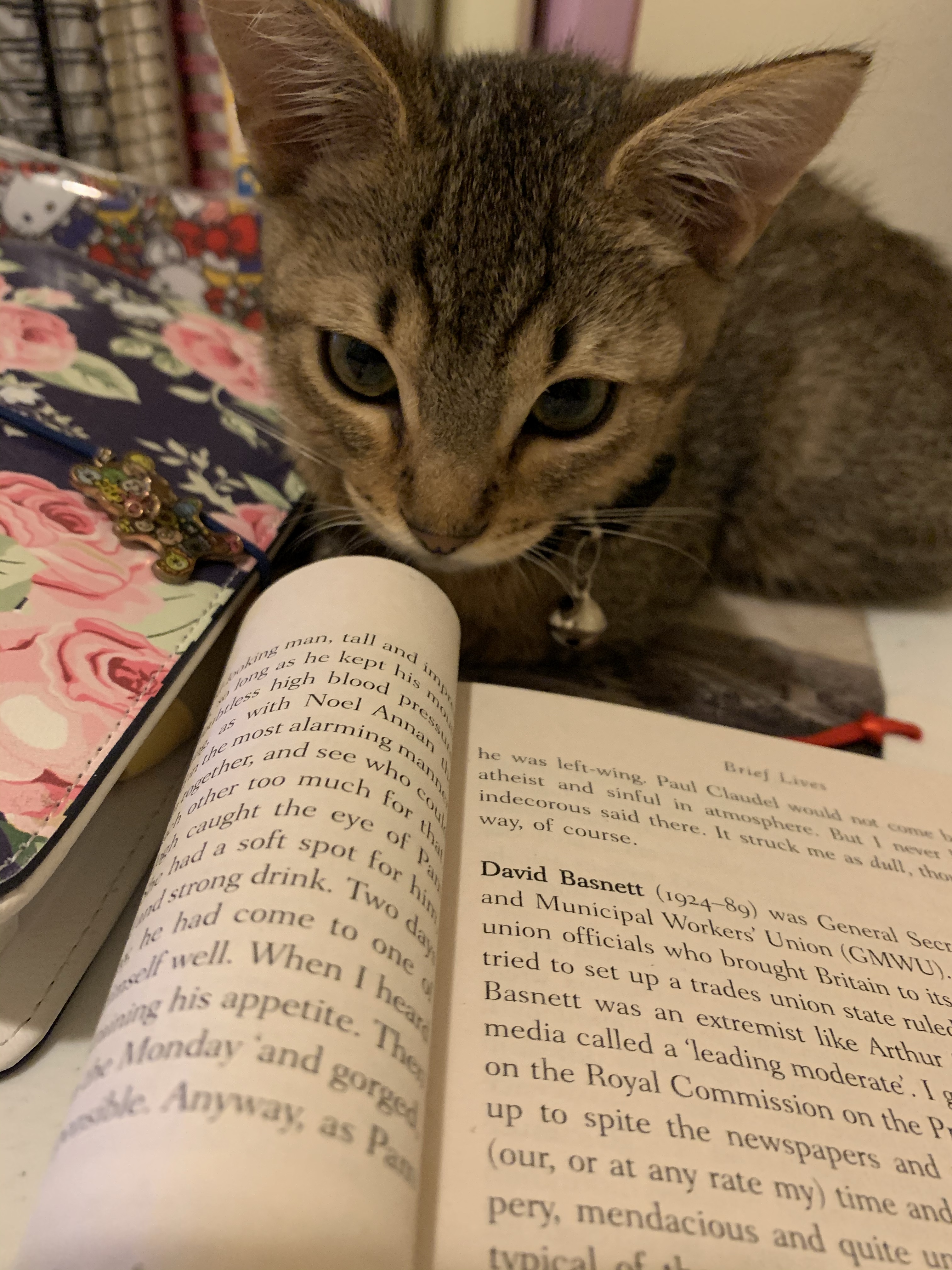
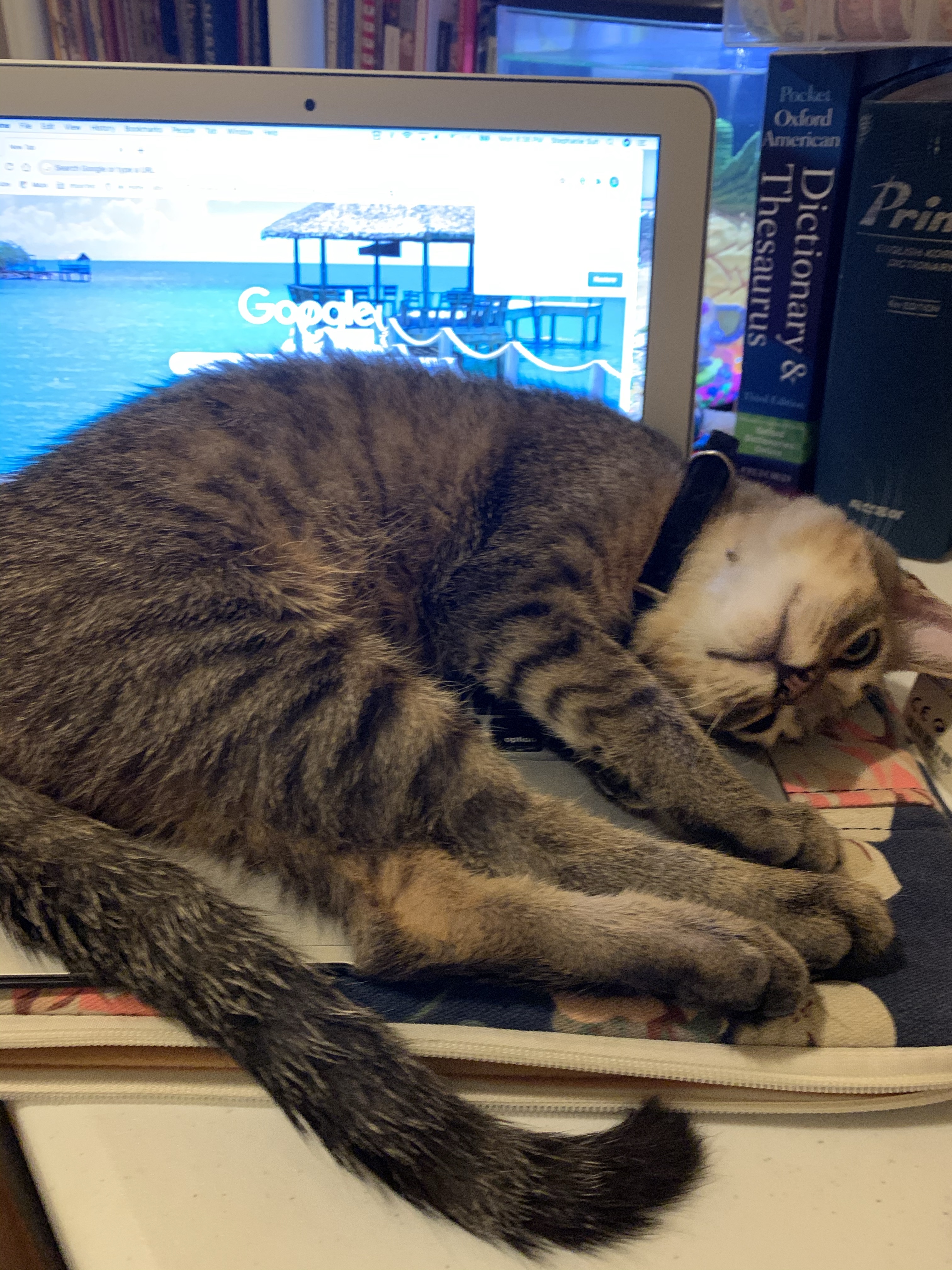
An ideal cat owner’s doctrines align against the condemned man’s images and the homeless cat in a cell. Then I also look at my 4-month old tabby cat Toro, whom I adopted from a shelter three months ago. Is he unhappy with me in this tiny apartment room? Is it because of boredom and separation anxiety doubled with a significant change of environment from pastoral life to city life that has driven him to a sudden pulsing and biting my hands and feet? Does he hate me because I leave him at home all day long with a mother who hates him when I go to work? Does he want to leave me and be adopted to a loving, perfect new owner because of my imperfection? Am I less qualified than the inmate to have a cat altogether? The thoughts smothered under the ineffective veil of forced positivism have reached the point where they can no more bear the suffocation and begun to erupt the lavas in the fiery magnitude.
As a first-time pet owner, I like to think that it is not a coincidence but Providence that Toro has come to my life because he was the only kitten who came to me and my brother bunting his little flurry head against our hands through the cold metals of the cage in the shelter. Toro and I are much alike in many aspects: leisured time in seclusion, uncompromising individuality, insatiable curiosity, innate sensitivity, and unfailing feistiness. We also instinctively know each other’s mood because when I am dejected, Toro studies my facial movements and comes nearer to me with those adorable eyes filled with liquid warmth. Then I look at the cute little Toro before me and think that genuine love and care transcends the high walls of a grim prison and eclipses the roof of a perfect happy house. There is a home sweet home for me and Toro in my tiny apartment.







You must be logged in to post a comment.