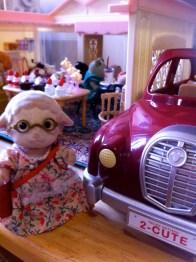
Once upon a time, by the sea far away from here, In a castle made by crystal, there lived a lady With Diamond Eyes and a Glass Heart as pure As the chaste high Moon on a wintry night sky, As delicate as the dewdrops on the leaves of Flowers in the meadow where nymphs of Dainty beauty danced with gods of winds. The lady in the crystal castle heard the merriment Of the nymphs and the winds in frivolous levity That grew loud and grew louder as the winds Blew hard and blew harder as their fiery gaiety Reached the demise of the frivolity finally as The great waves outside the castle were lulled away, Becoming a sweet lullaby of tidal waves peaceful ever, Caressing her spirit inviolate, her soul incorruptible ever. Alone, all alone – was she lonely? Not ever! Never! For she had two ravens named Thought and Sense That sat on her shoulders and told her of the tales of Day and Night, of Heroes and Gods, of Spirits and Sibyls, And then flew away when their mistress fell into slumber To deliver her message of her Thought and Sense Urbi et Orbi That she spurned the frivolities of the world in the guise of Romance, Reason, and Reality – the Virtual Vagaries as ever, In the crystal castle enameled with her mystic solitude as ever.
Tag: Writing
-
Mystic Solitude
-
For Love of Fate: Book review on Man’s Search for Meaning by Viktor E. Frankl
Man’s Search for Meaning by Viktor E. FranklMy rating: 4 of 5 stars
Many books are to be tasted or swallowed, whereas certain books are to be chewed and digested for the nourishment of our minds and souls, such as Man’s Search for Meaning by Viktor E. Frankl, the founder of Logotheraphy, the third Viennese School of Psychoanalysis, along with Freudian psychoanalysis and Adler’s individual psychology, that deserves of its recognition of being one of the books of our time for its content as well as its origin. This book is not of survival literature of the Holocaust but of a memoir of a courageous human soul that did not succumb to despondency. It is less about what he suffered and lost as a prisoner at four concentration camps during World War II than it is about the sources of his intention to live through it, attesting to the words of Nietzsche: “He who has a why to live for can bear almost any how.”
Man’s Search for Meaning is a fruit of Frankl’s resilient soul ever resisting the existential horrors of situations that life could afford; whenever the miserable conditions of the camp suppressed the spirit, Frankl diverted such negative energy to reconstructing the manuscript which he had lost in the disinfection chamber of Auschwitz and scribbling the key words in shorthand on tiny scraps of paper. In fact, it was a way of intensifying his inner life full of intellectual resources and spiritual freedom to which he could retreat from his terrible surroundings by forcing his thoughts to turn to another subject, which made him enable to rise above the situation, above the sufferings of the moment.
In addition to the willful act of deluding anxiety and negative feelings, Frankl ensures us that a sense of humor is another of the soul’s weapon in the fight for self-preservation and can afford an aloofness and an ability to transcend any situation, for developing a sense of humor and seeing things in humorous light is a kind of trick learned while mastering “the art of living.” That is, by laughing about any sordid or callous situation, we ease our mental distress and are able to take on a different stance on the situation in a less negative way that is essentially not overwhelmingly stressful or unbearable. After all, humans are the only biological organism that can laugh, and thus this sense of humor is our prerogative as human.
It is also interesting to learn that the prisoners who did their utmost best to look good even in the sordid surrounding survived the dreadful experience because they looked “fit” for survival. This act of grooming links to will to meaning – that is, a will to live- that has physiological bases of psychic energy which rejuvenates the body and the spirit to see a why to live. On the other hand, there was a young inmate in the camp whose sudden loss of hope and courage to live affected his already typhus-stricken body so adversely that such mental condition lowered the man’s temperature and resistance against typhus, which ultimately caused his premature death. This episode shows us that what we believe becomes our truth and thus can alter our reality with another one, a virtual reality as a product of psychosomatic effect, which also links to the three sources for meaning of life as follows:
• Creative Value – Doing something meaningful, such as Frankl’s scribbling the manuscript
• Experiential Value – Appreciating beauty of the Arts or love, such as his thinking of his wife in another camp whenever he was on the verge of falling into an emotional distress; and
• Attitudinal Value – Triumphing over biological, social, and cultural inhibitions during difficult times, such as Frankl’s endless efforts to divert his thought to another object of lofty value. It is this value that gives to our sufferings meaning by the way in which we respond to.Man’s Search for Meaning by Viktor E. Frankl testifies to Nietzsche’s dictum as aforesaid that suffering can grow out of existential frustration in the sense that there is a point to sufferings, that there is a hidden meaning in the guise of suffering, as there is only one right answer to the problem posed by the situation at hand. The essence of existence, which is search for meaning of life, underlies our awareness of a possibility against the background of reality – that is, what we can do about our given situations, not depending on the happenstances. Our emotions, which are interpreted as suffering, cease to be suffering as soon as we form a clear and precise picture of it by applying the three sources for meaning of life. Viewed in this light, this book is a veritable guide to how to overcome the struggles of our lives and achieve demands imposed upon our daily tasks however insurmountable they seem, which gains utmost credibility against the backgrounds of his own anguish in Auschwitz.
-
Herculean Rhapsody

Courtesy of google.com Thousands of years ago when gods and goddesses
Lived among the mortal and made love to them,
There lived a man in Greece across the oceans
Whose muscles invincible, confidence supernatural,
His spirit all greatness, all sincerity, all eagerness,
Untainted by the vanity of his divine heritage of Zeus.A fruit of lustful possession of the mortal beauty
Named Alcmena by Zeus, the god of gods, in slumber,
The son of god, the infant prodigy toying with a snake,
Grew out to be on a par with the strength and esteem of gods
That was the sacred prerogative exclusive to the Olympian.But lo! It was nothing but the elitism of the gods, for he could
Threaten the Sun to make it cool, waves when his boat’s tossed at seas,
And his music teacher for forcing him to play the lute against his will.
But alas, this man of incorruptible pride, of exceptional valor
Was to be pierced by the unquenchable flame of jealousy and
Hatred of Hera, the wife of Zeus, for his being the love child of
Her ever amorous husband whose objects of passion knew
No boundary between the mortal and immortal evermore,
Which she couldn’t bear at the sight of Heracles, nevermore.Thus, Hera cast the spell of Madness upon the son of Zeus,
Making him blind with terrible rage, talking sound and fury,
And exciting him to slay his wife and their three sons with a sword
smeared with their blood so crimson, so warm with their last breaths,
Leaving the wretched man in a bottomless pit of guilt and shame
In his awakening from the bewitched madness driven by the sulphurous
Envy of the wife of god, who sired this son of god, who loved his mother.The great surge of remorse swept over Heracles with wells of tears,
The sublime wish to expiate his sin suddenly urged him to go
To the Oracle of Delphi for Apollo’s guidance for his penance,
Where the sacred priestess in fits of divine frenzy told him to
Eurystheus, King of Mycenae, his cousin, the inferior to his being
To purge out his sins of Matricide, Uxoricide, Prolicide, and Filicide,
Once for all, in the name of Apollo, god of the Sun, Truth, and Healing.Thus obeyed Heracles, our wretched but genuine man of courage,
Who, at the command of Eurystheus, his loyal cousin, undertook
The Twelve Great Labors so impossible, so unthinkable, so incredible
By himself, alone, in act of penitence that was so brutal, so primordial as thus:Killing the Lion was met by vanquishing the Hydra;
Then he had to capture the Stag and the Boar;
He even deigned to clean the filthy Stables in a single day
To kill the monster Bids, followed by capturing of the bull;
Thereupon, he rounded up the Mares to steal the Girdle;
Herded the Cattle so unmanageable and untamable;
Went to fetch the Apples and then captured the Dog of the Underworld.The Greatness of the Spirit, the Purity of the Soul,
Far excellent, far above the Reason clothed in cowardly pride,
Far higher than arrogance and hypocrisy in the guise of intelligence,
Was the name of Heracles to whom no fear and intimidation did appear,
Nor the impossibility, nor injustice did exist in therein eternally evermore
enshrined in the memory of the half-man, half-god who once lived among us. -
The Birth of Humanities: Mythology by Edith Hamilton
My rating: 5 of 5 stars
The essence of myths is threefold: it is a branch of natural science, trying to explain what humans saw around them. It is also a genre of pure classical literature. Besides, mythology is religion, the deepening realization of what human beings needed in their gods and goddesses. That is, mythology is a way to show us the way the human race thought and felt untold ages ago. Through mythology we are connected to the men who had close relationship with nature, who had no real distinction between the real and the unreal, unchecked by reason but with the spirit. In this light, Edith Hamilton’s Mythology breathes life into the Greek, Roman, and even Norse myths, which are the bedrock of the western civilization – the stories of gods, goddesses, and heroes that have imbued the humankind with multifarious creativity from time immemorial to present.
The aim of this book is to produce knowledge of the myths that had been recorded by ancient writers and poets. In fact, the myths as we know now are the creation of great poets, one of which is the Iliad by Homer. Unlike the Egyptian, the Greeks made their gods in their own image and breathed them with their emotions and feelings. It is uncertain how the genesis of the Greek mythology came into being; however the earliest Greek poets arrived at a new point of view which had never been dreamed of in the world before them. It was at this point that mankind regarded itself as the center of the universe, intent upon producing the beauty of human, which was the very consummation of reality.
According to Hamilton, what distinguishes Greek mythology from others is it’s foundation on the factual reality. The nonsensical took place in a world, which was essentially rational and matter-of-fact. For example, Hercules always had his abode in the city of Thebes, save when he took of a journey to accomplish his twelve labors; Aphrodite’s birthplace was just offshore from the island of Cynthera; Pegasus’s comfy stable was in Corinth. There was a sense of reality in the mythological world but no place for magic.
Mythology is not a tome that requires of modern readers perquisites for scholarly knowledge of academic languages, intellectual superiority, or historical knowledge of the ancient time. It is an anthology of entertaining and inspiring tales of gods, goddesses, nymphs, and mortals who fell out of favor with the divine, written in plain English; it’s like listening to a very well-read story-teller. In Mythology, we meet all from the mercurial gods and jealous goddesses on the Mount Olympus even to Norse gods in Valhalla. We are fascinated with tales of Cupid and Psyche, Odyssey’s Golden Fleece, and forlorn Clytie whose love for Apollo pined away. We discover that Paris of Troy used to live with a nymph called Oenone before deserting her for Helen of Sparta. Also, we listen to the legends of constellations of the stars as well as many other references for literature, paintings, and music that have been deeply inspired by Greek mythology.
Mythology is the most comprehensive and lucidly accounted tales of mythology based upon Hamilton’s extensive collection of the sources from great ancient poets and writers. Of all other books on mythology of the western civilization I have encountered, this book is by far the most excellent in providing readers with both entertainment and knowledge without academically esoteric approach or literary pompousness. Mythology succeeds in offering education and appreciation of art that has been passed down to our present time for thousands of years. For this reason, Mythology by Edith Hamilton is a touchstone for books on mythology.
-
Neither Here Nor There: Travels in Europe by Bill Bryson
Neither Here nor There: Travels in Europe by Bill BrysonMy rating: 5 of 5 stars
When John Steinbeck, who wrote The Grapes of Wrath, East of Eden, and Travels with Charley: In Search of America, met a young man in traveling across America in his converted camping car named Rocinante, he met a young man who longed to travel to Europe with the idealization of the continent as he had seen in magazines and books. Steinbeck, being already weary of the existential dealings on the road, advised him, “What’s the need when the world is conveniently at your fingertips in colors without all those travel-related hassles? You can see the world in books and films and still keep your ideal images of Europe.” Which is exactly why Bill Bryson, an American- born British writer renowned for his great sense of wit and superb command of the English language, decided to embark on his journey once again twenty years after he and his pal Katz backpacked across Europe. Bryson wanted to see Europe in itself with a tabula rosa and write something about the cultures that seemed at once so different and yet so oddly similar in his own eyes. The result is the touchy-feely, impetuously hilarious, and astonishingly insightful Neither Here Nor There.
Bryson’s journey began and ended in the two geographical outposts of Europe, Hammerfest and Istanbul. By virtue of his narrative both so inviting and vivid with the use of languages both colloquial and literal that are so characteristic of his writing style, readers will easily and willingly follow his train of travel through the chapters, as he first takes us to Hammerfest to watch the beautiful shimmering gossamer of Northern Lights. We find Bryson feeling not-so-attractive while sitting on a bench at a park in Copenhagen, where all people looked handsome and beautiful. Such existential estrangement became heightened in Belgium, for all along he felt homesick, reminiscing about an old diner in Iowa and its cantankerous but hearty old waitress he frequented. In Amsterdam, he was concerned about the country’s “oddly wearisome” social conventions in regard of its complacency toward untenable political stance under the banner of tolerance. We see Bryson in the streets of Stockholm disappointed in the perfect socialist country littered and defiled by wastes mindlessly thrown away anywhere by its civilized residents without a shade of shame.
And who would not but sympathize with Bryson’s pathos in Florence? Here in this City of Flowers, Bryson saw the ubiquitous Gypsies importune everyone, with their haggardly clothed little children as an instrument for orating their poverty to passers-by at which Bryson was righteously indignant. He questioned himself why the police were not making any efforts to stop the Gypsies from harassing people. Further in Austria, we feel for him as his idealization of Austria as the epitome of all things European was ungraciously punctured by unfriendly services, an irritatingly slow mode of business operation, and a lack of charming coffeehouses where he could rest his spent body and spirit for a time. What a Don Quixote-like journey full of episodes it was.
Bryson’s cultural notes of each country he visited were, however, devoid of malicious sarcasm or jingoistic ignorance of its customs or social conventions. Things that he experienced in his travel in Europe was a clash of cultures he came from – originally Iowa, The U.S. and England afterwards – and cultures he had imagined in his mind, all of which spellbound him like a Boy in Wonderland. In fact, what fascinated him in Europe was his discovery that the world could be full of variety in which there were many different ways of doing essentially identical things, such as eating and drinking and buying movie tickets. Unlike other travel writers who only write about the sunny sides of the countries and peoples in their interests, Bryson is unafraid of telling readers his observations through his experience with a certain kind of fraternal or avuncular affection added by his trademark wits wonderfully interwoven with intelligence and humanism.
The travel ended in Istanbul with his hope of seeing more of the world, his everlasting wanderlust still luring with a vision of Asia across the Bosporus Bridge. He’s all up for the unforseeable happenings awaiting for him to encounter because that’s the glory of foreign travel, a travel to a terra ingonita where anyone can become a stranger, a wanderer blissfully ignorant of almost anything. To Bryson, the whole existence of traveler is to be constructed by a series of instantaneous guesses and endless actions. Notwithstanding all the woes of a lone traveler who was culture-bound, Bryson’s travels in Europe was something of his experience in Wonderland filled with a great sense of childlike wonder and appreciation of the wonders of each country in its own colors. Neither Here Nor There is his tale of veni vidi, vici experience and entertaining accounts of the world through his eyes with amusing and telling details resembling none other than themselves.
It has been almost over five good years since the Collies have immigrated to Elysia from Scotland. By now the family has well settled into the ways of life in their adopted home country, especially their beloved town of Avonlea, which has become their hometown. After all, anywhere can be anyone’s home as long as it feels comfortable and peaceful, if not exactly welcoming. Besides, if the customs and languages are similar to those of your native country, the process of acclimation is comparatively smooth without Herculean challenges. So in this respect the Collies have lucked out thus far.


You must be logged in to post a comment.