Tag: Writing

  • At the cafe on a New Year’s Day

    NEws Article about the upgraded cafe   (Click here for the cafe scenes)

    wpid-snoopy-writing

    Benjamin Franklin in his Autobiography advises his reader for the New Year to resolve to perform what he ought and perform without fail what he resolves. Mrs. Lompstrompf’s bakery whose official business name is “Rilakuma Cafe” is accordingly decorated anew with a variety of new snacks at affordable prices to accommodate the little ones’ pocket money. How thoughtful and generous the proprietor is! There is seldom anyone like Mrs. Lompstrompf in these days.

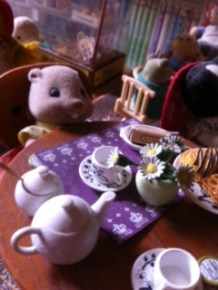
    So after wishing Happy New Year to their families and friends, the little ones gather in their elbow room in Avonlea. What is better than uplifting your spirits with sweets and refreshments in a wintry afternoon?

    The little ones are busy talking about their new year’s resolutions and plans among themselves, and listening to them makes anyone smile at their innocent wishes and simple hopes for the future, which is a prerogative of the young at heart.

    img-thing

    저장

  • Episode V: Spaghetti Evening

    A Spaghetti Dinner  (Click here, and it will take you to the House where you can read the dinner story with pictures of the characters.)

    PROLOGUE

    e990cab902b80e3b1926abcc44f7f4ce09debc88-tc-img-preview

    Last thursday was a spaghetti evening at Mrs. Lompstrompf’s house, where Sally and Mathilda lodged. Sally was still recovering from a serious case of abscess on her neck due to her weak immune system for being anemic. The medication Dr. Humbug had prescribed to  her was Ajaxcillin/TMP 800/169 MG TB, which was to be taken twice per day. It’s an antibiotic, and Sally took 2 tablets a day religiously with her hands supplicant for a quick healing of the wound. The effect of the medication dovetailed with its name derived from Ajax the Great, a towering figure and great warrior of valor and strength fighting alongside Achilles and other famous Greeks against Trojans. One portant tablet would make Sally dizzy and her stomach feel light. No feeling of hunger would be shed over her. In a way, Sally thought this could be an opportunity to  lose some weight.

    But Sally was prabably not meant to be thin because she could not resist the wonderful aroma of Mrs. Lompstromfp’s spaghetti. Mrs. Lompstrompf had receipts from her old Grandmother in Norway, the land of fjords and the Norse gods and goddesses, where her relatives were still thriving on their homemade dairy products.  Her spaghetti surpassed the most authentically Italian made one in flavor, texture, and contents filled with genuine affection for cooking and caring for whoever would taste her culinary blessing.

    66427fd4c99c03aca23464e721a0b5cc

    So Sally gladly joined the dinner table with Mrs. Lompstrompf and partook in a convivial conversation. She talked about her Web log activities, how much she liked writing anything that came to her mind, such as poetry, novellas, and book reviews although the works published were not widely recognized. Upon hearing this from Sally, the good old Norwegian lady gently encouraged Sally’s somewhat downcast spirit by saying, “Sally, but your writings are all original, written bottomless from the bottom of your mind. And besides, you are writing in a language that is foreign to you when all these other people write in their own tongues. ast out literary, grammatical, and syntactical inhibition when you write. Be like Hercules whose confidence equals that of gods and goddess.”

    With this inspiring word of advice and encouragement from the saintly lady, Sally suddenly felt a rush of appetite that had been quelled by the antibiotic agents, thus joyously enjoyed the delicious spaghetti. Anything coming from Mrs. Lompstrompf was opposite to deceit, flattery, and lie. She talked only truth like an oracle at Delphi. Surely, the spaghetti tasted better than ambrosia or nectar.

    fa8e830c9e8170c16507cc49b7b0aeb7And what about Mathilda, another boarder? She was in her melancholic mood again, so she stayed in her room. It’s not that she felt uncomfortable with both of the ladies but that it was her nature to be solitary once in a while. She was by  the way a writer like Sally. Both Sally and Mathilda kept their traveler’s notebooks in which  they wrote their journals and drafted what they would post on their Web logs.

    So it was a nice warm Thursday evening dinner. Sally’s spirit was emboldened by Mrs. Lompstompf’s truthful revelation, and her wound on the neck seemed to heal considerably. Sometimes, everyone needs good food for the mind and the body because as the ancient Greeks said, “Mens sana in corpore sano.” (A sound mind dwells in a healthy body.)


  • Billy Budd by Herman Melville

    Billy Budd, SailorBilly Budd, Sailor by Herman Melville

    My rating: 4 of 5 stars

    The ageless question of human nature pertains to the paradoxical mysteries of human personality shaped by our perception of the world, as reflected in ancient mythologies. Herman Melville saw this intricate irony in this representation of reality in connection with the development of complex human personality in the characters of Billy Budd, John Claggart, and Captain Vere in this nautical novella.

    (1) Psychoanalytic perspective: The characters are emblematic of Freudian elements of personality. They are id represented by Billy (intuitive mind), ego (conscious mind) by Claggart, and superego by captain Vere (ethical consciousness). Billy’s ingenuousness, unalloyed beauty both in physical appearance and inner qualities, and young age symbolize the earliest phase of development of human personality. Hence the name “Budd” seems to betoken this emerging state of metamorphosis into early adulthood. When Dansker warns him of Claggart’s malicious intention to do harm on him, Billy dismisses the advice and insists on Claggart’s friendly treatment of him. In Billy’s representation of reality, Claggart exists as what he sees: a kind officer who does not give him a hard time. In fact, it is this innocent child-man like quality that becomes Billy’s fatal flaw.

    Billy Budd is doomed to be ruthlessly crushed when he is transferred as a foretopman to the naval ship HMS Indomitable. Here he meets his Valkyrie John Claggart, Master-at-Arms equivalent of Chief Police Office or discipline officer, who is always down upon Billy, for a reason indicated none other than his being divinely beautiful and angelically kind. It is the old veteran sailor named Dansker who regards Billy as his little child and informs him of Claggart’s devious motive. All these characters are at the helm of Captain Vere (whose name is derived from the Latin word Verite, meaning truth. Here the vessel is a model of representation of reality surrounded by seas, which is the world it anchors in.

    Claggart’s reason for his hatred of Billy is clandestine. He appears to act according to his ego, the conscious mind which Socrates considers as spirit. It seems that Claggart’s loathing of Billy becomes inflamed when Billy accidentally spills pea soup on his feet because he believes it to be Billy’s intentional effrontery. Claggart seems to act by his emotions based on the purely abstract reasoning of the mind. Therefore, Claggart’s model of reality is a result of his own way of interpreting the situation with his faulty assessment of the character that defiles his mind with dangerous antipathy toward the youth.

    Captain Vere, a figure of authority that convenes both Billy and Claggart on the subject of alleged mutiny as instigated by Billy, represents the ethical mind, the superego, the reason. He acts as an executor of justice to gird up the loins of discipline among his crew amid the revolutionary wars on the sea. Vere feels that Billy is innocent; however, when Billy hits Claggart to death at his false accusation of him as a mutiny leader, Vere is convinced of Billy’s alleged guilt and orders his execution by hanging. In a way, Vere represents an amoral authority figure dealing with individual citizens or subjects according to law and order minus spirits and appetites.

    (2) Mythological perspective: It is also interesting to look at this story of Billy Budd as folklore tinged with a mythological undertone of heroism akin to Norse mythology. The figure of Billy Budd reminds the reader of an ideal hero dying young; the hero can prove his nobility of character by death because often heroism depends on lost causes. The young welkin-eyed Billy Budd’s death gives rise to the high concept of this Nordic hero because the real power of good is shown by continuing to resist evil while facing certain death as the legacy of Billy Budd is immortalized in the seaman’s ballad. In my opinion, this story of the welkin-eyed young hero reflects Melville’s model of a heroic individual whom he once envisioned in his sailing days. Or perhaps, Billy Bud could be what Melville wished his two sons lost in unfortunate occasions (Malcolm, the eldest, who died of a self-inflicted gunshot wound in 1867 and another Stanwix, who died in 1886 in San Francisco) to be like. It would have been Melville’s mournful tribute to the deaths of his sons as enshrined in the mythological figure of Billy Budd.

    The book is written in an intricate prose style with the literary vocabulary used in the 19th century and historical allusions to the revolutionary wars and the great Admiral Nelson’s naval wars to give to the story a more realistic setting. Melville, who was a seaman himself in his youth and later settled as a customs inspector in New York City, wrote this novella in 1891, the time of his death. It was actually his postmortem work, published in 1924, 33 years after this death. And it was this work that kindled widespread interest in Melville’s works.

    Reading this tale of an angelic sailor will give the reader a sense of reading a Norse mythological tale because the protagonist of the story is evocative of pathos flowing from the complex human nature that is sublimated into heroic triumph over the face of the harsh reality of the world.

  • It’s a Strange Place, England by Jack Strange

    It's A Strange Place, EnglandIt’s A Strange Place, England by Jack Strange

    My rating: 5 of 5 stars

    Jack Strange’s England is never a bore; it is a mystifying country with its tempestuous history and colorful characters populated by the ever undead of the bygone eras still roaming their past abodes or workplaces among the quick. It is a quaint country where history meets myth and legend. This book will guide the reader to Strange England where fanciful folklores and historical facts are anchored in the traditions and customs.

    The author admits that England is perhaps arguably one of the most haunted countries in the world, thanks to its religiously and politically tempestuous pasts spanning the wheel of time from the Roman colonial period to the present. To illustrate, in Derbyshire a spectral Roman sentinel is often seen leading a parade of a circus comprising gladiators, chariots, and slaves, then all of them disappear into the mist. Another lovelorn Roman soldier is witnessed alongside Hadrian’s Wall in Northumberland, wandering in despair of his betrayed love for a fair English maiden. The phantom English residents also encompass the Benedictine monks led by St, Cuthbert in Lindisfarne, which was a target for frequent raiding by Norsemen who also threatened the cradle of English Christianity. It is said that the best time to see the saint or the monks is when the tides are high and a full moon lights the shore as a natural lantern.

    England is also a home of many interesting sports that are historically – and sometimes by happenstance – originated. The World Gurning Championship in Egremont in Cumbria was originated in 1267 when the Lord of the manor gave out crabapples to the locals. One can imagine without difficulty the consequence of tasting the apple, and thus can master the art of making as ugly face as possible. Hence this hilarious tournament comes to exist to this day. It’s open to everyone – yes, even to the fairest of all – , and it’s all about fun and participation. Also, there is Black Pudding Throwing Championship in Ridge, Lancashire. Originated in 1455, this tournament shows English humor mixed with historical irony, which makes it all the more convincing. It was during the period of “War of the Roses” elegantly referred by Sir Walter Scott (who was a Scot) to the feud between the House of York whose symbol was a white rose and the House of Lancashire a red rose. At the Battle of Stubbins in Lancashire in 1455, both forces decided to throw puddings at one another instead of lances. Believe it or not, the descendents still commemorate the incident by holding a championship every year with mirthful popularity.

    Subsequent to Strange Tales of the Sea, the author Jack Strange has done a marvelous job gleaning the extensive historical documents and cultural artifacts from his tireless research to provide his reader with interesting facts about his England. Strange is a gifted artificer who digs artifacts buried in the depths of forgotten times and lost folklores. Strange is also a mysteriously reclusive figure himself because there’s no personal information about him. Maybe that’s why his writings are so hauntingly attractive and oddly addictive. Strange is an excellent storyteller who weaves a tapestry  of legends and folklores imbued with his impressive knowledge of the history of England and his English humor permeated in his writings. This book is Strange’s winking invitation to his beloved England that spins a general image of the country with enchanting oddity and wide-eyed wonder that the readers will not tire of.

    저장

    저장

  • Episode III: A Cozy Sunday Afternoon

    The Sato Family on a Sunday Afternoon (Click here.)


    chow

    Although it was an icy Sunday with a frequent scatter of snow today, which was a typical climatic tendency on the east coast, the home of Mr. Sato’s young family was cozy and nice with a fireplace, a rocking chair, a comfy set of sofa, and a TV set.

    Meet the Sato family from Japan, who have recently arrived in Charlottestown, a neighboring town of Avonlea. In spite of a different cultural setting, the Sato family fit right into the lifestyle and cultural mode of a new environment thanks much to their civil decorum, playful nature, and diligence work ethics that are universal virtues transcending the subjectivity of time and territorial boundaries.

    The Sato are a young, budding family with Mr. Sato himself, Michiko, his pretty wife, and 2 adorable little sons, Hideo and Yuki who are the apples of their eyes. Perhaps they may reside in Chalottestown permanently after Mr. Sato completes his term in the office. However different decision Mr. Sato will make, the family bound by love, understanding, and support will not be deterred by any existential difficulties of life and remain strong and be a bedrock of what a family should be in times of trouble.

  • Episode II of the Sylvanians: Before the Weekend

    Click here for Thursday evening

    24879320_502678990099370_2033890894_oThis is an episode 2 of the Sylvanian Series I have written. Although the story might be deemed intent upon children because of the characters being anthromopoistic, it is actually intended for all ages, including the young at heart.

    The theme of the story goes thus: It’s a Thursday evening, when the the residents of Avonlea enjoy their mealtime after a hard day’s work. In fact, Thursdays are much pleasant than Fridays because the impending weekends are all the more enlivened by plans of cherished weekend activities as they deem enjoyable and rewarding on their own accord.

    It’s always heartening and relaxing to expect to do something rather than doing it in actuality. Meet Sally, Mr. Karl’s family, Mrs. Lompstrompf, Mathilda, and a band of little guys for their evening repast.

    *Sylvanians are the residents of Avonlea, the miniature figures that I have. I haven taken pictures thereof and written a few short episodic stories thereabout.