I still want to see the world even if it has hurt my heart even it’s full of the imperfect; The Sky, the Sea under the Sun The Moon, the Stars at Night Blue, Green, sparkling, iridescent- I still want to see the beauty if given one more chance to see it and not to lose it with a promise to keep the beauty in my eyes, even if the world still hurts me even if it will always be imperfect.
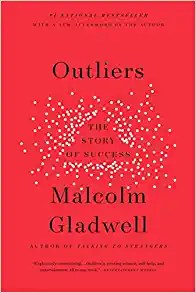
The personification of success equals the characterization of the person in our society that has established an unwritten pervasive eugenic rubric of material success in representing where you live. The stories of Rags to Riches are mainly to blame because they are modern-day mythology of heroes and heroines or fairytales to imbue the populace with slim hopes that can also be dangerous, like mass-marketplace placebo anti-depressants. From Hercules to Cinderella, those whose success from their humble origins we love is not self-made as they claim to be in their memoir or interviews but are made of chance and circumstances. This book reveals how these outliers are not outliers but are insiders of the leagues of winners in sociological terms and facts.
The book opens with a remarkable bible passage from the Gospel according to Matthew, dubbed as the “Matthew Effect” thus: “For unto every one that hath shall be given, and he shall have abundance: but from him, that hath not shall be taken away even that which he hath.” It means that success results from accumulated advantage and vice versa. The accumulated advantage is a combination of one’s ability and ambition interacting with the particular circumstances surrounding their rise over difficulties or challenges. Indeed, people who make lots of money must have burnt their midnight lamps to arrive where they are, but they also have people who help them and time to achieve their goals without worrying about other cares of the world. Hence, I don’t like JF Kennedy’s proclamation, “Ask not what your country can do for you – ask what you can do for your country. You can criticize people on welfare as losers lacking motivation and diligence when they need personal structural guidance and constructive public assistance to help them stand on their feet. You can’t just leave those behind the race as being slow or inadequate for the race.
In ancient Greek mythology, the human race was born of mud by Prometheus and imbued with intelligence by Pallas Athena. Prometheus then gave sacred fire stolen from Olympus to make a better life. In the Old Testament, God blessed Abraham with wealth, who also helped his chosen few from those who instigated his wrath. Although modern-day outliers are not prophets or demigods, they certainly have their lucky stars. As Shakespeare agreed, “it’s the stars that govern our conditions.” Even if you disagree, you should not judge people who make less money than you, or no employment, or live in humble housing, thinking their situations result from their faults.
I am not a baby anymore than you are a girl never; The hours, minutes, seconds we have traveled together How could we have known where we would be now when I see you in my eyes And me in your glass palace reflecting the liquid dreams forming the shapes of memories? The shadows of melancholy cast upon the liquid eyes filled with emerald dreams Will be cleared away soon When your lucky star finds you and the whole universe conspires to rebel against the malice of gods.
No pain, no gain! Who said that? What a sadist! Break the heart, what do you want? Blow the spirit, does it come again? Some may regenerate like an inveterate clown when some can’t take it with the heartstrings pulled tweaked, pinched, and torn Till their souls refuse to stay besieged, assaulted within. So, never say once again Pain is s necessary gambit with stacks of aces hidden because it simply isn’t but a swaggering fiddlestick.
T.S. Eliot, an admirer of the cat, advocates the importance of naming them in his Old Possum’s Book of Practical Cats because cats are so individual that they defy asinine nominative determinism inadvertently assigned by humans. Suppose cats like the names they are called. In that case, they will turn their heads toward the resonance of the calls with inquisitive eyes full of curiosity that often turns into alacrity of adventure. In this witty and illustrious book, Eckstein agrees with Eliot and gives practical advice on naming cats ranging from ancient legacies to modern celebrities.
Toro, the Tiger
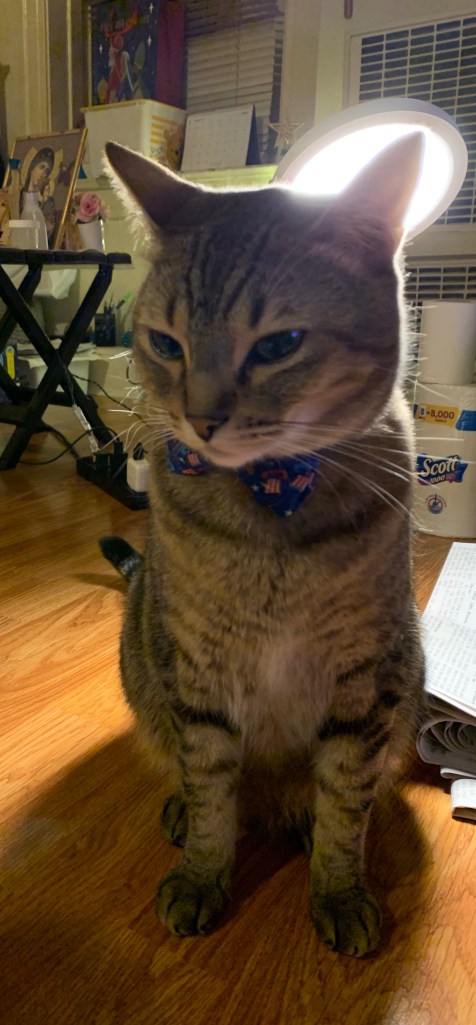
Eckstein provides a variety of ideas about cat names according to the guardians’ cultural inclinations, such as history, fine arts, and entertainment. For example, if you are keen on ancient history, consider the names like Cleopatra or Caesar. Picasso or Figaro if you love their paintings. How about Bono of U2? Whatever it may be, one thing is sure your cat loves it by responding to the name. According to a book I read about dogs written by a monk who specialized in dog training, it is advisable to give a gender-specific name to a dog. For example, if it is a female dog, the name should end with the -na suffix. Conversely, if it is a male dog, it should end with -no. Although the canine and the feline are different species, I always think it is convincingly good advice. Hence, I named my tabby cat Toro, derived from Tora, meaning a tigress in Japanese. Incidentally, my zodiac animal is Tiger, so I thought it would be apropos of him. Does Toro like his name? You bet.
Nero, being Nero
My black cat now has a new name, Nero, changed from Camille, the name he didn’t respond to. Initially, I thought about naming him Bono as suggested by Eckstein, not because I like U2 but because I suspected my newly adopted cat being a Bombay cat with his beautifully shiny and sleek ebony fur coat. So I tried it, but there was no response. Then I remembered the song “A Black Cat Named Nero,” I liked when I was a little child. The result was Nero materialized. What can I say? Cats are individuals.
I want to say this book is not only for readers with cats, but practically speaking, it isn’t. Any would-be cat owner or one who has just adopted a cat will find this book delightfully helpful in naming the cat. I have to say it reinforces me to change my second cat’s name from Camille to Nero. So when you call your cat, it should be the one only your cat has and likes it. You will know because your cat will meow. All cats are personal with stories to tell.
What seems abnormal may be normal to you. Seeing dead people may not be the most pleasant talent, but if that’s what you are born with, then it’s normal, and you have to live with it through Kubla-Ross’s famous five stages of dying. That happens to Jamie in his narrative of the coming-of-age proclamation of his identity in this story.
Dead people are like quiet people lurking in the background of Jamie’s life. They appear to him as the last moments of their earthly lives, talking and joking to Jamie, who can see and hear them, albeit rather unreluctantly, because he’s not much pleased with his uncanny ability. But then it’s the discerning talent -says the Bible – that helps him know who he is, like an epiphany of a family secret locked in his uncle’s lost memories, thanks to nature’s force of dementia. However, this story is not so much a psychological thriller as a supernatural drama that is so characteristic of Stephen King’s novels, with a level of uncanniness combined with realism that makes his stories all the more real and relatable. The settings, the dialogues, and the jobs the characters have are not far-fetched, fanciful, or bourgeoisie, all of which attest to King’s engagingly realistic storytelling skills.
Later is a three-fold story of horror without goriness, mystery without glamour, and bildungsroman without teenage angst. King has a unique knack for incorporating popular entertainment with serious literature that attracts readers of all generations and classes. He is a literary descendant of Nathaniel Hawthorne, Washington Irving, and Edgar Allen Poe, who defined American literature in the constellation of the World’s Literature for the joy of the beholders from generation to generation. All in all, this book will be one of the stars in the constellation.







You must be logged in to post a comment.