
Yesterday, yes her day
like any day as her only
today became bygone
like today, the moment
like this now, gone, ticked
but she can’t just look back
and say it’s just gone away.
Yesterday, yes her day
like any day as her only
today became bygone
like today, the moment
like this now, gone, ticked
but she can’t just look back
and say it’s just gone away.

She speaks the language of wind
only the children of sibyls can hear
in the susurrus of her rich sylvan hair
fluttering in the sweet soft twilight
with the scarlet hues of sunset
lingering in the west of the sun.

In a post-industrial age, when the mingling of classes in streets is a norm, and social mobility is a reality in a society, the stories about royal families become reality period dramas that seem to give them a status that fuses the capriciousness of greek gods with the glamour of Hollywood celebrity.
When I saw twitter’s promotion of Oprah Winfrey’s Harry and Meghan interview, I thought no wonder they were sought-after media darlings, living Romeo and Juliet, and something to talk about when things looked bleak and boring. And I honestly feel no qualms about them being a subject of gossip or the tabloid because they live in public eyes, albeit they most clamor for the privacy of their lives. Otherwise, what is the absolute need to broadcast their stories on a central television station at prime time? (No YouTube, please, in respect of their royalty.) Oprah Winfrey, who now seems to have replaced Barbara Walters’ seat, looks fit to the royal couple pleading for upscaled sympathy from the American public unfamiliar with the constitutional monarchy and possibly slightly partial to the name and images of monarchy without knowing them well.
To put the wedding story of Prince Harry and Actress Meghan Markle on a par with Cinderella story is to ignore the fact she is from a privileged class in the States with expensive private education and parental support. Despite Princess Diana’s aristocratic family background, people sympathized with the lonely Diana because of her doe-eyed, ever muliebral innocent beauty that looked impossible for debauchery. By the same virtue of beauty fused with sensualness of exotic charm, the American actress/model Meghan charmed Prince Harry, who would even venture to Hesperides’ garden to bring her a golden apple should she request. And now Harry lives in the Golden State, the land of his Helen, with a face launching waves of media coverages.
Ralph Waldo Emerson said that beauty tames the savageness of brutes and allays the hardened souls of criminals. Oscar Wilde added that a beautiful woman is the subject of conversations wherever she goes. The lovely Meghan beaming with sparkling amethyst eyes adorned with apricot cheeks reminded me of a modern-day Helen of Troy. After all, Helen’s prodigal beauty saved her from her first the ireful sword of her first and lawful husband Menelaus, the king of Sparta to whom she betrayed the slain Paris’s brother Deiphobus, her third husband. Despite vehement feminist catchphrases brandishing anti-sexism, beauty is still a woman’s privilege to achieve social escalation in work and an undefeatable power to purchase indemnity for all faults and foibles.
In addition to the claimed blackness of Meghan’s heritage, the media seems to shoehorn it to fit her estrangement feeling in the procrustean bed to a histrionic degree because one cursory glance at her wouldn’t strike her as a black woman at all. I honestly think that if a woman is beautiful, then where she comes from does not matter. In fact, I feel something is not quite right when someone in her position keeps playing a race card as a chance gambit to muster her retinue against the criticism raised by her unwilling participation in royal attendances and cavalier attitude towards learning the royal manners, which appear antithetical to her carefree American spirit hard to domesticate.
Call it an acrid narrative of a woman who juggles the daily affairs of life with what she has. Or you may say it is the usual cynical delusion of reference to those who got it all out of passionate envy burned in a fury. Yet, the interview appears to be nothing but their formal excuse for their present life, public proclamation of their still regal sovereignty warning people not to speak ill of them, which is probably directed to the ordinary whom they regard as meddlesome. Well, then let them be whoever they want to be. Playing Romeo and Juliet’s roles in a public theater in long-run shows will only lose favor with the audience, especially with Romeo now being well-stuffed, looking like a rich American, and Juliet still looking fabulous like a luxurious Beverly Hills demimonde.

The question of “Who discovered America?” lends itself to enlightening trivia pastime, spawning a series of plausible answers. Leif Eriksson and Christopher Columbus contend the discoverer’s title, possibly followed by Walter Raleigh and Francis Drake, except one John Cabot whose name is lost with his ship somewhere in the Atlantic Ocean just as his mysterious disappearance during the final voyage.
Giovanni Caboto, aka John Cabot, was a 15th-century Venetian maritime merchant, emigrating with his family to Tudor England in search of substantial royal sponsorship for his ambitious Far East expeditions. The age of expedition was imbued with the spirit of enterprise that propelled colonialism. England was no exception to the European competition. Spain and Portugal were the contenders for uncharted lands and undreamed waterways discovered by Christopher Columbus, Casco de Gamma, and Fernando Magellan. Cabot promised Henry VII that he would find the ways to the Shangri-La in honor of the land to the king with portions of profit for the homage. The king granted his royal patronage on the expedition in the hope of establishing a British mercantile empire around the world. After two misfortunate voyages, Cabot finally made it to what is now known as America in 1497 and called it “New Found Land.”

However, unlike his contemporary peers whose deaths are recorded either orally or textually, Cabot’s end as an explorer is undeservingly clandestine and amorphous. It is said that Cabot was a victim of mutiny among the seamen on his ship or that he settled in the New Found Land and died there. What is more confounding than the mystery of Cabot’s whereabout is the seemingly less recognizance of his achievement than that of the rival explorers of his time and posterity. Cabot was the first explorer who paved the transatlantic waterways between America and Europe, principally the British Isles, for the progeny.

Indeed, Columbus found the West Indies and the American continent by happenstance. Still, Cabot proved that rapid Atlantic travel was possible by sailing the west through the ocean, more substantially practical and influential than America’s ideologically symbolic discovery by Eriksson and Columbus. Would Cabot’s discovery of America under Henry VII’s banner be an issue for the recognizance of his achievement for independent minds of Americans liberated from the English sovereignty? Or, to put more blatantly, would the English royal sponsorship of Italian native Cabot’s exploration mar the spirit of American liberty? If England were still a Catholic country, would Cabot’s achievement have been of lesser brilliancy than those of his contemporary explorers? The questions of history require answers, but often they remain unheard and trail off in the wind of zeitgeist.
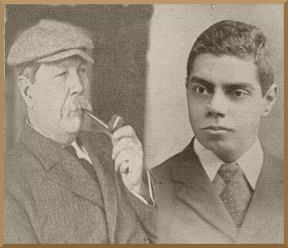
Sometimes the truth is so strange and mad that you wish yourself dreaming when you awake. That is what Sir Arthur Conan Doyle must have realized when he got a letter from one George Edalgi. The story read springing from Doyle’s Holmesian stories. Britain’s beloved author, partly curious and mostly indignant at the case’s stupendousness, felt responsible for searching the truth as the creator of his alter ego, Sherlock Holmes. So Doyle met the client Edalgi face to face in a hotel in January 1907.

George Edalgi, the eldest son of Parsi-English vicar in the small mining village called Great Wyrley in England and former solicitor, served seven years of penitentiary servitude for the Great Wyrley killings of 1903 he claimed innocent. Edalgi’s case was an ipso facto example of miscarriage of justice on indubitably evident grounds of racially imbued personal vendettas against him and his family for who they were. The Edalgi family, despite Charlotte, the mother, and wife, being white, were regarded as heathen Indians encroaching upon the comfortable life of the English, or more precisely, the white privileges, which was the bastion of the eyes of the most villagers. Since the beginning of Reverend Edalgi’s vicarage, the family had been constant targets for racial slurs and hostility that perpetuated the peaceful family life. Even after George became a lawyer, the villagers continued to disrespect his presence, culminating in the notorious Great Wyrley killings of 1903 in which livestock, including horses and cows, were atrociously mutilated and left dead in horrible agony. As Wyrley was a closely-knit village of miners, the easy target for the blame goes for the Edalgis, especially for their eldest child George. He was a loner with distinctively ethnic physical features roving around alone in rumination on evenings. Any white person doing the same ritual would seem philosophical, sentimental, or poetic even, but it did not apply to George’s leisurely ceremony.

Upon consulting George, who must have thought Doyle as the only person on the British Isles to listen to his truth, Sherlock Holmes’s writer has the hunch that the client could not possibly have committed such an abdominal crime for the following reasons. The trappings are so fitting to a conspiracy that they stink:
Doyle’s real motivation for campaigning for George’s amnesty is curious speculation. Yet, it was the darkest night of the soul when Doyle answered the call for justice. He lost his wife Louise to tuberculosis while he was in love with Jean Leckie. Doyle took Louise’s death as a pang of his consciousness for seeing another woman at the time of her illness and regarded the letter from George as redemption of his soul to redirect the ship adrift after maelstrom. Whatever it might have been, Doyle was one of the most ardent campaigners for George’s pardoning to reinstate his legal career and restore his tainted honor. The fruition bears two tastes of the victory: the case led to the establishment of the Court of Criminal Appeal in 1907, and George was allowed to practice law again, which he did in London. However, the official government’s compensation for George’s time from the malice of injustice yielded nothing. Soon the case and the name George Edalgi became a thing of the past unless Arthur Conan Doyle chimes the bell with the forgotten. 
This story I read from a British history magazine makes me think of what an author should be. An author sees the corrupt humanity and ills that cause it, stands furious with the honest minds, and speaks to the corrupt minds amid the chaotic order of nature that goes against truths. Charlotte Bronte posited that an Author has a faithful allegiance to truth and nature. Bestselling or obscure, an Author represents humanity who can see what others oversee or trivialize in preference to magnitude in power and splendor in fame. In that light, Conan Doyle deserves special homage for his search for truth. That is why he is still a great author in posterity.

Hounds are racing; horses are galloping,
She is running up on the hill so steep bedraggled
Panting in staccatos of fleeting hopes
for her star that someone stole away.
So she runs up on the hill again and ever
Till she finds her lost star.


You must be logged in to post a comment.