Tag: Writing

  • music, the moody food for the mind

    Music is a universal language of humankind, as perspicaciously illustrated in a segment of the film ‘Mission’ where benevolent Jesuit missionary Gabriel plays the oboe on the top of the stiff cliff surrounded by the heathen natives. The beautiful Gabriel’s melody enters the souls of the natives, stays there in wonder, enough to disarm all hostility toward Gabriel and open their hearts. The language of music intoxicates the heart and satisfies reason and nothing more.

    But that is not what it is like in this world we live in. Music is perceived as an ideological, political tool for suppressing and propagating specific ideas by persecuting the proponent of a theory that irks the majority populace, as posited in scholar John McWhorter’s article “Is music theory really #SoWhite?” The article’s gist is that two music professors at Hunter College are in a row because of their different opinions about renowned Austrian music theorist named Heinrich Schenker criticized for his openly racist views on just about everything. Schenker is long dead, but his genius in musical theory still retains magnificence among academics worldwide, including those whom Schenker might not have regarded as kindly and respectfully. One of the proponents is professor Timothy Jackson, who highly esteems Shenker’s musical theories irrespective of his personal belief and ideas.

    The nemesis comes in the name of professor Phillip Ewell. He is also a cellist and half-black, attacking his peer Jackson to defend Schenker’s racist views that are an essential part of his music theories, so to speak, campaign for Jackson’s dismissal from the college the count of racism. That is not the end of Ewell’s fury against Shenker and his admirer. The arrow also shots Ludwig Von Beethoven’s bust, whom Erwell thinks doesn’t deserve the genius composer’s high appellation because the panegyrics from white supremacists ornaments his abilities.

    Reading the article with the images of the dead Shenker and the two professors at tirades, so to speak, in my mind’s vision, I feel like watching an inquisition tribunal or communist party’s kangaroo court where the innocent not committed crimes regardless of his/her personal faults or weakness is savagely summoned and tried without attorney testifying the truth. The truth, said Edgar Allen Poe, is the satisfaction of reason, the fulfillment of judgment. I understand Erwell’s fury erupted in the BLM movement’s wake, which brings the suppressed matters into the light. But the accusation of Jackson as a racist that hurled him to the center of controversial debates at the expense of his livelihood because Jackson spoke for Shenker’s work as values attributable to the benefits of arts doesn’t seem to hold water. You can have a heart burning with passion with a head kept in the cold with reason.
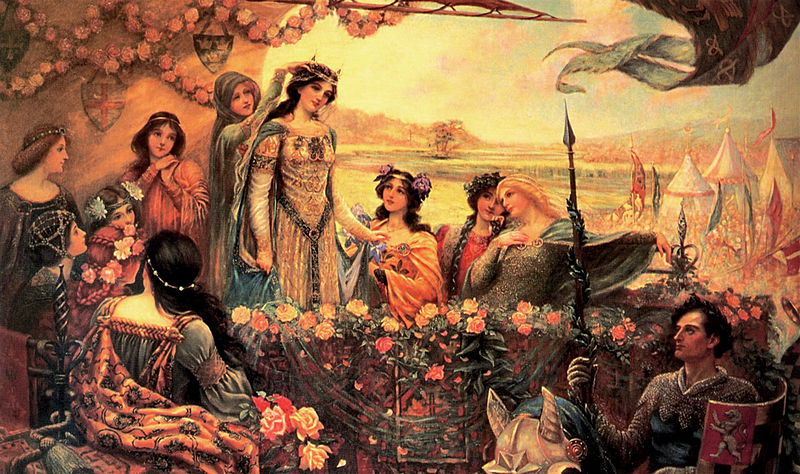
  • Avalon

    Across the five continents and seven seas
    Beyond the bridges of time over the Lethe
    There is the Fortune Isle – enchanting Avalon
    Where all things grow and perfect themselves
    Not by physical labor but by nature’s magician
    in the sovereignty of nine faerie queens’ realm
    of Prudence, Justice, Fortitude, and Temperance
    Adonized in Beauty, revered in magnificence
    As Morgan Le Fay, the Queen of the queens
    Keeps the Holy Grail under the Sacred Oak
    With her half-brother, once mortal King Arthur
    Whom the Queen has brought from the battlefield
    By Black Boat from which her paramour Dane Ogier
    Came to Avalon, where his journey ended in a tryst
    With the Queen by the lake of shining waters
    Where she brought her son Oberon into light
    who became the king of faeries and married Titania.
    Avalon is near and far, real and mythical from whither
    Truth and wishes are sought after and eloped together.

  • the sound of the sea

    Where the ocean sends forth

    The breeze of the shrill west

    Pegasus gallops over the waves

    Neighing in wondrous force, full of pathos

    Dolorous, vigorous, resembling

    The great conch of Poseidon, resounding

    Across a boundless reach of the sky.

  • ‘Poltergeists: Then and Now’. by Wayne Ridsdel – book review

    Poltergeists: Then and Now

    From Plato, who believed that the dead walked around a cemetery, Pliny the younger who told of his friend’s in Greece encountering a ghost of an old man in a chain, and Arthur Conan Doyle, who himself manifested as a revenant looking for his lost diary in his former early abode, there is no distinction between the learned and the general in acknowledging the existence of spirits. There are more things on earth than are explained in theories. Poltergeist: Then and Now by Wayne Ridsdell revisits the places where the noisy spirits were/are reputedly manifesting themselves and lets the reader judge the veracity of the existence of the century-old poltergeist on his own.

    The book reads like an anthology for the history of poltergeist 101. The author has gleaned several famous poltergeist cases from the Cock Lane Poltergeist to Borley Rectory Haunting, The Enfield Poltergeist, and the Rosenheim Poltergeist. They are all too familiar to stimulate the reader searching for a new case of the subject, even if it may not be as sensational as the aforesaid famous cases. But in all fairness, the instances’ enumeration latently serves as suggestive DYI touchstones for discriminating the genuinely supernatural from the others, including mental illness, fraud, or overt imagination. Take, for example, the Cock Lane Poltergeist and the Mayfair Ghost, aka Berkeley Square ghost. Despite the shocking incidents recorded in the annals, the circumstantial evidence surrounding the cases arises from a jilted lover’s malice, the rage of failed expectation, and rambunctiousness of avarice, manifested in one big hoax of an invented poltergeist. Although the authors do not directly debate the cases’ truthfulness, the detailed accounts of the stories behind the issues bespeak the possibilities of stratagem.

    What lacks in the originality of strange poltergeist incidents makes up in the unveiling intelligence about historical and literary relations to the ghostly phenomena. For example, the haunted 50 Berkeley Square in London inspired Rudyard Kipling’s “Tomlinson,” a poetic version of the Book of Dead retold in his poetic vision is a gem to discover. From London, the reader travels to the ghastly Glamis Castle and finds himself in the secret chamber where the sinister force originates from, which no one but the first-born son at his twenty-one birthday can access to. The secret remains intact to this date in the Bowes-Lyons Family, the castle owner, who included Queen Elizabeth, the Queen Mother, and the unfortunate Nerissa and Katherine, who were locked up in an asylum for their prenatal imbecility till their death, eschewed by their loyal cousins. The reader’s thirst for the supernatural piquancy in the context of historical evidence is adequately quenched in such information.

    The reader keen on supernatural (not paranormal, psychic, or psychological) stories based on real events might find this book mediocre in contents that are a well-organized summation of case studies. Still, the book is a good primer for the world of poltergeist and its historical record that links the past to the present, which the noisy spirit knows no boundary of time and space. What happened before happens now and will happen tomorrow. I think this is what the author wants to ascertain in this book.


    View all my reviews

  • fancy away

    Carry me into your faerie chariot, 

    take me away from this humdrum rut

    Over the bridge of the rainbows

    Far away to the Elysian gardens

    Where I will promenade fancy-free. 

  • ‘The Boy’ (2016) – film essay

    Invitation, Manifestation, and Escape are typical acts in horror movies from ‘The Exorcist’ to ‘The Changeling’ and to ‘The Others’, all of which are supreme ones of the genre, demonstrating the genuine scare is without a masked slasher on a killing spree that seems to revive forever like a Phoenix. But what about ‘The Boy’ (2016)? The movie is a lackluster flick, a smart apprentice of the masters mentioned above but without depth and breadth of knowledge of the essence of things, natural and supernatural.

    It follows a young American woman with a past named Greta (very German or Grimm maybe?) hired by the overtly strange elderly couple as a nanny to their little son Brahms (possibly Bram Stoker?), a porcelain doll. As in Kubler-Ross’s Stages of Death, she shocks and denies, then accepts that she is a nanny to the doll. Of course, pretty Greta is not lonely because a young, good-looking grocer named Malcolm courts her as politely suavely as an English can be. Then Greta’s ex-lover Cole, who is the epitome of big, rough, and domineering man, suddenly manifesting from America in the English mansion, demanding she should leave for the states in the morning with him. And that’s not the end, for we are rudely introduced by a third character (or the same?), and the stupendousness of the story swivels in the flashes of screams, blood, tears, etc.


    Watching this movie last night on Netflix made me think that the classic horrors of the 70s and 80s were indeed long gone and would not revive – at least for now. What begins as a classic supernatural story ends as a tepid escapade from one big mess. Greta’s coming to England is loosely explained, not to mention Cole’s sudden appearance in the English countryside manor is abruptly shoehorned into the story, breaking the thread of subplots, changing the atmosphere of the movie into a thriller that is not supernatural at all. Nevertheless, Lauren Cohan’s performance as Greta is commendable for her naturalness and arduousness in portraying her role that is the only gem of the movie that makes it watchable without turning it off.

    Maybe I am either anachronistic or fastidious in selecting horror movies because of my propensity for subtle but incredible supernatural thematic elements without monsters, deformed humans, or amorous lovers. So be it. It’s all about how a story is intelligently and entertainingly told on the screen with minimum special effects, gore scenes, love scenes staging in either big swanky English country houses or big deserted mansions that are conveniently used as thematic elements. Reading the background information on this movie, I have noticed that there are quite a few production companies involved in making it. Would it be the reason for turning this otherwise excellent thematic element into a dull child’s play? Did all the companies know a thing about a movie not in monetary terms but art for art’s sake? I wonder.