Category: BIBLIO ECRIT

  • Reading Book II of the Aeneid by Virgil

    Thursday, September 10, 2026

    I often wonder why God allows the ills of society to persist and their victims to suffer violence for no reason. What are the sins of children who suffer such violence? Why can’t he care more about changing the fates of these children? The same question arises through Aeneas in Book II when he sees his beloved Troy burning and, with a yearning heart, seems to demand an answer. If fate requires suffering, what is fate? Is God truly omnipotent and omniscient?

    Book II is Aeneas’s ballad of burning Troy—the story of his fate, which does not allow him to enjoy the ordinary life of a married man. His life doesn’t seem to be protected by the gods, even by his divine mother, who appears to her son as Venus, not as a mother. They force him to fulfill sacred pietas by carrying Troy’s future to foreign soil, where his descendants will build Rome. He tries to resist their gambit on the chessboard, where he is their number-one knight, moved around at their pleasure. Even his mother Venus is part of the divine ilk and hurries him out of Troy like a mom sending her son to school before it’s too late. In Aeneas’s mortal eyes, the idea of becoming the forefather of Rome appeals to him less than being a husband, a father, and a son at home. Can even his divine mother protect him from this fate?

    Gods are cruel just as God is cruel. They make his life easy only when he acts according to their will. Without the gods’ command, Aeneas would not have thought of fleeing the burning city with his elderly father Anchises on his back, his little son Ascanius at his right hand, and his wife Creusa following behind. But then Creusa must stay away from her husband, who has a duty far greater than his personal life. Her ghost appears and tells Aeneas that he must leave; as she vanishes into the folds of mist, all his chances of escaping his fate and its burdens vanish with her. He has no reason to stay but must move forward against his will.

    The Trojan Horse, Laocoön and his two sons engulfed by the sea serpents, and the cries of Priam and his wife Hecuba all signify the great labor of birth in the process of dying, all within the fate of a man who must act out his assigned role in the divine chess game.

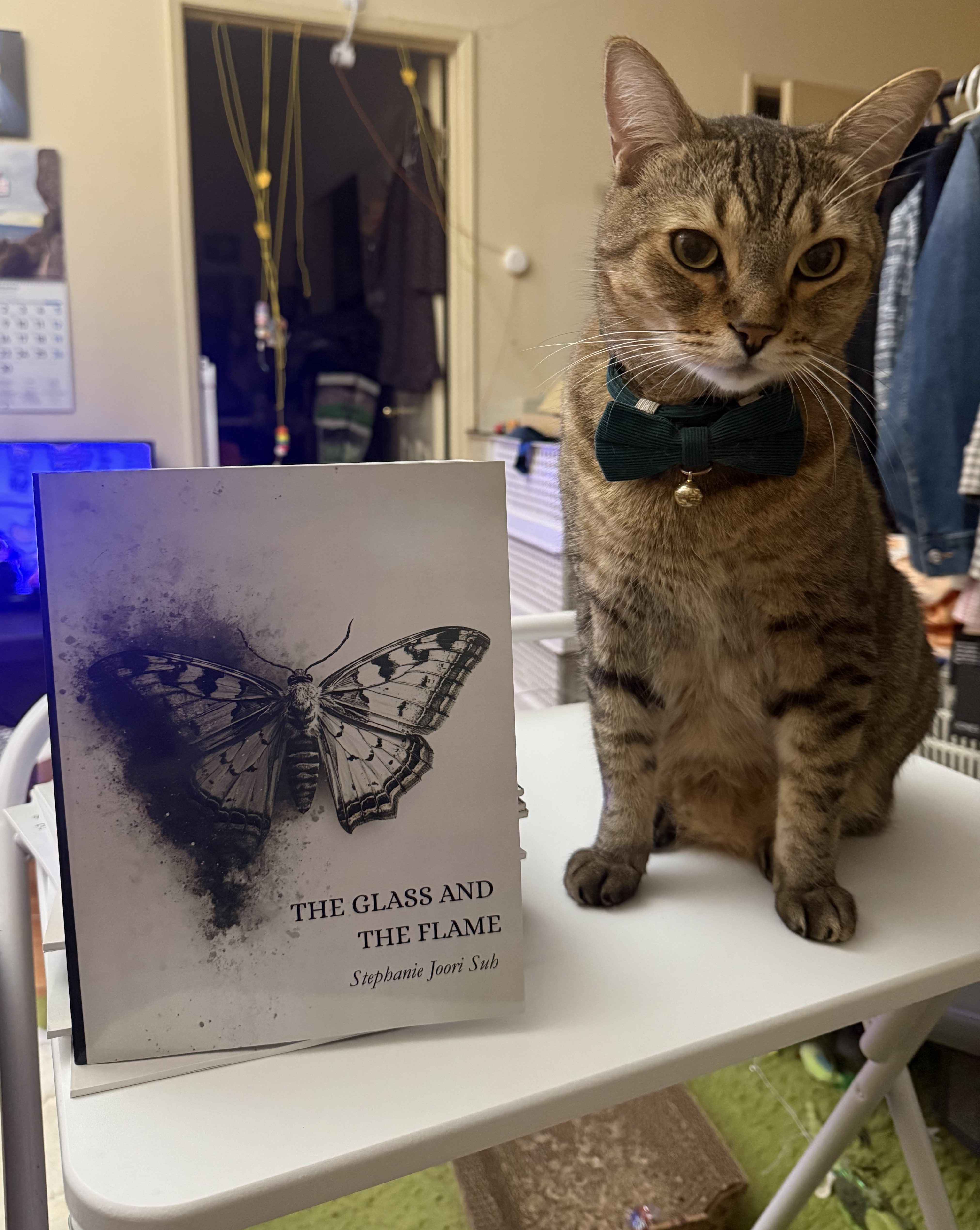
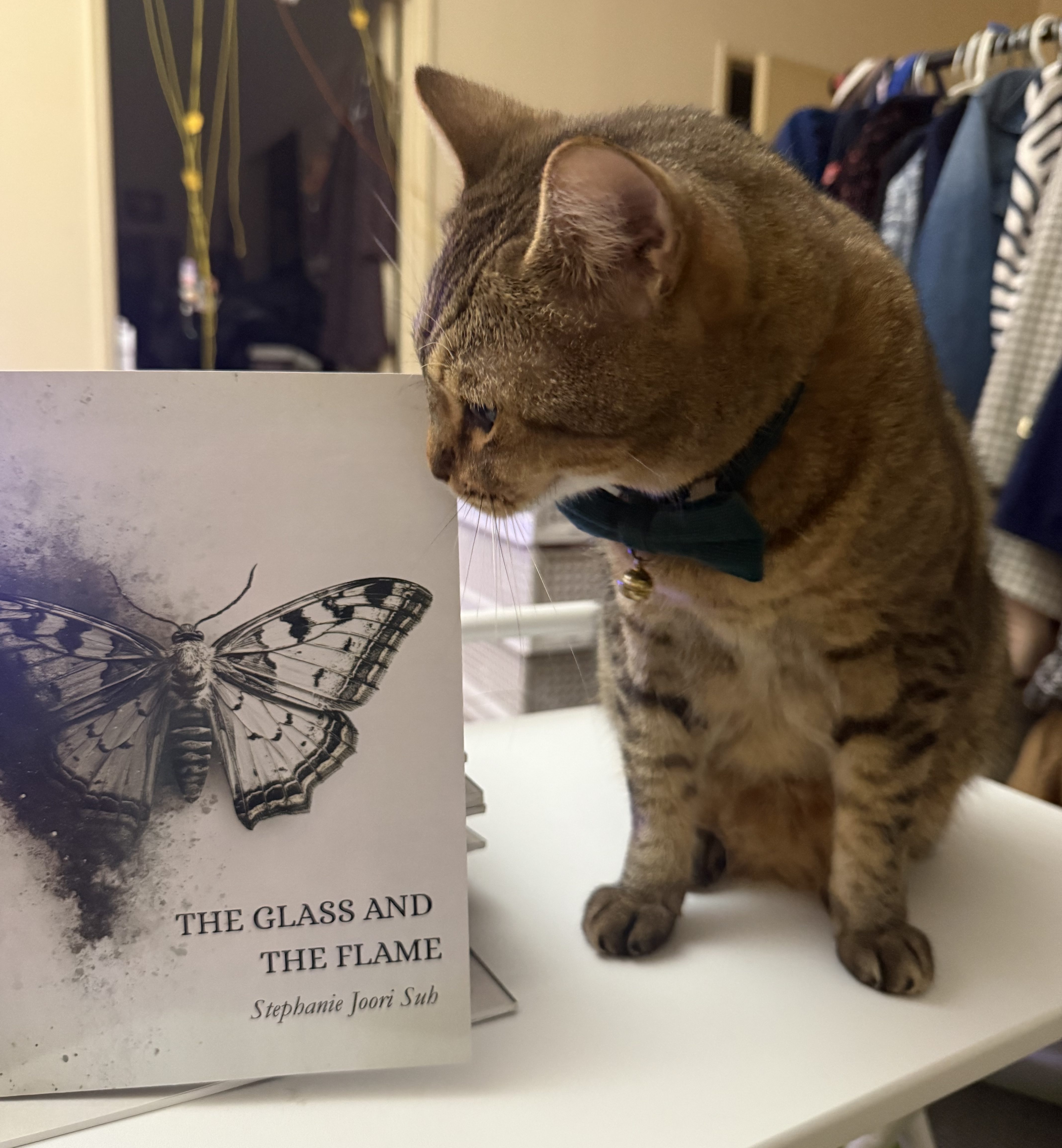
  • So This Is It: The Glass and the Flame

    My First book ever selected and published by an independent press. I knew that one day I would have my own book published. It is not arrogance disguised as confidence. Writing has always been part of who I am.

    The Glass and the Flame is a fugue of the heart, woven from multiple strands of longing and sorrow into a polyphony of eros and psyche. I have learned that you can write the felt without being met.

    The axiom that “you are who you are” is not necessarily true in my writing. Rather, I am what I write.

    In terms of Orwell’s reasons for writing, I write from aesthetic enthusiasm and sheer egoism. Neither political purpose nor historical impulse belongs to my work.

    If you dare, walk with me in the garden where Eros freely roams with Psyche.

    Listen to what I sing.

    The Glass and the Flame now lives in the world.
    You can find it here: https://dulcetshop.myshopify.com/products/suh

    Sincerely,

    Stefania

  • I Have a New Home on Medium — Come Find Me There

    For eleven years you have read me here. I am still here. But I am also writing on Medium now — longer essays, book reviews, and the kind of prose that arrives at midnight and demands to be written. Come find me: medium.com/@etoile1291

  • Prompt 19

    If you could be a character from a book or film, who would you be? Why?

    I am one of those sentimental folks who tend to make a parallel with themselves to the characters of a story in a book or film due to an uncanny spiritual ability to channel into the psyche of another. Methinks this could be something of an ancient Greek or Roman Sybil, who foretold the prophecies at holy places in ecstatic mania. Accordingly, my choice of avatars is of independent, strong-willed, but mistaken women whom people could not fail to notice out of the melee: Cassandra and Ariadne.

    Cassandra, the daughter of the last king of Troy Priam and his wife Hecuba, was a priestess of the god Apollo, who bestowed the gift of prophecy on her. However, when she refused the god’s amorous advance, the cruel god fated her not to be believed in her predictions. So when Cassandra warned her people of the fall of Troy, they didn’t deign to acknowledge her but to scorn her for such hokum. Alas, poor Cassandra! I knew him, Ariadne, for your beautiful deed and heart was betrayed by Theseus, whom you helped kill Minotaur and save the Athenian youths from the labyrinth! Theseus abandoned his beautiful savior on the island of the Naxos and sailed on to Athens. Why did he forsake her? It’s because the goddess Athena told him that Ariadne would be nothing but a nuisance in his way of constructing her namesake city-state! Before being the sacred and immortal goddess, Athena was also a woman, but how could she force Theseus to bloodlessly forsake the poor Ariadne, whose benevolence saved the youths of Athens?

    Both Cassandra and Ariadne’s benevolence and strong will were not appreciated by those whom they helped or tried to help. What a tragedy it was! Likewise, my heartfelt intention and humanity meet with cold shoulders or the least respect from the people I help and have helped. Sometimes I wonder if nature bestowed beauty on me, would they be unkind or appreciate who I am? Then I think of Cassandra and Ariadne and cannot help but feel for what they had been through.

  • Prompt 18

    What job would you do for free?

    I would work for something attending to the welfare of cats pro bono. With All My Soul, All My Might, and All My Spirit. The best place for me to do this is probably in a shelter or a rescue center where I can devote myself to cats needing help with my undivided love for man’s best consort.

    Being a cat person not made of the crude materials of this world, I feel most comfortable with my two cats, Toro and Nero, at home. Who says that cats are aloof and egoistic? Hardly so. Cats are so affectionate and kind and beautiful both externally and internally. Lucy Maud Montgomery, the author of Anne of Green Gables, was a cat lover who averred the beauty of the feline folk: “I love them. They are so nice and selfish. Dogs are TOO good and unselfish. They make me feel uncomfortable. But cats are gloriously human.” Indeed so, for when I am crestfallen because of the woes of daily life in this world, my cats come next to me and nestle their little furry body and soft head under my arms, purring, consoling, and allaying my fury and disappointment and sadness. Unlike my fellow human species, my cats know me well and accept me for who I am. They say animals can see the true colors of our characters. True, especially in the case of cats who can see spirits.

    I have noticed that people dislike cats with a sense of pride as if there were some peculiar virtue in expressing such shameless disapproval of cats. So be it because cat people are a particular tribe whose sensitive nature and delicate sensibility fit those of cats. Edgar Allen Poe and the Brontë Sisters would ditto in the constellation of literary stars excellently bright in heaven with their cats in their arms, purring and meowing. Therefore, in light of those mentioned above, why wouldn’t I willingly work tending cats free of charge?

  • Prompt 16

    What’s something most people don’t understand?

    Oscar Wilde admired beauty. So much so that he proudly proclaimed that he chose his friends for their good looks, his acquaintances for their characters, and his enemies for their intellect. But at least he’s honest about it, vocalizing what most people do when judging one another based on what the eyes, not the minds, see for the instant recognition of optical illusion morphed into reality.

    Our society favors gregarious extroverts, not reticent introverts nestled in the shade of anonymity, not because they are antisocial but simply because that’s how they are. Not everyone is uniformly outgoing. Nobody is impossibly happy go lucky. I always find it scary that having a happy face all the time is a specialty of a psychopath in disguise. But people do not usually warm to those who are lonely, quiet, or not so attractive, instead pinning them down as anti-social, incompetent, or negative to stay away from them. It amazes me to see people gossip about or ostracize unpopular, reticent people the way people falsely accused innocent women of practicing witchcraft in the past because they were in their selves. Or are they still? Come to think of it; if I had been born during the days of heightened witch-hunting, I would have been burned at the stake.

    I feel that people do not like to talk to me because I don’t have the face of Helen of Troy to launch a thousand ships or do not open up a conversation first, or because of my race being Asian, a race stereotyped as being docile, if not submissive, to voice out what’s kept inside. Notwithstanding the account above, I do not want to force myself to become someone I am not, cannot, and will not because, as Wilde pinpointed, I am myself since others are already taken. I am not a negative person who always accounts for a litany of woes. Instead, I can see people’s ills in the swing of things around me and how they affect me. If discussing the malaise of what’s happening in my life when I need a company to share grief in halves, I call it cruelly erroneous and unjust.