Category: Miscellany

Anything that’s on my mind.

  • the image of the war

    original
    from International Archive

    When Oberon, the king of Fairyland in Shakespeare’s The Midsummer Night’s Dream, demands that queen Titania yield the human child whose mother is a votary of her order,  she remonstrates thus: “Set your heart at rest. The fairyland buys not the child of me.” The queen is adamantly protective of her human changeling for the sake of his well-being. Then I see one of the famous photos of the war children, which was taken in the wake of the Korean War, as shown above in this post. Where is their Queen Titania in her fairyland? Or more tragically, has she forsaken these little children in their own care? What would have happened to them?

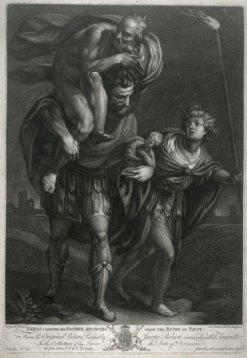
    The face of a doleful young girl carrying her little brother before the tank needs no assistance of words with a surge of the pathos of child refugees who were forced to grow fast in the reality of war. Wandering about their whereabouts now in mind conjures up the mental picture of Aeneas carrying his elderly father on the back, escaping from the carnage of the war behind. Both the elderly father and the younger brother are prone to any seismic events because of their weak mentality and physical strength, and therefore require special care at all times. Aeneas, the man destined to become a founder of Rome and the nameless girl, is, in fact, are brought together by the collective experience of war, bound by the familial duty that requires sacrifice.

    4157201206040087
    Aeneas carrying his elderly father

    Notwithstanding the official cease-fire agreement unwillingly made and entered into by and between the Two Koreas, the tension, the disbelief, and the conflict of the political, social ideologies are still in the consciousness of the North and the South, keeping the amber of the war volatile around the 38th Parallel Line. This current unfinished state of the war is arguably akin to the 10-year long Trojan War between the allied forces of ancient Greece and of Troy during which the Trojans continued to carry about living in the semblance of the ordinariness of life.  The compelling, emotive picture of the little Korean siblings attests to the atrocity of war that forfeits the innocence of childhood that every child in the world should have. It pleads in silence that we as citizens of the world should prevent a reprise of the Trojan War not only in the Korean peninsular but elsewhere in the world so that no more war children of their kind will be begotten by the tragedy of war.

  • Magical windows of the misty past

    The story of man and beast decorates the wondrous latticework of the enchanting casement of Greek mythology. The ancient Greek weavers of stories used their poetic license to mirror the human traits, both attractive and unattractive, through the figures of the beast in scintillating ways. The resultant mythology created an aura of mysteriousness wonderfully anchored in reality whose thematics were originated in, such as the following tales from Greek mythology that reflect the nature of humankind as mirrored in the perspectives on the natural elements of animals and the relations to it.
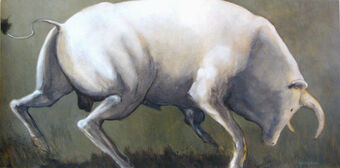
    Cretan_Bull
    The Cretan Bull
    • The Cretan Bull and the Minotaur 

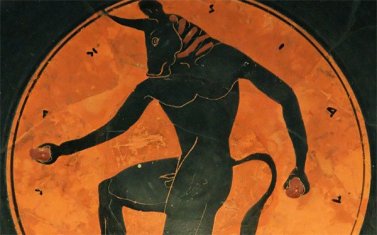
    The story of a half-bull and half-man monster known as the Minotaur epitomizes the primordial thematic perspectives of mankind juxtaposed along with the law of nature representing the mysterious force. It became a subject of belief tradition peculiar to its natural and cultural environs. The conflicting sentiments of reverence toward the awe-inspiring nature’s creatures and the ambition for domineering them as the ruler of the universe give birth to the bestial creature in the figure of the terrific Minotaur who was fated to be slain by the Athenian hero Theseus. 

    minotaur
    The Minotaur

    King Minos betrayed Poseidon by keeping his beautiful snow-white Bull, instead of sacrificing it to the expectant god, who, in turn, made his wife Pasiphae unquenchably infatuated with the Bull. She copulated with the beast by taking herself into the form of a hollow wooden cow designed by the Athenian architect named Daedalus. The result was the Minotaur kept in a Labyrinth by the selfsame designer of the wooden cow. The Minotaur showed no human feelings or emotions as the mythology did not treat him any more than a horrible bestial creature from the unnatural union of a woman and a beast. 

    A Bull in the ancient Greek culture was a chthonic animal associated with fertility and vegetation and also represented the sun and the might. In fact, the famous figure and paintings of bull-leaping are seen inside of the Minoan mausoleum in Knossos as first discovered by the eminent English archeologists Arthur Evans, who also found Linear A and B letters, the mother of the ancient Greek language, at the turn of the 20th century, 

    Unknown
    Argos finally uniting with Odyssey.
    • The dog – the best friend of mankind

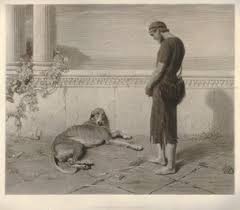
    The perspective on the dog as the loyal canine companion collapses the millenniums between the ancient Greek’s time and ours. Even the Cerberus, the three-headed guard dog of the Hades look tamable with a piece of sweet cake, making it look less of a menacing beast necessitating the blood and flesh of man. This goes without saying that it was Argos, the paragon of the faithful canine, who recognized his travel-weary employer Odyssey after 20 years of absence from home and put forth what might think he had to approach him with a wagging tail. He died as his long-waited boss in incognito passed by him with his heart pounded by a surge of pathos dubbed in warmth. Of all the gods, goddesses, heroes, and even his family, it was Argos who showed genuine, artless unconditional affection to Odyssey and thus rendered his heroic owner all the more humane and sympathetic. 

    Laelaps_web
    Laelaps, the dog that never fails to catch

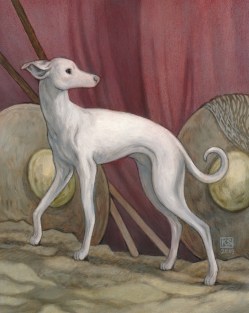
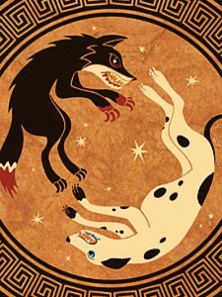
    Speaking of loyalty, Laelaps, a Greek mythological dog that never failed to catch what it was hunting, also denotes how the ancient Greeks perceived the dog as their life companions. Laelaps was initially a gift to Europa from Zeus, then bequeathed to Minos, who gave it to his concubine Procris whose sister included Pandora. She gave the hound to her husband Cephalus as a token of her unbroken love for him Cephalus used the hound for hunting the Teumessian Fox that could never be caught. Then Zeus turned both of the animals into the stars as the constellations Canis Major (the dog) and Canis Minor (the fox).

    12916666_f496
    The Eternal Catch-Me-If-You-Can between Canis Major (the Dog) and Canis Minor (the Fox)

    Consequently, the use of the animals above in the thematic context in the Greek mythology evinces that mankind cannot exist alone as part of nature. Man finds his meaning of what it means to be a human and its purpose in life by rendering the values and precepts of natural law emblazoned in the human consciousness to the meta figures of the mythology. The mythological animals, whether wild, imaginary, or ordinary, are the reflection of the human traits interbred with imaginary creatures from the Elysium of Fancy. It became the substratum of a belief tradition administering to the modes of social behaviors in society, and thus developed into an organized religion by way of syncretism in the era of Christianity. 

  • the journal of cat writer #1

    additional_7a1d79197752605194d5b4ab7d9c394967566b14-8

    The Roman emperor Marcus Aurelius said, ” Don’t feel harmed, and you won’t be, and you haven’t been.” Centuries later the emperor’s medieval Christian heathen Thomas Aquinas corroborated that no words should do harm on the soul of the heard. Well, it’s easier to say than to be done, especially from the high chairs of big wigs. So much so that none of those self- hypnosis of affirmation prescribed by the privileged rings true to me as I am trying to put together pieces of my heart.

    The cause of the malady of the heart ensues from my twitter correspondence with a literary man over my prescient knowledge of Theodora, a former comedian turned the wife of emperor Justian of East Roman Empire in the 6th century A.D. She was later canonized in the Eastern Orthodox Church, and her feast day is November 14, which he had denied. As it is my nature to strike up a meaningful conversation based on knowledge with an intelligent person with seeming affability, I commented on his tweet politely in bona fide intention to inform him of ill-conceived intelligence. However, the response felt heartbreaking with a blunt inflection that froze my heart instantly.

    By the spirit of utilitarian knowledge, I guided him to Wikipedia source that corroborated the fact. Despite his gratitude for the rectification, the disheartening incident has only cemented my long-term speculation that it’s either I was born luckless to have a seamless casual conversation with a stranger or I am hexed to be kept from anything nice even to the simplest and smallest degree happening to me – ever. Methinks, everything I think and touch turns useless gold with a feckless Midas touch.

    As Shakespeare aptly described, my nature is modulated by what it works in, like the dyer’s hand. I have also found that these flaunty intellectual men and women in the habiliment of affable erudition often turn out to be a superficiality of knowledge and disappointment of heart, floundering me ever in the lurch of disillusion. Moreover, although they seem so dazzlingly smart, they are not always omniscient. Maybe, I think, unless you are educated under the tutelage of kindly Chiron, the wise elderly centaur to whom Achilles, the son of Thetis, and Asclepius were entrusted, the immaculate acquisitions of knowledge and cultural finesse require divine intervention.

  • Officially Haunted, Really

    2ddcc1fd40814bbf40437d087f498150

    Prologue: I wrote this post in March of this year upon reading an article about historic haunted places in the UK from a subscribed issue of ‘BBC History Revealed’. I wanted to contribute my knowledge about the Whaley Museum in Southern California in a letter to the editor. The new July issue arrived on my Kindle Fire this morning, and I saw my letter featuring therein. It was edited in the context, but only for the perfect perspicacity. The letter is, in fact, one of the fifth letters that have been so far published in the magazine. 

    Sometimes they either don’t know they are dead or wouldn’t accept it because of strong attachments to their once earthly abodes. You may think it’s a puerile imagining to believe in ghosts, but there are indeed more things in heaven and earth than are dreamed of in your philosophy. As someone keen on supernatural phenomena happening in the background of our ordinary landscape of daily life, it gave me a fillip when I came upon an article from my subscribed history magazine the other day about the historical capital punishments going horribly awry as though to use the grisly scenes of capital punishment as a reminder of societal retribution for an eye-for- an eye. It also reminded me of a story of the condemned whose ordeal of execution was so unbearably painful that he is still roaming around at his execution site as though with eternal lingering attachment to his earthly life.

    Here in Southern California, the story of James Robinson (aka Yankee Jim) who was executed for attempted grand larceny in San Diego in 1852, is something of haunted folklore that attracts tourists and ghost hunters alike. He was hanged on a gallows off the back of a wagon, but being a tall man with long legs, he resisted being killed by keeping his feet in the wagon but was at last pulled off. His body then swung like a pendulum until he strangled to death. And it was this very site of hanging that one Thomas Whaley, who happened to witness the execution himself, built his dream house where he and his family soon began to hear the unexpected phantom footsteps as if being made by the boots of a large man, walking noise, and the windows mysteriously unlatched and opened up. Lilian Whaley, the Whaleys’ youngest daughter living in the house until 1953 was certain that it was the ghost of Yankee Jim haunting their house. Now the Whaley House is the Whaley Museum, a California Historical Landmark located in Old Town, San Diego, California.

    However, ‘Yankee Jim’ still lives there because although unseen, his presence is felt and heard by visitors and staff at the museum. Never malicious or naughty, the ghost of the hanged man is said to rather shyly manifest himself by footsteps, markings on the wall, or opening and closing of windows. So much so that the Whaley Museum, along with the Winchester Mystery House, is certified by the US Department of Commerce that it is genuinely haunted. So if you live in Southern California, it’s worth visiting the Museum and Jim. I think I may pay a visit. The address is 2476 San Diego Ave, San Diego, CA 92110.

  • Look with thy mind, not thine eyes

    Dear Reader,

    Hey, there! Thanks for visiting my blog and reading my post. And if you express it by pressing the Like button into the bargain, my spirit will surely be uplifted from the rut of my so-called life. If you are further intrigued by my e-book recently published on Amazon Kindle and drop just a few lines of your thoughts about the story upon reading, I will feel like a millionaire without the actual sort of money in my bank account.

    Well, it’s been two weeks or so since I published the e-book on Kindle, but a reception reminds me of the frightfully cold winter of New York City I have experienced. No one seems to read even the first page thereof, according to my Kindle Direct stats. Inevitably, a good book will find its readers without eye-catching promotions or pitiful solicitations for readership based on sympathy. But honestly, I don’t feel comfortable canvassing readership by either of the means. And yet, since I am a girl of contrasts, my ambition for full recognition of my work refuses to be humble and thus commands my unwilling spirit to write this letter to you.

    It’s only 57 pages in total, so the book won’t take much of your precious time. And I must admit that the formatting of the text may seem obtrusively arcane and dense, but Reader, look not with thine eye but with thy mind. The story is worth reading amid flotsam and jetsam of textual wonderland. Just click on the below book cover with one touch of your fingertip, and it will lead you to the place where the story begins via wondrous witchcraft. Many thanks for reading with my whole heart!

    Best, Stephanie 


  • Why I write

    413JqnAw54L
    My very first e-book now available on Amazon Kindle

    Dear Readers,

    Howdy to all. Thanks for visiting my hermit blog either by happenstance or curiosity. Writing has always been my favorite activity by which I feel meaningful and truthful. It has been a magic marble, an alchemical mode of transforming myself into all that I want to become or capable of becoming via the magical process of words. As Francis Bacon corroborates, reading makes a full person, writing makes a whole person by expressing the self to the extent possible. I am not a great writer, but my passionate volition to express my inmost thoughts and feelings that strive for artistic manifestation exceeds such fear of public derision. This yearning for manifested creativity chimes the bell of Kurt Vonnegut’s benevolent adage: “To practice any artno matter how well or badly, is a way to make your soul grow. So do it.”

    Hence I published my first-time official short fiction on Amazon Kindle that is available now for free. It’s a whimsical story without a complex plot about a young girl unsure of herself experiences a kind of Midsummer Night’s Dream or Rip Van Winkle’s fairy tale. This may sound audacious hyperbole, vis-a-vis the works of the geniuses in Literature, but the semblance of thematic and the author’s affinity for the brilliance of the great literature allow her to make a literary parallel thereto, so to speak.

    As some of you may know, English is not my mother tongue but a beloved adoptive linguistic child of mine that I love to nourish and nurture. That said, my first e-book is my attempt at producing a child of labor. This doesn’t surpass the degree of affection for this blog of mine, which is also a labor of love, but writing a book is certainly on a different spectrum of mental efforts.

    Solicitation of readership may come across as an aggressive way of forcing people to read what she writes because it may not satisfy the level of expectations that a reader has set as an intellectual or entertaining touchstone, which is why I find it hard to self-promote my e-book. And yet, despite my shyness fused with hesitation, I would like to request that you try my e-book and leave your feedback on Amazon after reading because that’s the way I can grow into and blossom into a beautiful literary rose in the future. Won’t you as a kindred writing pard throw me a rope of hope to climb up the Alpine Path? Many thanks in advance! 🙂

    Best regards,

    Stephanie