Category: Miscellany

Anything that’s on my mind.

  • Let Children out of Politics.

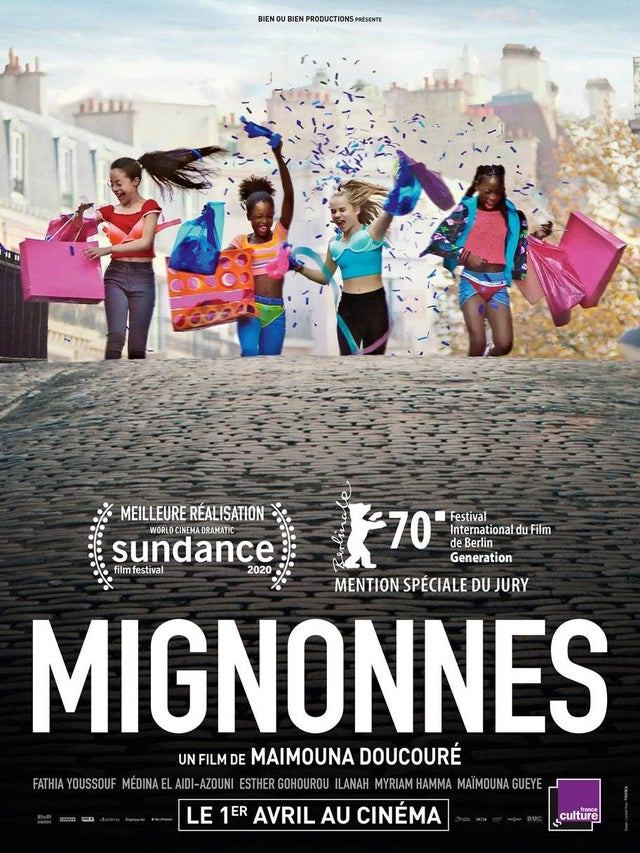
    There has been a vortex of fiery opinions on the controversial Netflix film “Cuties,” directed by French Senegalese Maimouna Maimouna Doucoure as her debut feature. I first heard of the movie while checking on Twitter feed filled with vehement subjective narratives divided -yet again-by the in-vogue trend of racially charged political views, which seems to blur the ambit of art for art’s sake appealing to the universal audience. But the unified viewpoint on the provocative representation of sexualized pre-adolescent girls weighs against the film’s thematic slogan of liberation from oppression, come what may.

    The movie has gained a cult status among self-professed progressive keyboard warriors, defenders of social inequality, when in fact, they are seldom in contact with the people they speak for or even get together in their daily lives. That said, the movie has become something of a visual manifesto of social activism, rather than a joy of cinematic experience that bestows a sensory pleasure and mental piquancy on viewers. No pornification and the misguided display of sexual oppression in children’s figures can be sublimated into art. Children are not a medium of political efficacy or a vehicle of personal ambition. The sexualization of children imitating adult acts is counter-productive in translating onto screen per se the socially disfranchised class consciousness in a highly secular society where the income level defines individuals’ worth. Little girls in skimpy attires, gyrating and eyeing in a way that makes them the cult of Ishtar at a Babylonian temple where girls offer their bodies to strange men for holy prostitution. Or shall I say it is a revisionist adaption of “Pretty Baby” or “Lolita” directed by a black woman whose directorial debut is undoubtedly impressive and provocative in the BLM wake?

    It amazes me to see people think themselves rational and reasonable when they are just self-professed egoists illustrated with their ostentatiously abstract view of social reality that seems to be out of touch with their own class. They regard “Cuties” as telltale cinematic radical feminism and socialism with a view to liberation by the parody of the reality. However, these intellectuals oversee or willfully ignore the truth about human nature: physical, rather than metaphysical; it is tactile rather than theoretical. Our faculty of mind is affected by the works of the senses and of the imaginations. To this effect, ‘Cuties” will adversely affect people’s judgment when their eyes direct toward the visual feast of perverted pleasure because the impulse, when arisen by stimuli, defeats Ego, voids the Superego, and commandeers false promise of liberation with rapacious sensuality.

  • Pets are not of a fad but for life.

    I read the Guardian article “A dog is for life, not Just lockdown” by Donna Ferguson (September 13, 2020 issue) with intimately acquainted feeling shared by our understanding of pets as family members with care, not as luxurious commodities treated with whims and caprice. Her search for a Poochon puppy for her daughter reminds me of my own story of the recent adoption of a tabby kitten from a shelter.

    As I was going to move into a pet-friendly apartment, I was excited to bring a dog into my new home to share companionship. However, during my search for a canine company, I became aware of the ugly reality of “pet business” intent on swindling and ripping off naïve would-be pet owners. Ferguson’s experience of encountering sellers of puppies suspected of scamming or deceiving chimed the bell of my experience in which a dubious welsh corgi breeder insisted on “shipping out” a puppy to me in the convenient pretext of Covid-19 protocol. Even legitimate ones are not exempt from my continued disappointment: Shiba breeders in Southern California had their waiting lists closed. One pet shop owner on the phone revealed to me that since the outbreak of the Covid-19 and California state made it difficult to sell and buy a pet at a pet shop. Hence the supply and demand for pets have become disproportionately unbalanced, skyrocketing the price of dogs immensely. Worse, the procedure of adopting dogs from shelters makes it excessively challenging and disheartening for bona fide would-be owners disappointed with the requirements of a near-perfection environment for dogs.

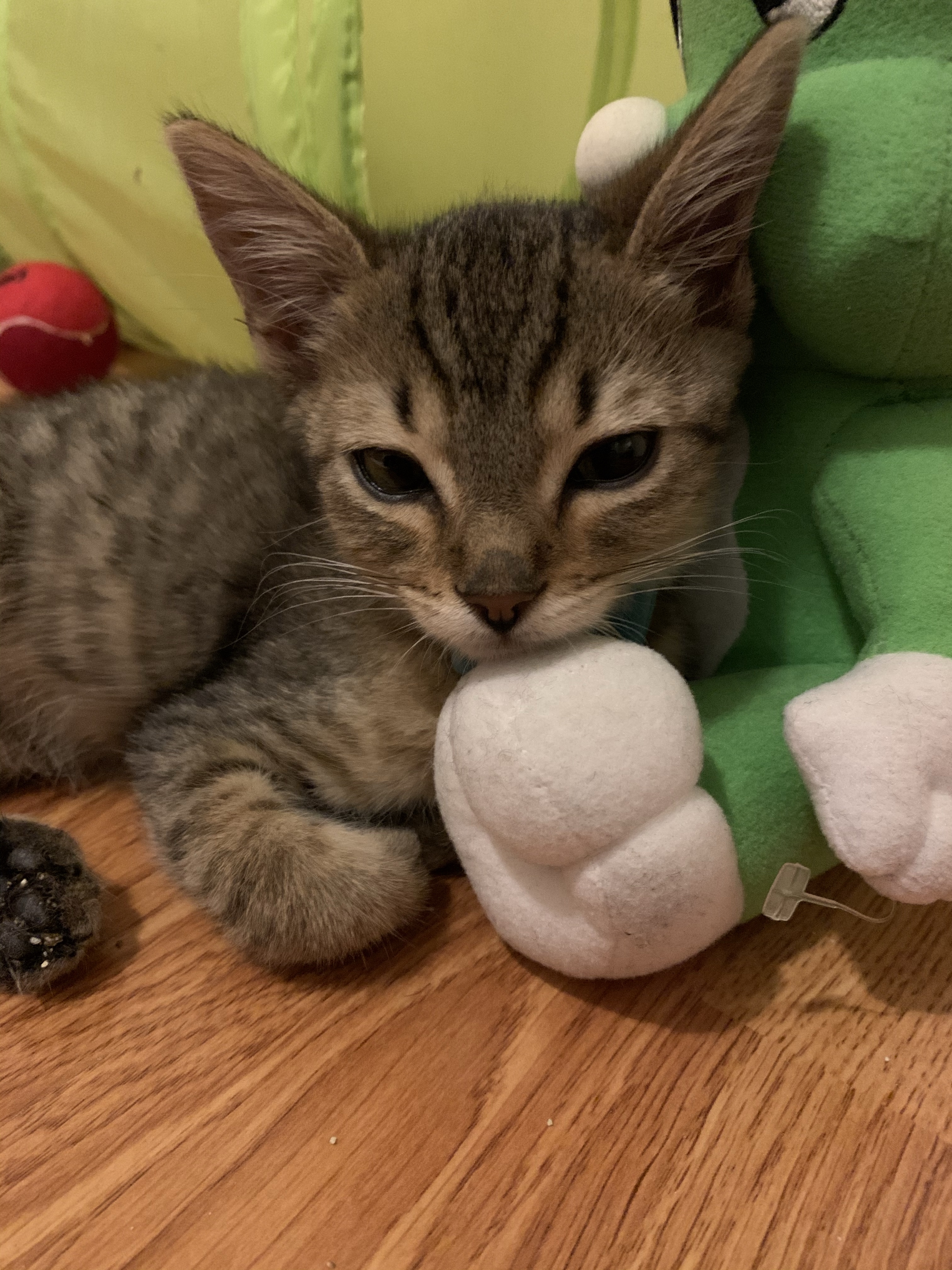
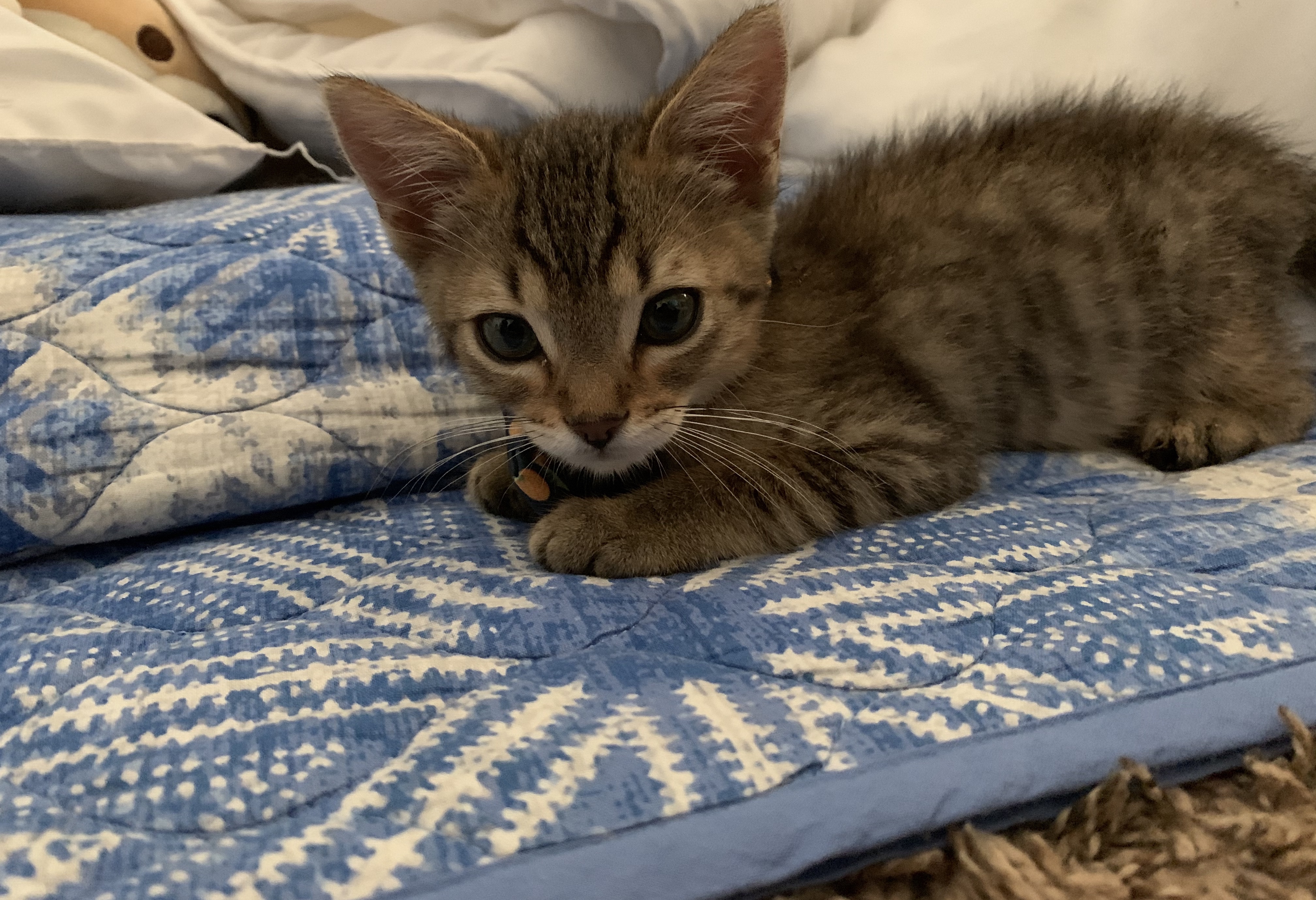
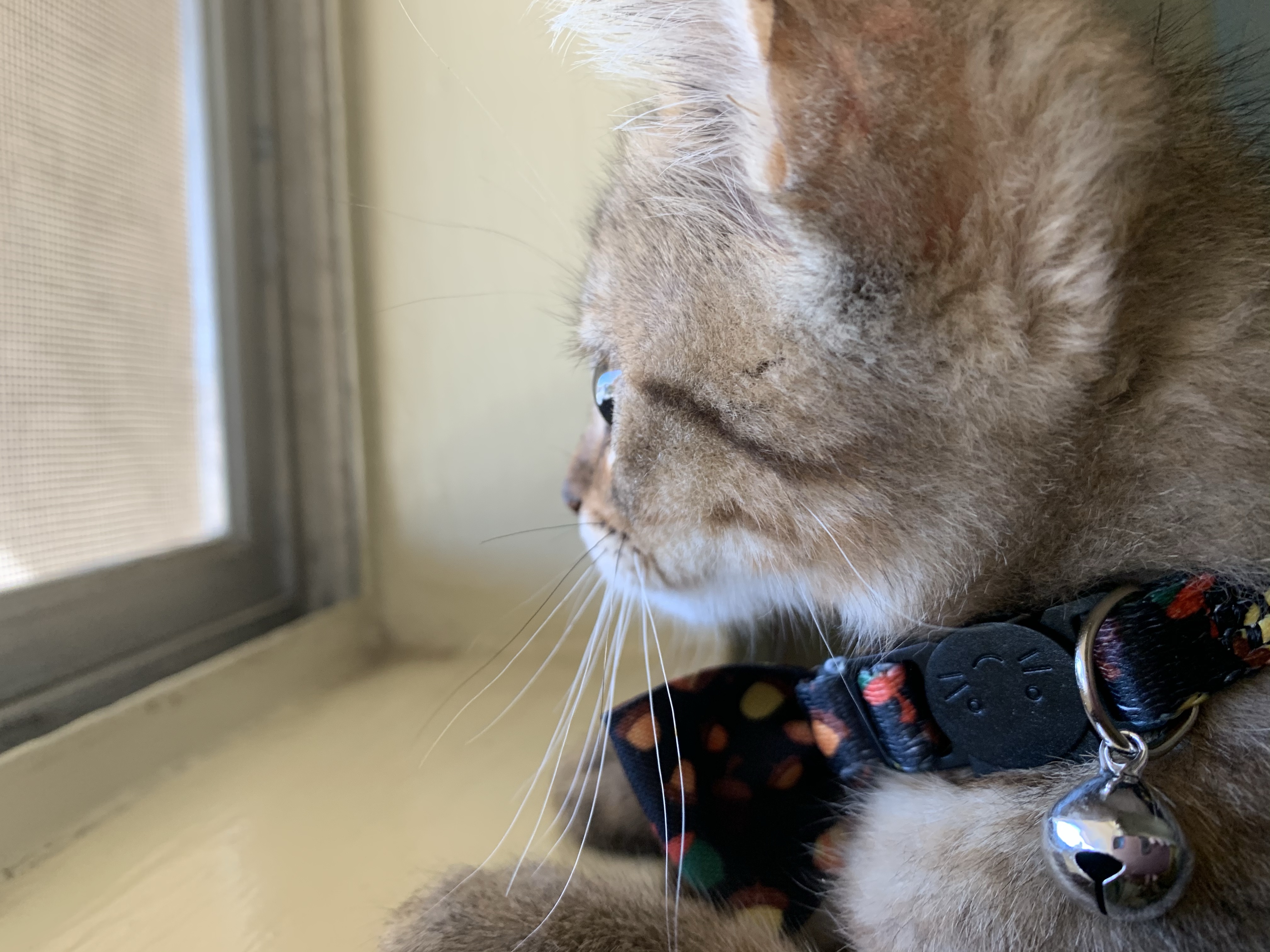
    Maybe all the disappointments and disillusion of having a dog meant to lead me to the world of cats because now I have a 12-week old brown male tabby named “Toro,” a masculine form of Tora, meaning in a little tiger in Japanese. I brought him from Ventura Animal Services three weeks ago. He is a smart, capricious kitten charged with a sudden pop of energy to stalk and play with the toy rat and anything moving from the frills of my skirts to dangling straps of my iPhone cover. Watching Toro peacefully cuddle up on my laps or my desk when I read or write, I can’t agree more with Ferguson that our cat and dog are not for our pandemic solace but our wish to share our homes with the lovely creatures.

  • I say Meow.

    I am a dog person. I like their playful innocence and adorable artlessness. And I still believe all dogs go to heaven because of their innate goodness that brings joy to our overtly complexed human life. Also, dogs and humans have been living together for about 15,000 years as family members. Remember Argos, the loyal dog of Odyssey, who was the only one who recognized his old master in rags and tatters? Also, there were the dogs who saved the lives of soldiers during historical manmade wars in the expanse of their own lives. So, if the circumstances give me the green light, I would love to have a dog at home. Who wouldn’t anyway?


    Then, given the express affection toward the canine race, how could my living with a cat be explained? The truth is still a mystery as  I still can’t believe I have Toro, an 11-week old male tabby I adopted from a shelter two weeks ago, at home with me all the time except when I am at work. Toro, which is a masculine form of ‘Tora”, meaning a tiger in Japanese, is a curious paradox of a beast; he is a little cutie with lovely big green eyes but shows all the characteristics of a predator just like his wild cousins. Toro shows he will grow into a formidable hunter contrary to his small and thin body with acute audibility and olfaction. Watching Toro playing with toys and the frills at the bottom of my skirts fluttering underneath the chairs, I wonder if Toro will turn out to be a Gremlin one day when I wake up in the morning. But his cuteness dominates fear, and he likes to sit on my laps when he feels like it. Toro seems to have crafted Ovid’s the Art of Love with innately feline caprice and whims turning it into an irresistible magic spell. What a kitty.

    Toro and I moved from the pastoral Ventura County to the heart of Los Angeles during the inferno heatwave of the labor weekend. We both suffered a sense of vertigo in new urban surroundings and a little bit quizzical about how we should adopt to smaller spaces in an apartment. Maybe Toro doesn’t like our new den because he does not wake me up by climbing on my back and meowing in the morning any longer. Besides, he seems to suddenly develop attention deficiency by frequently stalking, jumping, scratching, and biting. Worse still, Toro hissed a lot and aloud for the last two days. Although I force myself to think that it’s due to the diabolical heatwave, I cannot stitch up a little hole in my heart to the immaculate condition.

    Freud said the time spent with cats is never wasted. I want to believe it even if these days I spend most of the time tending Toro, instead of reading and writing. Certainly, unconditional love toward a living thing is noble and esteemed. Yet the Bard sums my state of mind thus: “Love sought is good but love unsought is better.” Still, there is a long way ahead of us to live according to the natures of our different species. Our inclinations are contralateral as our needs are egotistical for our own ends of the survival of the species. If so, then let it be – with pleasure.

    Maybe, I am more feline than my kitten. Who knows? Meow.


  • Minor Earth, Major Sky

    As a hobbyist dilettante writer, I have been writing this and that on my beloved blog for four years. Despite English being my Second Language, I dare to write in it against criticism of solecism regarding all the prescriptive rules of the most popular language of the Indo-European linguistic superphyla. The reason I continue to and love to write is no more than the justice of my meek self, smothered under the mask of exoticness that has become my sole identity, and a written touchstone for the neural activities of the mind. I sometimes wonder affected by the progress of neurological or physiological maladies as I slowly walk toward the end of the mortal journey on earth. So, I want to leave the mark of my existence. Welcome to My Invisible World, the Minor Earth.

    The provenance of today’s post comes from my reading of a Saturday edition of the Guardian subscription on my Kindle two days ago. It featured a book review of Must I Go by Yiyun Li, exultantly described as a cracking read written by a Chinese-American woman writer deserving of the commendation. The article began with her illustrious academic background as an immunologist and a recipient of a prestigious MacArthur grant bestowed on geniuses. While such introductory curriculum vitae is undoubtedly relevant to denote her intellectual brilliance, I wonder if such a decorative prerequisite is necessary for the book’s worth. What if Li were just an obscure Chinese writer delving into English writing without the decoration? Such a hypothetical question might be regarded as nothing but an incoherent rambling of a jilted would-be writer. Yet, I have noticed that ordinariness is off-putting, unglamorous, and unworthy of recognition. Call it a groundless presumption or jealous subjectivism even, but it’s the truth. Charlotte’s Bronte’s author’s tenet of faithful allegiance to truth and nature seems to apply to the otherness of the Far-Eastern writers whose ordinariness is merely invisible and regardless. That is, they exist in an invisible habiliment of mysteriousness from Shangri-La.

    The review analyzes Li’s literary reality of uprooted sentimentality in the background against America’s wilderness, so to speak, in which her existential question of who she is based. Li also rides on the crest of the waves of cultural identity, as is the principal thematic element of most Far-Eastern writers. Rather than striking the chords with the universality of human life, they tend to focus on the egoistic litany of alienation with their selfsame egoist emphasis on otherness. In this regard, Far-Eastern writers themselves foster this strangeness, this otherness, these less-than-ordinary images based on their literary tenet they believe truthful and appealing to selective, not universal readers. That is why I, who is also from the far east tend to eschew their stories, void of the common ground of empathy, no other than the shared physical reality.

    Enter Kazuo Ishiguro, author of The Remains of the Day, whose literary world is not limited in his racial and cultural backgrounds. A good writer is capable of travel and metamorphosis beyond the existential terra, where the vision becomes a reality of its own. Ishiguro wants to be all that he can be away from his physical context to manifest his views on human nature, which aims to chime the bells of universal emotions. However, such transfiguration of physical reality into the universal realm of consciousness does not betray Ishiguro’s ascribed biological characteristics because creative force, in conjunction with desire for aesthetic values of literature, is mightier and higher than physical reality. In this sense, Ishiguro gloriously triumphs over racial barriers, and splendidly demonstrates that what you look like and where you are from cannot confine you who you want to become.

    I still write despite my imperfect command of English simply because I love the act of writing as a valve for opening myself dying for a fresh breath. My book has sold only five digits of a hand. I recently received a comment on one of my book reviews I posted three years ago on amazon with 32 likes that callously slighted my ability to write in general because of minor violations of grammar rules. Yes, I am an amateur writer of Far-Eastern backgrounds with an ordinary job as a legal assistant with a B.A. in English from a state university. Yes, my English is far from the perfection of English Undefiled. Yet, writing is no longer a prerogative of the academically privileged whose selfish seclusion of lettered cases is adulated. Writing is a democratic vehicle in which anyone can morph into whoever she or he wishes without restraints. Take Tolstoy, Charlotte and Emily Bronte, and Jane Austen, all of whom put their literary aspiration into reality despite their spelling weakness. No one shall bully my writing skills, nor belittle my volition to write for universal readership. Forget how I look and speak. It’s the heart’s passion and satisfaction of reason letting out of the cocooned physical reality that deserves manifestation. For this reason, I write with or without public recognition with a myriad of likes.

    P.S.: I don’t believe that you can follow my blog without liking what I have written. Also, even if you fulfill the requirement above, if you are regarded as a marketing puppet, then I will drive you away. Therefore, I will not treasure your subscription to my blog if you just press the button on caprice and whims. Certainly not for my blog.
  • Beautiful Santa Barbara


    To see the pretty summer sky is poetry breathing life. The world outside books provide the optical pleasure that sparks up otherwise monotonous landscapes of everyday life. Indeed, it was such a beautiful morning that would make you forgive your persona non-grate with the love of mankind. It was a kind of jolly morning that made the whole world seem kin.  So Tuco took a lovely jaunt in the beautiful historic Santa Barbara County Courthouse this morning. He went there alone in the bliss of solitude that always flashed upon his inward eye for creative inspiration. One casual glimpse at Tuco might give you an impression of an ordinary guy with beer-belly spending his evening time and Sundays in front of a TV set. Contrary to his embonpoint, avuncular physiognomy, Tuco is an artist, a poet, a thinker. He is, what Edgar Allam Poe would call without hesitation, an intellect with passion.


    Tuco chose the Santa Barbara Country because its Spanish colonial architectural style reminds him of the familiar civic landscapes of his childhood hometown. The Courthouse, located at 1100 Anacapa Street, in downtown Santa Barbara, California, is famous for the Spanish Colonial Revival Style building designed by Charles Willard Moore and completed in 1929. It was designated a National Historic Landmark in 2005 for its beautifully distinctive colonial-style respective of the Spanish cultural heritage harmoniously attributing to the aesthetic character and history of California.

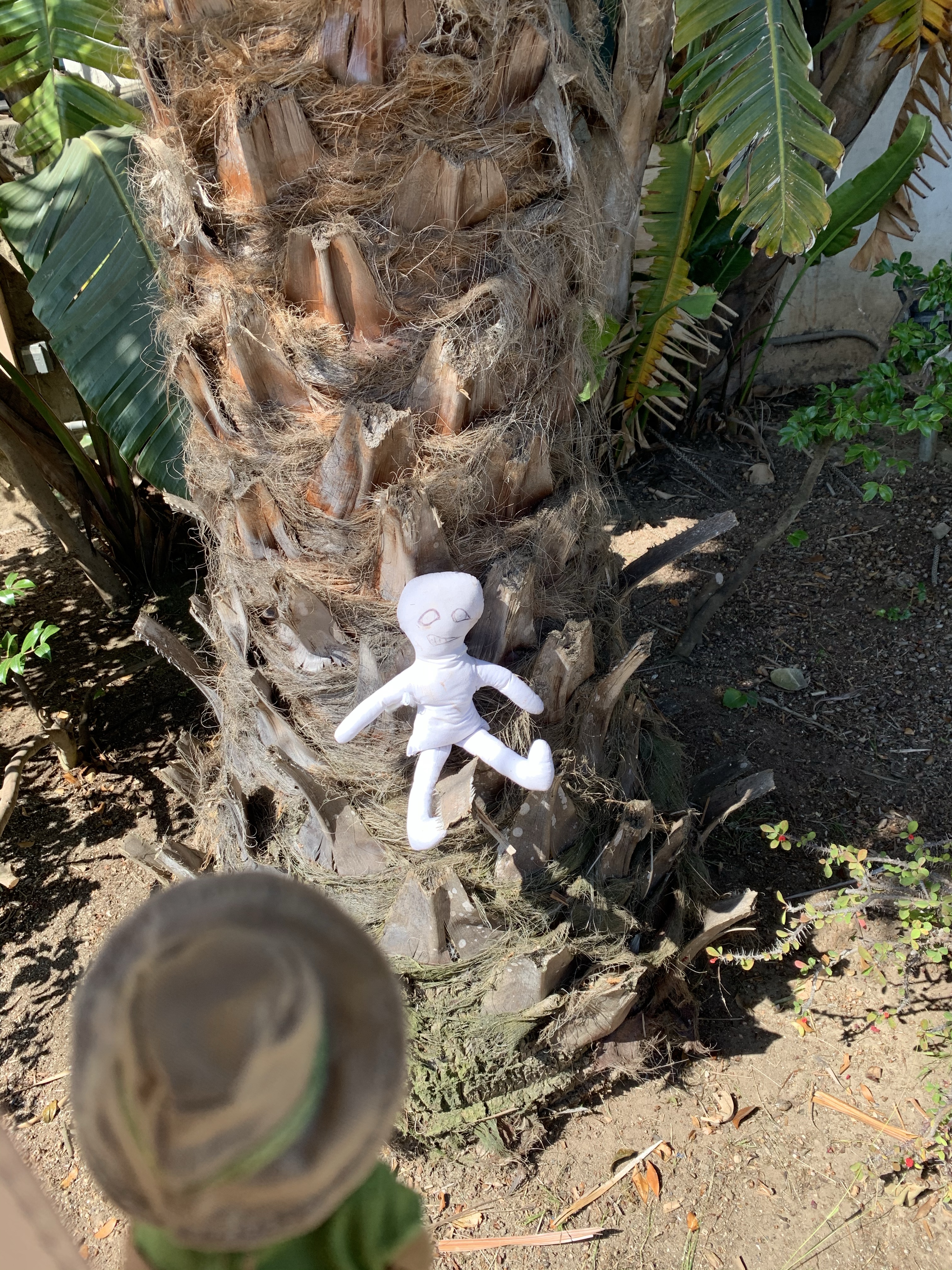
    img_1982While strolling around the Courthouse, Tuco’s eyes were suddenly fixed on a white doll attached to the palm tree. It was a tawdry but scary-looking doll that gave him the creep down on his spine. ‘Did someone who had a beef with the court’s decision put this voodoo doll here as a curse to the Courthouse?’ Trepidation for the unknown terror began to spring from his tactile sensory organs, making him momentarily delirious. He was becoming unsure of whether it was a wise decision to take a picture of the evil doll or even to come to the Courthouse. Was it an omen? ‘Oh, come on. Are you kidding me? It’s just a doll, more or less. No need to waste your energy on contriving meaning to the ugly voodoo doll.’ With this sudden forceful exercise of affirmation, Tuco wended his way toward the beautiful scenes of the earth, the sky, and the view of the world.


    Tuco exclaimed, “How hard it is to hide the sparks of nature!” The sky was high and blue, the lawn was full and green, and his eyes filled with pleasure. Today was the end of his vacation, and he lamented about returning to work for livelihood. However, the beauty of the scenery made his otherwise grim and dreary Sunday lovely, and Tuco thought life was not supposed to be all that hard and unbearable.


  • Dokkaebi: the gullible goblin

    img_1901
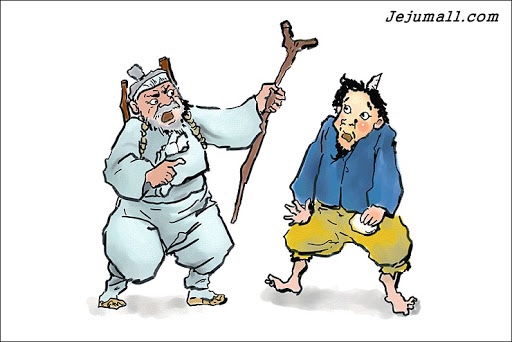
    Ireful old woodcutter castigating a not so menacing Dokkaebi

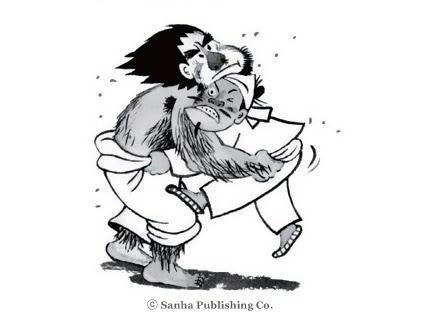
    The Dokkaebi is a mischievous, playful fairy-like spirit that is equivalent to the western counterparts of leprechauns in capricious temperament and of goblins in formidable appearance. The legend says it that an old broom made out of dried bush clover with bloodstains on will turn into a Dokkaebi, who will hold a spell over the mind of an unfortunate passer-by at night in the field or on the mountain. Befriending with a Dokkaebi can bring you a fortune at a house that he has lived as your protective spirit, but you must live there for precisely ten years only. Otherwise, the Dokkaebi will leave you with the ruins of your fortune and health. There are still people in Korea who believe this belief tradition by offering the Dokkaebi buckwheat cakes, spirited beverages, and steamed pork when they open businesses and move into new houses. Some people even report seeing them when walking alone in the thoroughfares or any lonely path where lights are dim at night between midnight and 4:00 am.

    main-qimg-603a724d0d501bab985518fa3c134c3f
    A Dokkaebi likes to challenge a passer-by with a wrestling match.

    The Dokkaebi may seem to possess the caprice and whims natural to fairy-folk. However, it embodies the human characteristics of compassion, selfishness, naivety, shrewdness, durability, and formidableness. The Dokkaebi reflects the pathos of life indelibly embossed in the collective consciousness of the Koreans. They have endured the anfractuous national tragedies and yet maintained their unique language and culture.

    Faerie tales often belong to the days of yore before the advents of industrialization, and the fairies are either imaginative creatures or exaggerated figures of fashionably esoteric religions in the west. Still, the Dokkaebi is a living spirit in the minds of the Koreans and has wept and laughed with Koreans.

    kim-jung-gi2-444x356
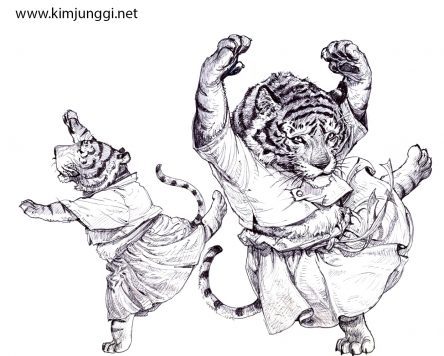
    A tiger is a Korean totemic animal that can mimic human voices.

    P.S. This post is my solipsistic response to #FariytaleTuesday, whose theme for today is the Asian fairies/spirits in folklore. The community is inundated with the wondrous tales of Japan and China but scarcely Korea. Koreans, like the Irish, love to talk and laugh with precious human sentiments, which result in the creation of the Dokkaebi. The Korean culture, as evidenced in the language, is closer to the cultures of the Ural-Altai language family, including the Finnish, the Japanese, the Turkish, the Hungarians, and the Mongolians.  Since there seems to be a scarcity of Korean spirits represented in the tweets, I felt responsible for writing about this playful Korean spirit with human characteristics.