Category: Novellas

  • French Dinner, Lords’ Supper

    IMG_3985
    Getting ready for the dinner

    Nice Christmas office dinners are all alike. Any not-so-nice Christmas office dinner is boring in its own fashion. It all depends on a venue and invitees, and a host of the occasion that create an ambiance and conjure up a spirit of the minor revelry. That said, this Christmas office dinner Seraphina attended last night was a nice and delicious revelation of characters, personalities, and tastes served with a fashionably delicious Haute cuisine at a fashionably cultural restaurant in downtown nearby the office. It was an unusual raillery of lawyers – the lords of the firm as Seraphina would like to think – whose stiffness seemed to be temporally suppressed by the intoxication of prime red wine. All of this became a valuable empirical addition to Seraphina’s quest for a meaning of her life, a voyage into the heart of the world, the terra incognita, charting her emotional course according to the winds of her unknown destiny.

    wp-1545534401344.jpg
    The course menu designed for the lords’ banquet

    The dinner began at La Boum, a new European fusion restaurant in town, at 6:30 PM. As Seraphina wended her direction toward the restaurant, she bethought herself of Somerset Maugham’s adage: “At a dinner party one should eat wisely but not too well, and talk well but not too wisely.” It was one of the best sagacious and elliptical advice on how to conduct oneself at such occasion, thought she. Or was it just a universal principle to be a civilized guest at a social event? It’s just that when such common sensible etiquette is uttered by a notable person like Maugham, it carries a tone of authority, power of significance. Come to think of it, the Little Prince in the eponymous novel by French aristocrat, writer, poet, and aviator Antone de Saint-Exupery thought the same when a Turkish astronomer dressed in the traditional costume presented himself at an academic convention, no one paid attention to him but belittled his outstanding scientific achievements. It was not until he changed his costume to a well-tailored suit that his fellow astronomers took him seriously and attended to his remarkable scientific contributions. Well, that’s one of the human foibles and follies that we all stumble upon no matter how educated and good-hearted we are, contemplated Seraphina, Lady Philosopher, as she was approaching near La Boum.

    IMG_4002
    The marvelous chef and proprietor of La Boum Monsieur Randy Beaver

    All the partners of the firm had already been expecting Seraphina’s elegant entrance into the restaurant. Always a principled, reliable, and capable assistant, Seraphina was their sine qua non, and they all could not exert their years of expertise on their areas of law, ranging from corporate to litigation, without her existence at the office. So they could not help but beam with smile at her beautiful presence into the dinner table that would have been rather drab and dreary without her graceful presence like Beatrice serving as Dante’s guide through Hell and Purgatory in Virgil’s Divine Comedy. So the course of dinner commenced with a glass of red wine made in 1986. It was amazing to see how just one sip of wine making a person agreeable and sociable quite contrary to his usual stiff and standoffish self. That might be the reason why Dionysus, the god of wine and anything relating to intoxicating spirits, was indiscriminately revered by all regardless of status, sex, and age in the antiquity. And the cult is still going strong all over the world.

    Amid the intoxicated euphoria under a glowing chandelier, Seraphina was observing the faces of the partners, the purveyors of her sustenance, her daily victuals, her existential livelihood. In the dusky glow, her minor and major bosses seemed full of amiable qualities. Seraphina liked their polished frankness, their intelligence, their sense of humor, their lack of snobbishness. Even the occasional moroseness and astuteness which sometimes were so like abrasiveness now seemed the natural sign of social ascendancy belonging to the station. They were lords of the world she now decided to care for, and they were ready to accept her only if she was willing to make it her primary world, not the secondhand, which had been that world she was now beginning to turn herself in. Or so it seemed at the moment. But one thing was certain that she felt within her a secret allegiance to their standards, an acceptance of the demands imposed upon her unavoidable obligations, a scornful pity for the people who would put their ideal ideas before existential needs and adhere to abstract abracadabra of metaphysical philosophy of life. Now she began to despise all such feckless rabbles, the starving intellectuals without the gumption, the proud egoists who put forward their own doctrines of life in which Seraphina would not want to find herself. Already she was beginning to feel like a new person at the denouement of the dinner. And her qualms about leaving for her imago bespoke a vestige of her abstract self that only lived in a textual world.

    porky

  • Coffee with Bach and Thoreau

    la-patisserie-jean-beraud
    La Patisserie by Jean Beraud

    It was still early when she got to downtown. And it was still an hour early before her day at the office was to start. That feeling of earliness needed to be indulged by the leisure of solitary coffee time at her regular coffeehouse that had lovely outside seating where you could enjoy a capricious respite with a cup of coffee and watch the swing of things, the world in motion, and the parade of the human race. That time was precious time for Julie, and it was to be observed religiously  in a way the Vestal Virgins guarded the sacred fire in the temple lest it should die out, as that would mean the peril of the Eternal City. The aroma of freshly brewed hazelnut coffee could do so many wonders, and one of them is vitalizing your listless, half-awaken stupor under which you would find yourself an unconscious somnambulist or a peevish whiner. This rhapsody of morning coffee is also testified by a testimonial of Johann Sebastian Bach, the father of Baroque music, who described himself as a “roast goat” without having a cup of sensuously aromatic coffee in the morning.

    Julie, as a faithful myrmidon of the power of wonder beverage, got her first morning hazelnut coffee and placed herself in the corner of her regular coffeeshop to set her cognitive functionality for a work day in motion by reading her subscription on Kindle Fire and writing down some notes from the reading. In fact, there was a set of rules of reading Julie adhered to: reading hardcopies on her commuter train and Kindle in coffee-shops because she found such modus operandi of reading quite congenital to her mental exercise. So there she was, doing what she always did, unless otherwise there was anything else that called for her urgent attention to attend before her work hours began. Then when her silver pocket watch indicated twenty minutes to nine, Julie headed for the office. That was how Julie began her normal work days. That was how she began to live another existential everyday.

    That particular morning, which was Friday, was a lucky one, for no exigency was awaiting for her to execute first thing in the morning. Julie was a legal assistant at a litigation firm, where a myriad of pleadings, discoveries, settlements, and confrontations were norms of the trade. And it had been only a week since a happy chance placed her into the position offered by goddess Fortuna, who had finally countenanced her new future on the frontier. Yes, it was a frontier, a new land of unyielding dreams, high hopes, and exciting desires that Julie had felt deprived of in that grey, grim land by the Atlantic Ocean. Even Henry David Thoreau attested such tenebrous somberness of the ocean as a Sea of the Old Habits and Constraints that bound people in the Memory of their aborted wishes and crushed ambitions and encouraged them to migrate to the Elysian Fields by the Pacific Ocean, which he romantically compared to the River of Lethe in his poetic pathos. Reader, you might think it as a humbug or even a jest in your most postmodern mode of thinking in the ethos of textual parallax thriving on non-platform media. But when you become known that our life is still woven by the Fates under the supervision of Fortuna and that you are made of spirit, fire, and dew, you will swivel your head in wonderment in recognition of Thoreau’s poetic perspective on the Exodus to a New Land where nature is all the more conspicuous by the relative absence of the Gothic skyline that rudely dominates the vault of heaven on the Other Side of the Continent. Julie knew it all, and that was why she wanted to start anew in the West, where the Lethe of the Pacific flew, where the rugged hills and primitive mountains setting against the deep blue ocean still maintained the rustic charm of a village maiden.

    저장

  • Morning Train

    15624886771_c2ecc92688_b

    She should have caught the first-morning train to the city instead of debauching her first cigarette of the day upon her arrival on the platform. She knew smoking as the first thing in the morning wasn’t the most salubrious thing to do, but she had to. It was her way of relieving her mind of its cares, anesthetizing her strains of everyday life for the moment of her sybaritic indulgence, which was the only hedonistic practice Julie insisted on keeping because no other things were permitted to her, literally, apart from all the virtuous and sensuous delights of all human creatures that denied her access. That’s probably a pathetically lame excuse for smoking, and the militantly health-conscious, priggish, and principled public would love to lambast her and her smoking habit not because they really care about her health but because they just do it since anti-smoking is now the ethos of this ostensibly egalitarian era, the zeitgeist of New Social Totalitarianism that dictates Social Science Model Behaviors. And although Julie was never a forceful character, she was a free spirit with proud individuality, declaiming against the mob psychology that was grounded on suitably fashionable stance for demotic mores. She defied it in her own way, in her own solipsistic way.

    The act of smoking could be conceived as one of the most highly advanced forms of humankind ever since the dawn of civilization when Prometheus, an ingenious and recalcitrant Titan, a fashioned man out of clay and water, and then stole sacred fire for mankind to kindle civilization. In this regard, manipulating fire in the ritualistic process of lighting a cigarette and emitting smoke from it can be regarded as a sacred ritualistic performance to pay homage to the benefactor of civilization. Also, Ahura Mazda, a lord of heaven and light and the only true god of the prototype of Judaism, Christianity, and Islam – Zarathustra, aka Zoroaster by the Greeks, was manifested in the form of Sacred Fire, symbolizing Purity, Illumination, Warmth, Enlightenment, and the Zeal. And there were also the Vestal Virgins, the ancient Roman priestesses who kept the celestial fire of Hestia, the virgin goddess of the hearth, home, and domesticity.

    Like the tortured thinker Kierkegaard anguishing over his existential conflicts caught between actions and religion, Julie was wretched in this world of collapsed grand narratives, fake news, volatile subjective opinions, hypocritical truths, and inflated egos, all fallen apart and adrift on a sea of the postmodernist detritus. What are am I in now? Is humankind really progressing for betterment or gearing up for its own destruction?

    According to the ancient Greek peasant/poet Hesiod, known for didactic elements in his poems, there are Five Ages of Mankind: the first one is a “Golden Age,” governed by the Titans, the first generation of Greek mythology, where no words for sickness, war, and discord existed. You see, the Titans were alright for humans although their own children raised war against their parents, even castrating Uranos, the first ruler of the universe, the sky, Titan of Titans; the second one is a “Silver Age,” a reign of Zeus and the Olympians who were very much like us in temperament and characters with the exception of supernatural endowments of immortality, talents, and beauty (but not in the case of Hephaestus, the lame and ugly god of fire and blacksmith, and the husband of Aphrodite). Humans lived only 100 years, most of which was suspended in childhood, consequently making them sophomoric, childish, and disputatious; then came a “Bronze Age,” chockablock with warriors and more warriors spending their time in the office of war and conflict; the next “Heroic Age” was a modified version of Bronze Age in the sense that the characters of war were tinctured with noble and epic elements as in the case of Homer’s “Trojan War” in which Hector, a Trojan prince and the greatest warrior and Achilles, the Greek version of Hector, Odyssey, the timeless voyager, and Aeneas, a Trojan refuge who later founded Rome, the ancestor of the feral brothers Romulus and Remus; and the last and the lasting one is the “Iron Age,” in which we all live now. Hesiod might have foreseen where we are now in his poet’s eye; it’s a world of vehement contenders vying for the sponsorship and the possession of the beautiful, the powerful, the fortunate,… THE FITTEST. It’s a world of social Spencerism that yoked Darwinian evolutionism into philosophy to champion eugenics. And what will be the next age be like? Julie was curious, but then she was soon past caring because she wouldn’t live to tell anyway.

    All of the aforesaid musing triggered by her smoking kept her occupied while waiting for the next train to the city. Julie looked around her at the station that began to be full of another batch of commuters, more men than women at a glance. Funny, Julie thought. Are there more men working in the city than women in this town? Or is it because there are just more men than women in this town? Anyway, the men looked just average without distinguishing outward appearances. Julie knew that beauty was only skin deep, but being a highly aesthetically person, she could not help but observe physiognomies of whoever she saw in view. As a matter of fact, even the intellectual like Francis Bacon also took a person’s physiognomy into consideration that he even rationalized phrenology, a divinity by shapes of skulls. And then there was Karl Lagerfeld who realized that the look was what others made interested in your soul.

    Woe betides anyone who would disagree with this dictum of our time, for she or he would be a downright hypocrite! The human faculty is instinctive, sentient, and physical. Beauty is an essential objective of intelligence that calls a beholder’s attention to the other elements of its possessor in the sense that the poster of a movie gathers spectators to the doors of the movie theater.

    Moreover, Julie could see what others could not see or decided to ignore because it’s regarded as a trifle. Her sense, sensitivity, and sensibility were extraordinary to the point of exquisite uncanniness. Then, she jeered at the thought and dismissed it as hocus-pocus, all jumbled up with meaningless bits of harebrained abracadabra in a shambolic array of grim masks that languished with faint tweaking in the left corners of their lips. That was another way of visceral escapism she sometimes took to bring herself to a different place from the rabble that seemed to belittle her nondescript exotic existence that didn’t fit their circle, their legion of the beauty. That’s the existential issues Julie had to face every day – an acute sense of isolation, an unquenchable feeling of rejection, and a sentient awareness of her aloneness… To escape from the excessively dour, namby-pamby sentimentality, Julie looked at the magnificently rustic beauty of mountains and hills outside the moving windows of the train and fell into a reverie of the 19th century Wild West where she as a Pony Express Rider was riding on a rapid mustang across the land to deliver a Letter of Hope to a final station in the city.

    저장

  • Catch-22!

    “Our doubts are traitors and make us lose the good we oft might win, by fearing to attempt. – W. Shakespeare

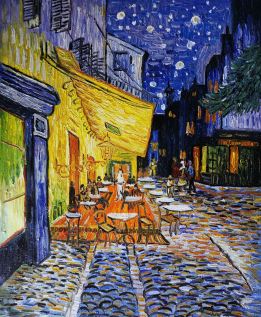
    Cafe-Terrace-at-Night-Oil-Painting-Reproduction-Canvas-by-Vincent-van-Gogh
    Cafe terrace at night by vincent van gogh

    We all have our best registers, our natural octaves, and Judy’s was a flow of unsteady streams of flotsam and jetsam of peripatetic life that cut her adrift from the safe mooring in the orderliness of life. The detritus of contemporary life seemed to be piled up in her own Aegean stable, and she felt like Hercules to clear it all away just as he had been assigned to wash away the ancient filth of his Aegean stable. And she was at the moment of decision to figure out how to start it off. And it was at that moment when she was also befuddled with yet another indecision. Would she do it, or did she really want to do it? Or could she do it?

    Judy was preparing for her initiation to the rite of conjuring up a fairy that was to serve her wishes and aspirations which she believed to be forfeited by her divisory lot. Whatever it was, whoever the perpetrator of such turpitude, Julie wanted to get things sorted out by encountering it face to face, even if that meant a risky business. She did not feel like a weird nor a devious satanist to get into the esoteric world of magic on the grounds of her knowledge about the history of religion and magic during the medieval and Elizabethan periods of England as well as the story of Dr. Faust. That those who were caught up in the existential vertigo of livelihood, literate or illiterate, rich or poor, man or woman, Christian or pagan, had often turned to the Other Side was a legitimate tendency, a sort of catch -22 attempt to grasp at a straw adrift on a life sea.

    In fact, there was a veritable historical account of a Cambridge medical student in Elizabethan England who made a pact with the devil to procure money to repay his student loans. Whether or not he was dragged into hell upon his death was clandestine, but that was a fact of the matter. So why not? That was Julie’s self-rationalization. That was the proximate cause of her premeditated action. That was her own defense against the sordid fact of life that pushed her into where she was.

    But here was Judy’s dilemma: what would a spirit be like? Would it be a female or male? What would it look like? Would I face an abominably hideous creature? Enveloped in a cloud of morbid speculations, Julie began to hesitate nervously, her spirit suddenly trapped in the intricate labyrinth of Anomie. Yes, the labyrinth, the one prodigiously built by the legendary architect Daedaius at the behest of King Minos of Crete named Knossos to lock up Minotaur, the half-bull and half-man creature born out of an unholy consummation between the Cretan Bull and Pasiphae, Minos’s beautiful wife, because Poseidon, the god of the Waters and the formidable brother of Mighty Zeus into the bargain made her madly in love with the Bull, which her husband had dared rescind the sacrifice of it to Poseidon and kept it to himself because of its magnificent beauty.

    To tell you the truth, Judy felt sorry for the deformed hybrid of the bewitched union despite its bestial ferociousness calling for human sacrifice. The brutality in behavior was often a manifest result of violent upbringing in conjunction with a denial of love and absence of trust at an infant stage. The security net woven by a loving and caring relationship between a mother and a child was sine qua non of a well-being in both soma and psyche. That was the reason Julie had a sneaking, sympathetic opinion on the Ancient Monster. But she kept her sentiment toward the mythological beast to herself, lest she should be lampooned by others whose idea of justice was a draconian, Jacobean execution of justice that would take no prisoners. Or those whose minds were desiccated by a drought of humanities would declaim against Judy’s altruism. Nevertheless, Judy had no wish to simulate such sternness or gruffness to join the melee.

    The whirlwind of thoughts was spinning like a potter’s wheel in her, and Julie was entranced into it rapturously. She let her mind dwell in it however long it would be. She loved the sensation of being drifted away into the world of fantasy, the world of dream, and fiction, as it was her a sanctuary amid the demands of everyday life. Was this the same kind of feeling E. B. White was feeling while he was looking at the beautiful young circus woman rider on a horse running around a grand circle during her performance? The Circle of Youth, the Circle of Beauty, that was. It was what enchanted White to follow her into the World of Magic, and it was what he felt the ecstasy of the sensuousness of Beauty.

    It was synchronicity, a mental realignment to the mind of another sharing the same or similar intellectual or psychical formations by which Judy could connect with others readily and efficiently. As a matter of fact, it was one of her gifts of mind she possessed, but which was unrecognized. No, it was suppressed by the possessor. To acknowledge her uncanny ability would upend the course of her life. It would be a radical reconstruction of everything she had been grasping at, knowing that it would be a seismic turnaround of her insecure but sedentary life. And it was giving her a hard time all the more. And she knew it, but she resisted it, and that was her problem – a classic case of circulus in probondo


  • trumpet volunary – beginning

    This is the beginning of my novella about a woman striving against the limitations imposed on her by reality with her fierce individuality and queasiness in her belief in destiny or fate. Her investment of spiritual discernment is her congenital gift, but that which makes her special defenestrates her to the perimeter of society like a cunning woman or herbalist in the Elizabethan England. Is she then a middling between an angel and a demon? Her search for the meaning of her so-called life, the secret of her existence is the linchpin of this daringly attempted story I have decided to conjure up in the peculiar alchemy of fiction. 


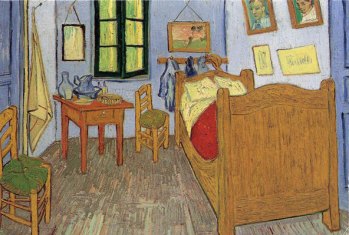
    van_gogh_vincent_5
    “Bedroom in Arles” by Vincent van Gogh

    It was a cool, bright mid-Monday morning, but Julie was still in bed, in bed with her still tenebrous somber spirit returning to possess her once again because she – yes, that is Julie Faustine, a single, plain woman nearing to the acquisition of stoicism in life – fell into a reverie of perfidious rebelliousness. But let the description of Julie not complacently settle on your a priori premature postulation that she was one of those feckless, mediocre, and nondescript women deprived of what the world could offer to be a woman. Nary a bit. Her inner world was always in a perpetual restive tempest propelling her to sail adrift on her sea of life fraught with existential strains of life, which stunned her venturesome spirit and moored it in the stony stasis of inertia that was killing her softly. She was a hostage to fortune confined in existentialism that did not allow her all the privileges and rights of womanhood and femininity due to a covenant arbitrarily made and entered into by and among her ancestors and an ancient entity prior to her birth.

    All this, all this preposterous truth was nothing but a real, physical one that was intractably lodged in Julie’s mind, and it was killing her softly. Nothing would be changed on my own, except the sure case of death, which would be a total force majeur situation. Christopher Malowe’s Dr. Faust was in league with me. And if I physically – and metaphysically – disappear from this earthly place, nothing would change. With such monologue in mind, Julie’s wish was to find herself in netherworld when she woke up in every new morning. No, it’s not pessimism or fatalism, but realism, whether you would agree or not with a sneer. W.H. Auden confirmed it in his poem, “Museum of Beautiful Arts.” Just as all the world’s great and terrible events, such as martyrdoms and nativities, took place amid everyday life, other people continued to do what they had been doing for their own interests. Whether or not you existed would not matter to the continuation of the world.

    But as luck would have it, Julie woke up in this world yet again this morning, in this dysphoria of her failed and failing dreams, dwindled and dwindling aspirations, disappointed and disappointing facts, and frustrated and frustrating desires. How shall I die? It’s got be without inscrutable pains and gory details. Painless suicide will be the most cherished and coveted solution to expunge all my baggage. Thus contemplated Julie in her usual serious self. Then came the phantasmal display of the last day of Eva Braun and Adolf Hitler. When Eva and Hitler knew that their ends were impending as the Reich was soon to fall, they hastened to kill their lives together. Hitler chose a pistol, but Eva – being nothing but a woman herself with a reason none other than being a woman – mulled over which method she would employ to murder herself in the least painful but the most feminine fashion. Out of the musing came a method of poisoning herself because it would preserve her pretty face even after death in order that anyone, the Allied or her German volks, finding her corpse would still think she was a pretty being.

    This story and image of Eva Braun still imprinted in Julie’s mind and imbued her with the selfsame way of beautifully saying adieu to her pitiful life. Nevertheless, this was never realized or did not seem to be realized at any time soon for some clandestine reasons made by the Fate, or the Fury, or the beautiful goddess Fortuna. And where would God be placed among these pagan elements? He would eventually come and vanquish all in the name of one Omnipotent, Transcendent, and Infallible of All in no time.

    So much so that in Julie’s religiously conditioned mannerism of reconciling herself to the limits imposed by the Reality of This World,  the image of God existed as a Bureaucrat aged somewhere between the fifties and seventies with a Victorian-style mustache and gravitas that would sting you to fumble with awkwardness, making you feel like a nincompoop. Julie was not a forceful character, and she would turn herself away from this humiliating embarrassment and would figure things out for herself, even though it meant a series of trials and errors over a long period of time all alone. That was her daring independent spirit. That was her most treasured possession. That was what kept her going against her senses and sensibilities. That was her lifeline and only one.

    So it was another morning and the very first morning of a new week into the bargain. Intentionally waking up late in the morning, Julie forced herself to breakfast against her prior determination of foregoing food until she would find employment that would make her earn the bare necessities however little it would pay her. Would this be my home forever? Would I become visible in this new land? Would I start anew in this place? Then Julie’s innermost secret and hidden questions came to surface at last: Could I chance to love? Could a man love me despite my plainness? My paroxysm of moodiness? My humdrum presence? CUT THE CRAP, concluded Julie, for all these supplementary wishes and vain hopes were verbose and verbatim Without A Job. Surely, not all pretty women with jobs – good jobs like professional ones held by the writers of all those popular memoirs bestriding NYT bestseller list for weeks – promenaded with their beaus, but Julie, always angst-ridden and precariously sentient – moped around the whirls of her mental pagoda of melancholy. She could not help making parallels with her life, comparing herself with the illustrious careers of her peers.

    The third week of unemployment was hard to bear, and it was daunting to bear even with her renowned stoicism, but her real passionate self defied it, cursed it, and bitched it. Still worse, radio silence following so-called officious interviews was the worst bitch. “Don’t take it personally,” was a bromide, a humbug, hokum out of human kindness, only to be cruel. Of course, it’s PERSONAL, when the parties engaged in the formal occasions were all humans made of blood and flesh, not robotics of steel and wire. That’s an infallible truth, n’est-pas? That’s a res ipsa loquitur case of negligence of truth, no?

    All of this in her mind pushed her into the brink of a life’s cliff, leaving her one choice, and the only choice she could resort to: a Mephistophelean pact, it was. Yes, that’s darn right. She resolved to make a pact with the devil, and she was going to do it no matter what, either out of sheer spite against her fate or pure supernatural adventure or innocent curiosity. She’s up for it, and when she was in for the kill, she sure meant it. And it was today she would do it when the frivolous west sun was set, and the shadow of darkness began to cover the horizon in the way the sky god Oruanos covered the earth goddess Gaia to make love to her furtively in the dark.

  • The Beautiful World of Henri de Toulouse-Lautrec

    220px-Lautrec_moulin_rouge,_la_goulue_(poster)_1891
    Moulin Rouge La Goulue 1891by Henri de Toulouse-Lautrec

    On my desk now, I have a lovely little music box made out of a replica of Lautrec’s Moulin Rouge La Goulue 1891 that pleasingly plays “French Can Can” when I wind up a handle attached aside to the box. The sweet melody played from the vivacious four-color lithograph affords a delightful digression during my study, which sparks off the subsequent musings on the artist and the arts, self-proclaimed, would-be,and aspiring artists and the act of creation itself.

    A creator of the arts is a solipsistic benefactor of humanity whose congenitally proud egotism is a grand collective reflection of his cultivated trauma, sadness, frustration, anguish, and anger. With this in mind, an artist is endowed with a certain kind of poetic license to be freely and respectfully egoistical because an act of creation – or sometimes referred to as “intellectual drudgery” – demands of an unusual degree of courage, imagination, imaginativeness, knowledge, confidence and patience, all in a frenzy of his imago already existing or incipiently forming, by pouring out everything that is in him unsparingly, furiously into his creation. In fact, creative originality of standing quality often reflects high resources of courage, especially when the artist will not yield to his formidable foe in the form of biological determinism. Such was a noble spirit of Henri de Toulouse-Lautrec (1864-1901), a French painter and illustrator who sublimated his existential cross into his glorious laurel through the medium of art, the creation of his own reality of the world as he saw and felt in his mind’s eye.

    bio_toulouse_lautrec_henri
    Henri de Toulouse-Lautrec (1864-1901)

    Anyone who is interested in the Post-Impressionist paintings by Cezanne, Gogh, and Gauguin, might have come across Lautrec’s bold but gorgeous posters of actresses and dancers of Paris cabarets and theaters during the Belle Epoch period (1870-1914). Lautrec’s inherited disabilities as a result of his aristocratic familial consanguinity blighted him with grotesque physical deformities and congenital weakness: a midget taking a feral resemblance to a cross between a bull frog and a monkey. If you think that this physical misfortune alone merits his artistry or self-inflicting sybaritic lifestyle, you are probably not seeing the forest for trees. True, that he was often too ill to paint any and frequently visited the brothel to dispel his existential loneliness due to his pronounced external features. However, it was his preservation of a sense of purpose in life and tenacious grasp on his artistic existence, his recognition of the values he possessed and talent to express them to mark his standing in the world. The wisely chosen attitude toward things that he could not change but accept speaks to our world of post truths, grand fustian narratives, fake news, and fleeting ambitions that demerits  courage and patience, which are the handmaids of genuine confidence as a reservoir of creativeness.

    4147-2
    Le Rire Les Grans Concerts De L Opera 1897  by Henri Toulouse Lautrec

    Being an admirer of the works of this amazingly daring and talented artist, I believe anyone struggling to better the self can relate to a prodigy of courage and effort demonstrated by Lautrec at the darkest hours of his life, when in fact it was the most creative time of his artistic career as a highly sought-after illustrator of French entertainment industry that provided visionary artists and technicians the substantial grist for the mill of their subsistence. Into this dazzling new luminous conflation of art and technology staged Lautrec, lord of the blank space and the bold line, to claim his dominance as the bell epoch’s master of artistic poster designer not only of his time but also of our time. The capital difference between Lautrec and his contemporaries was his daring characterization of the models and ambience he portrayed; the individuality was in the expression of the colors, lines, and perspectives, making the subjects into work of new creation, elevating their planes and milieus into the artistic ether of exquisite beauty and peculiar charm, giving unforgettable impressions on the minds of the beholders.

    Lautrec proves to be a human testament to triumph of will over biological/social inhibitions during difficult times. His decision to work through his sadness by painting comes closer to serving as a sovereign remedy to the existential ills than any other semblance to solution thereof. In light of the above, it occurs to me that to practice any form of art, however good or bad, is not a prerogative of a professional or publicly recognized artist with more than hundreds of followers. The actualization of ideation, i.e., an expression of yourself in writing or painting, is a noble act of claiming your sovereignty, your own intractably unique self that attests to your existence, a sense of purpose in life. A life is not fully realized unless you actually live through it by unlocking what’s inside you. Be it ever called a cathartic effect or solipsistic satisfaction through the medium of creative act, just as Aristotle defined the primary function of the Arts as an imitation of natural beauty. That is why I write, and so should you.

    저장