Tag: book essay

  • Upheaval: Turning Points for Nations in Crisis by Jared Diamond – book review

    Jared Diamond’s Upheaval analyzes why a nation is how it is now. Of course, culture plays a role in changing the ethos of each new zeitgeist. Still, it is not so much a differentiating element as a distinguishing factor to characterize a national character. Instead, it is a mindset of individuals, including the governing elites in the nation, that determine the success and stagnation of the nation’s progress.

    Of all nations’ approaches to and results of political and sociological revolutions, the most successful example is Japan’s Meiji Restoration in the 19th century and democratization in the aftermath of WWII, both of which are one-of-a-kind upheavals yielding to outstanding progress. Japan’s confrontation with the West might have blown their isolated cultural prestige. However, rather than coiling in fear of the changes, Japan sprang back with new attitudes adapted from Europe’s and the U.S.’s technological development and cultural legacy to survive the new zeitgeist as the time’s juggernaut.

    On the other hand, the United States today needs change because it is highly polarized by political affiliations, ideological inclinations, and racial stratifications. The U.S. seems to have lurched in the above marsh when it should focus on the constructive, substantial, and realistic aspects of political agenda and social movements. For example, Americans tend more to ideas than facts that collectively affect individual needs, such as universal healthcare, a better educational system, employment opportunities, housing assistance, welfare programs, and workers’ rights. It s because American politicians aim to mobilize an army of people, aka constituents, to win their ideological war for occupying more congressional seats. In fact, American exceptionalism, that America is the best of all other countries in the world, averts the eyes from the lessons from other countries simply because they are beneath.

    Diamond is a polymath well versed in science, literature, philosophy, geography, psychology, and sociology. He talks about his family, students, and friends from other countries. He is no stranger to their cultures with the knowledge of the languages and cultural cues, which entitles him to an appellation of “a citizen of the world.” This book reads persuasive and perspicacious, among other books on similar subjects. Maybe I am biased, but if the man whose assessment of nations strikes my chord, then I can’t help it.

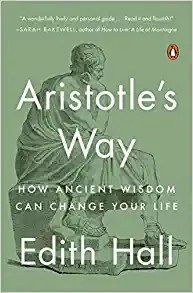
  • Aristotle’s Way by Edith Hall

    Tolstoy in Anna Kararina knows a thing about the Aristotelian school of subjective happiness thus: “All happy families are alike; each unhappy family is unhappy in its way.” Happiness is an antidote to depression out of hopelessness and envies out of disappointment in a purely subjective sense. It requires only self-will to choose the light and to follow it by constantly taming your brittle spirit via lifelong habit until you find a sense of why you are here in this world. If you doubt it as a cliche, then meet Aristotle, the student of Plato, who was the student of Socrates, and the private tutor of Alexander. 

    Along with his great predecessor Socrates, Aristotle was a thinker who billeted Philosophy from the heavens at the houses of mortals so that she could show them how to cope with the harsh realities of the world that discombobulated a sense of purpose in life. Aristotle’s main concern was that people weighed heavily on the outward material success as a sign of well-being and a carte blanche to happiness, which would lead people astray with a sense of emptiness inside. For example, we can’t know if all those glossy selfies on Facebook and Instagram reflect the real lives of those uploading them. Or the lives of Hollywood stars who predicate on images and styles are not, in fact, worth admiration, as revealed in the recent defamation trial of Depp v. Heard, in which Depp’s braggadocio of recalcitrant drug and alcohol uses combined with alarmingly repulsive backstage personality, is simply disgraceful. On the contrary, the Uber drivers I have come across appear to be more satisfied with their lives, content with their independent work mode, and love of families. This Aristotle refers to a state of eudaimonia, a feeling of bliss, however small it is, because it comes from a higher sense of pleasantness from within. 

    Of course, Aristotle’s way is not instant magic and may not show visible effects in one fell swoop, but it is a long-term remedy like a physical therapy that will show improvement. Aristotle’s way is not fanciful but practical with two recipes for the malady of hearts: (1) to keep everything in moderation, called the “Golden Mean”; and (2) training yourself continuously and actively to do the right thing like a habit. Aristotle reminds us that excellence is not an act but a habit. This happiness school parallels Emerson’s dictum that thinking is the function, and action is the functionary. So this is Aristotle’s simple but sophisticated stairways to your happiness, and I think it’s worth trying. No wonder his student Alexander became great. 

  • ‘Thinking Fast and Slow’ by Daniel Kahneman – book review

    We are not always right in what we believe. What we see with the eyes may not be the truth but in the likeness of truth as our instinctual response to sensory stimuli is swifter and mightier than the wise arbitrator of reason. Whether you like it or not, we procrastinate diligently assessing what the senses tell us, bypassing the voice of reason and judgment. Using automatic and biased instinct is a mental shortcut to make a judgment call in one fell swoop, sans inconvenience of time and cognitive analysis. Socrates knew it, Plato portrayed it, Aristotle acknowledged it, Shakespeare saw it, and now in our time Daniel Kahneman, an Israel-American psychologist and economist interpretes it in this book.

    Kahneman illustrates our intuition, or sense, as System I and mind, reason, as System 2. System 1 activates the images stored in a mind’s cabinet when prompted to evaluate the stimuli. There are three factors contributing to this design of instant machinery of thinking without an assistant of reason: available information, time constraints, and limited cognitivity. The system is highly biased, touchy, and impatient like a quick-tempered, spoiled celebrity. It is tuned to subjective truth inured to sensory perceptions about our surroundings and ourselves with quick fixes without consulting System 2, the voice of reason, the superego, which strives for objective truth. But such a dichotomy of Sense and Reason has always been observed and acknowledged, as I introduced earlier in this writing. For example, Plato alluded to the Chariot of Two Horses, of which one is noble and logical, and the other impulsive and recalcitrant. But the difference between Plato and Kahneman is the applicability of the mind-system to the principle of economic activities and consequences.

    The book is a steady bestseller, readable to all ranges of readers who want to search for the cause of their mental malaise and existential vertigo. What might have been a reiterating modern interpretation of how the mind works proves to be a piece of practical advice on how to overcome emotional trauma and live a purposeful and gainful life as thus: 1) When the signs of ill-judged biases arise from within, slow down and ask for reinforcement of the spirit of System 2. In doing so, we must acquire such skills to dominate the hubris of System 1 in a regular steady environment that provides an adequate opportunity to practice and rapid and unequivocal feedback about the correctness of thoughts and actions. If you still prefer a mental and physical shortcut to put the aforesaid into more effortless locomotion, how about taking the simple advice from Socrates?: “When unpleasant, depressive thoughts begin to cast on you, breathe deeply once, then bring a smile to your face.” Too trivially mundane? “Of course, you have to make it a habit,” quibbled Aristotle to support his teacher.

  • ‘The Maid’ by Nita Prose

    The Maid by Nita Prose is a one-of-kind, touchy-feely novel without collapsed grand narratives and vehement subjective rhetorics about existential vertigoes in life that burdens the reader with a duty to interpret the philosophical, the intellectual meaning of a story, all fragmented and adrift. Instead, the story uses the real to perfect the ideal delightfully blended with a taste of Murder She Wrote with relatively ordinary characters doing the most extraordinary things like you never know.

    The Maid is one lonely young Molly Gray. She is a Maid of Maids, taking her job religiously in a hotel that does not quite reciprocate her dedicated service but sees her as a quiet oddball because of her reclusive comportment. But Molly is a swan in a lake of ducklings and geese, a harpist among percussionists, whose feet constantly move beneath reality’s surface. Molly is anachronistically muliebral and incongruously proper. She belongs to a preceding era of decency, saying early Edwardian London as a chambermaid, a coveted position for working-class women. To judge Molly as a misfit is downright callous and heartless because she inwardly craves recognition from those she thinks of as sympathetic souls who use her as a pawn in their game of passion and avarice. The more we learn about Molly as the narrative deepens, the better we know of her as if we were contracted severe strains of Stockholm Syndrome. Hence, our better angels persuade us to forgive and forget the stupendousness of truth that Molly confides to us at the end of the story’s labyrinth.

    This fictional Maid by Nita Prose and that real-life Maid by Stephanie Land are stories about working-class women struggling with the realities of life by themselves. The only difference is that the former has a blessing of luck in the form of sympathetic and resourceful supporters who rescue her from a dungeon of hopelessness. It is understanding because, as Charlotte Brontë expressed, one of the reasons she wrote was to be a kind creator for her stories’ heroines otherwise to whom no sweet soft touch of warmth and love would caress their weeping heads. However, Molly, the Maid is not all melancholic, a damsel in distress, a clueless loner succumbing to a subtle form of gaslighting because she is the one who laughs the last laugh with intelligence wrapped in a maid’s hide. Molly Gray the Maid may have a woman’s body but has the king’s stomach and heart in the most magnanimous way. Therefore, don’t mess with Molly – and the likes.

  • ‘American Made: What happens to people when work disappears’ by Farah Stockman

    Howard Stern might not be everyone’s friend, but he’s got the point when he articulated in his radio show a decade ago that what was eating out this great nation was not racism but classicism. The recent unionization movements among service industry workers, such as Amazon and Starbucks, indicate that the demand for the dignity of workers supersedes ideological politics that discourage the growth of American esprit de corps. American Made is a story about this American class consciousness that will put together disintegrated tesserae of the collective national mosaic made by the people and events.

    The author follows the three principal workers of the now-defunct Rexnord Factory in Indiana: Wally, a black man whose diligence and amiability promoted him to a coveted position in the factory; Shannon, a single white woman with an abusive partner taking pride herself in being a wielder, a male-dominated position, and John whose fortitude and conscience never left him during his long, turbulent unemployment days. Sex and race don’t matter when it comes to losing their jobs, let alone loving them because the importance of what they do for a living and the need for their livelihood are their commonalities that build a sense of camaraderie. In fact, class solidarity can never be achieved if class consciousness is transcendent of racial prejudice to be achieved first. Unfortunately, the antebellum wealthy southern plantation owners systematically destroyed the poor white laborers’ wage systems by replacing their workforce with the free labor of African slaves, thus planting the seeds of racial hatred in the hearts of the poor whites. The vicious cycle of devious racialized economic caste system has since firmly constituted the American economic system ethos under “Separated but Equal.” The author sees the absurdities of American society as a result of the disintegrated labor movements primarily due to racial prejudices, which is why worker’s solidarity is a way forward to achieve national unity.

    Wally, Shannon, and John are not just working-class Americans. The author emphasizes differentiating her elite station characterized by expensive private higher education and intellectual “profession” from those with hardened coarse hands of workers in the factory. They are ordinary people, a majority of Americans making up this country, ubiquitous in the landscape of our daily life. They are expendable at the whims and caprice of profit-driven employers who see their employees as no more than living at-will automates. That is what happened to the Rexnord Factory, where workers’ lives were no less than collateral damage for a successful operational mission of the company.

    At times, the author positions herself as a conscientious liberal intellectual, paralleling her fortunate environment with her unfortunate subjects. Perhaps it’s an occupational hazard for being an NYT journalist. Nevertheless, the book succeeds in pointing out a lack of national cohesion resulting from the politicization of racial rhetorics into bipartisan ideology, which falls by the wayside of solidarity of labor movement overcoming institutionalized racial prejudices. Recently, I have read that the workers of Starbucks and Amazon in New York have voted to unionize. American Made is a story about them and us too because the dignity of work makes us who we are.

  • Wonderful Adventures of Mary Seacole in Many Lands – book review

    What we know as history takes a winning and popular side reflecting mass psychology because a winner writes it, and it is our human nature to win. Perhaps that is why the glare of Florence Nightingale eclipses the brilliance of Mary Seacole. Written in 1857, Wonderful Adventures of Mary Seacole in Many Lands is a vivid autobiographical touchy-feely account of one remarkable Mary Seacole who resisted herself being invisible and manifested her existence with a story to tell.

    Seacole was a healer and entrepreneur born of a Scottish father and a Jamaican mother. Her medicinal knowledge and business acumen distinguished her from her contemporary peers. They often showed discrediting and unappreciative regard to such achievements and her person, not least because of their bias. Seacole identified herself as a British with pride and patriotism, especially when confronting Americans whom she observed to be egregiously racists with unruly behaviors. She took pride in feminine propriety and cultural sophistication, which made her look audaciously flamboyant to those who determined to ignore her virtue, one of whom was Florence Nightingale.

    In the wake of the Crimean War, Seacole was imbued with the flames of patriotism and humanity to volunteer for Nightingale’s nurse corps. However, Nightingale and her nurses kept refusing her aspiration, calling her intention dubious because they suspected her setting up the famous Seacole’s Hotel at the battlefield by providing sensual comfort to soldiers with her women employees. Her noble courage and abundant charity were unreciprocated in non-institutionalized racist 19th-century zeitgeist that paved the way to systematic 20th-century scientific racism. It perceived non-white women as no more than sexual subjects of imprudence and passion. Being dark, Seacole was not seen for the flame of Nightingale’s candles.

    Had it not been for Nightingale, would Seacole have been regarded as the angel of the Crimean War? Or was it because of Nightingale that Seacole became known? I think that would be harsh undue judgment for both great women. It would be a typical social dynamic of praising one to the detriment of the other. Yet, I believe Seacole deserves recognition for what she did and who she was worth noting. To me, Seacole embodies Queen Elizabeth I’s Tilbury Address that though she might have a woman’s body, she had a king’s stomach and heart. That says it.