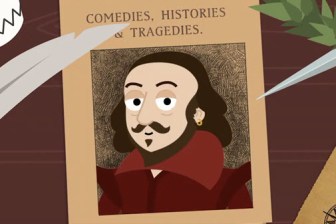
P.S.: Today is Shakespeare’s birthday, and I feel somehow responsible for writing about it to commemorate it as a continuing Student of Art and Dabbler of Wordcraft. What I love about the Bard is that he wasn’t classically educated and that he was something of an autodidactic artist whose natural light of wit and way with words made him all the more attractive and approachable. The image of a gigantic literary figure that we usually associate with Will is a Victorian invention of the grandiose grandeur of English literature undefiled. If Geoffrey Chaucer prioritized the English language, Shakespeare popularized it. Hence my eternal Kudo to the Brilliant Bard.
We live in a paradoxical culture of hero-worshipping and anti-hero admiring. Hence, the idea of heroism seems to belong to an antediluvian ethos of the misty past when heroic mortals became divine immortals enshrined in pantheons of gods and goddesses. In fact, the ancient Greeks regarded a hero as a paragon of Arete, a prized quality in the Homeric hero, a blend of soldiery valor and moral integrity, a perfect union of moral and physical virtues. However, human heroism is constant of every age, universal of every culture and boundless of race and gender, which the public will always find it appealing and compelling because it shows how one can transform the impossible into the possible with a shot of gusto for courageousness in a cloak of confidence. That said, Heroes by Paul Johnson bears the witness to historical heroes and heroines whose dauntless spirits flew over the mountains of obstacles and brings them close to us with their human sides of fallibilities and follies.
From Samson and King David of Israel to Alexander the Great of Macedonia, to Julius Cesar of the Republic of Rome, and to Joan of Arc to Margaret Thatcher of the U.K., what these people have in common is not supernatural feats of magical physical power or omnipotent knowledge, but natural courage winged by the independence of mind arising from the ability to think things by themselves against dominant waves of compromises of their times. In this regard, heroes, as we generally define per se, are anti-establishment, anti-totalitarianism, and anti-supremacy in the sense that they challenge the subjectivity of popular beliefs or received norms to unpick the validity of truths, even if doing so will require their sacrifice and cruelty at the same time. It’s a sacrifice that they should endure the pains of persecution, and cruelty that they should vanquish the signs of human frailties to act upon their resolution without fail. Alas and alack, it sometimes results in pyrrhic victory, not only of the hero but also of those the hero intends to bring the triumph of the collective glory. Being a hero is akin to being a Hamlet whose mental pendulum vacillates between “To be” or “Not to be.”
This is my fourth reading of Johnson’s books on history elaborately ornamented with his trademark natural wits, deeply saturated with his dazzling erudition of subjects, and deliciously narrated in a common language that always invite all, learned or novices, all of which are the essential key components of being a great writer who can share his knowledge and put people before ideas. In this book of heroes, Johnson is a sage raconteur of the heterodoxic history of mankind whose goal is to educate the public to illuminate the parts of our human history in the context of regarding the universal principles of reason and taste. With his scintillating story-telling skills, Johnson pivots deftly from the unknown interesting truths about his heroes to the cosmic principles of heroes that hold true today. If you are a history buff who always hungers for those unknown truths about famous people in history that are known to a few backstages of history, this book will satiate the appetites of your senses and nourish the mind married with pleasure.
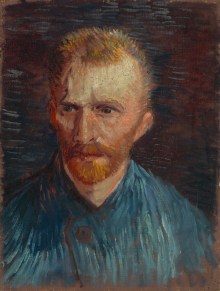
P.S.: I have recently come across an article about the nature of Vincent Van Gogh’s mental illness that eventually resulted in his suicide in May 1889 with a pistol that punctured his heart in Saint-Paul-de-Mausole asylum in Sant Remy, France.
It is said that Gogh had shown symptoms of disturbed mental states since he was 17 years old when his parents tried to get him committed. He was later seen eating coals while painting and told of hearing voices and seeing hallucinations. As a matter of fact, Gogh was from a family with a history of mental illness: his maternal aunt was epileptic, and two of his siblings died in asylums and two others by suicide. Surely, this doesn’t aver that mental illness is hereditary and therefore brings grist to the mill of eugenists.
In my opinion, it seems more likely that Gogh’s tragic life story comes from a combination of Gogh’s disappointment with the failed reception of his works and frustration with his ability to deal with the existential reality interacting with the unfavorable circumstances surrounding his struggles to mark his existence through a medium of art, which deserves of recognition for its beauty of his highly innate artistic sensibilities that glow in the dark night of the soul. To me, whether Gogh was clinically insane is to miss the gift of the artist to humankind that always thrives in the beauty of arts.
P.S; I was reading a book this afternoon and heard a bird singing from the bough of a tree outside the window; it was very pleasing and made my spirit flit in a mind’s garden. It was a beautiful Saturday afternoon, which resulted in this improvisational little poem.
If you feel why life can’t be lived at the same pitch
Of your mind’s notes written in the heart’s chamber;
If you find the utter cry of your heart without a hitch
In a solitary sea of words rolling and heaving under
A rainbow of vivid imaginations and fleeting emotions;
And your spirit often rebels and refuges in the ether
From the detritus of broken promises and shattered dreams,
You were born of the mystic race of the Highly Sensitive
Of Fire, Spirit, and Dew in the wondrous alchemy of beauty,
So beautiful, so pleasing, so delightful that your eyes are lit
With twinkles of sparkling waters, sparkles of diamonds
That which adonize you with the Supreme One of Mystery.
You don’t have to feel obligated to believe that apes are your distant relatives lost somewhere in the missing link because it is one of many theories based on educated guesses anyway. In fact, few species in the natural world are more indubitably wonderful and incredibly mysterious than mankind that Shakespeare swiveled his head in wonderment and uttered, “What a piece of work man is!” Accordingly, the origin of races has always piqued the curious, fanning the fiery imaginations of the human race and the wherefores of modern humankind in the discovery of the two kinds of the First People from Africa around 1.5 million years ago. The Neanderthals and Cro-Magnon: The History and Legacy of the First People to Migrate to Europe by Charles River Editions will present you these two unlikely yet compatible hominids in the panorama of human evolution that is unrolled as it narrates the sequentially arranged series of scenes from Africa to Europe and Asia.
The book helps you to unwind your conditioned belief that the unkempt, clumsy Neanderthals were not the ancestors of strictly non-Europeans; In modern populations of Europe and certain regions of Asia, DNA derived from the Neanderthals makes up between 1% and 6% of human genomes. In fact, the Neanderthals, who evolved separately in Europe, are a member of the genus Homo like Homo sapiens and share approximately 99.7 of their DNA with modern humans. This also leads to a wonderous finding of the co-existence of the Neanderthals and Homo sapiens migrating from Africa roughly between 40,000 and 30,000 years ago, about the time when the former slowly began to extinct due to weak immune systems, incompatibility with the changing environments, and gradual domination of the latter who knew how to manipulate fire as an essential living tool. The interbreeding of these two different peoples was most successful if a Neanderthal man mated with a Homo sapiens woman because then the offspring became fertile, contrary to the sterile progeny of a Neanderthal woman and a Homo sapiens man.
In addition to the Neanderthals as an intermediate evolutionary phase between Homo erectus and sapiens, you will come to know that Homo sapiens developed in Africa left the continent in the second wave of migration around 150,000 years ago and settled in Europe and Asia, thereby continuously living and occasionally mating with the Neanderthals, who were eventually displaced by more hunting savvy and physically advantageous Homo sapiens with their domesticated canine companions appearing around 36,000 years ago. The movie ‘Alpha’ will supplement the pictorial vividness of the history of the first anatomically modern human race with their first domesticated beast whose symbiotic relationship continues to this date.
In all likeliness, this book is a comprehensive read on the pre-historic legacy of the first anatomically modern people and the other hominid whose genetic similarities still manifest their evolutionary linkage in parts of modern Euro-Asian populations. Written in plain language devoid of elaborately subjective interpretation of the theory of evolution, the book will entertain your spare time, and your mind will feed off the sensation of exotic kind of knowledge that will enhance the treasures in your cabinet of curiosities. On a note of persecuted minority creation science follower, this book will provide you with a much less outrageous theory of human evolution than the hardcore origin of the species that graphically strips off even a remotely anatomically human semblance of the supposedly very early human species in despair. That’s quite a catch, isn’t it?



You must be logged in to post a comment.