Tag: book reviews

  • ‘Stupid Ancient History’, by Leland Gregory- review

    Stupid Ancient HistoryStupid Ancient History by Leland Gregory

    My rating: 5 of 5 stars

    The purpose of history is to transcend the subjectivity of times in the discovery of the truth about human nature with multidisciplinary approaches that aid in our understanding of the continuity of mankind. In this sense, history is an artifact of a collective human enterprise of culture and society, which mirrors how we humans have been, what we have done, and who we really are from the times immemorial to this date. If this sounds too stuffy and boring with the gravitas of an academic subject filled with dates and names and events to remember for exams, then you will love Stupid Ancient History by Leonard Gregory because it will make you both learned and amused with a course of delightful Amuse- Bouches throughout a solipsistic feast of reading to your heart’s content.

    Filled with many unknown tidbits of ancient Greek and Roman history, this book is a pleasure to your brain overtly fed by fake-news, ego-inflated memoirs of successful people, revisionist histories in favor of political ideology, and vehemently subjective narratives of self-proclaimed outsiders away from the realities of daily lives. It’s also refreshingly accessible to all, average and academic, which shows the humble and benign character of the author who, despite his wealth of knowledge on the subject, translates the words of an academic into those of a student seemingly with a general reader in mind. The book reveals it all; it ranges from Cleopatra VII Thea Philopather, (aka Mark Anthony’s Egyptian Lover, who wasn’t really Egyptian) to Pliny the Elder, who believed that pouring vinegar over ships gave them some slight protection against storms, to Emperor Nero, who didn’t play the violin during the Great Fire of Rome but paid out of his pocket for the provisions and housing for the homeless due to the fire, to the great ancient thinker Plato, the name meaning “wide, broad, broad-shouldered” betrayed his real name Aristocres, and to many others that will wow your brain conditioned to believe what they weren’t really.

    It’s a really a Eureka experience that you will get from reading this delightful book, and you will feel effortlessly erudite in the knowledge of history and positively enriched with the knowledge of humankind that has not changed a bit according to the racy but playfully innocent scribbles found in the ruins of the ancient city of Pompeii. What’s more, by adopting the in-vogue trend of using short episodic vignettes, the book doesn’t require your following the entire chapters to sequence the narrative and makes it a very pleasing and flexible read for the benefit of simple mental pleasure. So, if you want to be conversant with the history of ancient Greece and Rome without being overwhelmed by stuffy words and boring typography in one sitting, this book is the genie to your wish.

    View all my reviews

  • The Pathfinder of the American West – review

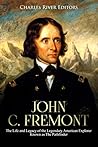
    John C. Fremont: The Life and Legacy of the Legendary American Explorer Known as The PathfinderJohn C. Fremont: The Life and Legacy of the Legendary American Explorer Known as The Pathfinder by Charles River Editors

    My rating: 4 of 5 stars

    Before the dawn of civilization set on the American West
    With metal horses and electrical messages and gold mines,
    The braveheart John Charles Fremont opened unpathed trails,
    Uncharted rivers, and undreamed regions of the unknown
    Crossing from the east of the Appalachians to the west of the Rockies,
    Following the watery highways of the west of the Mississippi rivers
    Enduring the perils of nature and hostilities of the ancient tribes
    Defying the temptations of returning to civilization with all might
    In the discovery of new hopes, new opportunities, and new beginnings
    For those wishing for a surrendering of old yesterdays and a trust in new tomorrows.

    View all my reviews

  • ‘Tom Horn: The Controversial Life and Legacy of One of the Wild West’s Most Famous Gunslingers by Charles River Editors’, – review

    Tom Horn: The Controversial Life and Legacy of One of the Wild West’s Most Famous GunslingersTom Horn: The Controversial Life and Legacy of One of the Wild West’s Most Famous Gunslingers by Charles River Editors

    My rating: 4 of 5 stars

    You may know what you are, but you don’t know what you may be. Things never seem to go in a way that you want them to, and life can’t always be lived at the same pitch as your heart’s content. For the fickle nature of life is beyond your mortal measure, which is called the vagaries of life according to the positions of the slings and arrows of the Wheel of Fortune on which someone’s loss can become your windfalls and vice versa. That’s why life isn’t fair, and you know it, but you just have to bear it with a grin in the manner of an obscure performer on stage getting the part you don’t like. It’s easy to be said and done, but that’s how the life of Tom Horn, one of the Wild West’s most famous and last gunslingers, seems to mirror how the play of the Fate in company of the juggernaut of an epoch betrays a man’s life despite his efforts to carve it out according to his will, which makes me question the validity of Calvin’s Doctrine of Predestination that I have thus far resisted.

    unnamed
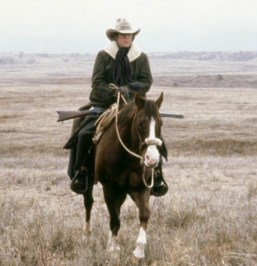
    Steve Macqueen as Tom Horn

    Tom Horn, born on November 20th, 1860 in Missouri, was an American scout, cowboy, soldier, cattle detective, and Pinkerton agent in the 19th-century and early 20th-century American Old West, spanning the two epochal societal and economic changes of the West that permeated the lives of the frontiersmen and women in all aspects of their contemporary life. However, nobody struggled to be accustomed to the changes more than the infamous Tom Horn, who allegedly committed 17 killings as a hired gunman throughout the west, including the dramatic capturing of the legendary Apache warrior Geronimo due to his commendable knowledge of Indian languages and negotiation skills. And yet, Tom Horn was not the usual footless gunslinger killing people for leisure or money, hanging around at saloons, or roaming about the town just to get kicks for scaring the onlookers with that usual contrived look of machismo. He was always working or in search of working out in the field, self-employed or employed, riding the horse from one end of the frontier to the other end where guns were a means of law and life. Until the U.S, Census Bureau officially closed the Western Frontier in 1900, Horn had been working as a mercenary assassin for the cattle industry whose job was to ambush cattle rustlers hired by local cattle lords. And it was during this employment that Horn was accused of killing a young boy in Iron Mountain, Wyoming as a result of a growing feud between the cattle and sheep industries breaking all borders of rationality.

    Whether Horn really killed the boy remains unresolved on the grounds of insufficient substantial evidence, but upon my reading of the book in association with watching the selfsame movie, starring Steve McQueen as Tom Horn, I posit that Horn must have been framed for the murder of the boy because (1) he was always a lone wolf without attachments; (2) he had extensive working experiences of handling fugitives, criminals, and hostile natives as an expert marksman; and (3) he wasn’t as cunning and slick as others to protect himself from false accusations and other kinds of infamy.

    In fact, Horn was a scapegoat for the changing social climate of the West in the transition from a lawless territory to a civilized society that slowly began to simulate the East Coast, where a man like Horn would be a subject of public farce, ridicule, and reprehension as an epitome of the barbarity of man deprived of the common constraints of civilization retorting back to the old law of teeth for teeth and eye for an eye. Horn’s glorious achievements as a dependable scout who guided the army through the unpatched perils trails packed full of unknown dangers to the frontier, a reliable bounty hunter who did his job well, and a good, conscientious employee obeying his employers were naught in the greedy minds of his cattle lords, and thus his existence was simply expendable just as another precarious serf who could be terminated for good at their wills.

    2627fc181fdf35677cd3d045929bf8d6
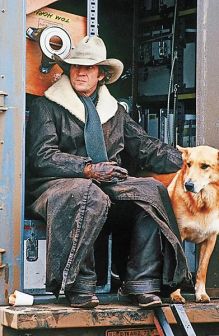
    Steve McQueen during a break on the set of Tom Horn

    Horn’s life was ended in the gallows generated by waters in a Wyoming prison on November 20, 1903. During his numbered days in a cell, Horn wrote his autobiography, Life of Tom Horn: Government Scout and Interpreter, published posthumously in 1904. Even Geronimo expressed his disbelief of Horn’s charges and the killing of the boy in a cold-blooded fashion. True that Tom Horn has become something of a Western saga with his larger-than-life figure. Nevertheless, he was not a fictional character but a real man who tried to make the best of his life in the wilderness of the West alone with what he had. I believe that Horn was a collective scapegoat sacrificed for expiating the barbarous past of the 19th Century western frontier for the want of a new zeitgeist of the 20th century civilized western society. For this, nobody sums up the tragedy of Tom Horns better than Elizabethan dramatist and poet Shakespeare: “As flies to wanton boys, are we to the gods; they kill us for their sport.” This is why my resistance to the doctrine of Predestination is being inclined to the truce for consideration.

    View all my reviews

  • Queen of hearts

    500_F_274341335_PD5mMsZ0oscaOWx7diG52TCPi3hEhp3w

    Boldness can take you to unpathed trails and to undreamed lands, transferring all your yesterdays into all your tomorrows in one fell swoop. For we are such stuff made on dreams, hopes, and wishes however far-fetched they may seem. You live only once, so why not roll with it as you wish? And this touch of adventurism can make your soul emboldened to do things that you wanted to but couldn’t because the grit buried under the flotsam and jetsam of your aborted dreams and discouraged expectations begins to bloom in your secret garden of the mind.

    With the mysterious aura of haze vanished beyond the endless horizon, Judy suddenly felt a sense of destiny filled with adventures in the wild that set its unsullied beauty and quiet sovereignty apart from the crowded theaters of Reality where spectators and players hoot and holler for the most beautiful, powerful, and successful only she could not feel allied. And within this sanctuary of nature, this wondrous sense of go-aheaditiveness felt real but unbelievable. Rufus, Ben, Raphael, and Judy were all together in this joint adventure that was forming a kind of mental alliance among them, which was also felt but unseen. Forget Reason! For their faculty was more physical than metaphysical, less reasoning than instinctive in response to any such fantastical experience that delivers a burst of sensation to their beings spreading like a prairie fire sweeping every part of their bodies.

    “Gee, I wonder what it was. I know there’s something in the air because my gut feeling never failed me,” said Raphael, the Talker. “Yeah, I felt it too. Otherwise, the dog wouldn’t have barked at the thing in the air so persistently. You know, dogs and cats have special eyes to see ghosts and things we can’t. But whatever that was, it’s gone. Let’s get on with it and leave.” With this sententious statement, Ben started climbing up the saddle that was placed a bit too high for his stocky figure on his Californian mustang. His artistic inclination made him a believer of supernatural beings, but his work experience as an itinerary musician made him a practical dreamer with a view to match in the real world. But of course, his ability to cope with existential strains of daily life paled by comparison when it was juxtaposed with Raphael’s shrewdness pleasantly blended in his avuncular charm. While Ben was struggling to make it to the top of the saddle, Rufus was being pensive about the present and the future with a dream to make it big with the Aztec gold so that he could set up his younger brother Joe with a general store in their hometown. He was secretly in agreement with Ben that they should just forget about the free magic show to continue their journey for the buried treasure. My dear reader, you should not regard Rufus as a materialistic, footless young man hell-bent on being rich because once you get to know him more, you will want to be his best friend. Must I go further to affirm his character reference?

    Judy was looking and listening to this funny trio like Artemis, the goddess of hunting and the Moon, watching the comedy of the mortal from the top of Mount Olympus and thought they were indeed a curious band of wayfarers in quaintly old-fashioned attire and even more antebellum deportment and parlance, which piqued her historical curiosity feeding on her love of good old Westerns and stories of pioneers and gunslingers. To her big beautiful brown eyes, Rufus, Ben, and Raphael looked just like the characters from one of those Westerns starring Clint Eastwood, James Garner, Steve McQueen, and Lee Van Cleef. No, not John Wayne, Paul Newman, or Henry Fonda because they possessed no natural screen charisma surrounding their physical appearances as well as the mental force that could only be generated by real-life experiences and natural endowments. Judy was hooked on these characters still discussing and arguing about what to do next in front of her without regard to the pretty lass. If these men were a bunch of perverted thugs, she could have and should have known it at the first sight of them because she prided herself on her Sixth Sense inherited from her mother who was also spiritually gifted. All seemed intriguing and fascinating, thought Judy, who was on one-weeks’ vacation from her job as a secretary at a busy law firm. So, she approached the trio now all on horseback to offer herself as their scout. This gotta be fun. Judy secretly entertained the thought of being a frontier scout and thought her course had already been set for the Wild West.

  • ‘Papillon (1973)’ – film review

    6daa8bbc3333a0740fe55fecd9b16439

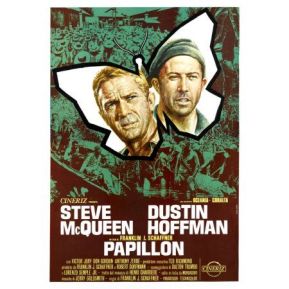
    From Shakespeare to Hemingway, the resilient human spirit rising above life’s challenges is always a high human drama. Nietzsche said: “What does not kill you only makes you stronger.” This paean to a noble human spirit against the existential strains of life has been a paramount theme for masterpieces of arts, especially in literature and cinema appealing to the universal audiences, touching the deepest valleys of human consciousness and pulling at the heartstrings all in a polyphony of humanity. It is this very reason that Papillon (1973), directed by Franklin J. Schaffner, still evokes ineffable inspiration and indelible impression so powerfully displayed on the screen with the authenticity of a true story of a real-life character.

    DagmEaVV4AENyWE

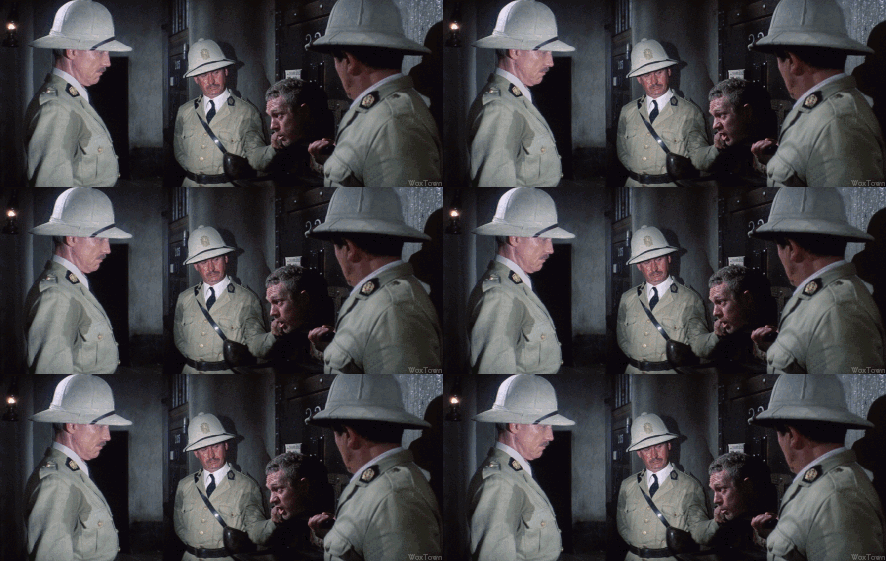
    Papillon, a butterfly in French, is a nickname of Henri Charriere (played by Steve McQueen), a safe-cracker framed for having murdered a pimp because he has a butterfly tattoo on his chest. Henri was sentenced to life imprisonment in French Guiana and decides to escape from the man-made inferno where death is the only way out of the murderous maltreatment doubled with dysentery and hard labor, which makes me wonder if the Nazis, especially Himmler and his ilk of the Final Solution, adapted the French Penal Colony system into concentration camps during World War II. And yet, Papillon’s will to escape and to live as a free man supersede the hellish daily realities fraught with endlessly cruel labor, inhumane solitary confinements, prolonged starvation, and deaths of his fellow inmates, all of which seem to conspire to break his will to live to conform to the totalitarianism of inhumanity in the name of punishment of his crime that he didn’t commit. Escape after escape, hope against hope, and betrayal after betrayal is fortune’s malice trying to overthrow his sovereign state. Still, Papillon’s sturdy mind exceeds the compass of her will, even if it takes him to the furious watery main and the murderous cliff in the Devil’s Island.

    source

    The stellar performance of Steve McQueen, playing the role of Henri Charriere, renders a sense of verisimilitude of the character and the story so convincingly that you dive into his emotions without realizing a boundary between a screen and yourself. Upon watching the film, you feel that you have contracted a severe biological strain of Stockholm syndrome with the Henri character on whose biography the film is based, which bestows the power of reality and the authenticity of truth upon your mind. Steve McQueen, often referred to as the King of Uber Cool, is excellent in portraying the convict with extraordinary feats of endurance and rebellion against the totalitarian penal system that wrongly imprisons his free spirit. McQueen’s abilities as a character actor shine when he commands his presence in a way that seems wholly authentic without overt gestures and contrived charisma but with his eyes sparkling even in the filthy prison uniform that speaks a thousand words surrounding him like a radiant halo as a token for his strong will to freedom.

    This film is, in a way, reminiscent of Ernest Hemingway’s ‘The Old Man and the Sea’ in terms of old Santiago’s indomitable burst of pep to fight the shark appropriating his hard-won big fish. The old man might look feeble and weak in comparison with the mighty power of the vast sea. Still, it is his will to win the battle against the force of sea that is sublimated into a victory of the human spirit with the resounding  dictum of this feat of humanity: “Man can be conquered, but cannot be destroyed.” That’s what comes to my mind while watching this excellent film about an ordinary human being with an extraordinary power of will to freedom. Hamlet uttered: “To be or not to be, that is the question.” To Henri Charriere, such contemplation is a meaningless echo of a defeatist. Henri is more of Macbeth working out on his plan for life as a free man with stubborn courage: “We fail! But screw your courage to the sticking-place, And we’ll not fail.” And Lo! Did he not take the advice of the Bard! And so, splendidly!

    unnamed

    Author’s Note: I watched the film last night and was immersed in the characters and the story. Not that I am an admirer of Steve McQueen but that he’s one of the greatest actors who vanished like a meteor gives a special meaning to this film. It is one of the best performances in his acting career and will always linger in our hearts. 

  • ‘The Remains of the Day’, by Kazuo Ishiguro – review

    The Remains of the DayThe Remains of the Day by Kazuo Ishiguro

    My rating: 5 of 5 stars

    Ask anyone and you will find everyone has something to talk about life with natural octaves from the highest note to the lowest and best registrar recorded over the vicissitudes of life as if living an ordinary life without a material curriculum vitae were a sign of defeatism synonymous with rootlessness. More often than not, a straightforwardly elliptical, honest-to-goodness narrative is not considered a smashing subject matter for a bestseller that merits an entire aisle of any bookseller, but the story of English butler Stevens shoehorns his ordinary work experience into a suitably fashionable stance for a modern-day memoir that reads like a continual fugue of flattering hopes, misguided beliefs, despotic self-denials, cruel disappointments, and smothered pleasures, all elegantly interwoven into a polyphony of life in The Remains of the Day by Kazuo Ishiguro.

    The Moment of Reckoning Stevens falls into, pace the general opinion of the mass, results not from his disillusioned loyalty toward Nazi sympathizer Lord Darlington but from his own disoriented value and belief systems in accordance with the changing zeitgeist in the wake of the two great wars. Lord Darlington epitomized what dignity and magnanimity meant to Stevens in a way that his position as a butler was as equally prestigious and sovereign as that of his aristocratic employer Lord Darlington, a figure of respectful English peerage that deserved of his dedication and devotion. It’s really a case of ‘Qualis rex, talis glex,’ meaning “As is the king, so is the people.” And it was this belief system that made Stevens endure occupational humiliation from arrogant guests of high birth, the grief of the death of his father, and tender feelings toward Ms. Kenton, a former head housekeeper at the Darlington Mansion. In fact, such belief system based on seemingly antediluvian values in the post-modern era was Stevens’ lifeline that had kept him going until he took a trip to see now married Ms. Kenton, a kind of Beatrice-like figure guiding Dante from Hell and Purgatory to Paradise.

    Stevens’s existential dilemma stems from his existential vertigo in the aftermath of the wars and the subsequent social changes that upended the foundations of the collective value and belief systems of society. Stevens’s inner world was put into an existential vacuum, a void that can only be filled by a sense of purpose and new attitudes toward life in search of finding meaning therein. Rather than bemoaning his life as a boring butler, Stevens kept trying to find meaning in what he had been doing, what he was still doing, and what he would do by asking himself the question of his own life to which only he could answer; that is, to a life he could only respond by being responsible. And it was not a reactionary response with his fists clenched in bitterness and a sprit of French Revolution against the privileged few, but his own examination of his life that felt a void in a sense of direction in life.

    Kazuo Ishiguro created a character whose existential dilemma is relatable and pitiable with his mastery of characterization, the wealth of imaginations, and study of human nature, in his signature elliptical narrative skills laced with nuanced emotions that never lay the whole character bare to the eyes of the public. He’s a fantastic writer who shows readers that a good writer is capable of travel and metamorphoses no matter where he was born or what he looks like. I wonder how many writers tried to break free from their biological planes and even dreamed about being who they wanted to be, confidently and naturally crossing the boundaries of culture and race just as Ishiguro did without branding his Japanese cultural and Asian traits as a convenient foundation for suitably fashionable “ethnic” literature. All in all, this is a fascinating book to observe how social changes can affect an individual and how one copes with such historic and cultural juggernauts in search of meaning in life. This book is a testament to the magical craft of writing that a writer should be all that he is capable of becoming no matter who he is. For a writer is also a magician of words, a wondrous sort of shapeshifter in letters.

    View all my reviews