Tag: book

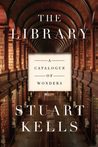
  • ‘The Library: A Catalogue of Wonders’, by Stuart Kells – review

    The Library: A Catalogue of WondersThe Library: A Catalogue of Wonders by Stuart Kells

    My rating: 5 of 5 stars

    Libraries are more than boring stockpiles of books gathered, nondescript depositories of books collected frequented by socially gawky individuals we love to call “nerds” or “misfits.” They are symbolic fortresses of our human cultural progresses as collective enterprises. In fact, libraries are precious repositories of our cultural wealth and knowledge inherited from the forerunners of the Humanities with prescient intentions to preserve the intellectual and spiritual prerogatives of the mankind for the posterity. Any book lover sees this magnificence of libraries, and that is the motif of Stuart Kells’s The Library: A Catalogue of Wonders, a vivacious, jocund presentation of histories and development of libraries and an uplifting rhapsody of bibliophile – love of books. What’s more, this book is not a product of armchair thesis of a library as an anthropological institution, but of an empirically telltale account of cultural, aesthetic, literary, and social phenomena dedicated to preserving the writings of Mankind based on Kells’s actual visitations to the libraries he presents to us.

    To begin with, Stuart Kells wears many hats in this book: a teacher, a guide, a book-collector, a historian, and a confirmed book-lover. But most of all, the image of him as I follow his narrative is that of a cross between a teacher and a tour guide with erudition and bonhomie. Like peripatetic Aristotle communicating to the minds of his students in the ancient Greek Lyseum, Kells invites the reader to saunter with him in his own mental library of snippets from a variety of literature and history that merit their substratum of textual human cultural artifacts bestriding the shelves of the Humanities ranging from the classical to the contemporary, all in the loving and caring custodianship of the author whose love of books is so deep and passionate that it’s almost physical. It’s personal, historical, academical, and magical in a way that imparts a sense of flitting in the phantasmal reverie of the world of libraries, now and then, existing and extinct, and  real and imaginary, to the reader.

    We travel along with Kells playing the role of a likable and knowledgeable cicerone from the Library of Alexandria to the Italian monastery of Bobbio in the Middle Ages that was said to house 666 manuscripts, Germany’s Wuttemberg State Library possessing a 17th century portrait of Vlad Dracul, aka Dracular, and the Abbey Library of Saint Gall, aka St. Gall’s Library, in Switzerland, which is now a UNESCO world cultural heritage site holding more than 400 manuscript volumes produced before the year 1000. And before we know it, Kells also brings us to the fantastic libraries of the famous Hobbits, also known as a race of bibliophile with personal libraries at home, however small the size might be, and the medieval monastery library in Umberto Eco’s The Name of the Rose, where lightheartedness of the atmosphere contributes to the joy of knowledge and the elevation of the mind and soul. Although Kells’s Australian identity tells of the superiority of J.R.R. Tolkien’s Mathom House, a wondrous library of literary paraphernalia, over the Italian Eco’s monastery library, it’s altogether a magical sightseeing of the mystical libraries conjured up before our eyes by the imaginativeness of Kells, and we can decide which of these fantastic libraries appeal to us.

    To conclude, the book is an axiomatic compendium of world’s famous libraries throughout the western civilizations, smartly studded with tidbit information on eccentric librarians, book-collectors/booksellers, and historical figures in between the chapters serving as a kind of delightful intermissions introducing a subject of each new chapter with provocative anecdotes and vignettes, which are pleasingly digressive rests from the tour of the libraries. It’s really a bright book, not a heavy-duty one with lots of footnotes and scholastic priggishness that the reader may expect a book of this subject matter to be. Notably, Kells’s interpretations drew on his impressively eclectic knowledge of these extensive sources as a respectful book-trade historian, but he wears his learning lightly and writes with a general reader in mind. And I believe that just as the famous English poet Samuel Taylor Coleridge often kissed the books of the Dutch philosopher Desiderius Spinoza, out of Kells’s passions for books and possession of the knowledge of multidisciplinary studies comes his love child in the form of this jolly, easy-to-read book.  In the end, the reader will come to love this book for simple, pure pleasure of reading and may kiss the book.

  • The Spectator – review

    cover_20181103_issueAlthough I try not to read a newspaper on a daily basis because it is always fraught with starkly existential horrors of life that rudely bestride a secret garden of my sanity like a herd of barbarians in the ancient forest, I enjoy reading a selection of magazines filled with well-written articles of interesting topics aiming to educate us, the citizens of the world, on the state of affairs around us in order that we may formulate our own views of the world based on the acquisition of the knowledge. In this regard, this historically and intelligently renowned magazine The Spectator epitomizes literary journalism in the most scintillating way that makes reading a magazine at once an enlightening and entertaining experience.
    Established in 1828 (but its actual genesis began way back in 1711 by Addison & Steele.), this magazine is packed full of current affairs, reviews of the Arts, essays, and many more that will pique your attention; they are also surprisingly easy to read without the usual journalistic lingo chockablock with gobbledygook, priggish literary expressions, and biased opinions that are common features of magazines of the similar kind.

    My Caveat emptor for The Spectator is thus: because of its political and cultural leaning toward conservatism, many of the first time readers might feel guarded to hold their due admiration of the fine quality of writing laced with the characteristic British witticism. But don’t let it deter you from enjoying this cracking compendium of our today’s world in a wonderfully intelligent kaleidoscope, which is a truly one-of-a-kind. This magazine provides to you all the knowledge with information rarely found in any other popular contemporary periodicals, especially here in the States where the majority of them are proudly anti-establishment, anti-tradition, and just about all anti-anything civility without meritorious writing styles laced with scintillating witticism that was once wielded by the pens of Mark Twain, Horace Greeley, and Roger Ebert.

    All in all, in reflection of Benjamin Franklin’s timeless sage adage “An investment in knowledge pays the best interest,” it is worth the subscribing to The Spectator. And if you have a Kindle Fire like I do, you will be looking forward to receiving and reading it every week with a kind of expectation you would rarely get from reading just another lackluster periodical.

    P.S. This overview of the magazine was written in response to an email sent by Amazon asking for my customary opinion on it. Hence this review.

  • Fairy summoning in the Florentine Renaissance period

    41a59389f2e8e71b94e50f9d1ae7d39a--vintage-fairies-vintage-artwork
    A supernaturally pretty fairy deludes men’s hearts.

    There are magical elements in religion, and there are religious facets to the practice of magic, as succinctly summed up by Sir Walter Raleigh: “The art of magic is the art of worshiping God.” That’s how I feel and what I see during my Dutiful Sunday Morning Masses, the ancient rite of the Church, a perennial panoply of syncretism with its splendid paraphernalia of prayers and the liturgical ceremony of rites and mechanical recitation of prayers; it is the melding of religions or beliefs of the similar elements but of different origins. Hence, to come upon an article in the recent issue of BBC History Magazine about an academic study by a certain British scholar of the existence of fairies in the context of the validity of cultural and historical artifacts gave me an uncanny pleasure.

    Dr-Faustus
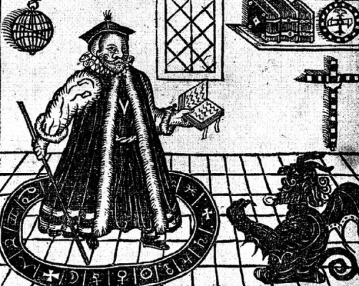
    The famous Dr. Faust, summoning Mephistopheles for his service

    In fact, Religion (that is, Christianity) and Magic (in the forms of divination and sorcery) are not to be seen as polar opposites and antithetical systems of belief because they are interdisciplinary agencies of attempting to seeking and offering a panacea to our dilemmas – physical, metaphysical – competing for supremacy in propitiation. Such mysteriously syncretic elements of the two different agencies of beliefs became the academic subjects of intellectuals, such as Francis Bacon and John Aubrey who accepted the potentialities of physiognomy as an infallible guide to predicting one’s character and argued for the validity of non-Christian practice based on certain intellectual bases therein. With this in mind, you would not be surprised to learn that fairy summoning rituals were all the rage in the Renaissance period (15th~17th centuries), indiscriminately practiced by all strata of society, learned or ignorant, rich or poor, Christian or pagan. The author of the article informed the reader that the early Renaissance idea of fairies was pretty nebulous and varied with a wide arc of wonder and trepidation and that the dainty image of ever famous “Tinker-bell” was a Victorian construction of the whole fairy race.

    Then, how did the “real” fairies look? Although there is no magisterial, definitive version of the physiognomy of a fairy, a collective description gleaned from various records boils down to it as a supernaturally attractive man/woman imperiling the souls of whoever it was summoned to, which is reminded of incubus/succubus, consecutively. Notwithstanding the dubious nature of fairies, the invocation of fairies halfway between angels and devils was widely used in hope to (1) acquire medical knowledge, such as whereabouts of herbs and their properties; (2) delight in the highest degree of sensual ecstasy; and (3) reveal the future and prevent from misfortune in advance. Be it as it may seem wholly pagan, the summoning ritual was surprisingly required for God’s intervention because it included periods of purification through abstinence, fasting, and prayer in preparation, all of which would testify to the sanctity of the performer ministering to the moral and ethical character. God willing, a fairy at request manifested to the summoner, but he should not come out of the circle he had drawn because it protected from sudden maleficence of the ambiguous fairy.

    Delphic_Sibyl_Michelangelo___21969.1501257269
    Delphic Sibyl from the Sistine Chapel fresco by Michelangelo

    In sum, the article was an elegant primer for a further interdisciplinary study of literature, religion, and folklore from the medieval times to the Reformation period and possible stretching to this date. The exemplary texts that spring to my mind are Religion and The Decline of Magic by Keith Thomas and Christopher Marlowe’s version of the legend of Dr. Faust, both of which are excellent testaments to the contextualization of the esoteric knowledge on the grounds of intellectual bases into academic studies of social, cultural, and historical facets of different zeitgeists, which also serve as invaluable literary artifacts to epochal changes. But for all that is worth, this relation between religion and magic is commensal, exhibiting a mesmerizing consilience of gods and God, profane and holy, pagan and ecclesiastical, forbidden, and disciplined, as superbly unfolded in the Sistine Chapel fresco, prodigiously expressed by Michelangelo.


    저장

  • Jane Eyre (1983 BBC TV Mini-Series)

    BBC_JaneEyre_1983
    Jane Eyre, the Timeless Classic

    Charlotte Bronte’s Jane Eyre (under the pen name of “Currer Belle” to discombobulate her biological determinism) is neither a romantic novel about a lonely young woman falling for her rich master nor a proto-feminist literature subtly championing women’s economic independence and choice to select their lovers on their own. It is a story of a resilient and noble spirit armed with education, clothed in a canopy of humanity, and adorned with reflective beauty of the mind that transforms physical plainness into comeliness. That’s what makes our heroine Jane Eyre timelessly unforgettable, undeniably attractive; perchance, that’s why this novel has been made into a series of film versions for television and cinema resurrecting the ambiance of the period and bringing the hauntingly impassioned characters into life. Of all the dramatized adaptations of Jane Eyre, this 1983 BBC mini-series version merits itself in the movie firmament as the authoritative translation of Charlotte Bronte’s original novel, wonderfully delivered by a cracking screenplay, a brilliant cast of performers, and a correct setting of the story, resembling none other than themselves altogether in this riveting panoply of Bronte’s dazzling creation.

    Dramatized by Alexander Baron, this TV series is composed of eleven episodes that faithfully capture the epochal moments of the passionate heroine Jane Eyre from the moments she was cruelly castigated by her callous aunt and her equally sordid cousins to her eight years of boarding school experience, to the fateful encounter with the brooding but vulnerable Mr. Rochester, and to the significant events packed full of surprises and serendipity worth every reward to the lonely Jane. The gem of this BBC miniseries is that each of the episodes is treated as a small story – that is, a story embedded in a whole story as if it were a short story itself – so you can skip the early years of Jane and jump into her employment as governess for Adele, the only daughter of Mr. Rochester at Thornfield without feeling adrift from the previous story that will defenestrate you to the middle of nowhere in the whole story. Of course, for those of us who have read and re-read the novel since the time immemorial, it’s a foregone conclusion, but even if you haven’t, take heart and play it fast forward to meet the grown Jane (although she’s only nineteen years old.) in her tantalizing, suspenseful moments with Mr. Rochester and even St. John Rivers.

    jane_1983_2_314x465
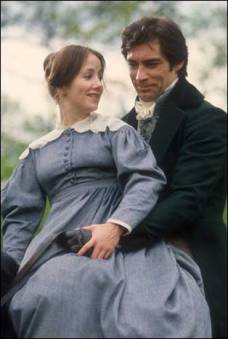
    Zelah Clarke as Jane Eyre and Timothy Dalton as Edward Rochester

    At the heart of the drama lies the commendable performance of the characters: Jane Eyre, played by Zelah Clarke, Edward Rochester aka “Mr. Rochester,” by Timothy Dalton, and St. John Rivers, by Andrew Bicknell invest the drama with the beautifully nuanced dialogues and gestures, which are never outlandishly displayed, vying for individual attention, but harmoniously concerted that impart the enthusiasm and the verisimilitude to the story. The appearances, gestures, and diction of these three characters are exactly what I have always imagined them to be in my mind’s eye. Clarke’s rendition of Jane Eyre is the finesse itself that would make Charlotte Bronte happy with her performance as well as physiognomy. Jane is a passionate soul, but conservative, if not conventional. She is an intelligent woman who loves her gruff but deeply hurt and lonely Edward Rochester as her equal despite a sea of an age difference and his petulant past. Unlike other Jane Eyres played previously and posteriorly, Clarke’s Jane epitomizes the heroine of oddly beautiful enigma personified: the plain but pretty, expressive but demure, passionate but docile, sensitive but intense, patient but yearning… Which is befittingly summarized by St. John Rivers, wonderfully and unforgettably played by Andrew Bicknell: “She has an unusual face rather…The grace and harmony of beauty are wanting in her features. She is not at all handsome…” I have seen other film versions of Jane Eyre, but none other than this Clarke’s Jane Eyre has won my approval in terms of all things regarding the heroine of Charlotte Bronte’s original novel.

    x1080-VfL
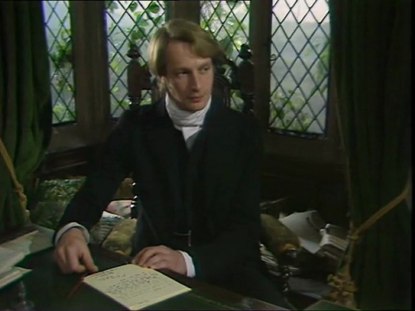
    Andrew Bicknell as St. John Rivers

    That goes the same for Timothy Dalton’s irrepressible Edward Rochester and Andrew Bicknell’s stoical but misguided St. John Rivers. On a personal note, Bicknell seems to nail the role down as handsome and intelligent St. John Rivers, who prioritizes his religious duties as a parson over his human feelings and emotions for his beautiful and kind-hearted admirer Rosemund Oliver in the irrational belief that stoicism is the grist for the mill of vocation as a man of the cloth. He believes that it is his calling to be a missionary in India and that it behooves him to abnegate sensuous delights to which a man is naturally inclined with all his might. Watching Bicknell playing the character makes me wonder if the casting director or the screenwriter had the uncanny ability to conjure up the spirit of Charlotte Bronte and ask of her the fitting image of the character before the production of the drama. The tall, imposing manly figure of St. John Rivers with beautiful Grecian facial features and golden hair is just as the description created by Bronte in the novel as if she had seen Andrew Bicknell in the peculiar alchemy of literature that enabled her to look into the future and to view her character incarnate.

    All in all, this 1983 BBC miniseries of Jane Eyre will arrest your full attention to every scene of the episodes without infelicity and pomposity that classical period dramas sometimes tend to produce on account of obsolete diction and rude gestures that look incongruously emphatic to our modern senses and sensibilities. This is a quaintly gorgeous drama without the ostentatious glamor of television drama exhibiting luminous Vanity Fair; it shows that just simple good scripts based on the loyal adaptation of the original novel and excellent performance of the fine cast that seems to be destined for the roles can translate the imaginative world of the author into the visual firmament of television drama this beautifully and impressively in a way that makes you feel the emotions of the characters by passing over to their inner worlds.

    저장

  • A travesty of some things

    I’m thrilled to read good stuff- I mean a real good one!

    Oscar Wilde, the wonderfully strange writer with a keen eye on the panoply of human behaviors, knew about voyeuristic streaks on human nature when he said thus: “One must keep a diary when traveling anywhere by train or coach to read something sensational.” Maybe that’s why people like to read the lives of others. Maybe that’s why the memoir, which I regard very much as a diary written backward in time, always bestride the bestselling list of nonfiction of The New York Times Book Review, which has become a formidably profitable genre of American literature. Admittedly, it’s awe-inspiring to read a success story of one whose hardscrabble background is a fortiori certifiable and renders a kind of feel-good sentiment with something of a vicarious experience to the reader sharing similar constraints of life in one way or another, or it may seem so. Frankly, any of the best-selling memoirs can hardly be less a modern version of Cinderella story than it seems to me, which is nothing but a proud exhibition of achievements by a select few (“The Chosen”) in the melee.

    I might be cruel, only to be real. I am all the more respectful of anyone who has risen above biological/social inhibitions in his/her own fashion. But this topic of Triumph of Will over difficulties has become a literary fad, as though anyone who had rough and tough times in growing up somewhere in the backwater of downtrodden south or mid-western regions were suddenly in a zealous Olympic competition of writing the most heart-wrenching personal story on one cardinal condition: that the writer must have a very good career that provisions him/her with a nice place to live and loving, understanding significant other into the bargain. That is, unless a would-be writer of memoir is well-established in society, it’s not worth the writing of the story because after all, who’s gonna read your story if you still live among the melee with some ordinary, if not nondescript, job with meager income to barely get by despite your noble resilient spirit and evergreen hope to better yourself?

    It’s all derivative of one model!

    For example, the October 7, 2018 issue of The New York Times Review carries an elegant book review of “Hey, Kiddo: How I Lost My Mother, Found My Father, and Dealt With Family Addiction”, a newest memoir of a certain popular illustrator-writer of children’s books named Jarrett Krosoczka, hailed as another survivor of economic and social determinism. The review presents the book as a courageous live-to-tell account of his childhood shadowed by his mother’s drug addiction and of his triumphant accomplishment as a successful artist who can presumably inspire many kids unfortunately mired in disadvantaged surroundings through no faults of their own. The spirit is commendable, but the gist is visceral. According to the elegant summary of the book, Krosoczka was better off than many other kids in his station because he had lumpish but loving grandparents who took care of him and encouraged his artistic inclinations, plus a cast of odd but good characters that complemented the other void of affectionate attention needed for a child. Back in our real nonfiction contemporary life, how many kids are fortunate to be endowed with the luck he had, and what if a kid struggling to escape from the plight with his intelligence and industry turned out to be just an ordinary adult still laboring to make the ends meet, while still secretly entertaining the thought of becoming somebody in his solitude? Would you think that his life is a failure? The memoir of this kind is more of a resume of individual experiences and achievements that, in a twist of irony, provokes a sort of catharsis in the reader as if he were watching a television drama that would made him feel like living in a holistic virtual reality.

    In all fairness of my acerbic and arbitrary opinion on the review of the aforesaid memoir, it goes against the grain not to point out other popular memoirs perching on the best-selling list: Educated by Tara Westover is about her story of how she got away from her bohemian parents to immerse herself in scholarship; Hillbilly Elegy by J. D. Vance, another one by a Yale Law School Graduate recounting the struggles of the white working class struggles through the story of his own impoverished childhood; Heartland by Sarah Smarsh, a daughter of a poor wheat farmer in Kansas telling her poverty-stricken childhood into adolescence and the hard lives of the working class in the Mid-West; and finally, Glass Castle by Jeannette Walls, revealing her errant childhood and her struggle to be away from the rabble that led her to a gainful literary success. And I suspect that there will be more memoirs to be published in future like new soppy television movies in production.

    Am I being too acerbic? But that is how I feel.

    As someone who regards Courage, Endeavor, and Resilience as great American drama in three acts, I am all for reading about someone who would continue his/her secret aspiration, while keeping the foot firmly grounded in reality, such as Laura Ingalles Wilder, Lucy Maud Montgomery, Jane Austen, and Charlotte Bronte, all of whom continued to tend their ordinary daily duties and responsibilities even after their literary success. To say it’s an anachronistic and antediluvian mode of thinking in the 21st century is to depreciate their literary geniuses and modus vivendi peculiar to the ethos of their times. However, the love of the writing must not corrupt into the worship of the hero. It’s the sense of the writer’s spirit that addresses the spirit of the reader, not the pageantry accolades of material successes that seem to be the bedrock of the memoir riding on the crest of popularity of rags-to-riches telltale revelations. We might live in an Orwellian world of reality prioritizing the ostentatious display of wealth or power, but we shall not devalue the truthfulness and value of ordinary life where the meaning of life depends upon whether or not we fulfill the demands placed upon our daily tasks however insignificant or trifle they may seem. For this reason, I don’t subscribe to the popularity of the best-selling Cinderella memoirs in which the sacredness of ordinariness in combination with the peculiar magic of literature is conspicuous by its absence.

  • Tarantism: St. Anthony’s Fire – review

    My-Neighbour-Totoro-5-940x460
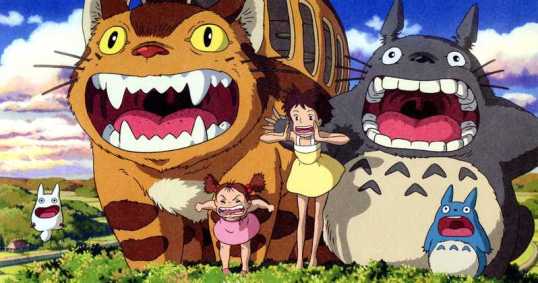
    This was exactly what it was like while I was waiting for my bus to work.

    The Kingdom of Rainfall, Dampness, Stuffiness, and Grimness reigns supreme all day long today without a ray of sunshine peering through the heavily downcast gray sky so lowly hung in the celestial ceiling of the Atlas that it almost looks like collapsing to earth. While basking myself in the typical Atlantic grayness of this somber weather, I could understand why the legendary lost Roanoke Colony was doomed to fail in the late 16th century; it was primarily due to this grim and damp weather condition only congenial to mosquitoes and other kinds of pest that thrived on the unpleasant sogginess. In the reign of the somber weather, to come upon an article in this month’s National Geographic History called “Killer in the Rye: St. Anthony’s fire,” which was also related to the gloominess of the weather seemed a tad pat.

    300px-Pieter_Bruegel_the_Elder_-_The_Cripples
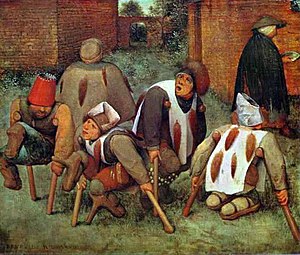
    “The Beggars” by Pieter Bruegel the Elder is said to have portrayed the victims of rye poisoning, most likely of St. Anthony’s Fire, as shown herein.

    Between the middle ages and the 17th century, inhabitants living in the proximity of the Rhine (Austria, Germany, and Flanders) where damp climate affected the crops adversely were frequently subject to a diabolical malady caused by a consumption of infected rye with symptoms of seizures, hallucinations, and infected limbs with excruciating agony that was said to be similar to the spiritual torment suffered by St. Anthony of Egypt. Hence the naming of the agricultural disease ensued. It all started with eating grain infected with a fungus called claviceps purpurea, black growths resembling a rooster’s spurs. This heinous fungus became ergot, toxic alkaloids cutting off the blood supply to the body’s extremities, which caused the hellishly burning sensations to the limbs. Since the cows were not immune from this fungus by dint of eating the infected crop as a staple diet, large parts of the population were exposed to the risk of contracting St. Anthony’s Fire.  In fact, this rye poisoning was multifariously diabolic in the saintly names, such as “St. John’s Dance” and “St. Vitus’s Dance”; the victims displayed tantrums of bodily movements – also known as tarantism – as if they were possessed by demons. Although the rye poisoning began to die out in the Western Europe as wheat replaced rye in the kitchen, the most recent cases of the rye-poisoning disease were seen in the early 20th Soviet Union and Ethiopia and India in the late 2oth century.

    My-Neighbor-Totoro-Rerelease-2018-30th-Anniversary
    Sun, Sun, Sun!

    Indeed, to happen on the article such as the aforesaid while I was sulking in the unpleasant conditions of damp weather gave it an extra fillip. Maybe I am being grumpy about one of those lousy weathers that may be beneficial to the others on the other hand, such as farmers needful of precipitations for their parched land or vendors and manufacturers of umbrellas and rain boots whose businesses hinge on the whims and caprice of Mother Nature.  But as the aforesaid historical records evidence, when dampness and cloudiness in partnership reigns supreme, it turns the world grim and dreary, listless and lethargic. And that is why the ancient civilizations began and prospered in the places where the gods of sun Ra, Apollo, and Helios claimed their sovereign powers among the dominant high gods and goddesses and retained their divine radiance.