
It’s a dewy one Saturday morning after the nightly rain that cooled off the fiery flame of the sun. Thanks to the abundance of flora in Avonlea, the process of transpiration by which leaves of plants release moisture into the air that results in rain on earth, the land of Avonlea is hardly parched, and the atmosphere always fresh and fragrant. That is why Helen induced her husband Priam to move to Avonlea a year ago from Roanoke, where humidity and mosquitoes ruled in autocracy; it was an unsavory place to live, let alone to start a family. The rumor had it that the nondescript town was later set ablaze and ravaged by a man driven to madness by such a torid ambience of the toil. In the background of all this, Helen cannot be happier than now, while listening to one of her repertoires, “Downtown” by Petula Clark on her iphone. In fact, she feels as if she and her George were flitting on her aerial bicycle in the blue sky.
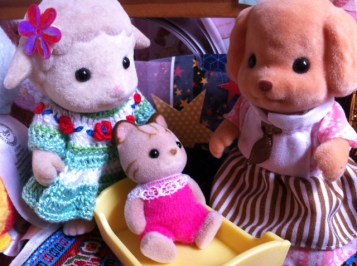
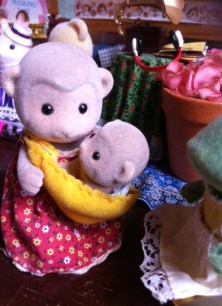
Meanwhile, Sally and Bonnie are cooing Alfred, a baby son of their neighbors Mr. and Mrs. Redfox who are on holiday to Prince Edward Island. Their vivacious daughter Judy is at a parochial summer camp in Thousand Silvers. The Redfoxes are scheduled to return home tomorrow afternoon, so it’s not too much of onerous task the two ladies have to tackle, straining themselves over how to pacify a crying baby, what to do in case he becomes sick out of the blue, and when to change his diapers, etc. Fortunately, Alfred is so mildly-tempered and easy to take care of in the bargain that it is actually a pleasure attending to the toddler without feeling stressful. Sally ponders if such equilibrium in temperament would be a manifestation of solidification of genetic composition. In a minute, Sally and Bonnie are going to take Alfred out for their usual morning promenade.
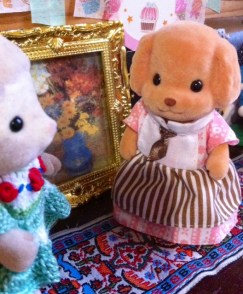
“Look, Bonnie. Alfred’s got a cute mole on the right cleft of his lips! So adorable! I wish I had it too!” “Let me see. Hmmm… I had not noticed it until you told me so. Don’t you know that his sister Judy’s got the same mole on the left cleft of her lips? And so does Mr. Redfox? It seems to be a genetic trait of the family. Definitely. Funny that a man like him has got it, while his wife has dimples. But then the dimples are more precious and feminine and more desirable than a mole, no?” In fact, Bonnie secretly wishes that she would have the same attractive dimples around the corners of her lips that would make her face prettier and perkier. But it is just one of those innocent, muliebral wishes of a lady who doesn’t think that she’s pretty enough to be wooed and sought after. But then who can blame Bonnie for vanity when a gentleman likes a pretty lady? But let us put all the convoluted thoughts and tangled emotions and untamed emotions aside for this bright Saturday fragrant with fresh petrichor. Forget all the worries just for Today and Tomorrow, which is Official Holy Rest Day, and let’s just pretend to have million dollars in our bank accounts for the weekend.



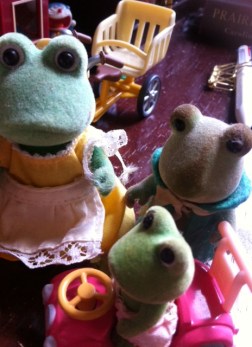 The mother and the son is also escorted by a trusty entourage of Phil, who is also concerned about his dear brother. Small as he is, Philip is all bravery and cheerfulness. He wants to make sure all’s well with Fred, who always reads him sweet bedtime stories by his nightly bedside as well as other illuminating stories about ancient Greek heros and the gods and goddesses of the Parthenon, great historical figures, and oeuvres of fine writers throughout the western civilization. Fred to Phill is what Yoda is to Luke in the Star Wars. Philippa is pleased to see her sons bound by Charity, Hope, and Faith, the three theological virtues, not by dint of mere blood relation that is often devoid of the virtues by default.
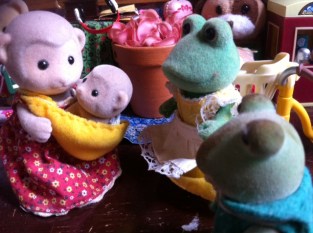 When the McGreen trio arrives at Dr. Hobson’s office on Kingsbridge road, they are amiably accosted by Helen, one of the prettiest and kindest ladies in Avonlea who is married with three children to a grocery proprietor Priam, who fell in love with her at first sight by thinking, ‘She’s beautiful, and therefore to be wooed. She’s a woman; therefore to be won.’ Helen and her three-old son George are pleased to see her neighbors there and wants to know what has brought all three of them to this far. “Fred has been in agony for two weeks due to a serious case of abscess on his right shoulder,” says Philippa, “But Fred did not tell me and his brothers until this morning, enduring all to himself only the gruesome pain that stymied his everyday activities, such as eating and working. In fact, the pain even prevented him from reading a book!”
 Helen does not understand Fred’s reason of silence that was broken this morning, so she ventures to inquire about the cause. “Fred, why did you not tell your mother when it began to hurt you? Had you told her about it earlier, you would have been cured.” Fred is absorbed in all the dialogues between his mother and Helen and forms the most honest and provident answer to the lady’s inquiry. “At first, I thought it would go away because it had happened before. But although I tried myself applying to a topical ointment and taking doses of pain suppressant and high hopes, it just became worsen… What’s more, I did not want to worry mom because she was always very busy with running the restaurant and the household all by herself. Now I am in great pain now, which has compelled me to alert mom about it.”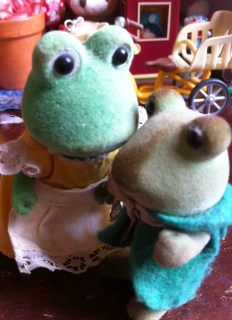


 Ever a voracious reader of good books and sensible, informative articles of The Los Angeles Times, Paul Collie is immediately steeped in a headline of today’s newspaper; that is, an article he has just read in the Times about a fight over the present fishing laws. It is reported that some amendments were made to the laws, which are called “The Magnuson-Stevens Fishery Conservation and Management Act”, a 42-year old rules regulating over-fishing of New England Sea Scallops and Bering Sea Crabs, and that they were approved by the House of Representatives on Monday. Subsequently, these changes have stirred a projected friction between fishermen and environmentalists mostly consisting of researchers, scientists, and radical natural/animal conservatory activist whose viewpoints are normally out of touch with realities.

 She writes, and speaks to a soul in many sorts of music. She sometimes invokes inspirations from her favorite Muses: Kalliope for epic poetry; Clio for history; and Euterpe for lyric poetry. In fact, she feels most ecstatic when the divine inspirations become one with her body and soul creating the ineffable rapture of the body and elevating the excitement of the soul in zenith. She is no less a dilettante of amateur music aficionado and an apprentice of alchemy of literature and history than Seraphina by herself.


You must be logged in to post a comment.