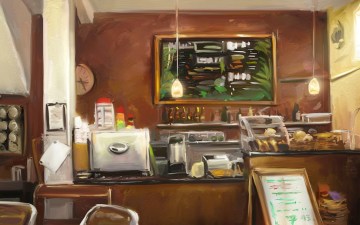
He wanted to talk to her but didn’t know how to begin. He did not want to look overtly anxious, and yet he was obviously anxious. Part of it was his urge to find out if she was the right one that matched his gossamer imago, and more of it was his untamed machismo that even his arete, the harmonious combination of moral integrity and physical discipline, could not surmount. In the age of Amazonian resurgence of matriarchy on the crest of #MeToo campaign, the subject matter of indomitable feat of virility could be highly volatile, incriminating even. But Hector was being none other than a man himself and going against nature would turn him into a closet monster or a spectacular hypocrite. Besides, Hector was an artist who was unafraid of following his heart according to the True North of Nature. He belonged to the race of the untethered, the bold and the beautiful, and he knew it. All of it, all that he had was working toward his wish to speak to her, the mysterious woman sitting three seats away from him.
When it reached the zenith of the urge, Hector couldn’t hold it any longer, and it finally erupted from his lips: “Excuse me, miss. I forgot to bring a pen with me. Do you have a spare one by any chance?” It was the best excuse he could think of because the woman was writing in her notebook. She seemed startled at first by a strange man’s request for a pen, but soon her fear of a stranger relented at his polite manner handsomely juxtaposed with his sonorous voice and beautiful eyes that radiated both warmth of the soul and allure of the flesh. Iris was always sagacious of people’s characters, which was her gift and curse of the Fates, and she saw genuineness in this strange but beautiful man’s eyes in an aura of charisma, a mythological power ascribed to the Olympians and select hybrids of mortals and immortals. In a phantasmagorical display of the Greek heroes and gods, Iris was filled with mysterious confidence that gave her a status that fuses the capricious power of a fairy with the sensuous charge of femininity. She finally fished in a pen from her pencil case and gave it to him. “Thank you, Miss. These days people do not seem to carry around a pencil case.” Hector thought that he talked too much and instantly regretted it. But it was a reflex of his heart that knew better. It was working slowly, the kindling of the amber that was beginning to grow. No, my dear reader, it wasn’t that usual playboy’s antics, that sleek glib of a smooth operator because Hector wasn’t the sort. Nothing namby-pamby about Hector’s sensitive nature, nor the supra-abundance of the embryonic courtship that might not even develop with fanfare. But nothing could be further from the truth – the truth that both Hector and Iris were votaries of aesthetic pleasure, the cult of Psyche and Eros, the seekers of Eleusinian Mysteries in their own rights.
Iris wanted Hector to go on, to take her on, to lead her on. Despite her instant bestowal of confidence, she was still wrapped up in her own clock of anonymity and invisibility like a fairy who was visible to the mortal eyes when she wanted to. A fairy whose sentiments were different from the mortals and who could be both impish and angelic according to her whims and caprice. For a fairy by nature was amoral and could fashion in whatever forms she would prefer. Thenceforth, Iris was lamenting that a fairy at the time of her birth did not bring her a gift of beauty that could captivate a man of her heart. Surely, she was told beautiful, sultry even, but her resemblance to Cassandra was the sine qua non of her solitude, although she would like to insist that it was her voluntary choice. The grace and the harmony of her features would make a beholder think that they were aesthetically proportioned, yet she wasn’t exactly a Helen of Troy for whom Paris, the prince of Troy, left his nymph companion in distress and for whom thousands of ships launched to win her love. Alas, poor Iris! I knew her, my dear reader. I commiserated with her spiritually. I should have cast glamour spells on her so that she could be instantly gorgeous at that time. But would it be a kind of beauty she really wanted?… I wondered. I questioned: then, would Iris- a lesser beauty, a confused fairy, and a distressed Cassandra- make this mysterious man interested in her soul until they became two by two and about what went they to? In this fey meditation, her spirit was pivoting ecstatically from the mind’s castle and swiveling in wonderment. Iris was secretly invoking the power of all the fairies in the limine spheres, the slice of seacoast between low and high tides, deepening foliage between field and forest, and the slope-land between plains and mountains.
 All lawyers are educated, expensive mercenaries of fortune with a high chance of variable expediency in allegiance to whoever employs their burst of legal pep, or “intelligent drudgery,” so to speak. Lawyers know no fear but lots of hubris that can move heaven and earth because of their Napoleonic credo of “There’s no word for impossibility in my dictionary.” To Sally, it’s a real case of Sartre’s existentialism which dictates that “Experience precedes essence.” And yet, the images of gentlemanly lawyers in the characters of Atticus in To kill a mockingbird played by Gregory Peck and Kavanagh QC portrayed by John Thaw are hard to be disembarrassed from Sally’s abstract ideas of fine lawyers.
 Sally’s position of legal assistant wears many hats: secretary, paralegal, accountant, receptionist, calendar person, and whipping girl paid to do a one-man show at a high price. You may yoke the concept of the position into that of a pricey maid, sort of an upgraded modern version of educated head maid you may see in TV period dramas, such as Upstairs and Downstairs, Berkeley Squares, and The Duchess of Duke Street. Accordingly, like a dutiful head maid in a manor house, docile Sally exerts all her efforts to fulfill incredibly hectic demands imposed upon her daily tasks with graceful patience and her very pretty smile.
 “It’s all a mind game, a sort of mental Tetris in which I have to find out a way to accomplish my tasks without being jammed with constantly generating tile blocks to be upgraded to the next level. And I want to win in this game.” Surely, as consciousness is the foundation of the universe, marshaling self-discipline and courage to perform her tasks to the fullest extent possible is the sine qua non of her happy metier. After all, the nature of lawyering turns its practitioner into a professional inquisitor of wickedness of mankind as observed by Arthur Schopenhauer.
 So the Victorian wedding was more of a social function that displayed one’s status and wealth. And with respect to the honeymoon occasion, it was something to be reckoned with in this modern time when the idea of marriage has become nothing more than official proclamation of legal co-habitation that is subject to be a void under the convenient pretext of irreconcilable differences between the partners. Besides, marriage now is more of a serial monogamy due to a fashionable trend of divorce. Seraphina thinks that although time changes and people change, marriage should be a sacred rite of starting a new family, the basic unit of society, a cradle of civilization that should not be dealt with a whimsical or capricious spark of passion soon to be extinguished time after time. Hasty marriage seldom proves well. Seraphina may be an old-fashioned lady with traditional values and pristine ideas about love and romance, but she believes that marriage as a time-honored institution throughout our civilization that has been preserved for thousands of years should be respected and kept alive as William Shakespeare concurred: “Marriage is a matter of more worth than to be dealt in by attorneyship.” And mind you that the real act of marriage takes place in the heart, not in a grand hotel or church. It’s a capital choice you make that is reflected in the way you treat your partner. Which also links to what Oscar Wilde advised to would-be lovers: “Never fall in love with one who treats you like you are ordinary.” How rightly so!


You must be logged in to post a comment.