Tag: Film Review

  • ‘The Entity (1982)’ – film essay


    “The Entity (1982)” is an American film based on the real-life event of Dorothy Bither, who was habitually raped by evil spirits that followed her everywhere. In the movie, Dorothy is Carla Moran, a young, intelligent single mother of three whose life becomes a Circle of Hell incarnate on earth in which she becomes a sexual slave of the unseen unclean spirits. Despite the physical signs of attacks, her well-meaning but over-zealous psychiatrist Dr. Phill Sneiderman believes that her unhappy childhood and different anfractuous life experience generate the mind’s play. He then forces his belief into her with a superior sense of academic and professional pride, even if her children have witnessed supernatural powers are attacking their mother. Carla catches at straws in the form of parapsychology to set herself free from the demonic forces, even if the help is not entirely altruistic and may turn on a full circle of violation of her body, her heart, and her spirit.


    The film agrees to the truth on the supernatural essence of rape by portraying Carla as a woman of diligence, intelligence, and heart who goes to a secretarial school at night for a better future. Her love and affection for children are filled with kisses and smiles, even to her head-strong adolescent son. Her childhood memories and paths she treaded upon thus far might have been labyrinthine, but just because you have past wounds doesn’t mean you are stigmatized for the malady of the heart forever. Dr. Sneiderman’s attitude toward his patient Carla is reminiscent of the late Victorian and early 20th-century institutionalization of women with checkered lives, the victims of violence, into crudely primitive asylums where any sane person was sure to lose a reason before long. However, Carla rejects her telltale testimony to the supernatural terror to be nothing but a tale told by a lunatic woman, full of sound and fury that means nothing.


    ‘The Entity’ is a classic movie of supernatural phenomena in the ordinary surrounding of Los Angeles, CA. What makes this film classic in its pure literary sense is the absence of gory scenes accompanied by shrill screams of overtly acted characters who know what will happen to them. Nudity is present in the film not as gratuitous scenes of repertories of box-office horror movies but as realistic segments of what and how it happened all. I initially avoided watching this film by its thematic subject of rape and its naturally subsequent psychological narrative analysis as someone craving for a true supernatural story without frequent staccatos of blood splashes and big sharp tooth. It was a low hope for high heaven when the film was impressively indelible in my mind after I watched it last Saturday. If you prefer watching 70s and early 80s supernatural films over slash movies after the golden periods of the genre, ‘The Entity’ will entertain your sentiment and satisfy reason. And remember this: “There are more things in heaven and earth than are dreamt of in your philosophy.” Don’t forget that.

  • ‘Hawaii’ (1966) – film essay

    Hawaii_(film)

    Religion is a man-made institution that has a hierarchy with a set of values and norms as dictated in protocols. Even the reformation trailblazer Martin Luther, who protested against institutional abuses of the Church, is not entirely free from the criticism. Thus, I hold a healthy amount of preconception about a religious individual whose outwardly practice of faith incongruent with his or her inwardly reflection of personality, which is a view shared by Gandhi’s opinion attesting, “I admire Jesus, not the followers of his.” The movie “Hawaii” (1966), an American drama about Calvinist missionaries and the Hawaiian natives directed by George Roy Hill, echoes the sentiment conflated with the profundity of religious zeal and the nature of humanity laid bare in the clash of cultures.

    images

    The epic adventure story is structured around stern Calvinist Reverend Abner (played by Max von Sydow) with his faithful and delightful wife, Jerusha (played by Julie Andrews). Abner’s devotion to the religious cause at the urge of young Hawaiian prince Keoki at the Yale Divinity School brings them to the beautiful heathen islands of Hawaii. Abner is a good man disoriented in the realm of dreary religiosity and ethnocentrism. He sees the beauty in his wife Jerusha and the land of the people he comes to serve but averts his eyes from it with the Bible on the one hand. He keeps all-natural feelings of love, joy, sadness, and even jealousy locked in his puritanical castle of mind and preaches the ire of God that imbues the natives with fear, not love. One look at him will make a man like Captain Hoxworth (played by Richard Harris) infuriated with contempt for the loss of her beloved Jerusha to such ungainly zealot. Abner is, in short, a man of God and would like to think him so as the will of God he serves.

    Hawaii2

    Max Von Sydow’s skillful performance of the role of Abner invokes both contempt and sympathy for the character who does not know how to act in the intimacy of human relationships. It seems that Sydow is particularly good at playing a clergy as he also did as veteran Jesuit Father Merrin in “The Exorcist” (1973). The tall slim figure carries the intellectual air without the pretentiousness that separates him from the mass, giving him the likeness of a suffering philosopher in the wrong place at the wrong time. In playing the internal character in the external context of reality, Sydow does a beautifully nuanced job of capturing all the inner conflicting emotions ranging from joy to disappointment, to ire mixed with envy, and to sorrow. Thus, Abner’s follies and foibles are forgivable and, in fact, a medium for his new conversion into the religion of Charity, Hope, and Faith.

    MV5BMTc1MzEzMzU5MV5BMl5BanBnXkFtZTcwMjY5ODA0NA@@._V1_

    The movie portrays a realistic portrayal of a missionary living in a foreign land. The excellent Jesuit method of enculturation is possible only when he is celibate without a family to support. Then, even mastery of enculturation guarantees no eradication of racial and cultural pride of the actor. Perhaps, the wish of an entirely benign messenger of the Gospel is vain mother to the thought in the ideation of an impeccable man of God. The best thing is to accept our human fallibility by which the meaning of God and the purpose in life come to a realization. “Hawaii” shows us a process of conversion into the mystery of faith occurring not in the pagan natives but Reverend Abner in the beautiful kaleidoscope of nature’s sceneries and the people living in them. This movie deserves its merit on the list of great films of all time for the posteriority.

  • ‘Ocean Waves’ (1993 film) by Tomomi Mochizuki – review

    ocean-waves-49Some stories are better told in animation. The characters become vividly alive in a way that your imaginary world effortlessly conjures up before your very eyes by a witchcraft of wondrous imagination. It’s a world of fantasy, but it is also a realm of parallel universe where reality is poetically translated through the avatars living in the creator’s make-believe world without the alloyed feelings and crafted emotions by way of thespian performance. It also enables the characters to perform feats of wondrous physical motions and a wealth of emotions effectually, which real persons can hardly accomplish. That said, animation as an established genre of performing art deserves of legitimate artistic appreciation and merits its own place in the canon of cinematography.

    “Ocean Waves” a 1993 Japanese anime television film directed by Tomomi Mochizuki and written by Kaori Nakamura based on the 1990 eponymous novel by Saeko Himuro is worth noting the beautiful cinematic qualities and elegant storyline that spreads through the mind and lingers there in alterations so deep that they are felt almost physical. The setting of the film is in the city of Kochi, located on the Japanese island of Shikoku. It tells of the first love developed by Taku Morisaki whose story flashes back to his high school years in Kochi as he catches the sight of a familiar woman whom he has fallen for on the platform opposite at a Tokyo subway station. It’s Rikako Muto, a bright and beautiful new girl transferred to his high school. At that time, Taku did not realize that he was besotted with her. However, as Taku narrates the events that have brought her into his life, Taku comes to know that for all these times, he has been crazy about her. It’s a moment of great awakening of love, an epiphany of adulthood, all in the calm recognition of meaning of love as to see the essence of another human being in the inner most core of who the person is. Taku and Rikako has known their own faults and frailties since they first met in school, and now they see one another’s innermost core of their personalities, which are the essential traits and features of the beloved person to actualize their potentialities in love with awareness and understanding.

    The emotions are elegantly nuanced in the narration, but we know that the feelings are all present in the ways that the characters move and talk. That is the beauty of this animated film that renders no less visual and dramatic effects than other genres of film. Director Mochizuki is a young, ambitious director whose punctilious attention to details and the authenticity of the ambiance and theme of this film speak to our lost days of innocence in this world of collapsed grand narratives, gratuitous sensual expressions and super abundance of raw, unbridled charge of emotions that are hard to be empathetic to the minds of those who are likely to find solace in quietude. Walt Disney said animation offers an effective medium of story-telling and visual entertainment which produces pleasure and story that people of all ages everywhere in the world can enjoy and relate to. For these reasons, this film is worthwhile to be noted.

  • ‘Bad Ben – The Way In (2019)’, by Nigel Bach – review

    I don’t know why I am drawn to this bold middle-aged curmudgeon named Tom Riley, who fashions himself to be a self-professed paranormal investigator. While I liked the Mandela Effect one about which I even wrote because of its refreshingly ingenious takes on a genre of horror film, it never occurred to me that I would be contracted with the uncanny charm of this ireful, cloddish Jersey man’s fiasco of battles with a legion of nine demons commandeering in the same beautiful house to no end. That’s the gist of this hilariously polished offbeat film about Tom Riley, the alter ego of director Nigel Bach, and that’s why he returns with his own legion of demons in this ‘Bad Ben – the Way in.’

    In this installment, Riley goes back to the haunted house of which he was a former owner to rid the demons thereof at the request of a new owner before the family moves in. He accepts the offer for none other than an existential need of money, hence the repertoire of his wrestling with the demons begins: the toy girls still wreak havoc of already edgy borderline neurotic Riley with seven other demons, introducing Clown and Voodoo dolls that look irritatingly menacing without diabolic charisma. Well, that’s the point of this new film by Bach, who seems to render the ambiance of irony fused with comedy and tragedy, which is another stance on life itself according to his view of reality. At least, that is what Bach visualizes his way of weltanschauung with go-aheaditiveness and hubris even though the motives are for lucrative rewards. But then who will pillory the man in need when we all need it to get by?

    Mad, bad and bold Riley is here again to do his job, and he does it with his trademark dour humor and grumpy face that render his continuing saga of ghost-busting all the more realistic and business-like, which is all the more refreshing and oddly attractive and highly addictive. If you do not like the person of Riley for his ill-temper at his worst, you can appreciate his resilience, optimism, and courage against the forces of evil at his best. This is Bach’s finest hour.

  • ‘A Harlot’s Progress (2006)’, directed by Justin Hardy – review

    71+BMGiROqL._RI_Throughout human civilization, prostitution has been arguably something of a necessary evil, intentional or unintentional, an institution of erotic bartering between a client and s prostitute for wants of flesh and fortune. For a client, it’s all about releasing his rapacious libido in a brothel, whereas for a prostitute offering a pleasure of the flesh can be a means to a social mobility in a period when women’s place was confined by biological determinism. But that social mobility would be possible with the intervention of Goddess Fortuna. ‘A Harlot’s Progress’ follows a life of an unfortunate prostitute named Mary through the eyes of William Hogarth, an English painter and social critic renowned for choice of his subjects crossing the strata of the social class system for inspirations.
    The painter Hogarth chooses Mary as his unofficial muse for various paintings depicting modern moral subjects as a series of picturesque statements of social criticism on the oppressed conditions of the poor whose lives are already determined by their biological and social statuses. Likewise, Mary’s downfall from a beautiful courtesan to a common, over-the-hill backstreet slut is already a foregone conclusion for the nature of the profession. Besides, she’s not exactly cut out for a fine prostitute with artful plans to forward her rank and condition; she has a pride but no courage. She yearns for a polite society, but her frailty of character prevents her from advancing in her career to a mistress of a high-birth man. In other words: Mary chose a wrong job that ruined her life.

    The film is said to be based upon a true story with references to the famous figures of William Hogarth and his friend Henry Fielding, the author of Tom Jones. It gives the veracity of the event with a charge of authority, rendering the story of lachrymose life of Mary emotionally powerful and factually unchallenged in the veneer of historicity. Yet, in terms of objectivity of the stance that the film takes, its view on prostitution in the 18th century London is clearly askew on the side Mary because she is cast as being a victim of the social evil with her purity of the soul torn apart by men’s rampant animalistic sexual desires as presented by all uniformly unattractive and perverted men on screen. In fact, the only pitiful character in the film seems to be Mother Needham, who is mercilessly abused on the pillory for three consecutive days and nights of stoning, defiling, and cursing from the public who were once or twice her clients and neighbors. The sight is sufficient to incite pathos because of her plea for life authentically delivered by the excellent performance of actress Geraldine James.

    No one can throw stones at Mary for her life of “sin and depravity” because there’s no one who is immaculately cleared of guilt and sins to judge her character as arbitrator of morals. But then she is responsible for her own life with her own free will to choose to be a harlot. For not all destitute women driven by abject economic conditions are succumbed to the trade of the flesh. Nonetheless, this film is a good period drama that resurrects the ethos of the time with the parlance, habits, and costumes of different classes peculiar to the 18th century, well executed by a cast of classically-trained fine thespians.

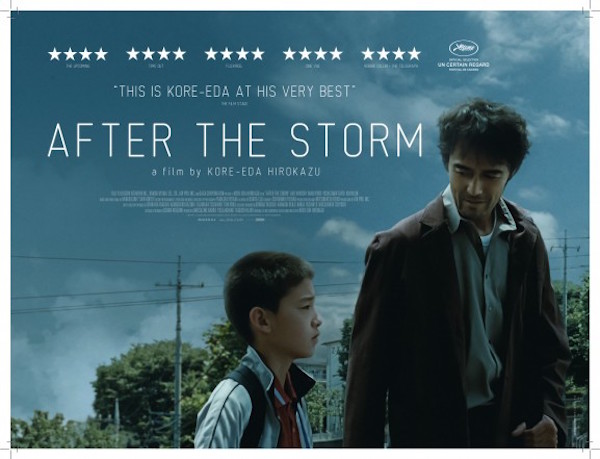
  • ‘After the Storm’, by Hirokazu Kore-eda – review

    After_the_Storm-landscape-600

    Life reminds me of a Baroque fugue; it begins with the exposition of a short melody, then develops into busy melodies and finally reaches a dramatic final entry in tonic. It is a continuous surrendering of the old and a trust in new beginnings with lots of in-between episodes, intricately interwoven by multiple strands of occasional chances called “luck,” failed expectations, and grace of hopes that creates a curiously riveting toccata. In this film by Kore-eda, Ryota’s life is a ballad of a soft troubadour, who wants to sing a happy song with his fractured but beautiful family.

    Ryota, once a promising novelist, now a divorced middle-aged struggling writer, makes a living as a part-time private detective under the pretext of enriching his writer’s imaginativeness for his next best oeuvre. He loves his ex-wife and his son dearly, so he always hangs around them surreptitiously. But he does not understand that how he feels about them is unrequited because he is not in their lives any longer. In fact, Ryota is even unsure of himself, of his reason for writing, and of what he wants to become amid his dwindling writing career and growing distance from his already fractured family. There is a sense of drift in his life, that feeling of emptiness, loneliness, and disappointments, all fragmented in the detritus of broken wishes, unpaid dues, and lost dreams. He has nonetheless a heart of gold, and his humor is his saving grace that helps him get going. Ryota’s life has been in the doldrums for so long that he forgets he has to move forward to get out of the stasis binding him in the longing for bygone days. A stream of pathos oozes out to see Ryota thinking, ‘Who would have known my life would turn out like this?’

    Director Kore-eda uses the storm, more accurately a typhoon, as a medium to free Ryota from the memories of the past, from the obsession of his past, in order to give him a new meaning of life, will to meaning. Kore-eda does a beautifully nuanced job of capturing the innermost feelings of the characters without elaborate lines or super-abudance of emotions throughout the scenes. It is a Japanese film, but the sentiments and judgments of the characters are rendered communicative to the hearts of the universal audience.